Iris Graessler, Deniz Oezcan (2026). Extended Exploitation of Data in Manufacturing Companies for Strategic Decision-Making. In: Human Systems Engineering and Design (IHSED2026): Future Trends and Applications. AHFE Open Access, vol. 237, pp. 352–363. https://doi.org/10.54941/ahfe1008175
For foresightful strategic decisions in engineering and production, it is important to identify and classify operational engineering data inmanufacturing companies in terms of relevance and impact. Established methods like Scenario-Technique or roadmapping consider expertise of strategic decision-makers and central decision-making bodies by, for instance, workshops and interviews. There is no overarching approach for evaluating the variety of operational data sources and feed them into specific data processing pipelines targeting strategic decision support. Based on a systematic literature analysis and comprehensive industrial experience, requirements are derived. These requirements are used to develop a method to identify, classify and evaluate data for strategic decision-making. The method is validated in an industrial project. The aim is to exploit informal and fragmented data from operational levels into structured, transparent decision support for strategic players.
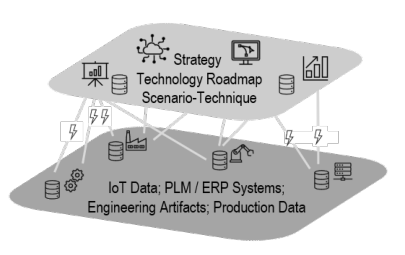
In an increasingly volatile and uncertain business environment, exploitation of data has emerged as a key strategic capability in Strategic Product Planning (SPP) and strategic decision-making (Mitake et al., 2020). In manufacturing companies, data from production control systems such as Manufacturing Execution Systems (MES) is becoming available and usable in decisions (Stark et al., 2017). Manufacturing companies have access to machine data, such as readings from internal sensors. At the same time, strategic decisions require knowledge and information on production planning, technology developments, investment planning and product or platform strategies (Graessler & Oezcan, 2025b). These decisions involve domain-specific expertise and are based on unavoidable uncertainty. Using this engineering data reduces the uncertainty of decisions. Identification and classification of relevant data sources within companies are challenges because of task-specific knowledge for exploitation in the company (Kim & Lee, 2021). Furthermore, data should be evaluated in terms of its decision-making usefulness and integrated into strategic decision-making processes as illustrated in Figure 1.
Received June 10, 2026 Revised June 23, 2026 Accepted July 8, 2026 Available online September 25, 2026
Figure 1: Lack of data integration in decision-making process.
Structure of this paper is as follows: Initially, an overview of the state of the art in the relevant topic areas is given to pave the ground for the specific objectives. Section three describes research questions and the scientific approach. The fourth section covers industrial challenges and related work. In section five the method is developed. Requirements are derived from review results, which serve as basis for developing the method. An industrial application and evaluation is presented in section six. This is followed by a summary and an outlook.
STATE OF THE ART Strategic Decision-Making in Manufacturing
Strategic decisions in manufacturing companies are designed with a long- term perspective (Graessler et al., 2017). Strategic decisions can take from a few years to several decades to implement. This long-term horizon is characterized by considerable uncertainty and usually involves significant investment. Typical areas of decision-making include production systems, involve resources in terms of personnel, new technologies or those to be implemented, manufacturing strategies, and locations (Schilling, 2005). To make these decisions, traditional methods such as Scenario-Technique, technology roadmapping and portfolio analysis can be employed (Frederiksen et al., 2021). Limitations in this area usually lie in the expertise of the decision- makers or the group of decision-makers consulted about the decision and in the limited relevance of data-driven decision-making (Deuse et al., 2024). Aim of strategic decision-making is to ensure that companies have future- robust value creation and equipped to meet challenges (Li et al., 2022).
Data Exploitation in Manufacturing Manufacturing companies handle various types of data. In addition to internal KPIs, machine data which includes parameters such as process temperatures, energy consumption and wear and tear (Otto et al., 2023). Alongside this data, quality data, logistics data and technology data can also be used. Incorporating such data into strategic decision-making processes
354 Graessler and Oezcan can resolve challenges at a granular level, as strategic decisions contribute to improving production processes. Internal data sources can include Enterprise Resource Planning (ERP), MES as well as Product Lifecycle Management (PLM) systems (Cui et al., 2020). Bothe for corporate data exchange as well as for cross-company data interfaces, there is an increasing need for building and adopting data spaces resp. data eco-systems (Graessler, Pottebaum, et al., 2024). Current research approaches primarily address big data analytics, predictive analytics and data-driven manufacturing (Wang et al., 2022). Focus of these approaches tends to lie more on operational optimization, quality improvement and process improvement (Kuliaev et al., 2019).
Data Integration for Decision Support In addition to workshops and decision-making bodies, data can be used to support decision-making. At operational level, data is used to improve quality and integrated into processes in a data-driven manner. Data integration into long-term decision-making processes carries potential to reduce uncertainty (Graessler & Oezcan, 2024). In standard procedures, decisions are made based on expert opinions and domain specific experts (Li et al., 2022).
RESEARCH QUESTIONS AND SCIENTIFIC APPROACH Key objective of this research is a method to identify, classify and evaluate data for strategic decision-making. The method serves as a basis for identifying relevant data sources within a company to provide decision-makers with the best possible support in their decisions. This article provides answers to two research questions:
RQ1: What criteria are required to assess the quality of data sources for strategic decision-making? RQ2: What data sources are relevant for strategic decision-making in
manufacturing companies, and how can they be systematically identified and classified?
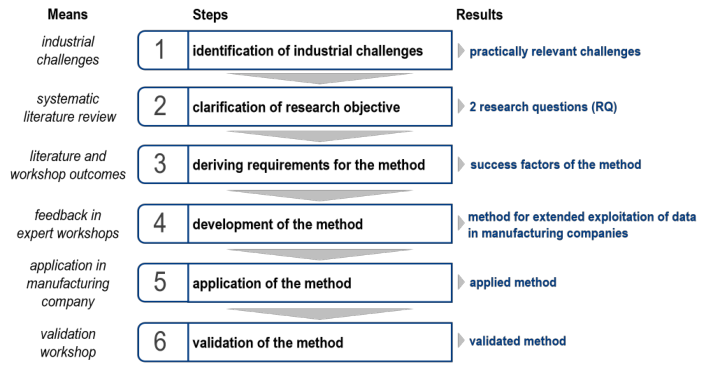
To answer the research questions, literature is used at first. A systematic literature review is conducted to identify potential approaches for the further utilization of data in manufacturing companies. Based on the approaches identified, a methodology is developed to make this data usable for strategic decision-making and to utilize existing data. Results are implemented and validated in an industrial company within the automotive sector. The scientific approach is shown in Figure 2.
Figure 2: Scientific approach.
ANALYSIS OF INDUSTRIAL CHALLENGES AND RELATED WORK Industrial Challenges
Manufacturing companies are increasingly operating in an uncertain environment shaped by various factors. External factors include geo-political crises or rises in the cost of materials along supply chains. In order to address these factors experts in workshops mentioned, it is necessary, firstly, to be aware of them and, secondly, to into account appropriate strategic decisions (Chermack, 2004). However, strategic decisions cannot be based solely on economic factors such as exchange rates, price trends and economic growth. Whilst these decisions relate to external factors, it is also necessary to take internal factors into account (Li et al., 2022). These are generally examined through workshops or internal analyses, such as dashboards showing production Key Performance Indicators (KPI). However, data aggregation leads to a loss of detail, causing underlying artifacts to blur and restricting their use to higher-level internal evaluations or quality measures. The experts clarified that decision-making bodies are often not sufficiently aware of the existence and potential of this data. Yet the relevance and use of this data can be of considerable benefit for strategic decisions, provided its use is enabled. The use of the data might contribute to better strategic decisions. There is currently no comprehensive methodology for evaluating data sources within companies for the purpose of strategic decision-making.
Systematic Literature Analysis Based on the aforementioned industrial challenges used to set the adequate scope for a systematic literature review. The search string focuses on these practical indications and the RQs. It is applied to databases Scopus, Web of Science and IEEE Xplore. The systematic literature analysis follows the PRISMA guidelines (Page et al., 2021).
356 Graessler and Oezcan A structured search string was applied, incorporating terms from the fields of data utilization (e.g., analytics, big data, exploitation), manufacturing (e.g., industry 4.0, production systems), and strategic decision-making. Additional terms covered relevant methods and classification aspects (e.g., data quality, predictive power). The search yielded a total of 105 results. By applying filter criteria, such as, research published in the last 10 years, and limiting the search to manufacturing companies. The total number of results was reduced to 54; while publications from the medical field were excluded.
The literature reviewed describes the requirements for using data from manufacturing companies to inform strategic decisions. These requirements can be divided into three overarching categories. The first category comprises functional requirements, the second data-related requirements, and the third organizational requirements.
Functional requirements are described in the literature as the ability to identify relevant data sources (Belhadi et al., 2019). The available data can be interpreted in different ways depending on its characteristics. In this context extreme data, can be highly heterogeneous and stored in different tools (Hramov & Pisarchik, 2025). In order for data to be relevant to decisions and usable for trends or forecasts, it must first be identified. Furthermore, a distinction is made in the classification of data according to strategic relevance. Data can possess strategic relevance at different levels, which is why it must be classified. It must be equally integrable into decision-making processes, and the underlying data quality must be assessable in order to make decisions based on the data (Lo, 2023).
Data-related requirements concern the availability, timeliness, granularity and accessibility of the respective data (Ojha et al., 2024). Data is often subject to uncertainties that must be assessed and analyzed before being incorporated into strategic decision-making processes (Li et al., 2022). Furthermore, data must be available, meaning it must be extractable in a suitable data format for decision-making and must meet the relevant requirements for timeliness (Tang & Meng, 2021).
The organizational requirements for data utilization concern integration into underlying decision-making processes. Processes must not be radically altered on the basis of the data; rather, the data must support existing processes within the organization and make decision-making more transparent through further free coordination. The data must also be usable and accessible in workshops and decision-making sessions in a suitable format. Finally, high levels of user acceptance, transparency and traceability must be ensured. It is only through this final requirement that data sources can be made usable in such a way that they also generate a significant and demonstrable added value in decision-making (Hramov & Pisarchik, 2025). All required criteria (functional, data-related, organizational) are identified through the systematic literature review and are used based on existing models for the use of data sources and answer RQ1.
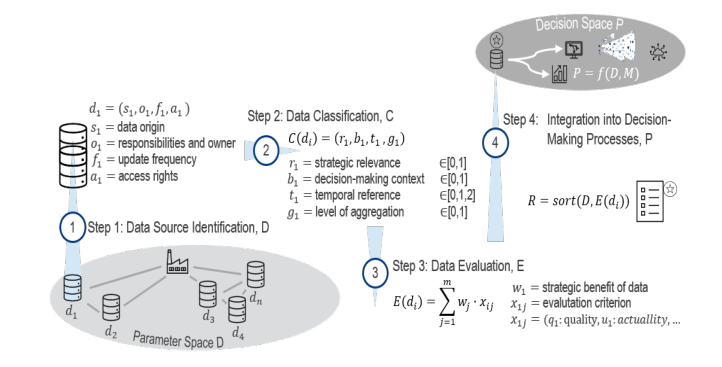
METHOD FOR EXTENDED EXPLOITATION OF DATA The method for extended exploitation of data in manufacturing companies is divided into 4 steps and is visualized in Figure 3:
1. Data Source Identification: D = {d1,d2,dn} 2. Data Classification: C(di) 3. Data Evaluation: E(di) 4. Integration into Decision-Making Processes: P → → → : F D C E P
The first step involves identifying relevant data sources D. A multi- stage approach is recommended for the structured collection of this data. It involves systematic mapping of internal data sources (Ojha et al., 2024). This identification is not exclusively system-driven, but is supplemented by stakeholder-based mapping methods, as described in Requirements Engineering literature. Another key aspect is the creation of a data inventory or data catalogue, as discussed in the literature on data warehousing and data lakes (Tao et al., 2018). This enables structured documentation of data sources based on defined data, such as data origin (si), responsibilities and owner (oi), update frequency (fi) and access rights (ai) (Tang & Meng, 2021). For the strategic context, it is also crucial that identification does not take place in isolation but is structured in line with the company’s strategic decision-making areas. This ensures that data sources are considered to have the potential to contribute to supporting strategic decisions (Lo, 2023).
d s o f a i i i i i = ( ) , , , The second step classifies the identified data to enable its structured analysis and comparability. Classification is carried out according to a multidimensional schema that integrates both data-related and decision- related criteria (Lorenz et al., 2024). The mathematical description defines a mapping function in the k-dimensional feature space, which is described in di.
→ : k C D R A key classification criterion is strategic relevance, which is derived from the extent to which a data source contributes to supporting long-term decisions. In addition, the decision-related aspect is considered, i.e. the assignment of data to specific decision-making areas such as technology planning, production strategy or investment decisions (Tang & Meng, 2021).
C d r b t g i i i i i ( )= ( ) , , , .
Data characteristics such as strategic relevance (ri∈[0,1]), decision-making context (bi∈[0,1]), temporal reference (ti∈{0,1,2}) and level of aggregation (gi∈[0,1]) are examined. The literature on big data analytics emphasizes that
358 Graessler and Oezcan the combination of these dimensions is particularly crucial for understanding the value of data in the decision-making process (Belhadi et al., 2019). Therefore, the method applies a predefined multidimensional classification scheme that integrates these dimensions and enables a clear and consistent assignment of data sources. Methodologically, the classification can be carried out using rule-based approaches or through structured evaluation workshops. The aim is to create a transparent and comprehensible structure that allows data sources to be systematically compared and their role in the decision-making process to be defined (Tao et al., 2018).
The third step iolves evaluating the data in order to quantify its contribution to the decision-making process. In the literature, approaches based on Multi- Criteria Decision Analysis and concepts of information quality are frequently employed for this purpose (Zopounidis & Doumpos, 2017).
Equation reproduced from the original PDF.
1
xij denotes the normalized value of criterion j for data source i, while wj indicates the corresponding weight of this criterion within the evaluation. The evaluation is carried out according to defined criteria that consider both data- related and decision-related aspects (Gonçalves dos Reis et al., 2023). The key evaluation criteria include data quality, timeliness, relevance to strategic issues, predictive power, and impact on the quality of decision-making.
Figure 3: Four-step method for extended exploitation of data in manufacturing companies.
Scoring models are used to operationalize these criteria, enabling a combination of qualitative and quantitative assessments (Fahmideh & Beydoun, 2019). The literature recommends the use of weighted evaluation
Extended Exploitation of Data in Manufacturing Companies for Strategic 359 systems to reflect the varying importance of individual criteria within the strategic context (Ojha et al., 2024). The evaluation is typically carried out by interdisciplinary teams in order to integrate both technical and business expertise. This is consistent with approaches from decision research, which emphasize that complex decisions benefit from multiple perspectives (Ren et al., 2019).
The final step of the method aims to integrate the data analyzed into existing strategic decision-making processes (Lorenz et al., 2024). The literature on strategic management and decision support systems emphasizes that data offers particular added value when it is contextualized and integrated into existing methods (Belhadi et al., 2019). Consequently, integration is not achieved through isolated analyses, but through embedding within established decision-making tools such as scenario analysis or technology roadmapping. A key component is the transformation of data into decision-relevant information, for example through the visualization of trends and patterns, the derivation of scenarios, and the identification of influencing factors and interactions (Ren et al., 2019). Furthermore, the design of decision-making workshops is important, in which the processed data is interpreted jointly with experts. This corresponds to the approach described in the literature of combining data-driven and knowledge-based decision-making processes (Hramov & Pisarchik, 2025). Another important aspect is ensuring the selection, ranking, traceability and transparency of data exploitation: R sort D E di = ( ) ( ) , . This includes documenting the data sources, the evaluation logic, and the derivation of decision options, as well as documenting the decision that was made. The decision model 𝑀 represents the demand side of strategic decision-making by formalizing decision problems, criteria, and time horizons, thereby enabling a systematic mapping between data sources and their decision-specific relevance. The integration is formalized as a mapping in decision models (M) as P f D M = ( ) , . These four steps address RQ2 through identification, classification, and evaluation for exploitation of data in manufacturing companies.
APPLICATION EVALUATION Industrial Application
The developed method was applied as part of an industrial project at an automotive Original Equipment Manufacturer (OEM) to systematize use of existing artifacts for strategic decision-making processes. The aim was to make data from the production and engineering process, previously used primarily for operational purposes, available for long-term technology and platform decisions.
In the first step, relevant data sources were mapped to the model’s data source layer, distinguishing between engineering artefacts, validation data, and change-related information. These included, in particular, artefacts from PLM, such as requirements and specifications, system architecture
360 Graessler and Oezcan descriptions, bills of materials, change requests, and verification and validation results. In addition, data from related systems for requirements management and quality assurance databases were considered. The identification process took place in workshops with domain experts from engineering, production and quality management.
The data was classified according to the model’s multidimensional structure, consisting of (1) strategic relevance, (2) temporal horizon, and (3) decision context. For example, change request data and validation results were classified as particularly relevant for the assessment of future technology risks, whilst architectural artefacts were of high importance for platform decisions.
On this basis, an assessment was carried out using the model’s evaluation mechanism, implemented as a weighted scoring model (Graessler, Wiechel, et al., 2024). Key criteria were data quality, timeliness, strategic relevance and predictive capability. The weighting was defined in collaboration with decision-makers following the model’s configuration approach, allowing decision-makers to adapt criterion weights based on specific strategic objectives. The results showed a clear prioritization of data sources, with structured engineering artefacts in particular, those with significant historical depth and a direct link to error patterns and change cycles, achieving high scores.
In the final step, the prioritized data was integrated into existing strategic decision-making processes. This was achieved by identifying trends, for example, regarding recurring change patterns or technology-related risks and incorporating them into roadmapping workshops. This enabled data- driven arguments to be systematically incorporated into the decision-making process.
The application demonstrated the effectiveness of the model’s structured approach to linking operational data with strategic decision-making. Through structured identification, classification and evaluation, transparency was increased and the quality of decision-making improved. At the same time, a bridge was created between operational engineering data and strategic planning.
Evaluation Results and Discussion The method developed was applied in the industrial project described, carried out at an OEM, by applying it to real-world engineering artefacts and by involving strategic decision-makers. The results of the data-driven assessment were presented at several decision-making workshops and discussed with experts from engineering, production and management.
This was followed by both quantitative and qualitative assessments by the participating practitioners. Quantitatively, the prioritization of data sources showed a high degree of alignment with the experts’ assessments, with a significant proportion of the highest-rated artifacts confirmed as highly relevant for strategic decisions. In addition, participants reported an improvement in the perceived transparency and traceability of decision- making. Qualitatively, the experts highlighted the structured approach as
Extended Exploitation of Data in Manufacturing Companies for Strategic 361 particularly advantageous for making implicit knowledge explicit and supporting cross-functional coordination. Furthermore, the method was viewed as especially valuable in early decision-making phases characterized by high uncertainty, as it enabled a more informed and data-driven discussion in those contexts.
It became apparent that the data sources prioritized by the model largely corresponded with the subjective assessments of the decision-makers. In particular, artefacts with high predictive power and a direct link to technological risks were confirmed as being of particular strategic value. At the same time, the structured evaluation model enabled greater transparency and traceability compared to purely experience-based approaches.
During the discussion, it was emphasized that the method contributes in particular to reducing uncertainties in early strategic phases. However, limitations exist in terms of the initial resource intensity as well as the dependence on data quality and availability. Overall, the validation confirms the practical applicability and added value of the approach for data-driven strategic decision-making.
SUMMARY AND OUTLOOK This paper presents a method for the enhanced use of data in manufacturing companies to support strategic decision-making. Based on lack of an integrated approach that links heterogeneous data sources with strategic planning processes, a structured method for identifying, classifying, evaluating and integrating data has been developed. The approach is based on a systematic literature review and is supplemented by industrial experience, resulting in a requirements-oriented method design. A key contribution lies in the formalization of the method through a multi-criteria evaluation model, which enables a transparent and reproducible assessment of data sources in terms of their strategic relevance. By integrating both data-related and decision-oriented criteria, the method bridges the gap between data analysis and strategic management. Industrial application at an OEM demonstrated the practical applicability of the approach. By using engineering data as data sources, the method enabled the identification of high-quality data for strategic decisions, particularly in the context of technology planning and risk assessment. Validation with decision-makers confirmed both the relevance of the selected data and the added value of the structured method, particularly in terms of transparency and decision quality.
Future research will focus on automation of data classification and evaluation, for example through Machine Learning approaches, as well as on the integration of real-time data streams to improve responsiveness (Graessler & Oezcan, 2025a). Overall, the proposed approach provides a foundation for the systematic use of data as a strategic asset in manufacturing environments.
REFERENCES
Belhadi, A., Zkik, K., Cherrafi, A., Yusof, S. M., & El fezazi, S. (2019). Understanding Big Data Analytics for Manufacturing Processes: Insights from Literature Review and Multiple Case Studies. Computers & Industrial Engineering, 137, 106099. Chermack, T. J. (2004). Improving decision-making with scenario planning. Futures,
36(3), 295–309. https://doi.org/10.1016/S0016-3287(03)00156-3 Cui, Y., Kara, S., & Chan, K. C. (2020). Manufacturing big data ecosystem: A systematic literature review. Robotics and Computer-Integrated Manufacturing, 62. Deuse, J., Klinkenberg, R., & West, N. (2024). Industrielle Datenanalyse. Springer
Fachmedien Wiesbaden. https://doi.org/10.1007/978-3-658-42779-5 Fahmideh, M., & Beydoun, G. (2019). Big data analytics architecture design—An application in manufacturing systems. Computers & Industrial Engineering. Frederiksen, T. B., P. P. Pieroni, M., Pigosso, D. C. A., & McAloone, T. C. (2021).
Strategic Development of Product-Service Systems (PSS) through Archetype. Gonçalves dos Reis, J. C., Mendonça Freires, F. G., & Vieira Junior, M. (2023).
Industrial Engineering and Operations Management (Vol. 431). Springer Nature Switzerland. Graessler, I., & Oezcan, D. (2024). Quality Key Figures for Developing Future Scenarios. Human Systems Engineering and Design (IHSED2024): Future Trends and Applications, -2(-2). https://doi.org/10.54941/ahfe1005553 Graessler, I., & Oezcan, D. (2025a). Graphical AI workflow modelling: Identifying
relevant competencies in AI-based automation of business processes. In AHFE International, Human Systems Engineering and Design (IHSED2025): Future Trends and Applications. AHFE International. https://doi.org/10.54941/ ahfe1006785 Graessler, I., & Oezcan, D. (2025b). Identifying future competence demands in production companies for strategic decision-making. In R. Teti & D. D’Addona (Chairs), CIRP ICME 2025, Ischia, Italy. Graessler, I., Pottebaum, J., Holland, M., Wiechel, D., Dickopf, T., & Stjepandić, J.
(2024). Leveraging Data Ecosystems in Model-Based Systems Engineering for Ecological, Circular Added Value. In A. Cooper, F. Trigos, J. Stjepandić, R. Curran, & I. Lazar (Eds.), Advances in Transdisciplinary Engineering. Engineering For Social Change (pp. 175–184). IOS Press. https://doi.org/10.3233/atde240858 Graessler, I., Pottebaum, J., & Scholle, P. (2017). Integrated Process and Data Model for Agile Strategic Planning. In S. Vajna (Chair), IDE Workshop, Magdeburg. Graessler, I., Wiechel, D., Oezcan, D., & Taplick, P. (2024). Tailored metrics for
assessing the quality of MBSE models. Proceedings of the Design Society, 4, 2545–2554. https://doi.org/10.1017/pds.2024.257 Hramov, A. E., & Pisarchik, A. N. (2025). Big Data Management and Quality Evaluation for the Implementation of AI Technologies in Smart Manufacturing. Kim, Y. S., & Lee, H. (2021). Process characteristics of Product-Service Systems
development: Comparison of seven manufacturing company cases. Journal of Cleaner Production, 286, 124971. https://doi.org/10.1016/j.jclepro.2020.124971 Kuliaev, V., Dwi Atmojo, U., Sierla, S., Blech, J. O., & Vyatkin, V. (2019). Towards Product Centric Manufacturing: From Digital Twins to Product Assembly. Li, C., Chen, Y., & Shang, Y. (2022). A review of industrial big data for decision
making in intelligent manufacturing. Lo, H.-W. (2023). A data-driven decision support system for sustainable supplier evaluation in the Industry 5.0 era: A case study for medical equipment manufacturing.
Extended Exploitation of Data in Manufacturing Companies for Strategic 363 Lorenz, R., Kraus, M., Wolf, H., Feuerriegel, S., & Netland, T. H. (2024). Selecting
advanced analytics in manufacturing: A decision support model. Mitake, Y., Hiramitsu, K., Tsutsui, Y., Sholihah, M., & Shimomura, Y. (2020).
A Strategic Planning Method to Guide Product—Service System Development and Implementation. Sustainability, 12(18), 7619. https://doi.org/10.3390/ su12187619 Ojha, V. K., Goyal, S., & Chand, M. (2024). Data-driven decision making in advanced manufacturing Systems: Modeling and analysis of critical success factors. Journal of Decision Systems, 33(4), 645–673. https://doi.org/10.1080/12460125.2023.2 263676 Otto, B., Seidelmann, J., Schmelting, J., & Sauer, O. (2023). Preliminary Study on
the Manufacturing-X Data Space: Architecture, Basic Services, and Organization, Taking into Account the Specifics of the Equipment Manufacturing Industry. Page, M. J., McKenzie, J. E., Bossuyt, ... Moher, D. (2021). The PRISMA 2020 statement: An updated guideline for reporting systematic reviews. Systematic Reviews. Ren, S., Zhang, Y., Liu, Y., Sakao, T., Huisingh, D., & Almeida, C. M. (2019).
A comprehensive review of big data analytics throughout product lifecycle to support sustainable smart manufacturing. Schilling, M. A. (2005). Strategic management of technological innovation [Internat.
ed]. McGraw-Hill/Irwin. Stark, R., Seliger, G., & Bonvoisin, J. (Eds.). (2017). Sustainable Production, Life Cycle Engineering and Management. Sustainable manufacturing: Challenges, solutions and implementation perspectives. Springer Open. Tang, L., & Meng, Y. (2021). Data analytics and optimization for smart industry. Tao, F., Qi, Q., Liu, A., & Kusiak, A. (2018). Data-driven smart manufacturing.
Journal of Manufacturing Systems, 48, 157–169. https://doi.org/10.1016/j. jmsy.2018.01.006 Wang, J., Xu, C., Zhang, J., & Zhong, R. (2022). Big data analytics for intelligent manufacturing systems: A review. Journal of Manufacturing Systems, 62, 738–752. Zopounidis, C., & Doumpos, M. (2017). Multiple Criteria Decision Making:
Applications in Management and Engineering. Multiple Criteria Decision Making.
FIND THE COMPLETE VOLUME IN THE AHFE DIGITAL BOOKSTORE
Explore the complete digital volume
Human Systems Engineering and Design (IHSED2026): Future Trends and Applications
Read this individual research paper free through the original publisher, or explore the full digital proceedings book.