Jasmin Schwab, Kai Franke, Tobias Koch (2026). Enhancing Usability in Crisis Management Training: Evaluation of the Virtual Reality-Based Situational Awareness Table. In: Human Interaction and Emerging Technologies (IHIET-AI 2026): Artificial Intelligence and Future Applications. AHFE Open Access, vol. 201, pp. 43–53. https://doi.org/10.54941/ahfe1007159
In a rapidly evolving world with advancing technology and climate change, crisis situations are increasingly unpredictable, requiring effective training for emergency response teams. To address this, we developed a virtual reality (VR) table to provide immersive, unrestricted training, simulating high-pressure scenarios that demand rapid decision-making. A laboratory study with N=15 participants evaluated the table’s usability, focusing on system usability, and user experience. Results demonstrated improved usability, providing valuable insights for designing effective crisis management training programs. The study emphasizes the importance of intuitive controls, quick information access, and minimal distractions in VR environments to enhance user satisfaction and performance. This research establishes a foundation for future VR-based training programs, highlighting their potential to advance crisis management training. Our findings provide valuable insights for emergency response teams and informants for design best practices, with applications extending to other fields, contributing to improved usability in VR training systems.
Environmental crises—climate disasters, health emergencies, and human- caused disasters—pose a major threat and are increasingly frequent and costly (Colwell & Machlis, 2019). Technical failures can trigger catastrophes, as in the 1979 Three Mile Island incident where a cooling-system fault and delayed operator response caused a partial core melt (Wickens et al., 2018). Recent events such as the 2020 Beirut ammonium nitrate explosion highlight the rapid escalation potential and large human and economic toll (Al-Hajj et al., 2021).
Crisis-management teams are deployed to prevent such outcomes, yet most personnel receive little or no training for emergency scenarios (Walker et al., 2011). Targeted training improves decision-making and stress coping, reducing injury risk (Williams-Bell et al., 2015). Virtual reality (VR) offers an immersive, cost-effective platform for realistic, learner-centered training (Stapleton, 2004; Williams-Bell et al., 2015).
We developed a VR scenario for emergency services that uses a Situational Awareness Table (SAT) as the primary interface, emphasizing free decision- making not having to follow any guidelines or being tied to a process that only allows certain actions and high immersion. A within-subject laboratory study with N = 15 participants evaluated the SAT’s usability. Results showed high usability but revealed some issues, like system instability, teleportation fatigue and visual distractions. Recommendations include improving stability, limiting movement, concise information displays, feedback mechanisms, and reducing clutter to enhance user experience.
Contribution Statement. This work advances crisis management by developing a virtual SAT training that improves decision-making in high- pressure situations. It presents a novel SAT tool that enhances responder decision-making, an analysis of VR user-experience factors guiding the design of effective systems, and practical recommendations for improving usability and training effectiveness.
BACKGROUND AND RELATED WORK Emergency responders must learn to make rapid, accurate decisions under extreme uncertainty, yet traditional drills and tabletop exercises cannot fully replicate the sensory overload, time pressure, and evolving risks that characterize real incidents (Stolk et al., 2001). Virtual training has emerged as a powerful remedy, offering immersive scenarios that present branching story-lines of plausible developments from an initial trigger, thereby allowing trainees to anticipate and counteract hazards before they materialize (Garvey, 2022). Existing platforms such as EGCERSIS (Congès et al., 2020) and CrisisVR (n.d.) cover a wide spectrum—from immersive mass-casualty simulations to modular VR drills for emergency response and business continuity—showing that extended reality can aid pressure- sensitive decision-making and offer scalable training for first responders. Yet their uptake is limited by some issues: they demand heavy technical and VR hardware setups, extensive local-protocol customization, and often lack interoperability with current curricula, while high licensing and maintenance costs curb accessibility for smaller agencies. Excessive interface complexity further erodes user confidence, increases perceived risk, and can lead to abandonment, thereby negating the training benefits (Norman, 2013; Wickens et al., 2018). A common root of these challenges is the insufficient integration of human-factor principles into system design; when usability is neglected, users experience frustration, higher error rates, and reduced learning outcomes, ultimately inflating training costs and compromising safety (Sagar & Saha, 2017). To address this, designers should employ evidence-based guidelines such as Wickens’ (2018) expanded 15-principle framework that covers attention, perception, memory, mental model, response selection, and interaction. By embedding these principles early in the development cycle, designers can close the gulf between user intentions and system affordances, reduce cognitive load, and create interfaces that support rapid, accurate decision-making. Applying these insights to VR-based crisis training yields systems that combine high-fidelity sensory realism with intuitive controls
Enhancing Usability in Crisis Management Training 45 and minimal extraneous stimuli, ensuring that emergency responders receive realistic, effective preparation while maintaining accessibility and cost-effectiveness for organizations of all sizes.
METHODOLOGY
In this study we evaluate the SAT, a VR front-end that supports crisis teams throughout all incident phases by projecting an interactive, automatically generated Digital Shadow onto its surface. An entity-based approach is chosen to build our data model for a site. Each entity type (e.g., building, roads) defines its own attributes and instances can be generated in different programming languages using Abstract Factory Method Patterns. All instances can be (de-) serialized to load or save a system. To allow for bidirectional conversion or augmentation of entities to fit the format of specific applications, wrapper classes around entities can be defined and generated by factories. Use cases include, but are not limited to constructing entity instances from various data sources (e.g., Open Street Maps), communicating entities across applications; Visualizing semantic information and real-time data (e.g., sensor readings), triggering interoperable simulations for forecasting and decision support and influencing actuator technology in the real world.
For the training setup of this paper, a site with 429 buildings is generated from OSM and CityGML data (see Cao et al., 2024) with the data model being managed by a FIWARE Orion Context Broker (see Franke et al., 2023). The table is coupled with an emulation backend that manipulates entity attributes on a virtual site in sequence and thus enables users to experience pre-defined scenarios, effectively simulating crisis situations. These scenarios can be triggered externally by the study leader, using specific endpoints in the backend.
Features of the Table The virtual training environment centers on a Situational Awareness Table (SAT) with panels that users interact with by touch or a laser pointer. Selecting a building reveals attributes stored and communicated via the FIWARE Orion broker—function, threat level, gas and smoke concentrations, temperature, and fire detection—plus a single-view summary of name and estimated occupancy. Threat levels are computed using Schneider et al. (2025) to guide emergency response. Participants can trigger real-world actions such as dispatching services or commanding a Boston Dynamics “Spot” unit, and deploy sensors for detailed observations. The SAT thus delivers an immersive, interactive platform grounded in practical emergency operations.
Research Objectives Since we want to develop a training tool that is suitable for decision support in crisis management and at the same time usable, we pose the following research question as part of the study on the SAT:
RQ1: How could the usability of the Situational Awareness Table be improved in the course of the study?
RQ2: How do participants evaluate the overall user experience of the Situational Awareness Table?
Usability engineering literature (Bangor et al., 2008; Norman, 2013; Wickens et al., 2018) demonstrates that systems designed for complex, high-stakes environments—such as crisis-management tools—must undergo iterative refinement to achieve “excellent” user performance and satisfaction to avoid abandonment of the system and user unsatisfaction. For this reason, we focus our research questions on usability and user experience in our study.
Study Design, Recruitment and Procedure In a laboratory experiment, we recruited N = 15 employees from our research institute—selected for their familiarity with crisis management—to avoid an introductory session and to focus on usability. We recruited 15 participants to ensure broad coverage of usability issues. Recent studies show that 15 users can uncover up to 90% of problems (Sauro & Lewis, 2016; Caron et al., 2024). This aligns with current best practices for reliable and comprehensive usability evaluation.
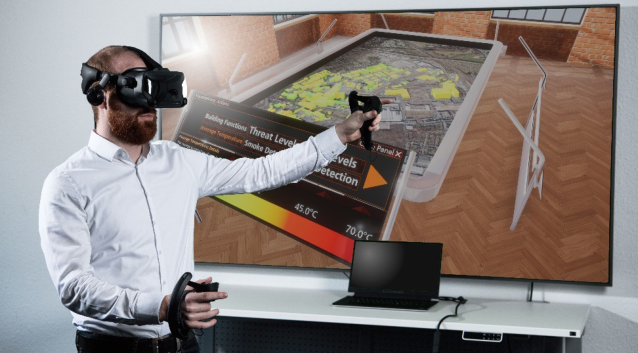
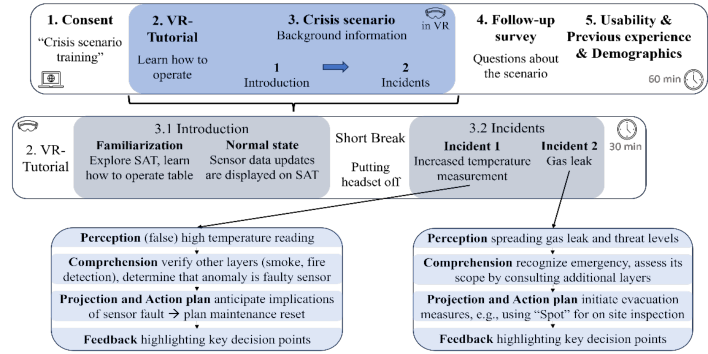
Candidates involved in the technical development of the SAT or scenario setup were excluded. Participants wore a Valve Index1 headset and controllers to navigate a VR environment (see Figure 1) and evaluate crisis scenarios with a virtual SAT; the headset was chosen for its precise external tracking, computer-bound architecture (minimizing optimization), seamless SteamVR integration, and comfortable fit. The VR application was executed on a Alienware x15 R2 laptop2 while the emulation backend ran on a Dell Precision 7920 workstation3 within the same LAN. Data were collected via an online LimeSurvey4 questionnaire that had been pre-tested with a pilot participant to refine wording and add items. Data collection was anonymous and ethical approval was obtained from the German Aerospace Center (DLR). The training scenario follows modern immersive simulation principles, balancing realism, context, and user expertise while limiting interaction choices to avoid overload (Ansone et al., 2023). VR was used instead of 2D/3D desktop apps because it immerses participants in a distraction-free environment. The 60-minute study (see Figure 2) began with background reading, informed consent, and a tutorial; participants then progressed through the familiarization, normal status, and two incident phases while the study leader read questions aloud and recorded responses. After completing all phases, participants removed the headset and finished an online follow-up questionnaire.
1Valve Index Headset: https://www.valvesoftware.com/de/index/headset 2Alienware x15 R2 laptop: Intel Core i7-12700H, NVIDIA GeForce RTX 3070Ti, 16GB RAM, Windows 11
Figure 1: Usability study on the situational awareness table.Figure 2: An overview of the study procedure.
Measurements The study used a combination of in-situ performance metrics, self-report questionnaires, and standardized questionnaires to assess the user-facing aspects of the VR training system. Participants completed the VR scenario after which they answered the online questionnaire.
The questionnaire comprised six sequential sections: (1) background and consent; (2) scenario-specific items probing participants’ comprehension through open-ended prompts on key events (e.g., sensor alarms, color changes), 5-point Likert ratings of each incident’s difficulty (“Very easy” → “Very difficult”), and evaluations of the tutorial, design, waiting room and overall training experience by rating statements (“Not applicable at all” → “Fully applicable”), including items on nausea and dizziness; open-ended items
captured positives/negatives and improvement suggestions, later coded into predefined categories such as “Ease of navigation”, “Realism”, and “Physical discomfort”; (3) the System Usability Scale (SUS) by Brooke (1996) (translated per Gao et al., 2020), a 10-item 5-point Likert tool assessing ease, efficiency, and satisfaction; (4) the IT Affinity Scale (ATI; Franke et al., 2019) gauging technical affinity; (5) yes/no pre-experience questions on VR, crisis management, and computer/video games; and (6) basic demographic information.
RESULTS
The data analysis examined whether usability improved over the course of the study. Fifteen participants were split into three sequential groups (g1, g2, g3) of five, allowing us to implement feedback after each cohort and track progress. Because the pilot participant missed some items, some results are based on 14 respondents, but all data were included in the final discussion.
The sample was 46.7 % female, 53.3 % male, with an average age of M = 34.29 years (SD = 7.19; Range = 25–51). Half had prior VR experience (n = 7), none had crisis-scenario experience, and 80 % (n = 12) had computer/video-game experience. The ATI technology-affinity score averaged M = 4.40 (SD = 1.07, α = .94). Usability of the SAT (overall M = 77.00, SD = 10.95, α = .71) did not differ significantly across the three sequential groups (Kruskal-Wallis H(2) = 0.59, p = .75), though mean scores rose from Mg1 = 74.50 (SDg1 = 13.74) to Mg2 = 76.5 (SDg2 = 10.40) to Mg3 = 80.0 (SDg3 = 10.16) over the study. No significant Spearman correlation was found between technology affinity and system usability (p = .88). Mann–Whitney U tests revealed no usability differences between participants with versus without prior VR experience; usability ratings on pre-experiences were: MVR_yes/no = 77.86, Mvideogames_yes = 77.29 for gaming-experienced and Mvideogames_yes = 81.25 for non-experienced). As we have no participants with previous experience in crisis situations, this was not evaluated. Overall, no significant group-related differences in usability evaluation emerged.
Evaluation of the Study The tutorial was rated highly: participants agreed that it was helpful (M = 4.87, SD = 0.35), sufficient for learning required actions (M = 4.60, SD = 0.63), and aided understanding of VR controls (M = 4.67, SD = 0.49). They also liked the tutorial’s design (M = 4.27, SD = 0.70), while the waiting room received a more neutral or slightly positive rating (M = 3.67, SD = 1.18). The training itself was deemed realistic (M = 3.73, SD = 1.10) and enjoyable (M = 4.20, SD = 0.68). Regarding transfer to everyday crisis- preparation work, the assessment was neutral (M = 3.23, SD = 1.54), and negative symptoms such as dizziness, nausea or exertion while wearing the headset were also rated neutrally/negatively (M = 2.75, SD = 1.04).
Nine participants praised the design and functionality, seven liked the operation, and five found the study content interesting. Five reported difficulty selecting buildings, and three complained about headset discomfort.
Enhancing Usability in Crisis Management Training 49 Suggested improvements included a waiting-room redesign, bullet-point tutorial texts, a summary window on the SAT, simultaneous multi-layer selection, and quicker action-layer feedback after emergency calls or robot dispatch (n = 1 for each suggestion).
Improvements During the study we refined the SAT scenario and questionnaire: teleportation was confined to designated zones, tutorial text shortened to bullet points, waiting-room movement restricted and multimodal haptic/visual cues added, non-essential décor removed, a two-stage table-height function introduced, incident temperatures raised to 100 °C, a hovering information panel displayed building details without layer switching, color coding followed familiar signal hues (light green/light blue to dark red) to aid intuitive status recognition, and building selection was limited to a single structure to improve overview—all changes aligned with recent findings that restrict teleportation to mitigate cyber-sickness (Nie et al., 2025), reduce textual complexity to improve learning (Makransky et al., 2019), limit movement and provide multimodal feedback to enhance task focus (Argelaguet et al., 2016), reduce visual complexity to boost performance (Ragan et al., 2015), and use intuitive color cues for rapid judgment (Okoli & Watt, 2018).
DISCUSSION
Our first research question examined how to enhance the SAT’s usability. Initially, the system already achieved a high usability rating (SUS = 77.00 ± 10.95), which the literature classifies as “good” (70–84 SUS) (Bangor et al., 2008). Usability improved across the study (group 1 to groups 2 & 3), yet neither technical affinity nor prior VR or computer- gaming experience produced significant differences in SUS scores. While the sample did not include participants with very low IT affinity, the data suggest that the SAT is broadly accessible and that prior experience is unnecessary for effective use. The tutorial, which introduced all control elements at each participant’s own pace, likely mitigated any advantage of pre-existing familiarity, consistent with findings that structured, self-paced instruction can reduce the impact of prior experience on performance (Clark et al., 2006). To further investigate IT affinity’s effect—given the small non-affine group— larger, more diverse samples are required. The next step is to solicit usability feedback from domain experts (emergency services, crisis committees) who constitute the ultimate target users; this will drive continued refinement toward “excellent” usability scores, thereby enabling routine crisis-training applications.
Our second research question examined how participants evaluate the user experience of the SAT. Participants reported a positive experience: the tutorial was very helpful, sufficient, and visually appealing, with no VR-related negative symptoms (Norman, 2013); the waiting room received a neutral rating, matching its distraction-free design to preserve immersion (Ragan et al., 2015; Föcker et al., 2022). Building selection proved challenging for
small structures, but allowing the table to lower to floor or waist height improved targeting accuracy; headset comfort was highlighted as an improvement area, suggesting additional padding or alternative headsets (Hou, 2018). A non-VR 3D/2D presentation is feasible due to the modular architecture but would limit future higher-fidelity training (teleporting into a 1:1 scale or moving inside buildings). Future work may add an at-a-glance overview of building data, but this must be expert-evaluated to avoid overload (Bąk-Sosnowska & Holecki, 2022). Following Putze et al., (2020), questionnaires were administered inside VR to preserve immersion and obtain reliable self-reports, a method that should be further refined in high-stress, high-fidelity settings. Emotions are central to system usability (Sagar & Saha, 2017), yet the SAT’s real-world usefulness and user willingness to continue remain unclear because our sample was not target-specific; detailed usage logs could refine training and inform long-term adoption (Sun et al., 2019), while user satisfaction and sustained use are key for lasting success (Hou, 2018), and the modular meCUE 2.0 questionnaire (Minge et al., 2012) would enable a granular assessment of emotions, product perception, and use consequences to support comprehensive user-behavior analysis.
Recommendations We summarize our recommendations for the development of training systems for crisis scenarios derived from the study in the following. We combine our own results and recommendations with validated study results from the literature:
(1) System crashes and errors lengthened the study and degraded the learning process. → Strengthen system stability by means of Continuous Integration and Continuous Delivery (CI/CD; Sane, 2021)—prioritize high-performance/reliability to safeguard user satisfaction and training experience. (2) Participants unintentionally teleported across the area, causing fatigue
and confusion. → Restrict movement to essential zones to preserve learning flow and avoid negative side effects (Nie et al., 2025). (3) Reading lengthy tutorial texts produced strong fatigue. → Replace continuous VR text with concise bullet points (Makransky et al., 2019). (4) Short waiting times for system state changes induced impatience and
repeated dialing, overloading the system. → Provide immediate haptic or visual feedback indicating system status (Wickens et al., 2018). (5) Decorative or orientation objects distracted participants (e.g., moving a chair, opening blinds). → Minimize extraneous objects; supply only non-interactive orientation aids (Ragan et al., 2015). (6) Teleportation to lower levels and unnatural actions (jumping onto a
table) caused vertigo and discomfort. → Naturalize movement; introduce level-balancing (e.g., lower the table to floor level). (7) Minor visual differences in information were often missed. → Amplify contrast, use signal colors, and add brief summary overviews (Okoli & Watt, 2018).
CONCLUSION
In our lab study, participants completed a VR training scenario with the SAT, progressing through an introductory phase, a system familiarization, and two crisis incidents designed to strengthen decision-making for emergency services and crisis committees. The study’s purpose was to identify usability improvements and enhance overall user experience. We found that the SAT already achieved good usability from the outset, which we further refined, yielding a largely positive user experience with a few identified improvement points. This user-centered approach has created a solid foundation for subsequent testing with the intended target group, ensuring that the system is ready for real-world application.
REFERENCES
Al-Hajj, S., Dhaini, H. R., Mondello, S., Kaafarani, H., Kobeissy, F., & DePalma, R. G.
(2021). Beirut Ammonium Nitrate Blast: Analysis, Review, and Recommendations. Frontiers in Public Health, 9. https://doi.org/10.3389/fpubh.2021.657996 Ansone, A., Dreimane, L. F., & Zalite-Supe, Z. (2023). Framework of Pedagogic and Usability Principles for Effective Multi-user VR Learning Applications. In M. L. Bourguet, J. M. Krüger, D. Pedrosa, A. Dengel, A. Peña-Rios, & J. Richter, Immersive Learning Research Network (pp. 96–110). Springer. https://doi. org/10.1007/978-3-031-47328-9_7 Argelaguet, F., Hoyet, L., Trico, S., & Lécuyer, A. (2016). The Role of Interaction
in Virtual Embodiment: Effects of the Virtual Hand Representation. IEEE Transactions on Visualization and Computer Graphics, 22(4), pp. 1611–1618. https://doi.org/10.1109/VR.2016.7504682 Bangor, A., Kortum, P. T., & Miller, J. T. (2008). An empirical evaluation of the system usability scale. Intl. Journal of Human–Computer Interaction, 24, 574–594. Brooke, J. (1996). SUS-A quick and dirty usability scale. Digital Equipment Co Ltd.
Reading. Bąk-Sosnowska, M., & Holecki, T. (2022). Overstimulation and its consequences as a new challenge for global healthcare in a socioeconomic context. Pomeranian Journal of Life Sciences, 68, 52–55. Cao, S., Franke, K., Koch, T., & Lenhard, T. (2024). Automated Generation Of Urban
Digital Shadows Using Open Data. Annual Modeling and Simulation Conference (ANNSIM), pp. 1–13. https://doi.org/10.23919/ANNSIM61499.2024.10732278 Caron, A., Vandewalle, V., & Marci, R. (2024). The optimal sample size for usability testing, from the manufacturer’s perspective: A value-of-information approach. Retrieved 11 11, 2025, from HAL Open Science: https://hal.science/ hal-03778112v1 Clark, R. E., Nguyen, F., & Sweller, J. (2006). Efficiency in learning: Evidence-based
guidelines to manage cognitive load. Pfeiffer. Colwell, R. R., & Machlis, G. E. (2019). Science During Crisis: Best Practices, Research Needs, and Policy Priorities. Science During Crisis: Best Practices, Research Needs, and Policy Priorities.
Congès, A., Evain, A., Benaben, F., Chabiron, O., & Rebière, S. (2020). risis Management Exercises in Virtual Reality. Conference on Virtual Reality and 3D User Interfaces Abstracts and Workshops (VRW), pp. 87–92. https://doi. org/10.1109/VRW50115.2020.00022 CrisisVR. (n.d.). Virtual Reality to train Emergency Response Teams. Retrieved
November 19., 2025, from https://www.vr-crisis.com/ Franke, K., Stürmer, J. M., & Koch, T. (2023). Automated Simulation and Virtual Reality Coupling for Interactive Digital Twins. Winter Simulation Conference (WSC), pp. 2615–2626. https://doi.org/10.1109/WSC60868.2023.10407185 Franke, T., Attig, C., & Wessel, D. (2019). A personal resource for technology
interaction: development and validation of the affinity for technology interaction (ATI) scale. International Journal of Human–Computer Interaction, 35, 456–467. Föcker, J., Atkins, P., Vantzos, F. C., Wilhelm, M., Schenk, T., & Meyerhoff, H. S.
(2022). Exploring the effectiveness of auditory, visual, and audio-visual. Attention, Perception, & Psychophysics, 5(2022), pp. 1611–1624. https://doi.org/10.3758/ s13414-022-02446-2 Gao, M., Kortum, P., & Oswald, F. L. (2020). Multi-language toolkit for the system usability scale. International Journal of Human–Computer Interaction, 36, 1883–1901. Garvey, B. (2022). Scenarios: What Are They, Why Are They Useful and How Can
We Best Use Them? In Uncertainty Deconstructed: A Guidebook for Decision Support Practitioners (pp. 115–149). Springer. Hou, C.-K. (2018). Examining users’ intention to continue using business intelligence systems from the perspectives of end-user computing satisfaction and individual performance. International Journal of Business Continuity and Risk Management, 8, 49–70. Makransky, G., Terkildsen, T. S., & Mayer, R. E. (2019). Adding immersive
virtual reality to a science lab simulation causes more presence but less learning. Learning and Instruction, 60, pp. 225–236. https://doi.org/10.1016/j. learninstruc.2017.12.007 Minge, M., Klee, M., & Hassenzahl, M. (2012). Modular evaluation of key components of user experience: The meCUE questionnaire. International Journal of Human-Computer Interaction, 28, 177–193. Nie, T., Pospick, C. H., Cantory, V., Zhang, D., DeGuzman, J. J., Interrante, V., .
. . Rosenberg, E. S. (2025). Peripheral Teleportation: A Rest Frame Design to Mitigate Cybersickness During Virtual Locomotion. IEEE Transactions on Visualization and Computer Graphics, 51(5), pp. 2891–2900. https://doi. org/10.1109/TVCG.2025.3549568 Norman, D. A. (2013). The design of everyday things: Revised and expanded edition.
Basic Books. Okoli, J., & Watt, J. (2018). Crisis decision-making: The overlap between intuitive and analytical strategies. Management Decision, 56(5), pp. 1122–1134. https:// doi.org/10.1108/MD-10-2017-0991 Putze, S., Alexandrovsky, D., Putze, F., Höffner, S., Smeddinck, J. D., &
Malaka, R. (2020). Breaking the experience: Effects of questionnaires in vr user studies. Proceedings of the 2020 CHI Conference on Human Factors in Computing Systems, (pp. 1–15).
Enhancing Usability in Crisis Management Training 53 Ragan, E. D., Bowman, D. A., Kopper, R., Stinson, C., Scerbo, S., & McMahan, R. P.
(2015). Effects of field of view and visual complexity on virtual environment navigation. IEEE Transactions on Visualization and Computer Graphics, 21(4), pp. 539–548. Sagar, K., & Saha, A. (2017). A systematic review of software usability studies.
International Journal of Information Technology, 1–24. Sane, P. (2021). A Brief Survey of Current Software Engineering Practices in Continuous Integration and Automated Accessibility Testing. Sixth International Conference on Wireless Communications, Signal Processing and Networking (WiSPNET), pp. 130–134. https://doi.org/https://doi.org/10.1109/ WiSPNET51692.2021.9419464 Sauro, J., & Lewis, J. R. (2016). Quantifying the User Experience: Practical Statistics
for User Research. Morgan Kaufmann. Schneider, M., Halekotte, L., Comes, T., Lichte, D., & Fiedrich, F. (2025). Emergency Response Inference Mapping (ERIMap): A Bayesian network-based method for dynamic observation processing. Reliability Engineering & System Safety, 255, 110640. https://doi.org/10.1016/j.ress.2024.110640 Stapleton, A. J. (2004). Serious games: Serious opportunities. Australian Game
Developers’ Conference, Academic Summit, Melbourne. Stolk, D., Alexandrian, D., Gros, B., & Paggio, R. (2001). Gaming and multimedia applications for environmental crisis management training. Computers in human behavior, 17, 627–642. Sun, H., Wright, R. T., & Thatcher, J. (2019). Revisiting the impact of system use on
task performance: An exploitative-explorative system use framework. Journal of the Association for Information Systems, 20, 3. Walker, W. E., Giddings, J., & Armstrong, S. (2011). Training and learning for crisis management using a virtual simulation/gaming environment. Cognition, Technology & Work, 13, 163–173. Wickens, C. D., Lee, J., Liu, Y., & Gordon-Becker, S. E. (2018). Designing for people:
an introduction to human factors engineering. CreateSpace, Charleston. Williams-Bell, F. M., Kapralos, B., Hogue, A., Murphy, B. M., & Weckman, E. J.
(2015). Using serious games and virtual simulation for training in the fire service: a review. Fire Technology, 51, 553–584.
LISTED IN THE AHFE DIGITAL BOOKSTORE CATALOGUE
Explore the complete digital volume
Human Interaction and Emerging Technologies (IHIET-AI 2026): Artificial Intelligence and Future Applications
Read this individual research paper free through the original publisher, or explore the full digital proceedings book.
ISBN 978-1-964867-77-9
Explore this ISBN in the AHFE Bookstore ↗Listed in the July 2026 bookstore catalogue; search by ISBN to confirm current availability · Digital book purchase optional