Pedro Santos, Violeta Clemente, António Gomes (2023). Towards safer mobility in cities and communities: a framework to assist the design process of cycling warning systems. In: Human Dynamics and Design for the Development of Contemporary Societies. AHFE Open Access, vol. 81, pp. 155–164. https://doi.org/10.54941/ahfe1003544
Cycling is currently booming as an affordable mean of transportation to replace fossil fuel vehicles. Regardless of multiple projects to increase and promote safe cycling environments, riders safety is a growing concern since it is affected by multiple variables such as circulating vehicles and pedestrians, road and city design and conditions, rider’s behavior, bicycle characteristics, among others.Currently, there are already some devices to help bicycle riders to discern threats in their journey and the literature reports a few studies aiming to evaluate users perception regarding such devices effectiveness and usability. However, according to our knowledge, those studies are scattered, focused on evaluating specific solutions and their contributions were not yet described in a holistic perspective. Based on a scoping literature review, presented paper aims to add a contribution to the topic by arranging knowledge from across those fragmented research approaches into a coherent framework.Since this work is part of a project focused on cycling safety solutions based on the use of digital technologies to assist rider preventive behaviour, the review was firstly conducted by assessing research dealing with this still emerging concept of rider self-protection enabled through warning systems, transportable by the cyclist or applicable on a bicycle, independent of the existence of a dedicated and/or exclusive external infrastructure. Additionally, some studies addressing safety measures depending upon other vehicles, city facilities or any other external entities or devices were also assessed, identifying the risk situations they address and user requirements in an alert situation. Aiming to bridge and unify knowledge, an integrative framework was developed. The framework intends to depict the principles of cycling self-safety systems mediated by smart devices, revealing key variables and concepts, clarifying its definitions and foundations, relationships between them, related processes and evaluation/measurement factors.The main contribution of this work is the proposal of a provisional integrative framework to serve as a guide during the process of designing cycling warning systems. Proposed framework is expected to assist the different activities throughout the design process, providing design and evaluation guidelines for selection of unexplored product development opportunities, new concepts development and selection, test and validation of prototypes or even products already in the market.
General concern with the environment is a global topic nowadays revolving around pollution generated by fossil fuels, with automotive industry increa- singly offering more eco-friendly means of transportation. At the same time, worldwide population is slowly reducing the use of automotive vehicles and travelling smaller distances by bicycle. But because bicycle wasn’t seen as a commuting vehicle in several cultures and locations, it was not taken into account in city planning until a few years back. Thus, many cities aren’t ready to accommodate cycling traffic and new problems regarding safety are emerging (Pucher and Buehler 2017).
In 2016 was averaged that 1.25 million people die every year from road traffic accidents with four percent of them corresponding to cyclists. Alth- ough the absolute number of fatalities is decreasing, the relative proportion of bike fatalities compared with other traffic fatalities is still increasing (Gohl et al., 2016). This increase is due to the global increment in bike usage. For example, according to Pucher and Buehler (2017), France had 1500 bikes in bike sharing services in 2005 and over three million in 2017. This incre- ment in bike circulation proves that cycling is becoming a viable mean of transportation but also reveals the need to increase safety for this type of transportation.
While it is established that cycling safety is an urgent problem to solve, one should recognize the solution must account for the diversity of traffic con- ditions potentially affecting cycling accidents such as vehicles, pedestrians, the direction of travel, type of location, lighting, road surface, and weather (Costa et al. 2022). Warning systems directed to measure and inform about these factors avoid occurrences by influencing cyclist’s reaction as stated by Strohaeker et al. (2022).
Addressing the problem from the product design and development stand- point, present work, which is part of an ongoing MSc. research project, builds on the idea that the process of designing better bicycle warning systems can benefit from a structured framework providing design and evaluation guide- lines to select unexplored product development opportunities, new concepts development and selection, test and validation of prototypes or even products already in the market.
STUDY METHODOLOGY The study followed a scoping literature review approach, which general pur- pose is “to clarify key concepts/definitions in the literature”, “to identify key characteristics or factors related to a concept” and “to identify and analyse knowledge gaps” (Munn et al., 2018, p. 2). Search was performed through SciVerse Scopus database with the following combination of terms: “Cyclist Safety AND Sensing”, “Warning Systems AND Cycling”, and “Warning Systems AND Bicycle”. A total of 1447 studies were retrieved, then screened by criteria listed below.
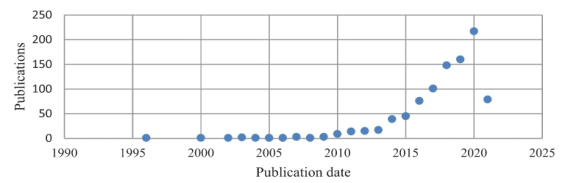
First criterion is the year of publication, since we wanted to scope the most recent technological studies in the field, without losing significance. According to Kapousizis et al. (2022) publications in this field started to peak
A Framework to Assist the Design Process of Cycling Warning Systems 157
Figure 1: “Distribution of publication through the years” (Kapousizis et al. 2022).
around 2017, (Figure 1), reason why a timeframe between 2017 and 2022 was assumed. Second criterion implies that all analyzed studies needed to be empirical, meaning a warning system concept was described in it, regardless of its development level. Purely theoretical studies, such as literature revi- ews were excluded. Furthermore, included studies needed to report warning systems for a bicycle that don’t take control away from its rider. For example, studies proposing autonomous breaking systems were excluded from the final count. Finally, the third criterion was set to admit studies reporting warning systems able to collect data relevant to traffic or the cyclist, such as a smart bicycle that captures the surrounding vehicles and informs the cyclists as pre- sented by Jeon et al. (2021), excluding papers that measured environmental data.
After screening, a total of 17 studies were considered to analysis. Given the reduced number of results, the timeframe was extended to englobe the years from 2012 to 2016 resulting in five more studies, with a final corpus of 22 studies (Table 1). Although modest, this collection of studies consti- tutes the scoping phase of the review, aiming the development of the first proposal to the framework. A systematic review, considering a larger corpus through more permissive criteria, will be carried in later in the next phases of study.
Table 1. Corpus of analysis.
Table available in the original PDF paper.
Terms Authors Count
8
“Cyclist Safety” AND “Sensing”
(Costa et al. 2018; Bernardes et al. 2019; Nuñez et al. 2018; Matviienko et al. 2022; Jin et al. 2021; von Sawitzky et al. 2022; Han et al. 2022; Dong et al. 2022)
9
“Warning Systems” AND “Cycling”
(van Brummelen et al. 2017; Oczko et al. 2020; Kaparias et al. 2021; Zignoli et al. 2022; Zignoli 2021; Strohaeker et al. 2022; Dozza et al. 2016; Dozza and Fernandez 2014; Blumenstein et al. 2014)
“Warning Systems” AND “Bicycle”
(Jeon et al. 2021; von Sawitzky et al. 2020; Panxhi et al. 2017; Wallich 2015; Liebner et al. 2013)
DIVERSITY OF CYCLING ACCIDENTS Resulting from the increasing overall awareness regarding the multifactorial nature of traffic accidents, some projects have been developed to increase the safety of cyclists, by analyzing traffic scenarios and developing systems to monitor the rider’s condition, as well as road vehicles.
Road cycling happens in a multitude of scenarios which, according to Gohl et al. (2016) can be divided into the following categories: longitudi- nal (parallel to the road direction), crossing (at intersection and crosswalks), turning (changing direction at an intersection) and others (involving statio- nary objects). This categorization of scenarios covers the relevant actions of cycling while excluding actions prohibited by law, like cycling in highways and pavements.
Besides the type of scenarios where cycling accidents can occur, variables such as car doors, irresponsible parking, or lack of space for safe cycling, may create conflicting scenarios, that jeopardize the cyclist’s safety. For example, Schimek (2018) states that door openings compose 12%-17% of bicycle-to- car accidents, due to the lack of space in the bicycle lanes. Analyzing each incident considering the multiplicity of possible involved elements, risks to generate overflowing datasets, that still may do not represent all accident possibilities. A more comprehensive classification of accidents elements may be gathered from police reports including motor vehicles, bicycles, pedestri- ans, fixed objects, falls and others, as suggested by Shinar et al. (2018). Additionally, as pointed by Matviienko et al. (2021) complete information about accidents should consider not only qualitative data coming from cycli- sts’ own reports and third-person descriptions but also objective/quantifiable data, such as from traffic cams, car sensors, bike dynamics, and riders’. Thus, conducted review clearly settles that first, cycling safety has a broad spectrum of variables to tackle and, second, measuring those variables only from a qualitative or quantitative perspective lacks a global understanding of the problem.
Regarding the specific aim to propose a design warning systems framew- ork, by bringing together the contributions from 2 of the analyzed studies, it was possible to propose 2 major groups to describe the majority of cycling accidents: Road Cycling Action and Type of Accident. In the first group we included 3 from the one proposed by Gohl et al. (2016): Longitudinal, Tur- ning, and Crossing. Category Others was excluded to avoid subjectivity. In the second group we listed 6 categories. Five originally proposed by Schimek (2018): Motor Vehicles, Bicycles, Pedestrians, Fixes objects and Falls. Again, category Other was removed (for the same reason already mentioned). A newer category, Cycling Lanes, contemplating road conditions was added to cover a larger number of situations. As a result, proposed framework will focus on 18 possible accidents scenarios.
TECHNOLOGY RELATED TO CYCLING SAFETY This section aims to map the relation between bicycle warning systems and technologies by identifying which were involve in the concepts reported in the 22 analyzed studies.
A Framework to Assist the Design Process of Cycling Warning Systems 159
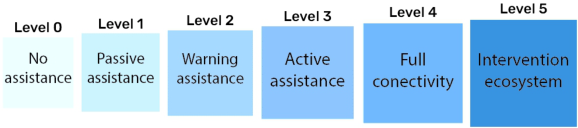
Overall, the smartness level of a bicycle warning system will depend on the specific features granted by the technology it incorporates. However, this definition is too broad to comprehend and distinguish all the safety systems in a bicycle (englobing market solutions and emerging technologies). Kapou- sizis et al. (2022) introduced a system to classify multiple types of bicycle safety systems, in accordance with their smartness degree, through an easily understandable scheme divided into six levels as presented in Figure 2. The system is aimed to clarify the benefits and limitations of each type of tech- nology which those authors synthesize into a table and purposefully indicate that microcontrollers are left out due to the multimodality inherent to them. However, in our perspective, controllers and microcontrollers must not be overlooked given the fact that they are the cognitive force that can increase a system’s smartness. They also affect the overall performance of the final pro- duct since real-time data and fast data aren’t the same as stated by Karvinen and Karvinen (2014).
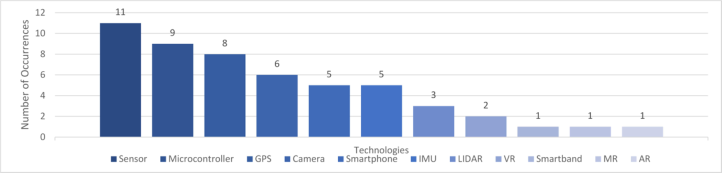
Looking specifically into bicycle warning systems, we found that the tech- nology behind them it’s generally the same that is applied to smart bicycles, although studies englobing bicycle or cycling warning system concepts tend to be at early stages of development. Generally, what those studies propose are new digital solutions for safety by promoting augmented, virtual or mixed reality prototypes to test concepts and methods of information or monitoring such as those presented by Matviienko et al. (2022); Oczko et al. (2020); von Sawitzky et al. (2020); von Sawitzky et al. (2022). The more common appro- ach implements GPS (global positioning system) and IMU (inertial measuring unit) to monitor cycling activity as reviewed by Han et al. (2022); Dong et al. (2022); Bernardes et al. (2019); Costa et al. (2018); Strohaeker et al. (2022); Zignoli (2021); Kaparias et al. (2021). Even this frequent approach is sho- wing recent progresses, as indicated by Zignoli et al. (2022) who concluded that the advancements in GPS technologies, numerical optimization techni- ques and modeling capabilities broaden the capacity to interpret cycling data. GPS technology can be implemented through smartphones that have enough accuracy to detect the location of the cyclist as stated by Liebner et al. (2013). Besides the previously mentioned technologies, review results show that other technologies are being implemented, such as ultrasonic, laser, radar sensors, gyroscopes, and accelerometers to measure one or more conditions during cycling (Jin et al. 2021; Nuñez et al. 2018; van Brummelen et al. 2017; Panxhi et al. 2017; Blumenstein et al. 2014).
The reviewed projects typically use technology to enhance safety, and the technological components utilized are consistent across all projects, as shown
Figure 2: Adapted smartness level of bike categorization (Kapousizis et al. 2022).Figure 3: Technologies applied in bicycle warning systems (@authors).
in Figure 3, indicating the flexibility of technology to adapt to different situations or variables. Since the same technology is applicable to multiple projects, the components become a by-product of the purpose given to the technology. Ahead, in Table 3 we present the same technologies, retained from the reviewed studies, to incorporate the framework proposal.
FRAMEWORK PROVISIONAL PROPOSAL The provisional framework presented in this section is aimed to assist the process of designing cycling warning systems. Previous sections depicted the current knowledge regarding bicycle warning systems, accident scenarios and technologies as these variables are addressed in 22 recently published empirical studies. Eighteen scenarios and eleven different technologies were identified, to be included in our framework.
Additionally, the analysis revealed that the diversity of perspective pre- sented in the studies derives from the importance that each author gives to different high-level requirements. We organized these requirements in an 8- category classification as showed in Table 2: Target Market, Sustainability, Objective, Technology, Scope, Information Type, Usability and Embed Zone.
From these eight high-level requirements categories, Target Market and Sustainability are concepts related to product design and development and are transversal to all project requirements as stated by Ulrich et al. (2020). The remaining categories arise from authors experience and understanding
Table 2. Project high-level requirements.
Table available in the original PDF paper.
High-level Requirements Options List Target Market Bike Sharing, Commuting, City Adventure, Fitness… Sustainability Ambiental, Social, Economic… Objective Monitor, Inform, Both Technology Sensor, Microcontroller, GPS, Camera, Smartphone, IMU, LIDAR, Smartband, VR, AR, MR… Scope Internal (directed to the cyclists), External (other road users) Information Type Visual, Tactile, Auditive Usability Effectiveness, Efficiency, Security, Utility, Learnability, Memorability… Integration Cyclist or Bicycle
A Framework to Assist the Design Process of Cycling Warning Systems 161
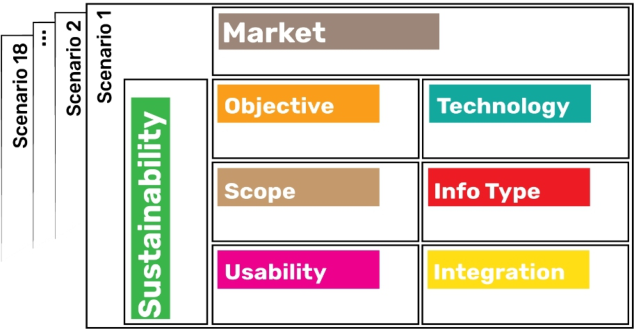
about aspects that drive and limit product design, directed to bicycle war- ning systems. The Objective variable defines the purpose of the project by indicating if it monitors (cyclist, bicycles, road users, or traffic conditions) or informs (cyclists or other road users) while the Technology one corresponds directly to was discussed in section 3. The Scope refers to the type of monito- ring that the project is directed to and is classified as internal (monitoring the cyclist or bicycle) or external (monitoring other road users or traffic conditi- ons). Information Type refers to the sensorial type perceived, meaning visual, tactile, or auditive cues. In terms of Usability, this is the system’s capacity to allow the user to perform its functions without difficulty. Integration is dire- cted to the location of application, for example, on the bicycle handlebars or the rider’s wrists. The categories presented above are subject to further deve- lopment and may be changed either in number or in definition. The options list for each category must be dynamic and updated according to the latest knowledge in the area. These options can be further broken down into more specific levels to detail project requirements and/or specifications. Finally, to relate the 8 high-level requirements categories with the 18 scenarios previ- ously mentioned, our provisional framework proposal (Figure 4) draws out a 3-dimensional table where requirement levels are disposed in the same plane, and depth is achieved by stacking similar planes that differ only by the cycling scenario, that way allowing comparison of the variable’s context across the board.
Figure 4: Framework proposal (@authors).
FINAL REMARKS The use of bicycle as a commuting vehicle is increasing worldwide, mostly due to increasing global concerns about fossil fuels consumption. Meanwhile, most cities infrastructures are not prepared to accommodate cycling traffic. Adding to this the enormous amount of motor vehicles still in circulation and the problem of cycling safety and the multitude of variables gravita- ting around it becomes evident. Cycling warning systems, either as part of
the bicycle or as an accessory, have been proposed as a means of contribu- ting to the safety of cyclists. Looking at this issue from the perspective of product design and development and, considering the diversity and unpre- dictability of the elements possibly involved in a cycling accident, this paper aims to put forward a provisional proposal for a design framework specifi- cally dedicated to warning systems. The presented framework results from a scoping literature review that examines 22 warning system concepts repor- ted in the literature in recent years and includes a three-dimensional matrix aimed at examining an 8-level requirements taxonomy across 18 different accident scenarios. Next phases of our study will include the validation of the proposal through a 2-stage validation process involving focus groups with bicycle design experts and the collection of feedback from users external to the project and then testing the framework against practical cases.
ACKNOWLEDGMENT
This work is financed by national funds through the FCT – Fundação para a Ciência e a Tecnologia, I.P., under the scope of the project UIDB/04057/2020.
REFERENCES
Bernardes, S. D., Kurkcu, A. and Ozbay, K. (2019). Design, implementation and testing of a new mobile multifunction sensing device for identifying high-risk areas for bicyclists in highly congested urban streets. Procedia Computer Science [online], 155, pp. 218–225. Blumenstein, T., Zeitlmann, H., Alves-Pinto, A., Turova, V. and Lampe, R. (2014).
Optimization of electric bicycle for youths with disabilities. SpringerPlus [online], 3(1). Costa, M., Ferreira, B. Q. and Marques, M. (2018). A Context Aware and Video- Based Risk Descriptor for Cyclists., 2018. Available from: https://users.isr.ist.utl. pt/ [accessed 25 January 2023]. Costa, M., Marques, M., Roque, C. and Moura, F. (2022). CYCLaNDS: Cycling
geo-located accidents, their details and severities., 2022. Available from: https: //doi.org/10.1038/s41597-022-01333-2 [accessed 31 January 2023]. Dong, X., Han, Z., Nishiyama, Y. and Sezaki, K. (2022). DoubleCheck: Single- Handed Cycling Detection with a Smartphone. Conference Proceedings - IEEE International Conference on Systems, Man and Cybernetics [online], 2022- October, pp. 268–274. Dozza, M. and Fernandez, A. (2014). Understanding bicycle dynamics and cyclist
behavior from naturalistic field data (November 2012). IEEE Transactions on Intelligent Transportation Systems [online], 15(1), pp. 376–384. Dozza, M., Bianchi Piccinini, G. F. and Werneke, J. (2016). Using naturalistic data to assess e-cyclist behavior. Transportation Research Part F: Traffic Psychology and Behaviour [online], 41, pp. 217–226. Gohl, I., Wisch, M., Stoll, J. and Nitsch, V. (2016). (PDF) Car-to- cyclist accidents from the car driver’s point of view. In: Bologna, Italy. Available from: https://www.researchgate.net/publication/330675292_Car-to- cyclist_accidents_from_the_car_driver%27s_point_of_view [accessed 28 April 2022]. Han, Z., Dong, X., Nishiyama, Y. and Sezaki, K. (2022). Head dynamics enabled
riding maneuver prediction. In: Proceedings of the 20th Annual International
A Framework to Assist the Design Process of Cycling Warning Systems 163
Conference on Mobile Systems, Applications and Services. New York, NY, USA: ACM, pp. 557–558. Available from: https://dl.acm.org/doi/10.1145/3498361. 3538782 [accessed 25 January 2023]. Jeon, W., Xie, Z., Craig, C., Achtemeier, J., Alexander, L., Morris, N., Donath, M.
and Rajamani, R. (2021). A Smart Bicycle That Protects Itself: Active Sensing and Estimation for Car-Bicycle Collision Prevention. IEEE Control Systems [online], 41(3), pp. 28–57. Available from: https://ieeexplore.ieee.org/document/9438011/ [accessed 26 January 2023]. Jin, W., Murali, S., Cho, Y., Zhu, H., Li, T., Panik, R. T., Rimu, A., Deb, S., Watkins, K., Yuan, X. and Li, M. (2021). CycleGuard: A Smartphone-based Assistive Tool for Cyclist Safety Using Acoustic Ranging. Proceedings of the ACM on Interactive, Mobile, Wearable and Ubiquitous Technologies [online], 5(4). Kaparias, I., Miah, S., Clegg, S., Gao, Y., Waterson, B. and Milonidis, E. (2021).
Measuring the effect of highway design features on cyclist behavior using an instrumented bicycle. 2021 7th International Conference on Models and Tech- nologies for Intelligent Transportation Systems, MT-ITS 2021 [online], 16 June 2021. Kapousizis, G., Ulak, M. B., Geurs, K. and Havinga, P. J. M. (2022). A review of state-of-the-art bicycle technologies affecting cycling safety: level of smartness and technology readiness. https://doi.org/10.1080/01441647.2022.2122625 [online], 2022. Available from: https://www.tandfonline.com/doi/abs/10.1080/01441647. 2022.2122625 [accessed 2 December 2022]. Karvinen, K. and Karvinen, T. (2014). Getting started with sensors [online].
Available from: https://www.oreilly.com/library/view/getting-started-with/ 9781449367077/ [accessed 19 January 2023]. Lawrence, B. M., Oxley, J. A., Logan, D. B. and Stevenson, M. R. (2018). Traffic Injury Prevention Cyclist exposure to the risk of car door collisions in mixed function activity centers: A study in Melbourne, Australia., 2018. Available from: https://www.tandfonline.com/action/journalInformation?journalCode=gcpi20. Liebner, M., Klanner, F. and Stiller, C. (2013). Active safety for vulnerable road
users based on smartphone position data. IEEE Intelligent Vehicles Symposium, Proceedings [online], 2013, pp. 256–261. Matviienko, A., Heller, F. and Pfleging, B. (2021). Quantified Cycling Safety: Towards a Mobile Sensing Platform to Understand Perceived Safety of Cyclists. Conference on Human Factors in Computing Systems - Proceedings [online], 8 May 2021. Matviienko, A., Müller, F., Schön, D., Seesemann, P., Günther, S. and Mühlhäuser,
M. (2022). BikeAR: Understanding Cyclists’ Crossing Decision-Making at Uncon- trolled Intersections using Augmented Reality. Conference on Human Factors in Computing Systems - Proceedings [online], 29 April 2022. Munn, Z., Peters, M. D., Stern, C., Tufanaru, C., McArthur, A., & Aromataris, E.
(2018). Systematic review or scoping review? Guidance for authors when cho- osing between a systematic or scoping review approach. BMC medical research methodology, 18, 1–7. Nuñez, J. Y. M., Teixeira, I. P., da Silva, A. N. R., Zeile, P., Dekoninck, L. and Botteldooren, D. (2018). The influence of noise, vibration, cycle paths, and period of day on stress experienced by cyclists. Sustainability (Switzerland) [online], 10(7). Oczko, M. C. H., Stratmann, L., Franke, M., Heinovski, J., Buse, D. S., Klin-
gler, F. and Dressler, F. (2020). Integrating Haptic Signals with V2X-based Safety Systems for Vulnerable Road Users. 2020 International Conference on Compu- ting, Networking and Communications, ICNC 2020 [online], 1 February 2020, pp. 692–697.
Panxhi, D., Selmanaj, D., Spahiu, A., Zavalani, O., Corno, M., Savaresi, S. M.
and Todeschini, F. (2017). Analysis of a vibrotactile actuator for bicycle handle- bars. Proceedings of International Conference on Smart Systems and Technologies 2017, SST 2017 [online], 2017-December, pp. 37–42. Pucher, J. and Buehler, R. (2017). Transport Reviews Cycling tow- ards a more sustainable transport future., 2017. Available from: https://www.tandfonline.com/action/journalInformation?journalCode=ttrv20. Schimek, P. (2018). Bike lanes next to on-street parallel parking. Accident Analysis and Prevention [online], 120, pp. 74–82. Shinar, D. et al. (2018). Under-reporting bicycle accidents to police in the COST
TU1101 international survey: Cross-country comparisons and associated factors. Accident Analysis and Prevention [online], 110, pp. 177–186. Strohaeker, E. H., Moia, A., Steinmann, J. and Hagemeister, C. (2022). How do warnings influence cyclists’ reaction to conflicts? Comparing acoustic and vibro- tactile warnings in different conflicts on a test track. Transportation Research Part F: Traffic Psychology and Behaviour [online], 90, pp. 151–166. Ulrich, K. T., Eppinger, S. D. and Yang, M. C. (2020). Product Design and
Development. 7th ed. New York: McGraw-Hill Education. van Brummelen, J., Emran, B., Yesilcimen, K. and Najjaran, H. (2017). Reliable and low-cost cyclist collision warning system for safer commute on urban roads. 2016 IEEE International Conference on Systems, Man, and Cybernetics, SMC 2016 - Conference Proceedings [online], 6 February 2017, pp. 3731–3735. von Sawitzky, T., Grauschopf, T. and Riener, A. (2020). No Need to Slow Down! A
Head-up Display Based Warning System for Cyclists for Safe Passage of Parked Vehicles. Adjunct Proceedings - 12th International ACM Conference on Automo- tive User Interfaces and Interactive Vehicular Applications, AutomotiveUI 2020 [online], 21 September 2020, pp. 1–3. Available from: https://dl.acm.org/doi/10. 1145/3409251.3411708 [accessed 25 January 2023]. von Sawitzky, T., Grauschopf, T. and Riener, A. (2022). Hazard Notifications for Cyclists: Comparison of Awareness Message Modalities in a Mixed Reality Study., 22. Available from: https://doi.org/10.1145/3490099.3511127 [accessed 25 January 2023]. Wallich, P. (2015). An early-warning system for your bike: Low-cost lidar can detect
approaching cars. IEEE Spectrum [online], 52(7), pp. 22–23. Zignoli, A. (2021). An intelligent curve warning system for road cycling races. Sports Engineering [online], 24(1), pp. 1–7. Available from: https://link.springer.com/ar ticle/10.1007/s12283-021-00356-z [accessed 25 January 2023]. Zignoli, A., Biral, F., Fornasiero, A., Sanders, D., Erp, T. van, Mateo-March, M.,
Fontana, F. Y., Artuso, P., Menaspà, P., Quod, M., Giorgi, A. and Laursen, P. B. (2022). Assessment of bike handling during cycling individual time trials with a novel analytical technique adapted from motorcycle racing. European Journal of Sport Science [online], 22(9), pp. 1355–1363.
LISTED IN THE AHFE DIGITAL BOOKSTORE CATALOGUE
Explore the complete digital volume
Human Dynamics and Design for the Development of Contemporary Societies
Read this individual research paper free through the original publisher, or explore the full digital proceedings book.
ISBN 978-1-958651-57-5
Explore this ISBN in the AHFE Bookstore ↗Listed in the July 2026 bookstore catalogue; search by ISBN to confirm current availability · Digital book purchase optional