Sílvia Espada, Ana Teixeira, Maria Antunes, Sonia Brito-Costa (2023). Natural and artificial lighting: Influence on readability. In: Human Dynamics and Design for the Development of Contemporary Societies. AHFE Open Access, vol. 81, pp. 102–111. https://doi.org/10.54941/ahfe1003538
In the study we present, the effects of different types of light (natural or artificial), different types of texts (scientific and children's) and different reading formats (on screen and on paper) on our readability are addressed, as well as determining the preference of each participant for reading tasks and to what extent reading with natural light and with influences of artificial light affects their readability in design, and how the reading process could be done more effectively, through manipulation of lighting variables. The experiments were based on different tasks, which required 10 participants, to read two different texts (children's text and scientific text), in two different formats (print and screen) under two different types of lighting (natural light and artificial light). During reading, we recorded the following parameters: Heart rate and EEG signal (levels of calm, neutral and active (%) using two devices: a heart rate monitor to measure heart rate and Muse, a brain detection headband that uses real-time biofeedback in its brain activity, which we used to monitor brain activity. After completing the protocol, participants answered a questionnaire to collect data on their reading preferences and were composed of three parts: the first part consisted of questions aimed at collecting demographic information from the participants (age, nationality, and other useful data for our research); the second part addressed three questions about the participants reading preferences; the third part was designed to explore the participants opinions about the test and their comfortability. We conclude that participants prefer reading on paper rather than on screen and their performance was better in reading with artificial light. Although reading with natural light was the preference of most participants, reading with artificial light provides better performance in performing the tasks. These findings could help designers to better understand the roles of lighting variables in the reading process and to create light design products that are more efficient, sustainable, and comfortable.
Light is an essential element for the life of all living beings, both in the performance of activities and for a human’s emotional and psychological well-being.
Light presents characteristics and properties that are fundamental for the performance of certain activities and can be emitted according to two types of sources, natural light and artificial light. The sun is the primary source of natural light, in the case of artificial light, the source is energy produced from
Natural and Artificial Lighting: Influence on Readability 103
alternative sources. According to (Daré, 2012), “It is taken as a basic principle that natural lighting characterizes space, while artificial lighting serves as support and is necessarily subordinate to that.” A light design project should be developed to provide sufficient lighting, whether natural and/or artificial, that allows its users to develop their visual actions with comfort and safety, as well as providing an pleasant view of the interior environment and that contributes to having comfort and well-being (Santos & Vasquez, as cited in (Daré, 2012).
The acquisition of information through vision is much easier and more effective than other senses (Kelly and Gaytan, 2014). With visual informa- tion shared through paper and computer screen, the human being is able to expand their knowledge and experiences (Daeun, n.d.; Penrose, 1998). One of the most relevant and practiced activities of the human being is reading, in this field, light plays an important element in visual performance and legi- bility. Readability is an important measure to access the visual performance of human beings. It is defined as the ability to read sentences easily irrespe- ctive of their meaning of the stimulus material that could be from any form of sources (Sathya and Natarajan, 2016). There are many factors that affect visual performance and legibility, light is one of them. Other studies have shown that artificial light sources affect human beings, both physiologically and psychologically (Sathya and Natarajan, 2016).
The increasing use of computers and tablets, along with their rapid tech- nological advancement, has made their use not only for research and work development, but also for the reading process. Software readability as the characteristic that influences the ease with which a code excerpt can be read and understood (Posnett et al., 2011). According to previous research, we can identify some factors that provide good reading on the screen, conside- ring that there are no 100% suitable solutions for screen reading and that they guide and provide the individual with levels of quality and comfort in reading. There are some more relevant factors that affect visual performance, presenting the mixture of light, stimulus purity, and luminance as the three dimensions of colour and the contrast ratio, chromatic contrast, and polarity as the components that characterize and indicate the existence of interaction effects between screen luminance and contrast ratio in visual performance. (Lin, 2005; Lin and Chen, 2006; Shieh and Lin, 2000).
The literature shows that light, specifically the spectral quality of light, has been found to have a significant impact on emotional brain processing (Van- dewalle et al., 2010) and exposure to different types of light can affect mood, cognitive function, and overall well-being (Figueiro et al., 2017). Additio- nally, there is a unique network in the brain that merges affective and ambient light information to influence emotional processing. This network includes the suprachiasmatic nucleus (SCN) in the hypothalamus, which is responsi- ble for regulating the body’s circadian rhythm, as well as several other brain regions such as the amygdala and the prefrontal cortex, that are involved in emotional regulation. (Vandewalle et al., 2010).
Natural light, because of its broad spectrum of colours, can create a sense of comfort and well-being, which can improve the overall reading experience. In addition, natural light can help to reduce eye strain, making it easier to
read for longer periods of time. However, as already mentioned, natural light can also create glare and shadows, which can make it difficult to read (Ram and Bhardwaj, 2018; Shieh and Lin, 2000). On the other hand, artificial light, can have different effects depending on the type of light and the way it is used. A consistent level of illumination can make it easier to read, but artificial light can also create glare, flicker, and color distortion. (Avci and Memiko˘glu, 2021; Ram and Bhardwaj, 2018; Vandewalle et al., 2010).
METHODS
Dataset We created different tasks, which required 10 participants (7 female and 3 male) with a mean age of 19.50 years [SD = 1.50), range (18 to 23)] (to read two different complexity texts (children’s and scientific text), in two different formats (print and on screen) under two different types of lighting (natural light and artificial light). In general, the visual abilities of people between 18 and 23 (study participants) present a view considered fully deve- loped. The visual abilities are highlighting visual acuity, depth perception, peripheral vision, visual processing speed and contrast sensitivity (Daiber and Gnugnoli, 2022). It should be noted that in this study all participants did not wear glasses, thus presenting equitable visual abilities.
Procedure We created different tasks, which required subjects to read out loud two dif- ferent texts (children’s and scientific), in two different formats (print and on screen) under two different types of lighting (natural light and artificial light). While reading, the heart rate and the EEG signal devices: a heart rate monitor watch to measure the heart rate and Muse which we used to moni- tor the brain activity (Kheirkhahan et al., 2019; Krigolson et al., 2017; Nair et al., 2016; Shih et al., 2012). Before the experiment, the subjects were told the purpose of the study, how they should behave during the tests and their doubts were clarified. To regulate the lighting for the experiment, we created two spaces, one for reading under artificial light and another one for reading under natural light.
Two different rooms were used in the experiment:
Natural Light The room includes a large window. The sunlight entering the room through the window, providing a range of colors and intensities that change through- out the day. Natural light is beneficial for regulating our sleep-wake cycles and boosting our mood and productivity. The tests were performed between 10 am and 3 pm. This is generally a good time to test lighting conditions as it allows for a range of natural light to be present and may minimize any potential issues with artificial light. However, it’s important to note that natu- ral light conditions can vary depending on factors like weather, season, and geographic location. Therefore, it’s important to consider that these factors are the same in all experiments.
Natural and Artificial Lighting: Influence on Readability 105
Artificial Light The room includes ceiling light. Ceiling lights providing general illumina- tion in a room, as they are typically installed in the centre of the ceiling and can provide a broad and even distribution of light. The ceiling light used is a daylight-coloured light, because provides bright and clear illumination that is suitable for tasks that require good visibility, such as reading or working. Daylight-coloured bulbs have a colour temperature which create a cool and energizing atmosphere in a room.
Both of the texts were presented in two formats, print and on screen. The texts have the same page layout, including line spacing, font size, colour and typography. For the paper format, they were printed on A4 copy paper (dimensions of 210x297 mm). The same passages were presented as PDF files for the screen format, at 100 percent scale. The device used for compu- ter reading was an ASUS Vivo book 15 F512 laptop, set with the brightness at maximum regardless of lighting conditions. Firstly, we explained the pro- cedure to the participants, to inform them which tasks they were performing. Thereafter, we set up the devices, which were measuring heart rate values and calmness levels during the participants read. The first part of the tests was done under natural lighting conditions. We established the following sequence for the procedure:
Natural Light-Scientific-Screen;
Natural Light-Children Screen;
Natural Light-Scientific-Paper;
Natural Light-Children-Paper; With ten minutes pause between them, while other subjects did the same test. Then the subjects performed the second part of this sequence two days after: in the other room (under artificial lighting), and continued the sequence:
Artificial Light-Scientific-Screen;
Artificial Light Infantile-Screen;
Artificial Light-Scientific-Paper;
Artificial Light-Infantile-Paper, With ten minutes pause between them, while other subjects did the same test, as well. All of the tests were performed between 10 am and 3 pm on both days. We chose to follow this sequence in order to avoid the possibi- lity of subjects recognizing and remembering the words in the text and this affecting the results. After completing this sequence, the subjects answered a questionnaire to evaluate some aspects of the tests. The gathered varia- bles were then subjected to statistical tests, such as Mann-Whitney U test and Kruskal Wallis test, to evaluate the relationships between variables and determine if any of them have a significant influence on the outcomes. The results of these tests can then be used to draw conclusions about the data and make predictions about future trends and outcomes. Note that, lighting is an important variable and has crucial role in our ability to read and affects many levels of human functioning, vision, heart rates, attention, and cognition, all
of which are implicit in learning and performance. Despite his significant role, the light designer has been undervalued in this process. Using adequate lighting will undoubtedly improve the reading performance of each person. This study aims to investigate the effects of different types of light (natural or artificial), different types of texts (scientific and infantile), and different rea- ding formats design (on screen and on paper) on our readability, as well as to determine each participant’s preference for performing reading tasks and to what extent reading with natural light and with artificial light influences their readability on design, and how the reading process would be done more effectively, through the manipulation of lighting variables.
All participants provided written informed consent prior to the experimen- tal session. The research has been conducted adhering to the ethical guidelines and the legal requirements of the country in which the study took place (Portugal).
RESULTS
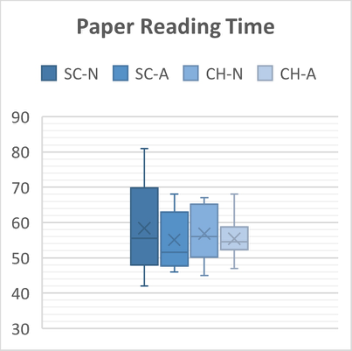
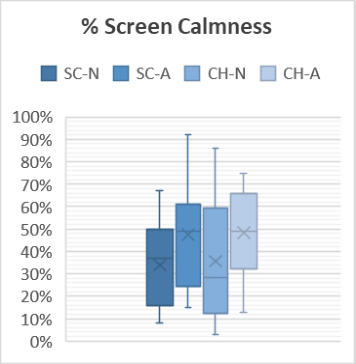
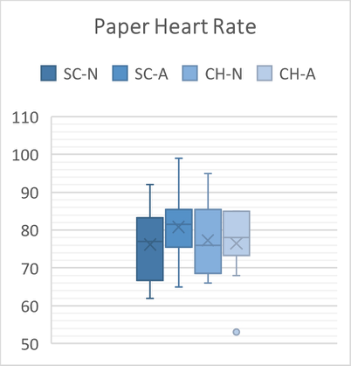
The results showed that in the artificial light environment, the quality of rea- ding increased. By analysing the results, we can conclude that, in most cases, under artificial lighting conditions, the reading time and heart rate values are lower, and the percentage of calmness is higher, in most cases (figures 1, 2 and 3). However, in some of the tests we realized that while reading the chil- dren’s text on screen, the results are equal in both artificial light and natural light conditions. This may be due to the fact that nowadays people are used to reading on screen in both lighting conditions, many hours a day.
By analysing the figure 3, it appears that in artificial light conditions, the heart rate values are lower when reading on screen and in natural light con- ditions, the heart rate values are lower when reading on paper. This suggests that lighting can have an effect on reading performance.
Figure 1: Reading Time on screen (right) and on paper (left) considering the Scientific (Sc) and Children’s (CH) texts in artificial (A) and natural (N) light environment.
Natural and Artificial Lighting: Influence on Readability 107
Figure 2: Calmness level on screen (right) and on paper (left) considering the Scientific (Sc) and Children’s (CH) texts in artificial (A) and natural (N) light environment.Figure 3: Heart Rate level on screen (right) and on paper (left) considering the Scientific (Sc) and Children’s (CH) texts in artificial (A) and natural (N) light environment.
Additionally, it is revealed that participants have a faster reading speed in the artificial light environment and have a slower reading speed under natural light conditions. This could be since natural light is more similar to daylight, which can be less harsh on the eyes and more conducive to comfortable rea- ding, while artificial light can be more intense and cause strain on the eyes, leading to a faster reading speed. Therefore, it can be inferred that lighting does influence reading performance. Considering the Mann-Whitney U test it is also evident that there is a statistical difference between reading time on paper and reading on screen considering Scientific text in natural light (p = 0.0156) and artificial light environment (p = 0.0391) and that there is a
statistical difference between reading on paper and reading on screen consi- dering Children’s Text in natural light environment (p = 0.0117). In addition, the calmness level is statistical different between natural and artificial light considering reading on paper and reading on screen for Scientific text and children’s text (p<0.05). In the case of heart rate level, the results are not statistically significant. Based on the results presented in figure 1, it appears that the reading time is shorter when the text is presented on paper (55.9 seconds) compared to when it is presented on a screen (59.8 seconds). This is in line with the conclusion that there is a statistically significant difference between reading time on paper and on screen. Also, the results show that the scientific text was more difficult to read than the children’s text, as it took longer for the participants to read and the heart rate values were higher as seen in figure 3, this could be due to the complexity and technical nature of the scientific text. Comparing the reading time values between the scientific text on screen with artificial light and the scientific text on screen with natu- ral light, we can confirm the results obtained above, since the reading time of the scientific text on screen was lower with artificial light. Additionally, by comparing the results of the scientific text on screen and on paper with artifi- cial light, it confirms that the reading time of the scientific text with artificial light was shorter when read on paper, this is in line with the initial conclusion that the reading time is shorter when the text is presented on paper compared to when it is presented on a screen.
CONCLUSION
Reading is an important skill, especially for academic and professional purpo- ses and the influence of lighting is a major factor when analysing the quality of reading under different types of lighting. The aim of this study was to understand the effects of different types of light (natural or artificial), dif- ferent types of texts (scientific and children) and different reading formats (on screen and on paper) on our readability. Based on the findings of this study, we conclude that these variables influence undoubtedly text reading. The questionnaire implied that most participants prefer reading on paper rather than on screen and under natural lighting conditions, differing from the research results, which demonstrate that performance in artificial light environments is better.
By this study participants prefer reading on paper rather than on screen and their performance was better in reading with artificial light. Although reading with natural light was the preference of most participants, reading with artificial light provides better performance in performing the tasks, which corroborate that are many factors that affect visual performance and legibility, light is one of them (Sathya and Natarajan, 2016).
This outcome may be since they performed the tests under artificial ligh- ting after the ones with natural lighting and it may have influenced their confidence and nervousness, which also corroborates (Sathya and Natara- jan, 2016) who shown that artificial light sources affect human beings, both physiologically and psychologically (Sathya and Natarajan, 2016). Although
Natural and Artificial Lighting: Influence on Readability 109
natural illumination, or light from the sun, can have positive effects on psych- ological well-being, such as increasing feelings of positivity, productivity, and overall mood (Edwards and Torcellini, 2002) artificial illumination, or light from sources such as lamps or light bulbs, can also have positive effects, such as providing a sense of safety and security in the dark, however, excessive artificial illumination or exposure to artificial light at night can have nega- tive effects on sleep and circadian rhythms, leading to insomnia, fatigue, and other sleep disorders (Blume et al., 2019; Cho et al., 2015; Osibona et al., 2021). However, long term exposure to artificial light at night also increase the risk of chronic health conditions such as obesity, diabetes, and depression (Falchi et al., 2011; Tancredi et al., 2022). This study has provided insights into the role of lighting variables in the reading process, and the potential benefits for designers in creating more efficient, sustainable, and comfortable design products.
FURTHER WORK The biggest limitation of our study is the size of the sample used which does not allow us to generalize the results, but only provides clues. Although this is a pilot study, it is necessary to increase the sample size to ensure more reliable results. Developing new studies using the same methodology in a representative sample will provide more comprehensive data and increase the statistical power.
ACKNOWLEDGMENT
We would like to express our gratitude to the students, Inês Fonseca, Joana Caetano, Leonor Santos and Pedro Mota who collaborated with us on this research.
REFERENCES
Avci, A. N. and Memiko˘glu, ˙I. (2021), “Evaluating effectiveness of led and oled lights on user visual comfort and reading performance”, A/Z ITU Journal of the Faculty of Architecture, Vol. 18 No. 2, doi: 10.5505/itujfa.2021.22438. Blume, C., Garbazza, C. and Spitschan, M. (2019), “Effects of light on human circa-
dian rhythms, sleep and mood”, Somnologie, doi: 10.1007/s11818-019-00215-x. Cho, Y. M., Ryu, S. H., Lee, B. R., Kim, K. H., Lee, E. and Choi, J. (2015), “Effects of artificial light at night on human health: A literature review of observatio- nal and experimental studies applied to exposure assessment”, Chronobiology International, doi: 10.3109/07420528.2015.1073158. Daeun, J., C. K., K. C. (n.d.). “Exploring the Interaction Between Lighting Variables
and Information Transfer as a New Function of Lighting”. Daiber HF, Gnugnoli DM. Visual Acuity. 2022 Jun 21. In: StatPearls [Internet].
Treasure Island (FL): StatPearls Publishing; 2022. PMID: 33085445. Daré, A. C. (2012), “Lighting design: uma abordagem sobre a visão e a perceção do design dos ambientes pelos idosos através da iluminação”, Convergências: Revista de Investigação e Ensino Das Artes., Vol. No10.
Edwards, L. and Torcellini, P. (2002), A Literature Review of the Effects of Natural Light on Building Occupants A Literature Review of the Effects of Natural Light on Building Occupants, Contract. Falchi, F., Cinzano, P., Elvidge, C. D., Keith, D. M. and Haim, A. (2011),
“Limiting the impact of light pollution on human health, environment and stel- lar visibility”, Journal of Environmental Management, Vol. 92 No. 10, doi: 10.1016/j.jenvman.2011.06.029. Figueiro, M. G., Steverson, B., Heerwagen, J., Kampschroer, K., Hunter, C. M., Gonzales, K., Plitnick, B., et al. (2017), “The impact of daytime light expo- sures on sleep and mood in office workers”, Sleep Health, Vol. 3 No. 3, doi: 10.1016/j.sleh.2017.03.005. Kelly, S. and Gaytan, J. (2014), “ Book Review: The power of infographics: Using pictures to communicate and connect with your audiences by Smiciklas, M. ”, Business and Professional Communication Quarterly, Vol. 77 No. 2, doi: 10.1177/2329490614527821. Kheirkhahan, M., Nair, S., Davoudi, A., Rashidi, P., Wanigatunga, A. A., Cor-
bett, D. B., Mendoza, T., et al. (2019), “A smartwatch-based framework for real-time and online assessment and mobility monitoring”, Journal of Biomedical Informatics, Vol. 89, doi: 10.1016/j.jbi.2018.11.003. Krigolson, O. E., Williams, C. C., Norton, A., Hassall, C. D. and Colino, F. L. (2017), “Choosing MUSE: Validation of a low-cost, portable EEG system for ERP research”, Frontiers in Neuroscience, Vol. 11 No. MAR, doi: 10.3389/fnins.2017.00109. Lin, C. C. (2005), “Effects of screen luminance combination and text color on visual
performance with TFT-LCD”, International Journal of Industrial Ergonomics, Vol. 35 No. 3, doi: 10.1016/j.ergon.2004.09.002. Lin, C. C. and Chen, M. te. (2006), “Effects of color combination on visual acuity and display quality with TFT-LCD”, Journal of the Chinese Institute of Industrial Engineers, Vol. 23 No. 2, doi: 10.1080/10170660609508999. Nair, S., Kheirkhahan, M., Davoudi, A., Rashidi, P., Wanigatunga, A. A., Corbett,
D. B., Manini, T. M., et al. (2016), “ROAMM: A software infrastructure for real-time monitoring of personal health”, 2016 IEEE 18th International Confe- rence on E-Health Networking, Applications and Services, Healthcom 2016, doi: 10.1109/HealthCom.2016.7749479. Osibona, O., Solomon, B. D. and Fecht, D. (2021), “Lighting in the home and health: A systematic review”, International Journal of Environmental Research and Public Health, doi: 10.3390/ijerph18020609. Penrose, J. M. (1998), “Book Reviews : Visual Explanations: Images and Quanti-
ties, Evidence and Narrative. Edward R. Tufte. Cheshire, CT: Graphics Press, 1997. 157 pages”, Journal of Business Communication, Vol. 35 No. 2, doi: 10.1177/002194369803500207. Posnett, D., Hindle, A. and Devanbu, P. (2011), “A simpler model of software readability”, Proceedings - International Conference on Software Engineering, doi: 10.1145/1985441.1985454. Ram, M. S. and Bhardwaj, R. (2018), “Effect of different illumination sources on
reading and visual performance”, Journal of Ophthalmic and Vision Research, Vol. 13 No. 1, doi: 10.4103/jovr.jovr_50_17. Sathya, P. and Natarajan, R. (2016), “Effect of energy efficient light sources on readability of students – An experimental approach”, Journal of Engineering Science and Technology, Vol. 11 No. 1.
Natural and Artificial Lighting: Influence on Readability 111
Shieh, K. K. and Lin, C. C. (2000), “Effects of screen type, ambient illumination, and color combination on VDT visual performance and subjective pre- ference”, International Journal of Industrial Ergonomics, Vol. 26 No. 5, doi: 10.1016/S0169-8141(00)00025-1. Shih, J. J., Krusienski, D. J. and Wolpaw, J. R. (2012), “Brain-Computer Interfa-
ces in Medicine”, Mayo Clinic Proceedings, Vol. 87 No. 3, pp. 268–279, doi: 10.1016/j.mayocp.2011.12.008. Tancredi, S. Urbano, U. Vinceti, M., and Filippini, T. (2022), “Artificial light at night and risk of mental disorders: A systematic review”, Science of The Total Environment, Vol. 833, No. 155185, doi: 10.1016/j.scitotenv.2022.155185. Vandewalle, G., Schwartz, S., Grandjean, D., Wuillaume, C., Balteau, E., Degueldre,
C., Schabus, M., et al. (2010), “Spectral quality of light modulates emotional brainresponses in humans”, Proceedings of the National Academy of Sciences of the United States of America, Vol. 107 No. 45, doi: 10.1073/pnas.1010180107.
LISTED IN THE AHFE DIGITAL BOOKSTORE CATALOGUE
Explore the complete digital volume
Human Dynamics and Design for the Development of Contemporary Societies
Read this individual research paper free through the original publisher, or explore the full digital proceedings book.
ISBN 978-1-958651-57-5
Explore this ISBN in the AHFE Bookstore ↗Listed in the July 2026 bookstore catalogue; search by ISBN to confirm current availability · Digital book purchase optional