Pedro Maia, Raul Pinto (2023). Original-Copy: ideation for a lampshade inspired by nature. In: Human Dynamics and Design for the Development of Contemporary Societies. AHFE Open Access, vol. 81, pp. 165–175. https://doi.org/10.54941/ahfe1003545
1 ID + Research Institute for Design, Media and Culture, University of Aveiro Polytechnic Institute of Coimbra, ESEC (DAT), Coimbra, Portugal ↗
2 ID + Research Institute for Design, Media and Culture, University of Aveiro Department of Industrial Design, Izmir University of Economics, Izmir, Turkey ↗
The following article looks at nature as a cultural pre-set narrative (or set of narratives) and reflects on how it can influence the design process to achieve a concrete result - a product. It describes an ongoing process that intersects intangible (behaviours) and tangible (matter) expressions of nature with the concept of Original-Copy, as the conceptual framework to develop and materialize a lampshade.The inclusion of behaviour patterns presents poetic and imaginative properties to trigger the conceptual phase of a project, while biomatter was chosen to physically materialize the ideas. In this context, the Original-Copy concept works as the archetype on which a new product can be based.The aforementioned approach has been applied and developed through a workshop, which intends to join the three concepts referred to above: behaviours, matter and original-copy.Firstly, a taxonomy of animals´ seduction rituals and courtship behaviours has been developed, which includes various criteria of classification, such as duration, triggers, interaction, or intensity. This taxonomy works as the catalyst of the workshop, to promote imagination and disruption in the design process.In this challenge, the shape of the object is predetermined by an original form (an archetype), in this case, the renowned Constanza lampshade, produced by the Italian brand Luceplan. The poetic dimension is induced by the attempt of translating the patterns of animal mating rituals described in the taxonomy into the characteristics of the biomaterial. The final objective was for the participants to express themselves through the physical dimension (texture, opacity, smell, touch, taste, bias) of created materials, inspired by animal behaviours, and use it to create the reinterpretation of the pre-existing form of the Constanza lampshade.After explaining the workshop methodology, the article presents the main ideas generated. Selected behaviours and the way of their application, composition of the created biomaterials used to materialize the ideas, as well as the final outcomes are described.An important part of the article is the report on the failed attempts of creating the materials and constructing the lampshades, their causes and the impact on the whole process.In the future, further evaluation and development of the proposed approach are anticipated, through the described workshops in different social and geographic contexts. It is awaited the possible creation of collections of other design classics lampshades, based on distinct triggers, for example on endogenous resources, emphasizing different ways how nature can influence design.
Humanity has always been inspired by nature, as demonstrated through arti- stic expressions and philosophical research that project images, metaphors, and analogies from the natural world (Manzini, 1994). In recent decades, the systematic observation of nature, as a tool for design, has become more popular as designers seek to learn from and be inspired by the natural world.
This article explores the relationship between design and nature, with a focus on how biological behaviors can inspire new ideas in design. While nature has been a source of inspiration for centuries, there is still much to be explored in terms of how we can learn from and apply natural phenomena to design. One area of interest is the study of biological behaviors, particularly mating rituals, and how these behaviors can inspire new and innovative ideas in design. Observing animal behaviors and translating them into tangible design elements is a complex process that requires a deep understanding of both biology and design. However, the potential benefits of this approach can be significant.
The paper draws on De Bono’s (2009) concept of creative thinking as a problem-solving method that involves exploring multiple alternatives, and argues that observing animal behaviors, specifically mating rituals, can play a crucial role in the design process.
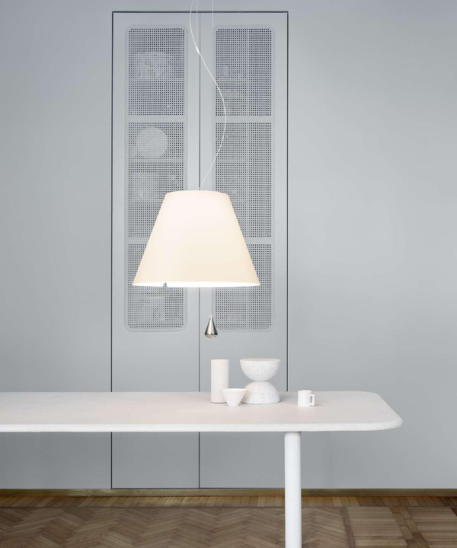
Through an examination of mating rituals and the development of a taxo- nomy, the paper shows how these behaviors can lead to new and innovative ideas in design. In the context of the workshop, the pre-developed taxonomy of mating rituals was presented to the participants as a prompt for their cre- ative expression. The participants were tasked with copying the Costanzina lampshade, designed by Paolo Rizzatto in 1986 for Luceplan, as it is sugge- sted to be an iconic exercise of simplicity. This lampshade was chosen because it was seen as an Original-copy, a form in which an idea exists more than the thing itself in its established shape.
The participants were asked to keep the lampshade’s pattern constant while allowing variability to arise from material and sensory expressions. The workshop guided the participants to copy the original shape of the Costan- zina lampshade’s abajur (plastic cover) using biomaterials, with the intention of producing similar shapes (that could function as an alternative to the ori- ginal) but unique sensory expressions, as a result of the (perceived) patterns extracted from observing natural behaviors and through the idiosyncrasies of its biomatter.
The document reflects on the workshop’s experiences and results and sug- gests future work in this area. It aims to contribute to a deeper understanding of the relationship between design and nature, the importance of studying natural phenomena from different perspectives, and the potential for new design opportunities. Considering this, it has the potential to contribute to the field of design by exploring innovative ways of integrating biological beh- aviors and biomaterials into the design process, which can lead to the creation of unique and sustainable products.
The paper starts by discussing three main nature-related narratives explo- red by the authors: 1) the potential for observation of natural behavioral
Original-Copy: Ideation for a Lampshade Inspired by Nature 167
Figure 1: Constanza lampshade, designed by Paolo Rizzatto in 1986 for Luceplan. (luceplan.com 2023).
phenomena to be a source of inspiration for designers, 2) how the materia- lity of living-matter can contribute to unique outcomes, and 3) if the concept of original-copy can contribute to a new mindset where copying is not about replicating, but about having a common starting point and pattern with a unique outcome.
The goals of the workshop were to: 1) generate outcomes rich in emo- tion inspired by animal mating behaviors, and 2) to produce outcomes that were seen as both copies due to the kept pattern and original due to the biomateriality.
TAXONOMY: SEDUCTION BEHAVIORS AND RITUALS The study and interpretation of intangible concepts or actions, due to the subjectivity that characterizes them, presents increased difficulties in their understanding and characterization. This has promoted the need to define a systematization strategy applied to design. To address this, a taxonomy of biological behaviors was developed to serve as a useful tool for designers to interpret these intangibilities.
Considering the importance of building new imaginary worlds in design processes and being inspired by nature metaphors, seduction and mating rituals were identified as an ideal group to work with. These behaviors, as Verdolin (2014) states, are complex and extensive processes designed to pro- vide each partner with enough information to determine whether the choice
168 Bandeira Maia and Pereira Pinto
will be the right one. Kateman (2010) notes that the typology of seduction behaviors has a wide variety of translations, which can range from an eloqu- ent dance, waving your feet as high as possible (e.g., Blue-Footed Bobbies), to the construction of elaborate seduction nests (e.g., Bowery Bird). During these rituals, males work tirelessly to advertise their strength, health, and desire for mating, producing complex signals with multiple components that span more than one sensory modality, such as combinations of tactile, visual, acoustics, etc. (Girard, Kasumovic, and Elias, 2011).
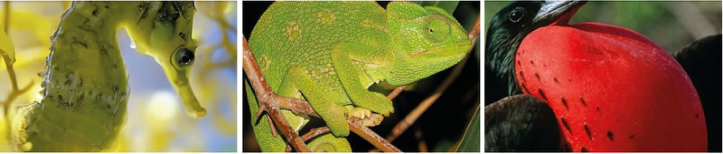
In this way, we think it is important to describe a few of the 20 behavi- ors used in the taxonomy, to contextualize their potential for inspiring the human imagination. The seduction rituals and courtship behaviors of seah- orses, chameleons, and frigate birds are just a few examples of the wealth of actions gathered under the umbrella of behavior that the taxonomy seeks to interpret and classify.
In the behavior of the seahorses, we find a sequence of ritualized actions with harmony and aesthetic intensity. They change color, intertwine their tails, and swim together during their courtship, caressing each other with their tentacles to determine if the pair is ideal for mating. Chameleons, who are practically deaf, communicate based on visual signals, shapes, colors, and patterns, strategies they use to communicate their availability or to recognize their partner. The frigate bird seduces through sound, image, and a kind of red inflatable on the chest, which when fully inflated attracts attention and indicates the male’s health conditions to the females.
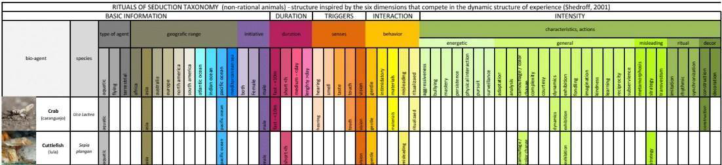
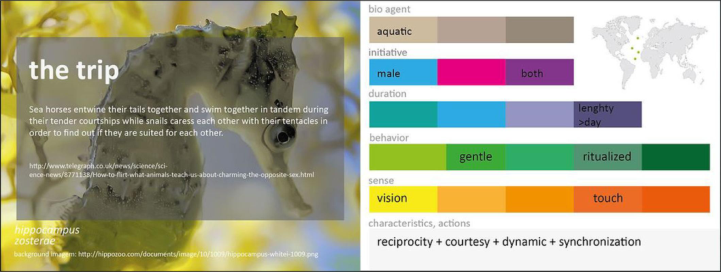
This taxonomy has been developed, according to Design’s perspective, based on Nathan Shedroff’s (2011) “dynamic structure of experience.” It interprets animals’ seduction rituals and courtship behaviors based on various criteria for classification, including duration, triggers, interaction, and intensity, serving as a “catalogue” for designers to choose behaviors that inspire imagination and promote disruption in their workshop design processes.
Figure 2: Seahorses, chameleon and frigate bird.Figure 3: Part of taxonomy grid.
Original-Copy: Ideation for a Lampshade Inspired by Nature 169
NATURE’S SIMPLICITY AND THE IDEA OF ORIGINAL-COPY The concept of original-copy has been debated by various thinkers throu- ghout history. Otl Aicher argues in his book Analogous and Digital that an organ is the most vivid representation of authenticity because it is self- generated and a complete entity that is part of a greater whole, conveying the idea that something authentic must be grown and cannot be manufactu- red artificially (2015). On the other hand, Edward Young, the 18th century poet, stated that humans are “Born Originals” that die as “Copies” (as cited in Johnson, 2017). This idea can be seen as supporting the notion that things that are born are original, while things that are grown are authentic.
However, Roland Barthes in his book Image, Music, Text, argues that “The author can only imitate a gesture, forever anterior, never original”, and this idea can be generalized to most human activities, as we all learn through imitation and are influenced by our sociocultural context (1977). The quote from Wilhelm von Humboldt that “no individual can ever be purely original: since each has received material transmitted by earlier generations”, which encapsulates the idea that a human is better described as a copy-of-a-copy rather than as something original (1836/1969, p. 58). This leads to the notion that a copy is also original because it is related to the action of copying, and when you act on something, you apply change to it, and the outcome will never be an exact replica of its ancestor.
The idea that originality is related to a state of impermanence and a replica with the hypothesis of constancy was established by Benjamin (1969). Howe- ver, we cannot abstract from the fact that a copy is a re-creation of something that preceded it, and that previous something is itself a copy of another thing that came before it, which leads to the notion of “prime objects”. George Kubler defines a prime object as a material by-product or idea that has never before been stated or even possible, and is better described as a “pattern” (1962).
In both the natural and the artificial, the grown and the human-made, serendipity and/or impermanence appear to be the common aspects that distinguish our perception of what is original and what is a copy. Both aspects have one common feature, they are time and space dependent, and it is this time and space dependency that imbues the original with characteristics that “even the most perfect reproduction is lacking”, and attributes the original with an “aura” that the replica lacks (Benjamin, 1969). If being an original- copy is strongly linked to the idea that the process-of-copying was meddled with by serendipity and/or impermanence, this means that every copy dif- fers from the original, progressively distancing itself from its prior, but it also needs to carry the fundamental attributes of its predecessor(s) in order to be recognized as belonging to the same typology. A pattern in this context can be seen as the code that defines the limits of variability of something’s constants (or span of similarities).
LIVING-MATTER AND ITS COMPLEXITIES Defining living matter is the process of finding the meaning of a term by connecting it to other familiar terms. This process of definitions is not endless
170 Bandeira Maia and Pereira Pinto
and some concepts can be understood without any help from other terms. People have known about chemical and physical things (like iron, liquid, salt, and planet) for a long time before they understood what those things actually were.
Living-matter is seen as all and only the matter that has the attributes of living things. It is the result of a living system, which is an open self-organizing form of life that interacts with its environment and is maintained by the flow of information, energy, and matter (1978). This means that living-matter should be viewed as a constantly changing thing, and its outcomes should be seen as a result of a process and not a predefined thing.
Cells are the smallest and basic structural units of living-matter and they have the properties that define life. In living-matter, form and matter are intertwined. Organisms are fundamentally different from inanimate matter and are hierarchical systems with unique properties. They represent a dua- lism of physical and metaphysical properties and are defined by both their genotype (inherited information) and phenotype (how the matter behaves in the environment).
Living systems are always changing, so what a living system becomes can partially be determined by the designer but is also defined by the behavior of its matter in and with the environment. This is why when working with living-matter, designers need to consider three things: morphogenesis (how the system develops its shape), epigenetics (how cells are influenced by the environment), and the physical and chemical pressures imposed on it by the designer (1980).
In nature, matter generates form spontaneously and the form is determined by natural laws. Matter is the source of all forms and imposes constraints on what can or cannot be formed. When working with living-matter, designers need to keep in mind that the outcome will be a collaboration with the living- matter and therefore should be open to diversity.
Life is a phenomenon that is closely related to form rather than matter. It is a kind of behavior that arises from the organization of matter rather than being a property inherent in matter itself. This means that life is an abstract concept that results from the observed manifestations of a system’s procedu- ral ontogenesis. Life also manifests differently depending on its constituent matter, as it is substrate-dependent. Moreover, life is in constant flux, influe- nced and constrained by its surroundings, resulting in phenotypic variability (2000).
Design, being a discipline that focuses on form-giving, cannot design life itself as it has no perceivable material dimension. Instead, designers tend to manipulate the fostering substrate of living systems to obtain certain outco- mes. Design in this context becomes a negotiator between the agendas of both humans and non-humans, and requires a high level of solidarity (2017).
There are two main sets of questions surrounding the understanding of living-systems and design in their context. The first set of questions revolves around the lack of formal definition when working with living-systems, while the second set of questions arises from the behavioral aspect of living matter.
In conclusion, when considering the complexities and nuances of working with living-systems, it becomes evident that design in this context should be
Original-Copy: Ideation for a Lampshade Inspired by Nature 171
seen as a change-proposer, always taking into account the constant nego- tiation between multiple agendas and the incremental nature of change to mitigate possible ripple effects. The limits of design’s intervention in living- systems expand beyond the material dimension into the sociocultural and subjective, making it necessary to re-examine the paradigm of design as a cultural mediator between matter and what matters. Ultimately, the idea of living-matter highlights the complexities of designing with systems that are in constant flux, with unique reactions to stimuli, and existing within interconnected ecosystems.
INSPIRED BY NATURE: FROM POETICS TO PRODUCT WORKSHOP The workshop was held at the ˙Izmir University of Economics in May 2022 for ten second-year industrial design students divided into three groups. The workshop was divided into two three-hour sessions. The first session intro- duced the supporting theoretical concepts and provided opportunities for exploration and development of concepts. The second session focused on materialization using local biomaterials.
The main objective of the workshop was to streamline the process of converting complex intangible expressions as inspirations (in this case the previously generated taxonomy of animal mating behaviors), into tangible final proposals. Having also been given the intended final outcome, a sheet of any biomaterial that could be laser cut and curved into a copy of the abajur of the Costanzina lampshade by Luceplan. The participants were guided to convert the animals’ seduction rituals and courtship behaviors, such as dura- tion/intensity, typology of triggers, and patterns of interaction, into variables that could be expressed through the material exploration done in the second section.
SESSION 1 The primary goal of the first session was to raise awareness of biologically inspired design and the potential for incorporating behaviors into design methodologies.
Figure 4: Example of taxonomy information.
172 Bandeira Maia and Pereira Pinto
By emphasizing the poetic potential of non-human animal rituals of sedu- ction and courtship, which are rich in visual, auditory, tactile, olfactory, and gustative elements, and can generate new languages, concepts, or experiences when applied to design projects.
After the introduction, students were asked to choose one animal courtship ritual and analyze it using the taxonomy, texts, and several images or videos provided by the workshop authors.
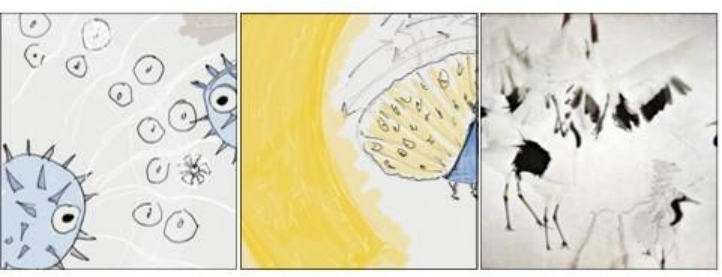
With all the poetry associated with the rituals, students started the idea generation phase by developing sketches and diagrams, trying to translate the intangible inspiration into concrete characteristics that could inform the bio- material they would use to produce their outcome. The students first analyzed their chosen behavior, from a holistic perspective, trying to understand its magic and dynamics as a combined set of actions or variables. In a second moment, they deconstructed this first analysis, isolating the characteristics that could make sense to use in their design ideation. The three seduction rituals chosen were the Puffer Fish, the Peacock and the Japanese Crane. The Puffer Fish was chosen because of the way it communicates by drawing circu- lar patterns on the sandy seabed to attack his mate. The Peacock due to the exuberance of its tail and the physical burden that outcomes from displa- ying that heavy arrey of gold and blue over green. And, the Japanese Crane because of its majestic dance of pure white delicate movements.
SESSION 2 In the second session, participants were challenged to copy as much as possible the renowned Costanzina lampshade by using easy access bioma- terials and the manipulation of these biomaterials should translate sensorial experiences from their chosen rituals into their final product.
After analysing the existing lampshade and extracting as much as possible of its physical attributes: dimensions, transparency, weight, texture, etc.; each group was asked to translate the ideas developed in the first session, into the characteristics of the biomaterial that they would produce. The final goal was to add value to a pre-existing form (an original-copy) by giving a material dimension to intangible behavioral manifestations.
Figure 5: Sketches of ideas. From left to right: puffer fish, peacock and Japanese crane.
Original-Copy: Ideation for a Lampshade Inspired by Nature 173
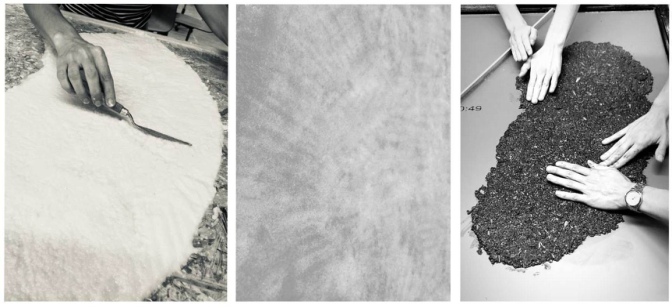
Figure 6: Moments of the 1st section of the Workshop.
After opening the original abajur, its geometry was easily extracted, and casts were executed that would receive the liquid biomaterial until it set into a flat surface with the desired thickness. Second, the groups were asked to cho- ose from online DIY-biomaterial libraries, the recipe that would best express their intentions.
The Puffer Fish project intended to incorporate the striking patterns that resulted from the rotation movements of the fish’s fins against the seabed into its biomaterial. For this effect, eggshells were added to a tree-resin based recipe so it could resemble sand, and this was done also in circular move- ments to mimic the fish’s radial undulations. The Peacock project sought to attain dense green foliage composed of many layers of green that would use the lamp’s light to reveal its gold hue. For this outcome, a recipe based on vegetable glycerin, alginate, water, and artichoke leaves with various particle dimensions, from course to dust were used for its visual expression. While the Japanese Crane project used the same recipe as the Peacock project, except in this case the artichokes were substituted with powdered coconut.
This session ended with all three pieces resting, the intention was to after they became solid, mount them on to suspension lines with light inside and set up a small exhibit.
RESULTS
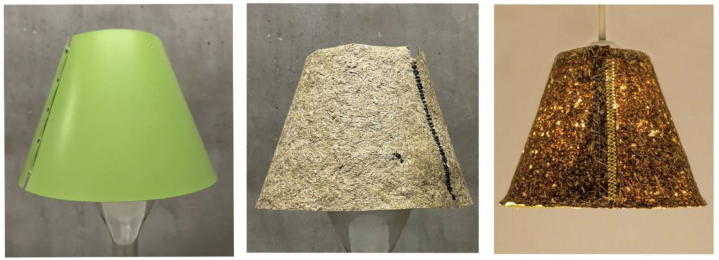
The workshop concluded with material exploration inspired by different ani- mal courtship rituals. Unfortunately, all three attempts were unable to be transformed into the desired outcome, which was a replica of the Costanzina lamp.
In the eggshell experiment, the surface of the container where the mixture was poured into was too porous, causing the mixture to become stuck. In the Artichoke recipe, too much alginate was added, resulting in a permanently gelatinous state, making it impossible to maintain the desired shape. Lastly, the coconut trial was also a failure, as the natural oils in the coconut made the mixture impossible to solidify.
174 Bandeira Maia and Pereira Pinto
Figure 7: Original Costanzina lamp shade and tests done by Alara Ertenü.
At this point, we continued working with one of the participants, Alara Ertenü, as she intended to continue exploring bioplastics. After many trials, she was finally able to achieve the desired outcome using the artichoke recipe with some modifications and using corn leaves as a substitute for coconut.
CONCLUSION
This paper describes a workshop and explores the theoretical body that sup- ports it by examining the intersection of living-matter, behavior, and design, which leads to new ideas in design. The workshop utilized a taxonomy of ani- mal seduction rituals and courtship behaviors to promote imagination and disruption in the design process, with the objective of creating an original- copy of the iconic Costanzina lamp shade using unique sensory expressions through biomaterials while preserving the original pattern. Reflecting on the experiences and results of the workshop, including the failed attempts to materialize the biomaterials, we understand the significance of working with better-controlled recipes in future workshops. Living-matter is sensitive to change within itself and its environment, and even the slightest alteration can have significant consequences on the final product. However, we also ackno- wledge that this inconsistency, imposed by serendipity and/or impermanence, is what gives living-matter the power to add perceived value by generating unique outcomes. Overall, this paper contributes to a deeper understanding of the relationship between design and nature and its potential for new design opportunities.
REFERENCES
Benjamin, W. (1969). The Work of Art in the Age of Mechanical Reproduction (H. Zohn, Trans.). Schocken Books. (Original work published 1936). Barthes, R. (1977). Image, Music, Text (S. Heath, Trans.). Hill and Wang. De Bono, E. (2009). Lateral Thinking: A Textbook of Creativity. Penguin Books. Girard MB, Kasumovic MM, Elias DO (2011) Multi-Modal Courtship in the Pea-
Original-Copy: Ideation for a Lampshade Inspired by Nature 175
Hoffmann, A. A., & Hercus, M. J. (2000). Environmental stress as an evolutionary force. BioScience, 50(3), 217–226. https://doi.org/10.1641/0006- 3568(2000)050[0217: ESAAEF]2.3. CO;2 Johnson, L. (2017). The power of originality. The Journal of Creative Behavior, 51(1),
2–6. https://doi.org/10.1002/jocb.174 Kateman, B. (2010). Courtship Rituals in The Animal World. Earth Institute, Columbia University. Accessed in april 2016, from https://blogs.ei.columbia.edu/2010/ 12/01/courtship-rituals-in-the-animalworld Kubler, G. (1962). The Shape of Time: Remarks on the History of Things. Yale
University Press. Manzini, E. (1994). Design, Environment and Social Quality: From “Existenzminimum” to “Quality Maximum”. Design Issues, 10(1), 37–43. https://doi.org/10. 2307/1511653 Manzini, E. (1994). Physis and Design. Interaction between nature and culture.
Elisava: nature, Design and Innovation. Miller, J. G. (1978). Living systems. McGraw-Hill. ISBN 0-87081-363-3. Shedroff, N. (2001). Experience design. Indianapolis, Indiana, USA: New Riders,
2001. The Future We Want: The UN System We Need. (2017). Papers by the Independent Team of Advisors: The ECOSOC Dialogue on the Longer-term Positioning of the UN Development System in the Context of the 2030 Agenda for Sustainable Development. United Nations. https://www.un.org/ecosoc/sites/www.un.org.eco soc/files/files/en/qcpr/tdr/papers_by_the_independent_team_of_advisors.pdf Verdolin, J. L. (2014). Wild connection: what animal courtship and mating tell us
about human relationships. Nova Iorque: Prometheus Books. von Humboldt, W. (1969). The Sphere and Duties of Government. In J. W. Burrow (Ed. & Trans.), Wilhelm von Humboldt: On Language, On the Diversity of Human Language Construction and its Influence on the Mental Development of the Human Species (pp. 56–79). Cambridge University Press. (Original work published 1836). Zeiler, M. D., & Thompson, T. (Eds.). (1980). Analysis and Integration of Behavioral
Units. Lawrence Erlbaum Associates.
LISTED IN THE AHFE DIGITAL BOOKSTORE CATALOGUE
Explore the complete digital volume
Human Dynamics and Design for the Development of Contemporary Societies
Read this individual research paper free through the original publisher, or explore the full digital proceedings book.
ISBN 978-1-958651-57-5
Explore this ISBN in the AHFE Bookstore ↗Listed in the July 2026 bookstore catalogue; search by ISBN to confirm current availability · Digital book purchase optional