Mengkun Bi, Chengcheng Ma, Min Hua (2026). A Geneplore Model-based Taxonomy of Digital Tools for Supporting Creative Design Processes. In: Creativity, Innovation and Entrepreneurship. AHFE Open Access, vol. 206, pp. 85–95. https://doi.org/10.54941/ahfe1007386
Creativity is a central driver of design and innovation, increasingly mediated by digital technologies. As artificial intelligence becomes embedded within contemporary design environments, a growing range of digital tools supports creative activities across different stages of the design process. However, existing studies often treat AI-based and traditional digital tools as separate categories, overlooking their functional continuity in shaping creative cognition. To address this gap, this study proposes a taxonomy of digital tools for creative design grounded in the Geneplore model of creative cognition. Based on a systematic literature review of 19 studies, a total of 57 digital creativity support tools were identified and analyzed using qualitative content analysis. The framework distinguishes between tools facilitating generative processes and those supporting exploratory processes, and further organizes these functions into eight cognitive support dimensions. The resulting taxonomy maps digital tools to specific components of the creative process, revealing how different tools scaffold ideation, exploration, and refinement in design activities. By articulating the cognitive mechanisms underlying digital creativity support tools, the framework provides a theoretical basis for analyzing, selecting, and designing AI-augmented creative systems. The study contributes a structured perspective on how digital technologies mediate creative design processes and offers guidance for integrating AI and traditional tools within creativity support environments.
Creativity is widely recognized as a key driver of design innovation and knowledge creation, commonly defined as the production of ideas that are both novel and useful (Runco & Jaeger, 2012). In design practice, creativity unfolds through iterative cycles of ideation, representation, and evaluation, forming the cognitive foundation of design thinking (Cross, 2023; Lawson, 2006). As digital technologies increasingly mediate creative work, computational tools have become central in supporting creative design processes.
In human-computer interaction research, Creativity Support Tools (CST) describe interactive systems that enhance human creative capabilities (Shneiderman, 2007). CST studies examine how digital tools scaffold activities such as ideation, exploration, and evaluation during design tasks (Frich et al., 2019). Recent AI advances, including generative models and interactive systems, have expanded this landscape, giving rise to human-AI co-creative Received March 6, 2026; Revised March 31, 2026; Accepted April 14, 2026; Available online July 20, 2026
systems (Rezwana & Maher, 2023; Lin & Riedl, 2023). However, many studies treat AI tools as a distinct category, limiting systematic comparison and obscuring the cognitive continuity underlying creative processes.
To address this gap, this study examines how digital tools support creative design processes through the lens of the Geneplore model of creative cognition (Finke et al., 1992). Rather than separating AI-based and traditional tools as distinct technological categories, the study classifies tools according to the generative and exploratory processes they support. Based on a systematic literature review and qualitative content analysis (Tranfield et al., 2003), this paper contributes: (1) a cognitive-process taxonomy of digital creativity support tools; (2) an analysis of eight support dimensions that characterize tool functions across creative design activities; and (3) a perspective on the functional continuity between AI-based and non-AI tools, offering guidance for selecting and designing AI-augmented creativity support systems.
THEORETICAL BACKGROUND AND LITERATURE REVIEW Creativity Support Tools and Design Creativity
Creativity has long been recognized as a core capability in design, where novel and useful outcomes emerge through iterative problem framing, idea development, and evaluation (Runco & Jaeger, 2012; Cross, 2023). Design research highlights that creative work unfolds through cycles of representation and reinterpretation, in which external artifacts such as sketches, diagrams, and prototypes function as cognitive resources (Lawson, 2006; Dorst, 2011). Creativity is therefore shaped not only by individual cognition but also by task characteristics and social context (Amabile, 1996; Sawyer, 2023), implying that tools mediating representation and interaction can significantly influence creative outcomes.
Within human-computer interaction research, this perspective is formalized through Creativity Support Tools (CSTs), defined as interactive systems that enhance discovery and innovation by supporting the generation, exploration, and refinement of ideas (Shneiderman, 2007). Subsequent research has mapped the CST design space and evaluation methods. For example, Frich et al. (2019) provide a comprehensive overview of tool characteristics and usage contexts, while frameworks such as the Creativity Support Index evaluate user-perceived support for creativity (Cherry & Latulipe, 2014). These studies collectively demonstrate how digital tools scaffold creative cognition and design practice.
Creativity research also increasingly frames creativity as a socio-technical phenomenon emerging from interactions among people, artifacts, and computational agents (Fischer et al., 2005; Giaccardi & Fischer, 2008). In this perspective, digital tools are not merely aids but integral components shaping the cognitive and collaborative dynamics of creative design.
A Geneplore Model-Based Taxonomy of Digital Tools for Supporting 87 The Geneplore Model and Creative Cognition
Creativity support in design involves diverse systems and interaction paradigms, making comparison challenging without a shared cognitive framework. The Geneplore model (Finke et al., 1996) provides such a framework, describing creative cognition as an iterative cycle between generative and exploratory processes. Generative processes produce preinventive structures, including mental images, conceptual combinations, sketches, or partial configurations, which serve as candidates for interpretation and refinement. In design, these intermediate representations align with externalization, reframing, and progressive structuring of possibilities (Lawson, 2006; Cross, 2023; Dorst, 2011). Exploratory processes operate on these preinventive structures to interpret, evaluate, and transform them, revealing emergent properties and developing coherent solutions. Activities include attribute finding, conceptual interpretation, and constraint satisfaction, consistent with reflective evaluation and iterative refinement in design (Lawson, 2006; Dorst, 2011). This dual- process perspective situates creative cognition within broader theories of creativity, emphasizing mechanisms rather than spontaneous insight (Boden, 2004; Sawyer and Danah, 2023), and complements stage-based accounts of creative thinking (Wallas, 1926).
For tool research, the Geneplore model is valuable because it foregrounds the role of representations and cognitive operations, allowing digital tools to be evaluated by the processes they scaffold rather than surface-level technology. A tool supports creativity if it facilitates the generation, exploration, and reinterpretation of candidate structures. This perspective aligns with CST research, where tools often integrate multiple functions supporting both ideation and evaluation within a workflow (Shneiderman, 2007; Frich et al., 2019). Consequently, the Geneplore model provides a cognitively grounded framework for systematically classifying CST capabilities, including AI-augmented tools, based on their support for generative and exploratory processes rather than technological labels.
Rationale for a Cognitive-Process Taxonomy The rise of AI-augmented tools has heightened interest in how digital systems shape creative design. Human–AI co-creativity research has examined interaction frameworks, roles, and coordination between designers and computational agents (Rezwana & Maher, 2023; Lin & Riedl, 2023; Haase & Pokutta, 2026). These studies treat AI not merely as automation but as an active participant in co-creative activity, raising issues of initiative, communication, and shared control. Empirical work shows that designers perceive AI as a “creative partner” during divergent thinking while balancing concerns about direction and value (Khan et al., 2025). Recent analyses also highlight tensions between exploration and fixation, motivating designs that scaffold both divergent and convergent thinking (Wen et al., 2025).
However, much of the literature categorizes tools primarily by technological type, such as AI versus traditional digital systems. This distinction may
obscure functional continuity across tools. Traditional digital tools already support generative and exploratory activities through visualization, search, versioning, and collaboration (Shneiderman, 2007; Frich et al., 2019), while AI tools extend these capabilities by accelerating alternative generation and enabling richer interactive exploration.
METHOD
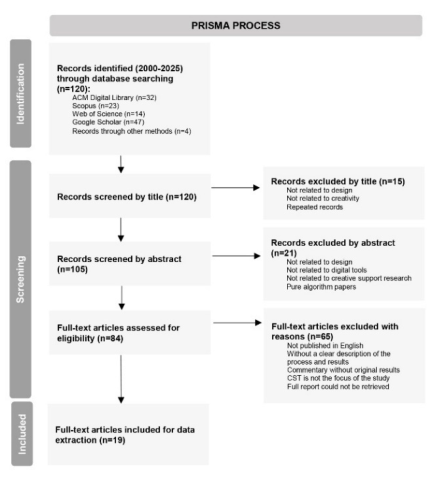
Systematic Literature Review This study employs a systematic literature review combined with qualitative content analysis to synthesize research on digital tools supporting creative design. Systematic reviews enable structured synthesis of fragmented research and are widely used in interdisciplinary domains (Tranfield et al., 2003). The review followed established guidelines (Keele, 2007) and covered ACM Digital Library, Scopus, Web of Science, and Google Scholar, using keyword combinations related to creativity support tools, creative design tools, design ideation, human-AI co-creation, and AI creativity tools. Publications from 2000 to 2025 were included, covering both traditional digital tools and AI-augmented systems aligned with the HCI Creativity Support Tools research agenda (Shneiderman, 2007). Records were screened through identification, title and abstract screening, and full-text eligibility assessment following a PRISMA-informed procedure.
Inclusion Criteria and Study Selection The selection process followed a structured screening procedure inspired by the PRISMA framework, comprising three stages: identification, screening, and eligibility assessment. Duplicate records were removed after aggregating results from all databases. Titles and abstracts were screened for relevance, retaining studies describing interactive systems, design tools, or computational frameworks explicitly supporting creative work.
Full-text articles were evaluated using predefined inclusion and exclusion criteria. Studies were included if they: (1) described a digital or computational tool used in creative processes; (2) provided information on functionality or interaction design; and (3) discussed the tool in relation to creativity, ideation, or design activities. Studies focusing solely on algorithmic performance or general productivity software were excluded.
Figure 1: Article screening process of the scoping review.
Data Extraction Structured data extraction was conducted to capture key characteristics of the tools and their usage contexts, ensuring consistency across heterogeneous studies (Keele, 2007). Extracted variables included tool/system name, application domain (e.g., product, UI/UX, art), supported creative task (e.g., ideation, sketching, concept generation), interaction modality (e.g., visualization, generative suggestion, collaborative interaction), type of contribution (conceptual, prototype, empirical), and reported evidence type. These data facilitated comparative analysis across domains while preserving contextual details.
Content Analysis and Coding To identify patterns in how digital tools support creative cognition, this study employed qualitative content analysis (Mayring, 2014). The coding framework was developed using a theory-guided approach based on the Geneplore model of creative cognition (Finke et al., 1996), distinguishing generative and exploratory processes. Codes were iteratively refined through examination of the reviewed literature, resulting in eight support dimensions describing how digital tools facilitate different aspects of creative cognition, including idea generation, exploration of design alternatives, and evaluation/ refinement.
To enhance consistency and reliability, a subset of articles was independently coded by multiple researchers, and inter-coder agreement was evaluated using established procedures (Krippendorff, 2018). Iterative refinement and theory-driven coding ensured that the resulting framework provides
a coherent and reusable structure for analyzing digital tools that support creative design processes.
RESULTS
Overview of Included Studies After applying the screening protocol, 19 studies were included in the final analysis, from which 57 digital creativity support tools were identified. A tool was counted when it had a distinguishable system name, interaction mechanism, or functional role in supporting creative design activities. The included studies span human-computer interaction, design research, computational creativity, and AI-supported design systems.
Across the reviewed literature, digital tools can be broadly categorized into two technological groups: AI-based tools and traditional digital CSTs. AI-based tools include generative image systems (e.g., Midjourney, DALL-E, Stable Diffusion), large language model-based assistants, and contextual recommendation systems that generate visual concepts, textual ideas, or design suggestions to stimulate ideation. Traditional CSTs include sketching environments, VR-based design platforms, collaborative whiteboards, and integrated design software that support visualization, manipulation, and communication of design ideas.
Despite these technological differences, both categories serve a shared purpose of scaffolding creative cognition. Digital tools support designers by providing inspirational stimuli, enabling the externalization of ideas, facilitating exploration of design alternatives, and supporting reflection and collaboration throughout the creative process. For example, the system proposed in May AI? recommends inspirational materials through cooperative contextual bandits, expanding conceptual associations during early ideation. Similarly, VR sketching tools allow designers to interact with spatial representations, supporting transitions between perceptual, physical, and conceptual reasoning. Human-AI co-creative systems further function as interactive partners by generating suggestions, offering critiques, and prompting reflection. These findings highlight the complementary roles of AI-based and traditional CSTs in supporting different stages of creative cognition.
Geneplore-Based Taxonomy of Digital Tools To systematically categorize digital CSTs, the 57 identified tools were mapped to the Geneplore model of creative cognition, which distinguishes between generative processes and exploratory processes. Generative processes involve producing novel ideas or representations, whereas exploratory processes emphasize evaluation, refinement, and elaboration of emerging concepts.
Using a dominant-function classification, 35 tools were primarily associated with generative processes, accounting for 61.4% of the identified tools, while 22 tools were primarily associated with exploratory processes, accounting for 38.6%. Generative tools mainly support idea creation, inspirational stimulation, externalization, and conceptual variation. Exploratory tools mainly support evaluation, manipulation, refinement, collaboration, and contextual integration. However, this distinction should not be understood
A Geneplore Model-Based Taxonomy of Digital Tools for Supporting 91 as rigid. Several tools provide functions across both phases, suggesting that digital creativity support often operates through transitions between generation and exploration rather than through isolated stages.
Eight Cognitive Support Dimensions To further analyze how digital tools scaffold creative cognition, their functionalities were distilled into eight cognitive support dimensions aligned with the Geneplore framework.
The generative dimensions include Idea Generation, Stimulus-based Inspiration, Representational Externalization, and Conceptual Variation and Expansion, which primarily support early-stage ideation and divergent thinking. The exploratory dimensions include Analytical Evaluation, Iterative Refinement, Collaborative Alignment, and Contextual Integration, which support the assessment, development, and contextualization of design concepts.
Table 1: Geneplore-based taxonomy of digital tool functions.
Table available in the original PDF paper.
Phase Dimension Cognitive Function Theoretical Foundation
Mapping digital tools to these dimensions reveals distinct coverage patterns. Tools supporting generative processes predominantly facilitate idea generation, inspirational stimuli, externalization, and concept variation, whereas tools supporting exploratory processes emphasize evaluation, refinement, collaboration, and contextual integration. Several tools support both processes, providing broader cognitive support across the design process. Overall, early-stage ideation functions are most frequently supported, while contextual integration and personalization appear less consistently addressed, indicating potential directions for future tool development.
DISCUSSION
Functional Continuity: AI vs Non-AI Tools The analysis reveals functional continuity between AI-based and traditional digital CSTs. Although AI tools are often associated with generation and traditional tools with exploration, many tools support both processes. VR sketching environments and generative AI systems both enable externalization and concept variation through different mechanisms. This continuity suggests that designers move across AI and non-AI tools during ideation, evaluation, and refinement rather than treating them as discrete categories.
A Geneplore Model-Based Taxonomy of Digital Tools for Supporting 93 Implications for Tool Selection and Tool Design
The taxonomy suggests that creative design is better supported by tool ecologies than by isolated tools. In early ideation, AI-based systems can expand the conceptual search space by generating textual or visual alternatives. During concept development, representational and collaborative tools help designers externalize, compare, and negotiate ideas. In later stages, modeling, simulation, and prototyping platforms support evaluation, refinement, and contextual integration. For tool designers, the key challenge is therefore not only to add generative capabilities, but also to support smooth transitions between generation, exploration, collaboration, and refinement.
Cognitive Impact Layers: Individual, Collaborative, and Tool-Mediated Analyzing CSTs according to their impact on different cognitive layers provides additional theoretical insight. At the individual cognition level, tools support idea generation, concept variation, and externalization, directly influencing divergent thinking and mental representation development. At the team or collaborative level, tools facilitate alignment, communication, and shared understanding, enhancing collective exploration and convergence. At the tool intelligence or assistance level, automation, inspiration provision, and knowledge augmentation allow designers to focus cognitive resources on higher-order reasoning, problem framing, and conceptual combination. This layered perspective highlights how digital tools mediate human cognition and collaborative strategies, offering a framework to understand their complementary roles in supporting creativity across multiple levels of design activity.
CONCLUSION
This study developed a Geneplore model-based taxonomy of digital creativity support tools by reviewing 19 studies and analyzing 57 tools. The taxonomy maps tool functions onto generative and exploratory processes and identifies eight cognitive support dimensions across creative design activities. The findings show that AI-based and traditional digital tools should not be understood as separate categories, but as part of a functional continuum that supports ideation, externalization, exploration, evaluation, refinement, collaboration, and contextual integration. The taxonomy provides a theoretical lens for analyzing how digital tools mediate creative cognition and offers practical guidance for selecting and designing AI-augmented creativity support systems. At the same time, the study is limited by the size of the reviewed corpus and by its reliance on tool descriptions reported in prior literature rather than direct empirical observation of tool use. Future research should validate the proposed dimensions through expert review and empirical studies with design practitioners.
ACKNOWLEDGMENT
This work was supported by Shanghai Jiao Tong University (Grant No. WH220527002), the International Association of Cultural and Creative Industry Research (Grant No. IACCIR202304), and the Ministry of Education (Grant No. HZKY20220068). The authors gratefully acknowledge the generous financial and administrative support provided by these institutions and their dedicated staff.
REFERENCES
Amabile, T.M. (1996). Creativity in Context. Boulder, Colo: Westview Press. Boden, M.A. (2004). The Creative Mind: Myths and Mechanisms. Routledge. Brown, J.S., Collins, A. and Duguid, P. (1989). “Situated cognition and the culture of learning”, Educational Researcher, 18(1), pp. 32–42. Cherry, E. and Latulipe, C. (2014). “Quantifying the creativity support of digital
tools through the creativity support index”, ACM Transactions on Computer- Human Interaction, 21(4), pp. 1–25. Cross, N. (2023). Design Thinking: Understanding How Designers Think and Work.
Bloomsbury Publishing. Dorst, K. (2011). “The core of ‘design thinking’ and its application”, Design Studies, 32(6), pp. 521–532. Finke, R.A., Ward, T.B. and Smith, S.M. (1996). Creative Cognition: Theory,
Research, and Applications. MIT Press. Fischer, G., Giaccardi, E., Eden, H., Sugimoto, M. and Ye, Y. (2005). “Beyond binary choices: Integrating individual and social creativity”, International Journal of Human-Computer Studies, 63(4-5), pp. 482–512. Frich, J., MacDonald Vermeulen, L., Remy, C., Biskjaer, M.M. and Dalsgaard, P.
(2019). “Mapping the landscape of creativity support tools in HCI”, Proceedings of the 2019 CHI conference on human factors in computing systems, pp. 1–18. Giaccardi, E. and Fischer, G. (2008). “Creativity and evolution: A metadesign perspective”, Digital Creativity, 19(1), pp. 19–32. Guilford, J.P. (1967). The Nature of Human Intelligence. New York: Macgraw Hill. Haase, J. and Pokutta, S. (2026). “Human-AI Cocreativity: Exploring synergies
across levels of creative collaboration”. Generative Artificial Intelligence and Creativity. Academic Press, pp. 205–221. Hutchins, E. (1995). Cognition in the Wild. Cambridge, MIT Press. Keele, S. (2007). Guidelines for Performing Systematic Literature Reviews in Software Engineering, Vol. 5. Technical report, ver. 2.3 ebse technical report. Khan, A., Shokrizadeh, A. and Cheng, J. (2025). “Beyond automation: how designers
perceive AI as a creative partner in the divergent thinking stages of UI/UX Design”, Proceedings of the 2025 CHI Conference on Human Factors in Computing Systems, pp. 1–12. Krippendorff, K. (2018). Content Analysis: An introduction to its methodology. Sage Publications. Lawson, B. (2006). How Designers Think. Lin, Z. and Riedl, M. (2023). “An ontology of co-creative AI systems”, arXiv preprint
arXiv:2310.07472 Mayring, P. (2014). Qualitative Content Analysis: Theoretical Foundation, Basic Procedures and Software Solution. Mednick, S. (1962). “The associative basis of the creative process”, Psychological
Review, 69(3), 220.
A Geneplore Model-Based Taxonomy of Digital Tools for Supporting 95 Osborn, A. (1953). Applied Imagination: Principles and Procedures of Creative
Problem-Solving. New York: Charles Scribner’s Sons. Parnes, S.J. (1967). Creative Behavior Guidebook. Scribners, New York. Rezwana, J. and Maher, M.L. (2023). “Designing creative AI partners with COFI: A framework for modeling interaction in human-AI co-creative systems”, ACM Transactions on Computer-Human Interaction,30(5), pp. 1–28. Runco, M.A. and Jaeger, G.J. (2012). “The standard definition of creativity”,
Creativity Research Journal, 24(1), pp. 92–96. Sawyer, R.K. and Danah, H. (2023). Explaining Creativity: The Science of Human Innovation. 3nd edn. New York: Oxford Academic. Sawyer, R.K. and DeZutter, S. (2009). “Distributed creativity: How collective
creations emerge from collaboration”, Psychology of Aesthetics, Creativity, and the Arts, 3(2), pp. 81–92. Schön, D.A. (2017). The reflective practitioner: How professionals think in action.
Routledge. Shneiderman, B. (2007). “Creativity support tools: Accelerating discovery and innovation”, Communications of the ACM, 50(12), pp. 20–32. Tranfield, D., Denyer, D. and Smart, P. (2003). “Towards a methodology for
developing evidence-informed management knowledge by means of systematic review”, British Journal of Management, 14(3), pp. 207–222. Wallas, G. (1926). The Art of Thought. New York: Harcourt, Brace and Company. Wen, C., Phung, T., Mehrotra, P., Gulwani, S., Beaty, R. E., Nagashima, T., & Singla, A. (2025). “Exploration vs. fixation: Scaffolding divergent and convergent thinking for human-AI co-creation with generative models”. arXiv preprint arXiv:2512.18388.
LISTED IN THE AHFE DIGITAL BOOKSTORE CATALOGUE
Explore the complete digital volume
Creativity, Innovation and Entrepreneurship
Read this individual research paper free through the original publisher, or explore the full digital proceedings book.
ISBN 978-1-964867-82-3
Explore this ISBN in the AHFE Bookstore ↗Listed in the July 2026 bookstore catalogue; search by ISBN to confirm current availability · Digital book purchase optional