Julia Berner, Holger Kett (2025). Strategic Transformation towards Advanced Mechanical Engineering: A Systematic Review and Taxonomy of Trends and Enabling Factors. In: Human Systems Engineering and Design (IHSED2025): Future Trends and Applications. AHFE Open Access, vol. 198, pp. 91–102. https://doi.org/10.54941/ahfe1006765
The field of Advanced Mechanical Engineering (AME) is undergoing a profound transformation, driven by technological innovation, digitalization, sustainability imperatives, and shifting customer expectations. Despite the strategic relevance of these developments, a coherent and comprehensive understanding of strategic readiness in this domain remains fragmented. This paper addresses this gap by developing and validating a holistic conceptual framework — a taxonomy — using a design research approach. Based on a systematic literature review (from 2023 onward, Web of Science Core Collection), an inductively derived framework was refined to synthesize current scientific knowledge while offering practical utility for industrial application. The aim is twofold: to consolidate state-of-the-art academic insights and to provide a practice-oriented evaluation matrix that companies can apply to assess their strategic positioning and identify key areas for future investment. The resulting taxonomy structures the strategic landscape of AME along two axes: five strategically relevant trends (dimensions of strategic transformation) and four overarching enabling factors (transversal trends), which act as critical levers enabling and influencing the five strategically relevant trends. The findings illustrate how the interplay between these trends and enablers reshapes engineering design and manufacturing systems — highlighting, for instance, modular and flexible design approaches, digital twins, and data-driven decision-making as central to achieving excellence and sustainability. Ultimately, this validated taxonomy provides a robust foundation for future research and serves as a pragmatic tool for practitioners. It supports organizations in systematically organizing and aligning their strategic initiatives and offers actionable insights for academics, engineers, and decision-makers aiming to foster innovation in engineering design and manufacturing in response to emerging challenges.
INTRODUCTION AND CHALLENGES The Advanced Mechanical Engineering (AME) sector is undergoing a profound transformation, shifting beyond its traditional role as a producer of physical machinery. This evolution is driven by accelerating digitalization,
the imperative for sustainability, and sophisticated customer demands (Adel et al., 2024; Permin et al., 2021). Key players are increasingly becoming providers of intelligent, adaptive, and integrated solutions, specializing in technologically advanced, often customized equipment (Verhoef et al., 2021). This transformation redefines value creation and strategic positioning, moving towards Industry 4.0 and 5.0 principles that combine engineering excellence with human-centricity, resilience, and sustainability (Yaqub and Alsabban, 2023; Tallat et al., 2024; Santhi & Muthuswamy, 2023; Rijwani et al., 2024; Zahariev et al., 2024). AME is thus evolving into an innovation partner providing comprehensive solutions, including digital services, rather than just products (Adel et al., 2024; Nebauer et al., 2023).
Despite these clear strategic implications, the understanding of what constitutes strategic readiness for future challenges within this discipline remains fragmented (Figlie et al., 2024). Existing literature often addresses individual transformation aspects (e.g., digital technologies, sustainability, new business models) but lacks a broad, integrated framework tailored to the unique context of AME. This fragmentation hinders organizations in systematically identifying strategically relevant trends and implementing necessary strategic adjustments for the internal organization as well as the product offerings including its external effects towards the customers and other market players. Consequently, there is a discernible gap in providing a structured overview that connects various transformation dimensions with their underlying enabling factors for sustained competitiveness (Forschungsbeirat der Plattform Industrie 4.0, 2022). To bridge this, this paper aims to develop and validate a comprehensive taxonomy for strategic readiness in AME, addressing how such a framework can be structured, supported by existing literature, and refined through systematic review. Thus, companies can leverage this taxonomy as a diagnostic tool to map their current state against the defined trends and factors, revealing strengths and identifying areas for strategic measures and investments.
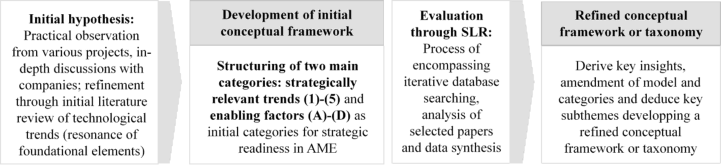
RESEARCH METHODOLOGY Adopting a design research approach (see Figure 1), an initial hypothesis provided the foundational starting point for constructing our initial conceptual framework. The evaluation and refinement of the initial conceptual framework for enabling strategic readiness in AME was conducted through a systematic literature review (SLR). Following established guidelines (Tranfield et al., 2003; Kitchenham, 2004), our SLR was adapted to focus on the current scientific discourse, allowing for the inductive validation, refinement, and expansion of the proposed framework into a comprehensive taxonomy.
The review utilized the Web of Science (Core Collection) database, chosen for its peer-reviewed content and citation indexing. Tailored search strings were iteratively developed for each category of the initial framework, encompassing concepts of “strategic transformation,” “Industry 4.0/5.0,” and specific mechanical engineering domains, ensuring comprehensive thematic coverage.
Strategic Transformation Towards Advanced Mechanical Engineering 93
Figure 1: Design research approach of conceptual framework or taxonomy.
The search was limited to publications from 2023 onwards (until June 2025) to capture the most recent developments in the rapidly evolving industrial landscape. Initial search results were filtered by essential Web of Science Categories (Engineering, Manufacturing; Computer Science; Business, Management) and ranked by citation count to prioritize influential contributions. A subsequent screening of titles and abstracts assessed thematic fit, excluding papers without direct relevance to the general transformation of AME.
The objective was to identify a manageable set of high-quality papers per category (at least 2–3 highly relevant papers per category), ensuring comprehensive coverage of the most important themes and future trends in AME for thorough validation. The total number of selected papers was kept below 100 to ensure depth of analysis. This deliberate limitation prioritized an intensive qualitative analysis for framework refinement. Breadth was nevertheless ensured through iterative search string development, prioritization by citation count, and qualitative saturation across thematic areas. Selected papers underwent comprehensive full-text analysis on the basis of each topic and key research question. Data extraction focused on the core themes, key findings, and their alignment with the initial framework’s components, ultimately leading to a refined conceptual framework, or taxonomy, that helps mechanical engineering companies in their strategic decisions. This inductive process involved iterative cycles of data categorization, thematic aggregation, and subsequent validation against the evolving framework. Regular cross-checks by the authors ensured consistency in the refinement process.
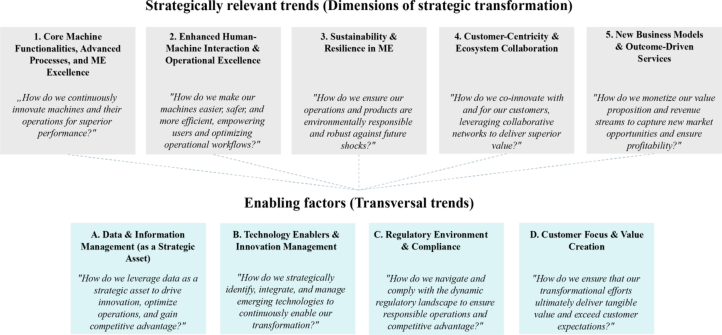
INITIAL CONCEPTUAL FRAMEWORK: DIMENSIONS AND ENABLERS FOR STRATEGIC TRANSFORMATION The initial conceptual framework is presented in Figure 2 and outlines two core components: strategically relevant trends (dimensions of strategic transformation) and enabling factors (transversal trends).
The framework identifies five strategic dimensions that represent the critical pillars that AME organizations must proactively cultivate and integrate. These dimensions are crucial for ensuring long-term viability, successful transformation, and maintaining a competitive edge in a rapidly evolving industrial landscape. Each dimension is explicitely defined by a key
94 Berner and Kett
research question, which serves to guide the evaluation of strategic readiness within that specific area.
Figure 2: Initial conceptual framework: structure and key research questions of strategic relevant trends and enabling factors for strategic readiness in AME.
Complementing these strategic dimensions are four crucial enabling factors. These transversal trends represent fundamental capabilities that cut across the strategic dimensions, empowering AME companies to effectively adapt to future market demands. Similar to the strategic dimensions, each enabling factor is also associated with a key research question for comprehensive evaluation.
This initial conceptual framework thus provides a holistic lens through which the complex strategic landscape for enabling strategic readiness in AME can be analyzed and understood. By outlining these primary dimensions of transformation and their enabling factors, it offers a structured understanding for those navigating this complex environment.
EVALUATION AND REFINEMENT OF INITIAL CONCEPTUAL FRAMEWORK This section presents the inductive evaluation and refinement of the initial conceptual framework, drawing upon comprehensive scientific literature.
The systematic literature review largely affirmed the initial conceptual framework’s relevance and comprehensiveness. The adopted search strategy identified a targeted set of highly cited and impactful papers, providing empirical and theoretical support for the model’s core structure and its components. No fundamental dimensions or enablers were found to be missing, underscoring the initial framework’s foundational strength.
Furthermore, the review yielded relevant insights into emerging research questions and subthemes that will be important for the trend analysis of AME companies in the future. The literature reviled granular trends of emerging technologies, novel methodological approaches, and evolving
Strategic Transformation Towards Advanced Mechanical Engineering 95
strategic considerations, significantly enriching the framework’s detailed components. This inductive refinement process led to.
THE REFINED AND VALIDATED TAXONOMY This section presents the final taxonomy, which emerged from the systematic literature review and subsequent refinement process.
The taxonomy aims to provide AME organizations with a clear and operationalizable understanding of strategic readiness, serving as a comprehensive roadmap to optimize strategies and offerings for long- term success. It serves as a foundational tool for future research and practical applications. By systematizing relevant areas and illustrating their relationships, the taxonomy provides a robust yet flexible classification, stemming from an iterative process of categorization, aggregation, and validation.
Table 1 presents the taxonomy in detail, showing which literature has been chosen and reviewed and which insights derived for each trend category.
Table 1: The refined and validated taxonomy: details of strategically relevant trends and enabling factors for strategic readiness in AME.
Table available in the original PDF paper.
Key Subthemes
Category Chosen Papers Per Category (1) Kim et al., 2023 (2) Lee & Wang, 2024 (1) Core Machine Functiona-lities, Advanced Processes, and ME Excellence
(3) Wang et al., 2024 (4) Chu & Liu., 2023 (5) Wang et al., 2024
Advanced Mechanical Design for Adaptive Functionality: leveraging new functional capabilities in mechanical systems by improved mechanical functionalities or by the application of intelligent materials (e.g., Shape Memory Alloys for active control and complex motion generation) (1). Precision Manufacturing for Enhanced Machine Performance: Implementing methods for augmented ultra-precision machining (e.g., reducing cutting forces, improving surface quality, lowering tool wear) to achieve superior functional precision, efficiency, and extended operational longevity of mechanical systems (2). (2) Enhanced Human-Machine Interaction & Operational Excellence
Human-Centric & Safe Collaborative Workflows: achieving operational excellence and safety through human-robot collaboration, enhancing operator well-being and efficiency in industrial environments (3, 5). Intuitive & Adaptive Operator Guidance: improving human-machine interaction and operational performance through intelligent, context-aware support and intuitive user experience for operators (4, 5).
Continued
96 Berner and Kett
Table 1: Continued
Table available in the original PDF paper.
Key Subthemes
Category Chosen Papers Per Category (3) Sustainabi-lity & Resilience in ME (6) Karkaria et al., 2025 (7) Ghobak-hloo et al., 2023 (8) Zlatanovic et al., 2023 Integrated Sustainability & Resilience: driven by Industry 5.0, achieving eco-innovation & holistic sustainable manufacturing through a data-driven approach; resilient operations (6, 7). Circular Economy & Remanufacturing through Digital Product Passports: enhancing resource efficiency and reducing environmental impact by leveraging comprehensive, transparent product lifecycle data for advanced planning and closed-loop systems (8). (4) Customer-Centricity & Ecosystem Collabora-tion
(9) Madruga et al., 2024 (10) Jurmu et al., 2023 (11) Mubarak et al., 2024
Mature Customer Experience Excellence: achieving advanced levels of customer experience, ensuring the organization proactively adapts to evolving customer demands and cultivates stronger, outcome-driven customer relationships (9). Seamless Ecosystem-Wide Data Collaboration: establishing fluid and trusted data exchange across the manufacturing ecosystem, enabling collaborative innovation and delivering enhanced value tailored to customer needs (10). Open Innovation for Co-Created Value: realizing significant customer value and accelerated innovation by systematically integrating external collaboration and co-creation practices with customers within the broader ecosystem (11). (5) New Business Models & Outcome-Driven Services
(12) Karamanli et al., 2025 (13) Grefen et al., 2023 (14) Yang et al., 2024
Equipment-as-a-Service (EaaS)/ Machine-as-a-Service (MaaS): reviewing of servitization, insights, challenges and future trends, facilitating the redefinition of value propositions and revenue streams from product sales to service-centric models (12). Outcome-Based Contracts & Performance-Based Pricing: shifting from selling products to delivering promised results, requiring strategic implications and operational requirements for guaranteed customer outcomes in smart manufacturing (13). Data-Driven Services & Predictive Analytics: leveraging data to create dynamic user profiles for human-centric and tailored services; optimizing smart Product-Service System designs (14).
Continued
Strategic Transformation Towards Advanced Mechanical Engineering 97
Table 1: Continued
Table available in the original PDF paper.
Key Subthemes
Category Chosen Papers Per Category (A) Data & Information Management (as a Strategic Asset) (15) Pei et al., 2025 (16) Landeck et al., 2024 (17) Gormaz-Lobos et al., 2025 Digital Twin & Data Interoperability: Foundational methodology for building robust and consistent Digital Twin models for CNC machine tools, enabling data as a strategic asset in manufacturing, crucial for the Digital Product Passport (15). Cybersecurity & Data Integrity: addressing challenges and risks related to data protection, privacy, and the operational integrity of interconnected systems in AME and Industrial IoT platforms (16). Data Literacy & Culture: identifying critical skills and fostering a data-driven mindset in organizations for Big Data professions and digital ecosystems (17). (B) Technology Enablers & Innovation Management
(18) Bagherian et al., 2024 (19) Martini et al., 2024
Strategic Technology Adoption & Digital Transformation Roadmapping: systematically integrating Industry 4.0/5.0 technologies (e.g., Smart Factories, AR/VR/MR), while proactively addressing implementation barriers (18, 19). AI-Driven Innovation & R&D Strategy: Artificial Intelligence, when integrated with cutting-edge technologies, enabling human-centered and sustainable AI applications within Industry 5.0 (19). Human-Technology Co-evolution: enabling collaboration with advanced AI systems, ensuring societal and ethical considerations are integrated into technology management (19). (C) Regulatory Environment & Compliance
(20) Wiegand & Wynn, 2024 (21) Kim et al., 2024 (22) Yang et al., 2025
ESG Regulations & Corporate Governance: driving digital technology innovation and sustainable development, extending compliance beyond traditional environmental permits and impacting both internal governance and external market perception (20), such as the digital product pass. Cross-Border & Fragmented Regulatory Harmonization: as inconsistent regulations impede the commercialization of innovative products and technologies, highlighting the necessity for consistent industry standards and global cooperation (21). Ethical & Societal Implications of Technology Regulation (e.g., EU Data Governance, EU AI Act, EU Data Act): need to develop frameworks for the responsible deployment of AI, anticipating future regulatory landscapes that govern environmental/safety impacts and societal and ethical dimensions (22).
Continued
98 Berner and Kett
Table 1: Continued
Table available in the original PDF paper.
Key Subthemes
Category Chosen Papers Per Category (D) Customer Focus & Value Creation (23) Apraiz et al., 2023 (24) Kao et al., 2025 (25) Mironcika et al.
User/Customer Experience Integration: extending from internal Human-Robot Interaction for improved efficiency, adaptability, and quality of manufacturing processes, contributing to value perceived by the end-customer and enabling the creation of more personalized products (23). Digital Platform-Driven Value Co-creation: fostering sustainable business model innovation, allowing to integrate customer feedback and adapt rapidly to evolving demands through collaborative ecosystems (24). Strategic Customer Relationship Management in Supply Chains: understanding complex supplier-customer interdependencies to optimize productivity, enhance customer satisfaction, and ensure robust value delivery (25).
CONCLUSION AND OUTLOOK This study developed a comprehensive, inductively validated taxonomy for strategic readiness in AME. Through a rigorous systematic literature review (2023 onwards, Web of Science, English-focused), the entire initial framework was iteratively refined. This process yielded a structured, holistic, and nuanced understanding of five strategically relevant trends (Core Machine Functionalities, Human-Machine-Interaction, Sustainability, Customer-Centricity, New Business Models) – representing the “what” to achieve – and four crucial enabling factors (Data, Technology, Regulation, Customer Focus) – embodying the “how” to enable these achievements.
The inherent value of this taxonomy lies not only in identifying these distinct elements but also in illuminating their critical interdependencies. The following Table 2 summarizes how the strategically relevant trends are profoundly shaped and enabled by the transversal factors.
Table 2: Interaction of strategically relevant trends and enabling factors.
Table available in the original PDF paper.
Strategically Relevant Trends Interaction With Enabling Factors (1) Core Machine Functionalities, Advanced Processes, and ME Excellence Innovation driven by advanced technology (materials, additive manufacturing); holistic design & lifecycle management supported by precise data management. (2) Enhanced Human-Machine Interaction & Operational Excellence
Enhanced by technology (AR, Digital Twin, AI) for safety/productivity; user-centricity (Human Digital Twin) fostered via customer focus and data.
Continued
Strategic Transformation Towards Advanced Mechanical Engineering 99
Table 2: Continued Strategically Relevant Trends Interaction With Enabling Factors
Table available in the original PDF paper.
(3) Sustainability & Resilience in ME Enabled by technology (AI, Digital Twin, digital product pass, digital platforms) for resource utilization; supported by Regulation (circular economy) and holistic data perspectives. (4) Customer-Centricity & Ecosystem Collaboration
Personalization & collaboration rely on secure data exchange (federated data spaces) and technology (Blockchain); reinforced by direct customer focus (Customer experience management, co-creation). (5) New Business Models & Outcome-Driven Services
Shift to servitization (PaaS, MaaS) via technology (digitalization, platforms) and advanced data analytics for smart services; outcome-orientation reflects strong customer focus.
This literature-based taxonomy provides actionable insights for strategic planning, effectively bridging academic discourse and practical application. It significantly enhances the precision and applicability of strategic transformation initiatives, serving as a guide for organizations. Crucially, the achievement of improved strategic readiness in a “what” dimension often presupposes the establishment of foundational “how” capabilities. For instance, offering advanced digital services for machinery necessitates the prior development of robust technical infrastructure (e.g., cloud platforms) as well as the consistent collection and availability of IoT data. This highlights that many strategic endeavors require longer, preparatory efforts in building enabling factors before their full potential can be realized. Given the complex interdependencies within the framework, a multidisciplinary approach involving diverse roles across the company is inherently supported, fostering the holistic understanding vital for addressing future challenges and overcoming previously fragmented insights.
Limitations include the literature scope and initial lack of empirical validation, acknowledging the field’s dynamic nature. As technologies and market demands continually evolve, the taxonomy itself must remain a living document, subject to ongoing refinement. Future research should prioritize empirical validation, develop assessment tools, investigate interdependencies, explore temporal dynamics, and quantify impact, ensuring the taxonomy remains a robust guide for future-proofing AME organizations.
ACKNOWLEDGMENT
This research was financially supported by the Ministry of Trade, Industry, and Energy (MOTIE), Korea, under the “Global Industrial Technology Cooperation Center(GITCC) program” supervised by the Korea Institute for Advancement of Technology (KIAT) (Task No. P0028468).
100 Berner and Kett
REFERENCES
Adel, A., Alani, N. H. S., & Jan, T. (2024). Factories of the future in industry 5.0-Softwarization, Servitization, and Industrialization. Internet of Things, 28, 101431. Apraiz, A., Lasa, G., & Mazmela, M. (2023). Evaluation of User Experience in
Human-Robot Interaction: A Systematic Literature Review. International Journal of Social Robotics, 15, 187–210. doi: 10.1007/s12369-022-00957-z. Bagherian, A., Srivastav, A. L., & Mukherjee, S. (2024). Exploring barriers and strategic approaches in smart factory adoption: A real-world case study in a German manufacturing company. International Journal of Advanced Manufacturing Technology, 134(11–12), 5191–5224. doi: 10.1007/s00170-024- 14340-x. Chu, C.-H., & Liu, Y.-L. (2023). Augmented reality user interface design and
experimental evaluation for human-robot collaborative assembly. Journal of Manufacturing Systems, 68, 313–324. doi: 10.1016/j.jmansys.2023.03.013. Figlie, R., Amadio, R., Tyrovolas, M., Stylios, C., Pa´sko, Ł., Stadnicka, D., Carreras-Coch, A., Zaballos, A., Navarro, J., & Mazzei, D. (2024). Towards a Taxonomy of Industrial Challenges and Enabling Technologies in Industry 4.0. IEEE Access, 12, 19374–19391. Forschungsbeirat der Plattform Industrie 4.0/acatech - Deutsche Akademie der
Technikwissenschaften (Hrsg.). (2022). Blinde Flecken in der Umsetzung von Industrie 4.0 - identifizieren und verstehen. doi: 10.48669/fb40_2022-1. Ghormaz-Lobos, D., Galarce Miranda, C., & Koehler, T. (2025). Development of a Measurement Instrument for Digital Competences of Engineering Students. In: Futureproofing Engineering Education for Global Responsibility (Lecture Notes in Networks and Systems, Vol. 1260). doi: 10.1007/978-3-031-85652-5_24. Ghobakhloo, M., Iranmanesh, M., Foroughi, B., Tirkolaee, E. B., Asadi, S., & Amran, A. (2023). Industry 5.0 implications for inclusive sustainable manufacturing: An evidence-knowledge-based strategic roadmap. Journal of Cleaner Production, 417, 138023. doi: 10.1016/j.jclepro.2023.138023. Grefen, P., Vanderfeesten, I., Wilbik, A., Comuzzi, M., Ludwig, H., Serral, E.,...
& Pietrasik, M. (2023). Towards Customer Outcome Management in Smart Manufacturing. Machines, 11(6), 636. doi: 10.3390/machines11060636. Jurmu, M., Niskanen, I., Kinnula, A., Kääriäinen, J., Ylikerälä, M., Räsänen, P., & Tuikka, T. (2023). Exploring the Role of Federated Data Spaces in Implementing Twin Transition within Manufacturing Ecosystems. Sensors, 23(9), 4315. Kao, T.-W., Su, H.-C., Ro, Y. K., & Fu, W. (2025). “Love thy neighbor, but don’t pull
down your hedge”: The influence of interdependence with major customers on supplier productivity. Journal of Purchasing & Supply Management, 31, 100969. Karamanli, A., Xanthopoulos, A., Gasteratos, A., & Koulouriotis, D. (2025).
A Bibliometric and Systematic Review of Manufacturing-as-a-Service: Literature Insights, Challenges, and Future Trends. Applied Sciences, 15(5), 2440. Karkaria, V., Tsai, Y.-K., Chen, Y.-P., & Chen, W. (2025). An optimizationcentric review on integrating artificial intelligence and digital twin technologies in manufacturing. Engineering Optimization, 57(1), 161–207. Kim, J., Zhang, Z., Won, D., Yoon, S., & Jin, Y. (2024). A pick-and-place
process control based on the bootstrapping method for quality enhancement in surface mount technology. The International Journal of Advanced Manufacturing Technology, 133, 745–763. doi: 10.1007/s00170-024-13767-6.
Strategic Transformation Towards Advanced Mechanical Engineering 101
Kim, M.-S., Heo, J.-K., Rodrigue, H., Lee, H.-T., Pané, S., Han, M.-W., & Ahn, S.-H. (2023). Shape Memory Alloy (SMA) Actuators: The Role of Material, Form, and Scaling Effects. Advanced Materials, 35(33), 2208517. doi: 10.1002/ adma.202208517. Kitchenham, B. (2004). Procedures for Performing Systematic Reviews. Keele
University. inf.ufsc.br/∼aldo.vw/kitchenham.pdf. Landeck, Y., Balta, D., Wimmer, M., & Knierim, C. (2024). Software in the Manufacturing Industry: Emerging Security Challenge Areas for IIoT Platforms. In 46th International Conference on Software Engineering: Software Engineering in Practice (ICSE-SEIP) (pp. 111–120). IEEE/ACM. doi: 10.1109/ ICSE-SEIP62035.2024.00021. Lee, Y. J., & Wang, H. (2024). Sustainability of Methods for Augmented Ultra-Precision Machining. International Journal of Precision Engineering and Manufacturing-Green Technology, 11, 585–624. Published: 27 August 2023. Madruga, R. P., Silva, É. R., Pessanha, J. F. M., Arruda, H. H. de, & Haddad, A.
N. (2024). From IFCX to CXMMI: Validation and Evolution of a Customer Experience Management Maturity Model. IEEE Access, 12, 119370–119385. doi: 10.1109/ACCESS.2024.3448465. Martini, B., Bellisario, D., & Coletti, P. (2024). Human-Centered and Sustainable Artificial Intelligence in Industry 5.0: Challenges and Perspectives. Sustainability, 16(17), 7579. doi: 10.3390/su16177579. Mironcika, S., Frens, J., & Wensveen, S. (2022). Ultra-Personalization of Safety
Footwear: Unperceived Opportunities and Perceived Risks. The Design Journal, 25(2), 241–260. doi: 10.1080/14606925.2022.2030061. Mubarak, M. F., Evans, R., & Tello, E. A. (2024). Manufacturing in Industry 4.0: A Scoping Review of Open Innovation Practices and Future Research. In 2024 IEEE Technology and Engineering Management Society (TEMSCON LATAM) (pp. 1–6). IEEE. doi: 10.1109/TEMSCONLATAM61834.2024.10717814. Nebauer, S., Schneider, M., Schöllhammer, O., Rauh, L., Schel, D., Bauernhansl, T.,
Evcenko, D., Kett, H., Wirth, J., Bauer, K., Sawilla, I., & Höding, M. (2023). Visionspapier “Serviceorientierte Produktion der Zukunft”. Hrsg. Fraunhofer IPA, Stuttgart. doi: 10.24406/publica-817. Pei, F., Chen, S., Li, Q., Guo, S., Xi, Y., & Huang, P. (2025). Construction Method of CNC Machine Tool Digital Twin Model Based on the Four-Layer Framework. IEEE Access, 13, 70217–70228. doi: 10.1109/ACCESS.2025.3560647. Permin, E., Vollmer, T., Grunert, D., & Schmitt, R. (2021). Creating digital products
in engineering companies – a practitioner’s review. Procedia CIRP, 100, 205–210. Rijwani, T., Kumari, S., Srinivas, R., Iyer, K. A. G., Vara, H., Dubey, S., Revathi, V., & Gupta, M. (2024). Industry 5.0: A review of emerging trends and transformative technologies in the next industrial revolution. International Journal on Interactive Design and Manufacturing (IJIDeM), 19(2), 667–679. Santhi, A. R., & Muthuswamy, P. (2023). Industry 5.0 or industry 4.0S? Introduction
to industry 4.0 and a peek into the prospective industry 5.0 technologies. International Journal on Interactive Design and Manufacturing (IJIDeM), 17(2), 947–979. Tallat, R., Hawbani, A., Wang, X., Al-Dubai, A., Zhao, L., Liu, Z., Min, G., Zomaya, A. Y., & Alsamhi, S. H. (2024). Navigating Industry 5.0: A Survey of Key Enabling Technologies, Trends, Challenges, and Opportunities. IEEE Communications Surveys & Tutorials, 26(2), 1080-1119.
102 Berner and Kett
Tranfield, D., Denyer, D., & Smart, P. (2003). Towards a Methodology for Developing Evidence-Informed Management Knowledge by Means of Systematic Review. British Journal of Management, 14(3), 207–222. doi: 10.1111/1467- 8551.00375. Verhoef, P. C., Broekhuizen, T. L., Bart, Y., Bhattacharya, A., Qi Dong, J.,
Fabian, N. E., & Haenlein, M. (2021). Digital transformation: A multidisciplinary reflection and research agenda. Journal of Business Research, 122, 889–901. https://doi.org/10.1016/j.jbusres.2019.09.022 Wang, B., Zhou, H., Li, X., Yang, G., Zheng, P., Song, C.,... & Wang, L. (2024).
Human Digital Twin in the context of Industry 5.0. Robotics and Computer- Integrated Manufacturing, 85, 102626. doi: 10.1016/j.rcim.2023.102626. Wang, S., Zhang, J., Wang, P., Law, J., Calinescu, R., & Mihaylova, L. (2024). A deep learning-enhanced Digital Twin framework for improving safety and reliability in human–robot collaborative manufacturing. Robotics and Computer-Integrated Manufacturing, 85, 102608. doi: 10.1016/j.rcim.2023.102608. Wiegand, T., & Wynn, M. (2024). Circularity and Digitalisation in German
Textile Manufacturing: Towards a Blueprint for Strategy Development and Implementation. Processes, 12(12), 2697. doi: 10.3390/pr12122697. Yaqub, M. Z., & Alsabban, A. (2023). Industry-4.0-Enabled Digital Transformation: Prospects, Instruments, Challenges, and Implications for Business Strategies. Sustainability, 15(11), 8553. https://doi.org/10.3390/su15118553 Yang, B., Huang, J., & Chen, Y. (2025). The relationship between ESG ratings and digital technological innovation in manufacturing: Insights via dual machine learning models. Finance Research Letters, 71, 106362. doi: 10.1016/ j.frl.2024.106362. Yang, X., Zhang, C., Li, Y., Tang, C., & Liang, P. (2024). Dynamic user
profile construction and its application to smart product-service system design: A maternity-oriented case study. Expert Systems With Applications, 249, 123772. Zahariev, P., Bencheva, N., Le, C. H., Hristov, G., & Beloev, I. (2024, February).
Industry 4.0 and Beyond–Present Trends, Emerging Solutions and Future Technologies in the Area of the Industrial Automation. In 2024 Joint International Conference on Digital Arts, Media and Technology with ECTI Northern Section Conference on Electrical, Electronics, Computer and Telecommunications Engineering (ECTI DAMT & NCON) (pp. 1–6). IEEE. Zlatanovic, N., Schaltegger, S., & Wagner, M. (2023). Digital product passports for a circular economy: Data needs for product life cycle decision-making. Sustainable Production and Consumption, 37, 233–248. Published: March 2023. doi: 10.1016/j.spc.2023.03.003.
LISTED IN THE AHFE DIGITAL BOOKSTORE CATALOGUE
Explore the complete digital volume
Human Systems Engineering and Design (IHSED2025): Future Trends and Applications
Read this individual research paper free through the original publisher, or explore the full digital proceedings book.
ISBN 978-1-964867-74-8
Explore this ISBN in the AHFE Bookstore ↗Listed in the July 2026 bookstore catalogue; search by ISBN to confirm current availability · Digital book purchase optional