Sandra Frings, Holger Kett, Jürgen Falkner (2023). Enhancing a Capability Maturity Model for the Smartification of Products by a Generic Approach and a Third Dimension. In: Intelligent Human Systems Integration (IHSI 2023): Integrating People and Intelligent Systems. AHFE Open Access, vol. 69, pp. 828–836. https://doi.org/10.54941/ahfe1002907
Since decades, two-dimensional capability as well as maturity model (CMM) based approaches next to the simpler version of readiness checks are a common and structured method – within the specific focus subject and its thematic indicators (1st CMM dimension) – to determine the approximate current maturity, competence and/or capability level (2nd CMM dimension) of an organization. Hundreds of CMMs have been developed – all being made up of indicators to be fulfilled on a certain level – shown in numerous CMM literature review publications let alone in 2022 (Hoang 2022, Ünal 2022, Mirihagalla 2022). This indicates the diversity but also relevance and importance of their application domains of identifying optimization potentials (SEI 2010, Becker 2009) and delivering a structured way for transformation and change. Nevertheless, the situation with most academic two-dimensional CMMs today, is that the models 1) are very general for the subject at hand; 2) usually do not deliver understandable guidance how to define which level it needed for the intended change; 3) usually do not deliver specific measures to reach the next levels; 4) are mostly designed in such a way, that the user is not able to use them without external support; and, most importantly for this paper, 5) mix the process, human, and technology related base capability criteria within the capabilities necessary for the subject at hand. They are not separated enough which blurs the assessment result.When developing a new CMM-based method to support SMEs in the strategic decision process of the currently not very widespread subject of smartifying products, a well-balanced approach is required which also takes into account the explicitness and definiteness of the underlying dimensions as well as an acceptable effort needed for their specification. Further requirements towards such an approach are already outlined within our previous work (Frings 2021). For this paper, we focus on the need for explicitness and introduce a third dimension in our CMM. We separate the thematic aspects defined within the 11 areas of action within smartification (Frings 2022) from the cross-sectoral base capabilities grouped into general process-, human- and technology-oriented criteria – these coming from the corresponding core components of organizations. For each of the derived base capabilities which include business process integration, human competencies and capacities, as well as technological capabilities and capacities, we defined specific criteria, i. e. documentation/reporting, responsibilities and governance, rules and guidelines (compliance), and scalability. The paper will give insights into these criteria and their six different assessment levels – both specifically formulated for the smartification intent of the SME.This multi-dimensional approach contributes to more transparency in the assessment result, being able to derive more specific and appropriate measures, deliver input for completeness of the assessment topics, as well as underlines the modular approach of the smartification tool kit (Frings 2021). Our work will bring SMEs a large step closer to their strategic decisions by considering the integration of people and intelligent systems in a competitive manner to develop future service business and make more use of the advantages of the digital transformation.
Various exogenous (general global economy conditions: e.g. compliance, sustainability, staff shortage; market requirements: e.g. altered buyer be- havior, individualization, swaying customer demand) and indigenous (inter- nal and cross-company digitization needs: e.g. digitalization of business processes and automatization, networking and cooperation, transparency, business analytics) drivers of change (See, 2019) are causing manufacturing companies to reconsider the strategy of their product range. This not only affects the products to be adapted, but also the business models and services offered, internal processes, systems and in particular the needed capabilities and competencies.
Using digital transformation, which has been happening since years, as change driver, strategic considerations and decisions to be made can be
Enhancing a Capability Maturity Model for the Smartification of Products 829
challenging and risky, but also offer opportunities (See, 2019). If the moti- vation for change is high, the effort put into good strategic decision making pays off as a good investment (Jung et al., 2018; Khakifirooz et al., 2021). Knowing which capabilities are available in the company is very valuable and essential input data for a change decision (Konopik et al., 2022).
Since decades, capability as well as maturity model (CMM) based approa- ches next to the simpler version of readiness checks are a common and stru- ctured method to determine the approximate current maturity, competence and/or capability level of an organization – or departments within – regar- ding a specified topic (Steinlechner et al., 2021). A common component of a CMM is a two-dimensional matrix of subject related dimensions and subdi- mensions – called “areas of action”in our research – listed in rows, capability and/or maturity levels listed in the columns and requirements and/or indica- tors defined for each (sub)area of action for each level (Software Engineering Institute, 2010) as body of the matrix. Hundreds of CMMs have been deve- loped for specific topics as well as for digital transformation in general. Numerous CMM literature review publications let alone in the last years (Angreani et al., 2020; Batista Sarmento dos Santos-Neto & Cabral Seixas Costa, 2019; Bertolini et al., 2019; Hellweg et al., 2021; Hoàng & Hong, 2022; Mirihagalla & Vastag, 2022; Ochoa-Urrego & Peña-Reyes, 2021; Sadiq et al., 2021; Williams et al., 2019) indicate the diversity but also rele- vance and importance of using CMMs to identify optimization potentials (Becker et al., 2009; Software Engineering Institute, 2010) and delivering a structured way for transformation and change.
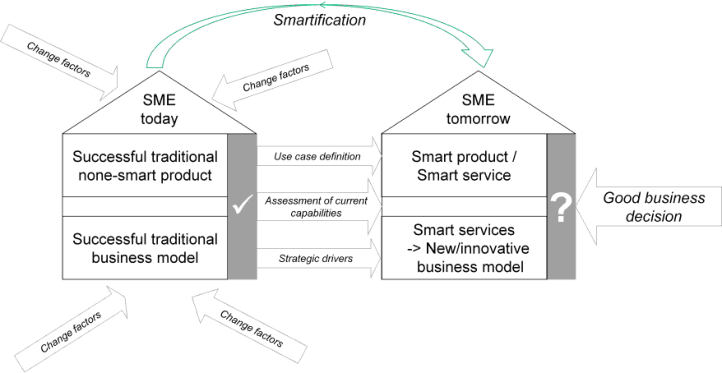
In our research, we focus on the transformation process from a traditio- nal, non-smart product to a smart product (Kett et al., 2021), here called smartification. Due to the advantages of digital transformation, the CEO of a SME wants to rethink the current business model of producing traditio- nal non-smart products toward smartification of the product and towards an innovative way of offering smart services along with the smartified pro- duct. To be able to make the decision towards smartification, the CEO needs to have knowledge about which product to smartify, in which context (use case) and exactly the reasons why to do so. What would the new and innova- tive business model look like? Which smart services should be offered? Is the SME able to transform and if not, what needs to be changed? A “good” deci- sion is relevant to be successful in producing and selling the smart product and services (see Figure 1).
CHALLENGES As indicated above, CMMs are a well-known method to structurally deter- mine the capabilities and maturity of a given subject. Nevertheless, there are challenges when using CMMs (Williams & Schallmo, 2020). Our under- standing is that today most CMMs are not available “as-is methods” for the own purpose – for our research very specifically product smartification. CMMs are mostly designed in such a way, that the organization is not able to use them without external support. The more the CMMs go into detail, the more complex the application is. Once the current capabilities are assessed, a
Figure 1: Aspects relevant for the business decision towards smartification. (Own work).
logical next step would be to derive which level to thrive for to reach the inten- ded goals. CMMs usually do not deliver understandable guidance how to define which level is needed for the intended change and with that do not deli- ver specific measures to reach the next level. The overall capability/maturity is usually mathematically calculated where the result indicates a level. Capa- bility/maturity “level” implies a “level model” like in a staircase. Once all requirements for one “step” are fulfilled, the next step (level) is reached. This set of requirements is a whole bundle of different single requirements tou- ching different aspects of the overall capability/maturity of the specific topic like smartification. Since many users of CMMs would like to receive this one capability/maturity value as a result, the average across the capability/ma- turity values of each subarea of action is calculated, which usually delivers a value between two levels. This is mathematically incorrect but provides a “capability/maturity indicator” to be used for benchmarking and comparing purposes across companies or within the company for different periods. Due to the fact, that CMMs cannot be endless in length, the different parts of assessment questions – being made up of different subquestions – are usu- ally combined with logical operations (“AND” and “OR”). Furthermore, the questions mix two types of criteria within one set of assessment questions of a given area of action: subject-oriented requirements (e.g. data collection using sensors) and base requirements (e.g. human competencies/ documentation/ responsibilities for data collection). The person who answers the questions selects the “best choice”. This carries the risk that the evaluation result is inaccurate.
PREVIOUS WORK We are developing a Smartification Tool Kit to support SMEs in the strategi- cal decision making toward product and service smartification. The tool kit
Enhancing a Capability Maturity Model for the Smartification of Products 831
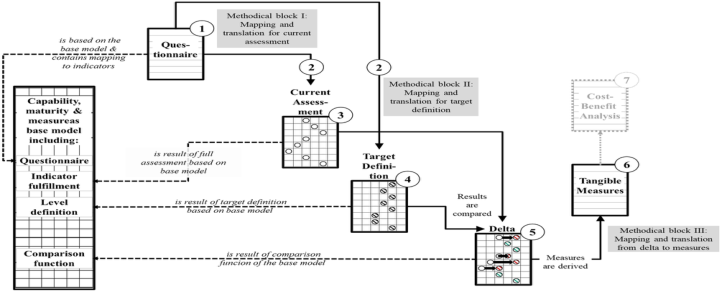
Figure 2: Process of applying the Smartification Tool Kit (Frings & Kett, 2021) and 11 areas of action for product and service smartification (Frings et al., 2022).
is made up of an underlying CMM and a process model to apply the tool kit. The CMM will address the challenges mentioned above. Our previous publications (see Figure 2) describes which components of such a decision framework are necessary, what the requirements of such a framework are as well as what the process model will look like (Frings & Kett, 2021). Further- more, we identified 11 essential areas of action (Frings et al., 2022) relevant for the smartification of traditional physical products, building the basis for an evaluation method to support not only the identification of the essen- tial aspects, which need to be further developed in a SME, but provides the different degrees of effort for advancing these aspects.
GENERIC LEVEL DEFINITION Next to quality criteria like transparency and effectiveness, we included flexi- bility in our process model for the application of the Smartification Tool Kit: The first step assesses the strategic orientation (Frings & Kett, 2021). Depen- ding on the outcome, the focus of the further assessment steps and questions is chosen. Due to this needed flexibility, we developed a generic level scheme. The placeholder is called “object under consideration” and can be applied to different facets. Table 1 gives an overview of the rough and generic formu- lation of our capability/maturity levels. The description of requirements is defined in such a way, that “object under consideration”can stand for “smar- tification” in general, a specific area of action (e.g. data), a specific subarea of action (e.g. data collection), a base requirement (e.g. human competencies) or a specific criterion within the base capabilities (e.g. documentation). Due to this generic approach, we – at the current state of development – refrain from naming the levels.
THIRD DIMENSION OF THE CMM As mentioned above, CMMs are usually two-dimensional. Due to the poten- tial for inaccuracy in the assessment (see challenges above), for our CMM we therefore separate the thematic capabilities defined within the 11 areas
Table 1. Rough and generic description of the capability/maturity levels (own work).
Table available in the original PDF paper.
Level Rough description Generic description of requirements ? Unknown – not analyzed Capabilities (related to the object under consideration) have not yet been assessed so there is no statement or knowledge about which capabilities are necessary and/or whether the existing capabilities are sufficient, or measures must be taken to achieve them. 0 State of having nothing available
The capabilities (related to the object under consideration) are ad hoc and rudimentary built up, used, or carried out (i.e. selectively). There is no process for this.
Capabilities (related to the object under consideration) are not available. They do not exist. 1 No formal approach – initial – performed – ad hoc – chaotic – unconscious – unsystematic – unpredictable – incomplete 2 Reactive approach – defined – repeatable – intuitive – controlled – guided – rudimentary – basics present Capabilities (related to the object under consideration) are defined, built up, used, implemented (e.g. for a project, i.e. “with some foresight”) in a needs-oriented or purpose-oriented manner. But there is no process for that. 3 Stable formal systematic approach – established - proactive – advanced
Capabilities (related to the object under consideration) are available. For those, a general process is defined and documented (e.g. based on a requirements analysis) and responsible people for this process are specified. 4 Regular review and measurement – quantitatively guided – quantitatively managed – consistent – mature
Capabilities as well as the process related to the capabilities (for the object under consideration) are regularly checked, measured and necessary improvements are initiated as needed. 5 Best possible state of performance – optimized state – sustainable state
A continuous improvement process (CIP) is set up in such a way that constant optimization of the process related to the capabilities (related to the object under consideration) is fully established and anchored in the minds of those who are responsible. A quality assurance process for this optimization exists. The need for capabilities as a process result is determined regularly and measures to meet the needs are implemented.
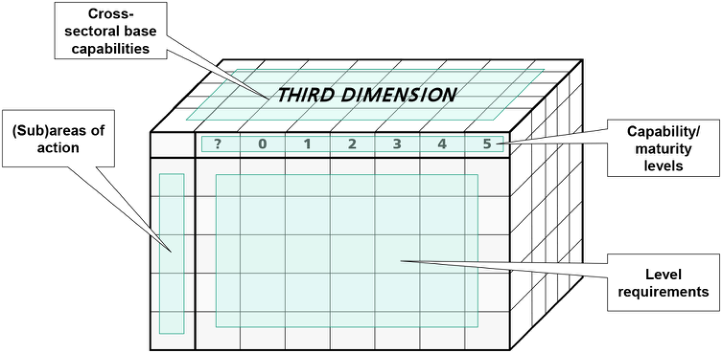
of action for smartification (Frings et al., 2022) from the “cross-sectoral base capabilities”. With this separation we introduce a third dimension (see Figure 3) which is grouped into five subcategories which are business process-, human- and technological base-oriented.
Enhancing a Capability Maturity Model for the Smartification of Products 833
Figure 3: Third dimension of the CMM. (Own work).
The five subcategories within the cross-sectoral base capabilities are also used in combination with the placeholder “object under consideration” and deal with the following questions to be answered in the assessment using the level scheme mentioned above:
To which degree is the object under consideration integrated into the business processes of the SME?
To which degree are human competencies regarding the object under consideration available in the SME?
To which degree are human capacities regarding the object under consi- deration available in the SME?
To which degree are capabilities of the technological base regarding the object under consideration available in the SME?
To which degree are capacities of the technological base regarding the object under consideration available in the SME?
Depending on the specific object under consideration, the question “to which degree” can vary or be added by examples like: “how often are you using …”, “what is the quality of…”, “does … exist …”, “how do you assure …”, “what is the potential for …”, “what is the process for …”, “who is involved in …”, “what is offered …”, how is … integrated…”, etc.
Table 2 gives an example of having applied the general level description (see Table 1) to the specific cross-sectoral base capability “human competencies” and the subarea of action “data quality” “as object under consideration”. The result is a list of requirements. The use of logical operations AND and OR indicate the combination of the requirements.
To go one step further, these five subcategories can be detailed regarding requirements only dealing with processes in developing and administrating documentation and reporting, responsibilities and governance, rules and gui- delines (compliance) as well as scalability. This task may be subject to further research.
Table 2. Human Competencies in the context “data quality” (own work).
Table available in the original PDF paper.
Level Specific Requirements ? Human competencies regarding “data quality” have not yet been assessed. So, there is no knowledge of the need or the current situation of personnel skills and experience regarding data quality. 0 There are no skills and no experiences regarding data quality available in the focus of assessment (e.g. in the SME, in the department, in a specific project, etc.). 1 Employees have rudimentary points of contact with the topic data quality OR employees are currently acquiring the necessary skills ad hoc (i.e. selectively) OR gain initial experience with the data quality. And there is no general competency management process. 2 Regarding data quality, employees have a loose understanding OR employees acquire the necessary skills in a needs-oriented or purpose-oriented manner (e.g. as part of a project, i.e. “with a little foresight”) and gain experience for data quality. AND there is no general competency management process. 3 Regarding data quality, employees have proven experience and relevant skills are available and are used. AND a general competency management process (related to data quality) is defined and documented (e.g. based on a requirements analysis) and those responsible for this process are specified. 4 Regarding data quality, employees have many years of experience and in-depth skills are available and used. AND the existing competencies as well as the competence management process are regularly reviewed and checked, measured and necessary improvements are initiated as needed. 5 A continuous improvement process is set up in such a way that constant optimization of the competence management process regarding data quality is fully established and anchored in the minds of those responsible. AND a quality assurance process for this optimization exists.
SUMMARY The described generic level scheme as well as the three-dimensional appro- ach contribute to more transparency in the assessment result, being able to derive more specific and appropriate measures, to deliver input for comple- teness of the assessment topics, as well as underlining the modular approach of the smartification tool kit (Frings & Kett, 2021). Our work will bring SMEs a large step closer to their strategic decisions by considering the inte- gration of people and intelligent systems in a competitive manner to develop future service business and make more use of the advantages of the digital transformation.
REFERENCES
Angreani, L. S., Vijaya, A., & Wicaksono, H. (2020). Systematic Literature Review of Industry 4.0 Maturity Model for Manufacturing and Logistics Sectors. Procedia Manufacturing, 52, 337–343. https://doi.org/10.1016/j.promfg.2020.11.056
Enhancing a Capability Maturity Model for the Smartification of Products 835
Batista Sarmento dos Santos-Neto, J., & Cabral Seixas Costa, A. P. (2019). Enterprise maturity models: a systematic literature review. Enterprise Information Systems, 13(5), 719–769. https://doi.org/10.1080/17517575.2019.1575986 Becker, J., Knackstedt, R., & Pöppelbuß, J. (2009). Developing Maturity Models for
IT Management. Business & Information Systems Engineering, 1(3), 213–222. https://doi.org/10.1007/s12599-009-0044-5 Bertolini, M., Esposito, G., Neroni, M., & Romagnoli, G. (2019). Maturity Models in Industrial Internet: a Review. Procedia Manufacturing, 39, 1854–1863. https://doi.org/10.1016/j.promfg.2020.01.253 Frings, S., & Kett, H. (2021). Towards a Capability Based Approach to Strengthen
the Strategic Decision Making Process for Developing Smart Products and Services in SMEs. In C. Leitner, W. Ganz, D. Satterfield, & C. Bassano (Eds.), Advances in the Human Side of Service Engineering (pp. 189–196). Springer International Publishing. https://doi.org/10.1007/978-3-030-80840-2_21 Frings, S., Kett, H., & Falkner, J. (2022). Essential Areas of Action for the Smartification of Traditional Products and Services Considering the Capabilities of SMEs. In AHFE International, The Human Side of Service Engineering. AHFE International. https://doi.org/10.54941/ahfe1002571 Hellweg, F., Lechtenberg, S., Hellingrath, B., & Thomé, A. M. T. (2021). Literature
review on maturity models for digital supply chains. Brazilian Journal of Opera- tions & Production Management, 18(3). https://doi.org/10.14488/BJOPM.2021. 022 Hoàng, P. M., & Hong, P. T. T. (2022). Comprehensive Review of Digital Maturity Model and Proposal for A Continuous Digital Transformation Process with Digital Maturity Model Integration Model Integration. IJCSNS International Jour- nal of Computer Science and Network Security. http://paper.ijcsns.org/07_book /202201/20220197.pdf Jung, R. H., Heinzen, M., & Quarg, S. (2018). Allgemeine Managementlehre: Lehr-
buch für die angewandte Unternehmens- und Personalführung (7. neu bearbeitete Auflage). ESV basics. Erich Schmidt Verlag. Kett, H., Evcenko, D., Falkner, J., Frings, S., & Neuhüttler, J. (2021). Künstliche Intelligenz als Veränderungstreiber für Geschäftsmodelle. In M. Bruhn & K. Hadwich (Eds.), Forum Dienstleistungsmanagement. Künstliche Intelligenz im Dienstleistungsmanagement (pp. 51–75). Springer Fachmedien. https://doi.org/10.1007/978-3-658-34324-8_2 Khakifirooz, M., Fathi, M., Pardalos, P. M., & Power, D. J. (2021). Decision Support for Smart Manufacturing. In J. Wang & M. Khosrow-Pour D.B.A. (Eds.), Advances in Logistics, Operations, and Management Science. Encyclope- dia of Organizational Knowledge, Administration, and Technology. IGI Global. https://doi.org/10.4018/978-1-7998-3473-1.ch162 Konopik, J., Jahn, C., Schuster, T., Hoßbach, N., & Pflaum, A. (2022). Mastering
the digital transformation through organizational capabilities: A conceptual fra- mework. Digital Business, 2(2), 100019. https://doi.org/10.1016/j.digbus.2021. 100019 Mirihagalla, P., & Vastag, G. (2022). Maturity models – Taking stock and moving forward. https://www.researchgate.net/publication/361073625 Ochoa-Urrego, R.-L., & Peña-Reyes, J.-I. (2021). Digital Maturity Models: A Syste-
matic Literature Review. In D. R. A. Schallmo & J. O. Tidd (Eds.), Management for Professionals. Digitalization (pp. 71–85). Springer International Publishing. https://doi.org/10.1007/978-3-030-69380-0_5
Sadiq, R. B., Safie, N., Abd Rahman, A. H., & Goudarzi, S. (2021). Artificial intelligence maturity model: A systematic literature review. PeerJ. Computer Science, 7, e661. https://doi.org/10.7717/peerj-cs.661 See, B. von. (2019). Ein Handlungsrahmen für die digitale Transformation in Wert-
schöpfungsnetzwerken [Disseration, TUHH Universitätsbibliothek]. DataCite. Software Engineering Institute (2010). Capability Maturity Model® Integration for Development (CMMI-DEV), Version 1.3: Improving processes for developing better Improving processes for developing better products and services (Techni- cal Report). Advance online publication. https://resources.sei.cmu.edu/asset_files/ technicalreport/2010_005_001_15287.pdf. Steinlechner, M., Schumacher, A., Fuchs, B., Reichsthaler, L., & Schlund, S. (2021). A
maturity model to assess digital employee competencies in industrial enterprises. Procedia CIRP, 104, 1185–1190. https://doi.org/10.1016/j.procir.2021.11.199 Williams, C. A., Schallmo, D. R. A., Lang, K., & boardman, L. (2019). Digital Maturity Models for Small and Medium-sized Enterprises: A Systematic Literature Review, 137–155. https://www.researchgate.net/publication/334108295
LISTED IN THE AHFE DIGITAL BOOKSTORE CATALOGUE
Explore the complete digital volume
Intelligent Human Systems Integration (IHSI 2023): Integrating People and Intelligent Systems
Read this individual research paper free through the original publisher, or explore the full digital proceedings book.
ISBN 978-1-958651-45-2
Explore this ISBN in the AHFE Bookstore ↗Listed in the July 2026 bookstore catalogue; search by ISBN to confirm current availability · Digital book purchase optional