Ziang Wang (2023). Hot Spots and Trends Analysis of Elderly-Oriented Interface Design. In: Intelligent Human Systems Integration (IHSI 2023): Integrating People and Intelligent Systems. AHFE Open Access, vol. 69, pp. 916–924. https://doi.org/10.54941/ahfe1002917
This study aims to analyse the hot spots and trends of elderly-oriented interface design, use Web of Science Core Collection data as a sample and apply the scientific bibliometric method to visualize the documents publications, countries, research institutions, authors, keyword clusters, reference co-citation status to generate a map of scientific knowledge by VOSviewer and CiteSpace, the analysis and discussion are also combined with relevant parameters. The overall number of documents within the search range are on the rise, but the cooperation between research institutions and authors is not close enough. Research hotspots are mainly focused on usability, user experience, human-machine interface, human-computer interaction, quality-of-life, performance, healthcare, system, etc. The future hotspots and trends of elderly-oriented interface design will consist of physical-activity, health, management, etc. This study offers researchers a comprehensive understanding of elderly-oriented interface design studies in the last decades and research directions for the future.
Interface design is the medium through which information is transmitted and exchanged between humans and machines, ensuring that users can intuitively use the interface to give commands to the computer. As the aging population is increasing internationally, the demand for computers and interfaces from older people is increasing, and many designers are working to provide better interface design for older users (Zajicek 2004). At the same time, research on elderly-oriented interface design is gaining attention, but there are many issues that need to be addressed when targeting older users. With the develo- pment of the Internet era, the needs of the elderly for interfaces have become personalized and diversified, so how to meet the needs of the elderly has become an important factor to be considered in interface design (Pullin and Newell 2007). Many scholars have been involved in the research of Elderly- Oriented Interface Design (EOID), and a large amount of documents have been produced. Therefore, it is necessary to further summarize the current status of EOID and existing research results, analyse various kinds of docu- ments with the help of scientific bibliometric method to extract the potential laws and information, so as to provide reference for the subsequent resea- rch and hope to improve the user experience of the elderly when using the interface.
Hot Spots and Trends Analysis of Elderly-Oriented Interface Design 917
DATA SOURCES AND METHODS Data Sources
In this study, the Web of Science Core Collection was chosen as the main source of research, and the five major citation indexes, SSCI, SCI-Expanded, A&HCI,CPCI-S,and CPCI-SSH,which are commonly used in the WOS data- base, were selected as the search sources. The search results were exported and the interfering articles such as deviations from the research topic, missing field information (such as time, keywords, authors and other key informa- tion), and duplicate data were excluded. A total of 674 articles were obtained for further quantitative analysis.
Methods
The scientific bibliometric method and information visualization method are the main research methods in this study. Among them, the bibliome- tric method is a mathematical and statistical method to mine and summarize the potential patterns and information in a large amount of literature data with the help of various characteristics and quantities of literature. For data mining and visualization presentation, we selected VOSviewer and CiteSpace as analysis tools and applied knowledge map and literature statistics to the comprehensive analysis. VOSviewer was developed in 2009 by Van Eck and Waltman at the Center for Scientific and Technological Research, Leiden University, The Netherlands, with a powerful user graphical interface and mapping visualization (Van Eck and Waltman 2010). CiteSpace is a JAVA- based multivariate, time-phased scientometric visualization system developed by Professor Chaomei Chen at Drexel University, USA, and has become one of the most reliable and advanced software in the field of scientometric data visualization (Chen 2006).
RESULTS
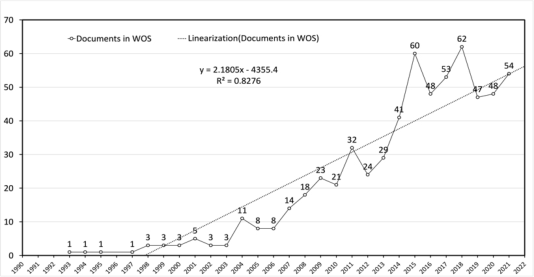
Distribution of Publications One of the important ways to measure the research trends of EOID is to analyse and assess the research dynamics of the field based on the change of the output of the academic literature over time. The annual publications of EOID (see Figure 1) can be obtained by filtering the retrieved data and extracting the fields. The first article in the scope of the search was published in 1993, as shown by the publication status of WOS. Since 1993–2021, the annual publications increased from 1 article in 1993 to 54 articles in 2021, and reached a peak in 2018 with 62 articles in total. The overall trend of literature output is on the rise, and elderly-oriented interface design will be the focus of academic research in the future.
Performance of Countries The number of publications and the number of citations by country/region in the data set describe the high-producing countries in the research field and their impact. The results show that in terms of country/region output,
918 Wang
Figure 1: Distribution of annual publications on EOID.
there are 55 countries/regions contributing to this research area worldwide. In terms of countries, England, the USA, China, Germany and Japan are the top 5 countries in terms of the number of publications, accounting for 41.1% of the total number of publications, indicating that these 5 countries are important forces in EOID research and maintain cooperative relationships, but are not close enough and are mostly scattered.
Performance of Institutes and Authors EOID-related research was conducted by 182 institutions worldwide from 1993–2022, and the statistics of the literature output of the institutions sho- wed that the top 5 productive publications were University of Cambridge, University of Toronto, RWTH Aachen University, University of Dundee, and University of Tokyo, with 8, 8, 8, 7, and 6 publications, which show that higher education institutions are the main force of EOID research. Auth- ors are the smallest unit of literature output and the direct contributors to EOID research. The top 5 productive authors are Cosmin, Valeria, Iyubanit, Kwang-hyun, and Martina.
Performance of Journals The articles within the search were sourced from 96 journals. There is a list of the top 10 most productive journals from 1993–2022 and their respective five-year impact factors (see Table 1). Their publication volume account for 26.55% of the total number of articles published. The first in line is Sensors, which has 11 articles and an impact factor of 3.847. The second in line is Interacting With Computers, which has 10 articles and an impact factor of 1.623. The third in line is International Journal of Environmental Research and Public Health, which has 9 articles and an impact factor of 4.614. The fourth in line is Behaviour & Information Technology, which has 8 articles and an impact factor of 3.32. The fifth in line is Disability and Rehabilitation- Assistive Technology, which has 8 articles and an impact factor of 1.834.
Hot Spots and Trends Analysis of Elderly-Oriented Interface Design 919
Table 1. Top 10 high-yield journals.
Table available in the original PDF paper.
No. Journals Country Documents Impact Factor Impact Factor (5 years)
Switzerland 9 4.614 4.799
1 Sensors Switzerland 11 3.847 4.05 2 Interacting With Computers Netherlands 10 1.623 1.532 3 International Journal of Environmental England 8 3.32 3.615 Research and Public Health 4 Behaviour & Information Technology
England 8 1.834 2.333
5 Disability and Rehabilitation-Assistive
Germany 8 2.629 2.42
Technology 6 Universal Access in the Information
Canada 5 7.077 7.68
7 Society BMJ Open England 5 3.007 3.587 8 IEEE Access USA 5 3.476 3.758 9 Journal of Medical Internet Research 10 Applied Ergonomics England 4 3.94 4.641
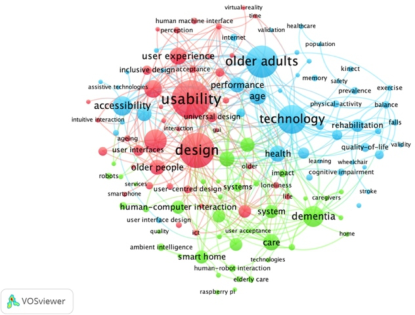
Analysis of Hot Spots and Trends The keywords of the literature are the authors’ high refinement of their research, and the high-frequency occurrence of keywords reflects the long- standing research hotspots of EOID. A total of 2396 keywords were included in the 674 documents within the search. In the course of the study, the keyword co-occurrence frequency was set to 5 by running Vosviewer, and the keyword co-occurrence clustering network formed by 126 keywords was obtained after filtering and merging synonyms (see Figure 2). The keywords with the same colour in the figure belonged to the same cluster. A total of 3 main clusters were formed. From the analysis results, the hot research topics of elderly-oriented interface design can be divided into three major catego- ries, which are #1 interface design and usability, #2 elderly-oriented and user requirements, and #3 human-computer interaction.
Cluster #1—interface design and usability contains 40 cluster members, mainly including usability, interface design, user experience, human-machine interface, universal design and other keywords. This cluster reflects that EOID not only focuses on the basic content of interface design, but also focu- ses on usability and user experience, emphasizing the usability and ease of use of user interface. Usability has become a key factor to product success, and a suitable user interface is closely related to usability (Luo, Wang et al. 2009). With the development of the times, the user interface should not only be easy to use, but also be useful, which can bring value to people and improve the quality of life and user experience of the interface for the elderly (Holzinger, Ziefle et al. 2010).
Cluster #2—elderly-oriented and user requirements contains 47 cluster members, mainly including older adults, technology, healthcare, quality-of- life, performance, safety, etc. The cluster reflects that EOID focuses on the elderly users, explores and analyses the requirements and psychological or physiological characteristics of the elderly, ensuring that the designed inter- faces meet the humanized requirements. Taking people as the core part of interaction interface design can improve the level of interaction interface design and meet the requirements of modern society (Hong-juan 2015).
Cluster #3—human-computer interaction contains 39 cluster members, mainly including human-computer interaction, system, human-robot intera- ction, smart home, user acceptance and other keywords. The keywords in this cluster all belong to the frontier hot direction, showing the transformation and upgrading of EOID in interaction, and more and more emphasis on the interaction between interfaces and users. The central concept of HCI is usabi- lity, ease of use plus usefulness (Hartson 1998). Interface Interaction Design not only studies the visual elements such as graphics, symbols, colour, and text in the interface, but also the interaction elements such as the informa- tion structure level, navigation and layout in the interface. In recent years HCI has also started to focus on artificial intelligence and virtual reality, which has played an important role on the widespread use of virtual reality and improvement of user experience (Zhang, Guozhong et al. 2016).
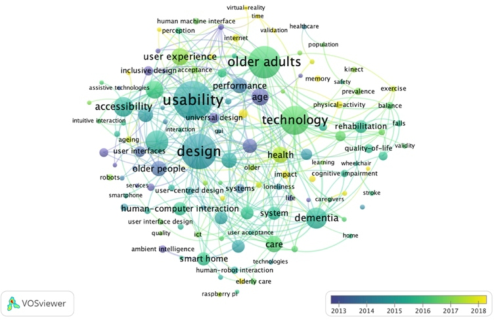
In order to further study the frontier themes and development trends of EOID, the average occurrence times of keywords were statistically analysed separately and superimposed on the original clustering map (see Figure 3). The research hotspots summarized by the three clusters can be found that the time of keywords in cluster #2—elderly-oriented and user requirements is closest to the present. The keywords in cluster #2 are the cutting-edge the- mes of EOID research. Secondly, cluster #3—human-computer interaction is also an important research direction of EOID research. Cluster #1—interface design and usability occurred on average before 2015, which was a hot spot for early research in the discipline. In the whole clustering network, the keywords with an average appearance time later than 2016 are technology,
Hot Spots and Trends Analysis of Elderly-Oriented Interface Design 921
human-computer interaction, system, smart home, health, physical- activity, virtual-reality, etc.
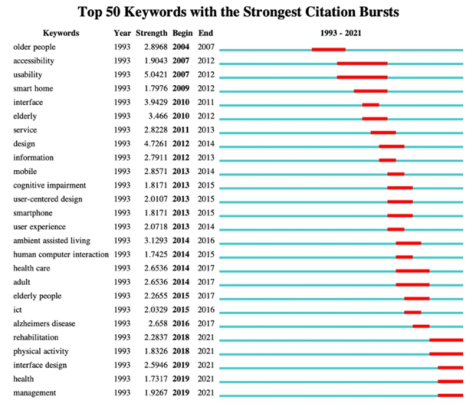
Additionally, in order to further explore and corroborate the cutting-edge trend of EOID research, a map of keywords burst term from CiteSpace (see Figure 4) was used in the study. There is a list of the top 30 keywords with the strongest bursts in different periods from 1993 to 2021. After sorting the top 30 burst keywords by time, we can see that the strongest burst keywords burst in the last 3 years and continue to burst until 2021 are physical- activity ‘inter- face design’ health and management. After a comprehensive analysis, we can see that the future research contents of EOID will focus on human-robot inte- raction, system, physical-activity, interface design, health, management, etc. The research trend is more closely integrated with technology, emphasizing
922 Wang
Table 2. Top 10 high-cited literature.
Table available in the original PDF paper.
No. Literature Author Year Citations Hawthorn, D. 2000 24
1 Possible Implications of Aging for Interface Designers
Fisk, Arthur D. 2009 16
2 Using Direct and Indirect Input Devices: Attention
Czaja, Sara J. 2006 14
Demands and Age-Related Differences 3 Factors Predicting the Use of Technology: Findings
Davis, FD 1989 14
from the Center for Research and Education on Aging and Technology Enhancement 4 Perceived Usefulness, Perceived Ease of Use, and
Kurniawan, S 2008 13
User Acceptance of Information Technology 5 Older People and Mobile Phones: A Multi-Method
Venkatesh, V 2003 13
Investigation 6 User Acceptance of Information Technology: Toward
Dickinson, A. 2007 12
a Unified View 7 Methods for Human-Computer Interaction Research
Portet, Francois 2013 12
with Older People 8 Design and Evaluation of a Smart Home Voice Interfa-
Kobayashi, M 2011 11
ce for the Elderly: Acceptability and Objection Aspects 9 Elderly User Evaluation of Mobile Touchscreen Inter-
Ziefle, M 2005 10
actions 10 How Older Adults Meet Complexity: Aging Effects on the Usability of Different Mobile Phones
the health management of the elderly, while taking into account certain psych- ological factors related to the user’s thinking process, feeling and behaviour (Alves, Natálio et al. 2020).
Theoretical Basis According to the collation and statistics, a total of 16530 valid references were cited in the 674 documents within the search scope. As some refe- rences are cited in pairs and form co-citation relationships, the whole set of references form a co-citation network. The co-citation network shows the evolution of EOID at the basic knowledge level. The top 10 high cited classical literature is listed below (see Table 2).
Hot Spots and Trends Analysis of Elderly-Oriented Interface Design 923
The first in line is “Possible implications of aging for interface designers”, which was authored by Hawthorn, D in 2000. The authors identified research needed in the area of interface design for older users and reviewed findings about the effects of age on related abilities. They used this information to pro- vide recommendations to consider when designing interfaces for older users (Hawthorn 2000). The second high-cited literature is “Using direct and indi- rect input devices: Attention demands and age-related differences”, which was authored by Fisk, Arthur D. et al. in 2009. The journal focused on less attentive group such as the elderly and provided a better approach to select input interface for tasks by considering the overlap between device attributes and input requirements to support design decisions (McLaugh- lin, Rogers et al. 2009). The third in line is “Factors predicting the use of technology: Findings from the centre for research and education on aging and technology enhancement”, which was authored by Czaja, Sara J. et al in 2006. The article reported CREATE’s findings on the use of technology about community-dwelling adults. The relationship between age and tech- nology adoption was influenced by cognitive ability, computer self-efficacy, and computer anxiety. The article also discussed these findings in the context of training strategies to promote technology adoption (Czaja, Charness et al. 2006). The fourth in line is “Perceived usefulness, perceived ease of use, and user acceptance of information technology”, which was authored by Davis, FD. in 1989(Davis 1989). The fifth in line is “Older people and mobile pho- nes: A multi-method investigation”, which was authored by Kurniawan, S in 2008. This article investigated the issues related to the use of cell phones among people aged 60 and above, and the characteristics of aging-friendly cell phones. This showed that elder people were passive users of cell phones, and most of the preferred design features should highlight the importance of interface design (Kurniawan 2008). The high-cited literature above promotes the in-depth development of EOID research and lays the theoretical founda- tion of the EOID field to a certain extent, which creates adequate conditions for the subsequent research.
CONCLUSION
By analysing the literature in the field of EOID, we can find the overall num- ber of documents within the search range are on the rise, England, the USA, China, Germany and Japan are the core countries in the international EOID research. Higher education institutions such as University of Cambridge, Uni- versity of Toronto, RWTH Aachen University, University of Dundee, and University of Tokyo are the main research institutions; Cosmin, Valeria, Iyubanit, Kwang-hyun, and Martina are the main research authors. The keyword clusters reveal that EOID research is comprehensive and diverse, the hot research topics of elderly-oriented interface design can be divided into three major categories, which are #1 interface design and usability, #2 elderly-oriented and user requirements, and #3 human-computer interaction. Research hotspots focus on usability, user experience, human-computer inte- raction, quality-of-life, performance, healthcare, safety, system, etc. In the process of development, EOID research trends have changed from the study
924 Wang
of universal design, usability and user experience to human-computer intera- ction, and in recent years to health, physical-activity and technology. Future research will focus on physical-activity, interface design, health, and mana- gement. Meanwhile, in the field of EOID, a number of classical literature has been produced, which constitutes the main knowledge base and links most of the research contents, promoting the development of EOID research and laying the foundation for the subsequent profound research.
REFERENCES
Alves, T., J. Natálio, J. Henriques-Calado and S. Gama (2020). “Incorporating personality in user interface design: A review.” Personality and Individual Differences 155: 109709. Chen, C. (2006). “CiteSpace II: Detecting and visualizing emerging trends and
transient patterns in scientific literature.” Journal of the American Society for information Science and Technology 57(3): 359–377. Czaja, S. J., N. Charness, A. D. Fisk, C. Hertzog, S. N. Nair, W. A. Rogers and J.
Sharit (2006). “Factors predicting the use of technology: findings from the Center for Research and Education on Aging and Technology Enhancement (CREATE).” Psychology and aging 21(2): 333. Davis, F. D. (1989). “Perceived usefulness, perceived ease of use, and user acceptance of information technology.” MIS quarterly: 319–340. Hartson, H. R. (1998). “Human–computer interaction: Interdisciplinary roots and
trends.” Journal of systems and software 43(2): 103–118. Hawthorn, D. (2000). “Possible implications of aging for interface designers.”
Interacting with computers 12(5): 507–528. Holzinger, A., M. Ziefle and C. Röcker (2010). Human-computer interaction and usability engineering for elderly (HCI4AGING): introduction to the special the- matic session. International Conference on Computers for Handicapped Persons, Springer. Hong-juan, S. (2015). “People-oriented user interface design.” Packag. Eng 4:
113–116. Kurniawan, S. (2008). “Older people and mobile phones: A multi-method investigation.” International Journal of Human-Computer Studies 66(12): 889-901. Luo, S., Y. Wang and J. Guo (2009). Research on ontology-based usable user interface
layout approach. 2009 IEEE International Conference on Intelligent Computing and Intelligent Systems, IEEE. McLaughlin, A. C., W. A. Rogers and A. D. Fisk (2009). “Using direct and indirect input devices: Attention demands and age-related differences.” ACM Transactions on Computer-Human Interaction (TOCHI) 16(1): 1–15. Pullin, G. and A. Newell (2007). Focussing on extra-ordinary users. International
Conference on Universal Access in Human-Computer Interaction, Springer. Van Eck, N. and L. Waltman (2010). “Software survey: VOSviewer, a computer program for bibliometric mapping.” scientometrics 84(2): 523-538. Zajicek, M. (2004). “Successful and available: interface design exemplars for older
users.” Interacting with computers 16(3): 411–430. Zhang, F., D. Guozhong and P. Xiaolan (2016). “A survey on human-computer interaction in virtual reality.” Scientia Sinica Informationis 46(12): 1711–1736.
LISTED IN THE AHFE DIGITAL BOOKSTORE CATALOGUE
Explore the complete digital volume
Intelligent Human Systems Integration (IHSI 2023): Integrating People and Intelligent Systems
Read this individual research paper free through the original publisher, or explore the full digital proceedings book.
ISBN 978-1-958651-45-2
Explore this ISBN in the AHFE Bookstore ↗Listed in the July 2026 bookstore catalogue; search by ISBN to confirm current availability · Digital book purchase optional