Han Zhang, Seunghee Lee (2023). Drowsiness Prevention System in Automatic Driving -- Effects of Light Position on Comfortable and Unconscious Wakefulness During Driving. In: Intelligent Human Systems Integration (IHSI 2023): Integrating People and Intelligent Systems. AHFE Open Access, vol. 69, pp. 8–16. https://doi.org/10.54941/ahfe1002816
With today's automated driving assistance, drivers must always remain awake and aware of road conditions. In an emergency or when having difficulty operating the automated driving system, the driver must immediately assume vehicle control. In particular, autonomous driving is currently used mainly on highways, where drivers are prone to drowsiness due to the monotonous driving environment. Faced with this problem, many researchers and companies have developed drowsiness-prevention driving systems to prevent drivers from falling asleep. However, most conventional methods force people to wake up to unpleasant loud sounds, neglecting the driver's sense of driving experience. This study aims to identify the effects of light position on comfortable and unconscious wakefulness during driving. Specifically, we investigated 20 participants' concentration, reaction time and stimulation experience evaluated by brainwave apparatus, the Mackworth Clock Vigilance Test (MCVT), Karolinska Sleepiness Scale (KSS) and the Subjective Evaluation Survey when three stimuli were used: voice only, voice and handle lighting, voice and ambient lighting. The results showed no significant differences between the three stimulation modalities in KSS (p = .082) and MCVT (p =.547). Conversely, the evaluation of audio-visual experience was significantly impacted by the position of lighting by Bonferroni pairwise comparisons: when the handwheel light was displayed, participants felt more surprised than with the other two stimuli (p =.03). The findings of this study compare the effects of different light positions on the audio-visual experience and provide reference suggestions for the visual placement of drowsiness prevention systems.
Due to the rapid technological progress of automated driving, advanced dri- ver assistance systems (ADAS) can support drivers to perform driving tasks more safely. However, one of the most pressing research questions in highly automated driving (HAD) is how to aid the driver in making safe transitions
Drowsiness Prevention System in Automatic Driving – Effects of Light Position 9
between manual and automated control (Bazilinskyy et al., 2018). The dri- ver of automatic cars may occasionally need to switch from their secondary task to the driving task when an urgent situation happens (Janssen et al., 2019). During this switch, the driver must always remain awake and aware of road conditions to ensure they can take over the system in time. Unfortu- nately, when drivers no longer effectively control their vehicles, they are easily distracted and drowsy (Zhou et al., 2020). In particular, autonomous driving is currently used primarily on highway road conditions, where the driver is easily to drowsiness due to the monotonous driving environment. Drowsy driving is the culprit in 20% – 30% of fatal traffic accidents (Murata, 2016) and is one of the major causes of rear-end collisions (Guo et al., 2021).
To increase traffic safety and reduce the number of accidents due to drowsy driving, numerous universities, research centers, and automotive companies (such as Toyota, Benz and Audi) are contributing to developing a drowsiness prevention system (DPS) in automatic driving. Most researchers have focused on developing the technical aspects of DPS (Dinges et al., 2005), including sensors for measuring physiological (Sahayadhas et al., 2012) (Richman and Moorman, 2000), behavioral changes (Slater, 2008) (Mardi et al., 2011) (Balandong et al., 2018) and algorithms to quantify and predict (McDonald et al., 2018) these changes. For instance, Anthony et al. designed and evalu- ated a contextual and temporal algorithm for detecting drowsiness-related lanes (McDonald et al., 2018). The algorithm reduces the false positive rates in highway and rural environments, which are typically problematic for vehicle-based detection algorithms. It may be combined with visual-auditory methods to improve driving safety.
Meanwhile, for the warning design of the drowsiness prevention system, the main way of expression is to design an alarm sound (ZHANG, 2020) and a warning light (Schwarz et al., 2019) on the dashboard. Ann used the Korean traditional instrument gong sound, kkwaenggwari sound, cymbals sound, tofu bell sound and shaman bell sound in the drowsiness prevention system (Ann, 2018). All five proposed sounds were proved by frequency analysis, EEG analysis and MOS test survey that awakening is sufficient. However, most conventional methods force people to wake up unpleasantly, neglecting the driver’s sense of driving experience.
Compared to previous research, this study tended to investigate how to keep the driver awake in a relaxed and unconscious state during autonomous driving. Additionally, the purpose of this study was to use a combination of different in-vehicle light positions and voice reminders to compare the differe- nces in drivers’ concentration, sleepiness, and audition subjective assessments during driving.
MATERIALS AND METHODS
Participants A total of twenty participants (MAge = 33.7 ± 7.6 years old) took part in the experiment. The sample consisted of n = 11 females and n = 9 males. On average, participants had owned their driving license for 8.2 years (SD = 4.31). The sample quoted their driving experience as “very experienced”
(20%) or “experienced” (75%). Only 1 participant was “inexperienced” (5%) with driving. Regarding how to avoid drowsiness while driving, 60% of the participants chose to listen to music and 30% indicated that they chewed gum to stay awake.
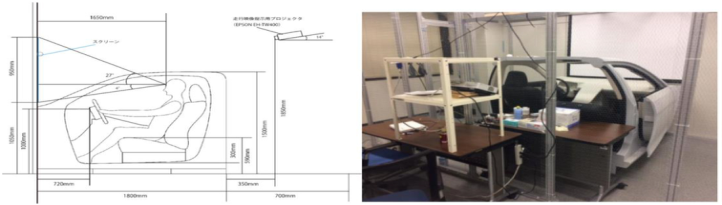
Apparatus The study was conducted in a full-scale model of a domestic sedan-type vehi- cle in a silent room. The dimensions of the car model and participants’ seating position are shown in Figure 1. The screen was placed on the curtains in front of the mock-up to show the driving environment. As the angle at which the participants looked at the screen during the experiment varied with their hei- ght, it was calculated assuming a height of 170cm. Provided the participants with 1920 × 1200 video quality and a horizontal field of view of 180
× 31
.
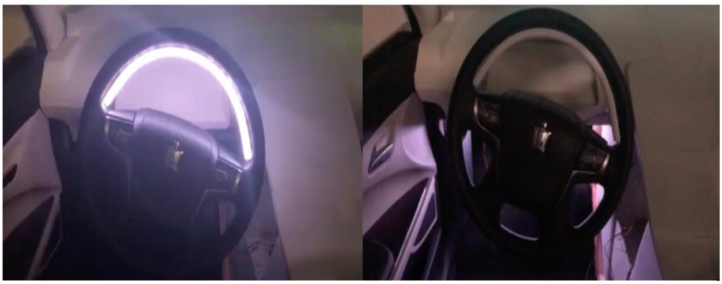
In the experiment, we set up three kinds of stimulus materials to keep the driver awake, (1) voice reminder, (2) steering wheel light with voice reminder, and (3) ambient light with voice reminder. As shown in Figure 2, The visual stimulus is a basic LED white light, and the brightness is adjusted according to the automotive ambient light regulation. When the participant misses or delays the response to the red dot jump time in MCVT, he/she will be judged as having drowsiness and the stimulus will be displayed.
Drowsiness Prevention System in Automatic Driving – Effects of Light Position 11
Figure 3: EEG measurement interface.Figure 4: Mackworth Clock vigilance Test (left) and Reaction time of pressing the button (right).
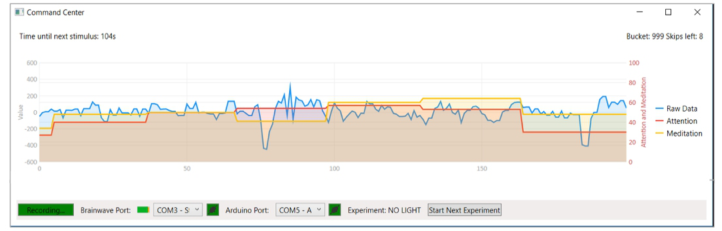
Assessment and Measurements Drowsiness can be assessed by using either subjective or objective data. The experiment used method to assess subjective fatigue is the Karolinska Sleep Scale (KSS) (Jarosch et al., 2019). Participants state their subjective drowsi- ness on a 9-point Likert scale: extremely alert (1), alert (3), neither alert nor sleepy (5), sleepy – no difficulty remaining awake (7) and extremely sleepy – fighting sleep (9). For objectively assessing drowsiness, the experiments were conducted using Mind Wave Mobile, which is a brainwave headset equipped with Think Gear Asics, for collecting drowsiness data. This product can out- put data converted to digital signals after noise elimination from the acquired EEG signals, data analysed by the algorithm, and electromyogram data of blink (see Figure 3).
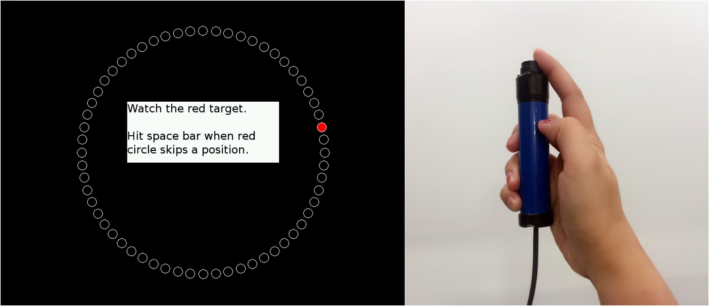
To measure the participants’ attention during driving, the experimental procedure used the Mackworth Clock Vigilance Test (MCVT) to collect rea- ction times. MCVT mentions that vigilance work, monitoring, requires the best physiological and mental state to react (Lichstein et al., 2000). It is chara- cterized by lengthy uninterrupted periods by the participant, attention to find small stimuli and react to their cause (Veksler and Gunzelmann, 2018). As shown in Figure 4 on the left picture, the red dot is turned in sequential order
12 Zhang and Lee
Figure 5: Experimental procedure.
like a clock, occasionally skipping. Suppose the participant notices when the red dot skips and immediately presses the button. The reaction time of pres- sing the button is recorded. Data for Miss, False, and detected were extracted from the MCVT and analyzed using the following formula (1). If a red dot in sequential progress skips, it is judged “detected” when clicked within 3 seconds; if not clicked within 3 seconds, it is identified as “missed”; Furth- ermore, if the red dot does not skip but is clicked, it is recognized as “false start”.
∗100% (1)
Score = ndetected nfalse start + nmissed + ndetected Three scale values (no, yes, neither) were given for the following six items in the subjective evaluation of lighting stimulations. The questions were positive “excited” and “awakened” and negative “surprised,” “anxious,” “angry,” and “uncomfortable” to evaluate the participants’ subjective feeling state during driving.
Procedure The study lasted a maximum of 2 hours per participant and was conducted from 9 am to 11 am or 2 pm to 4 pm. In an invitation letter, participants were asked to avoid drinking caffeinated beverages 7 hours before participating in the experiment and ensure they do not get hungry during the experiment. Furthermore, the experimental purpose and the principles of the takeover system in autonomous driving are also described.
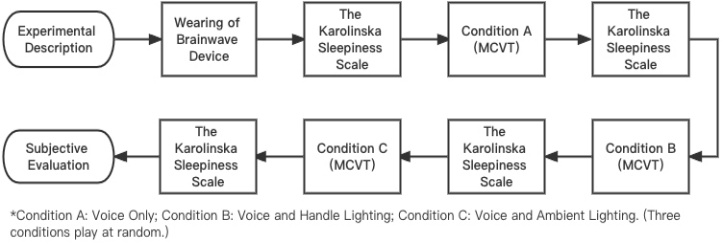
On the experiment day, participants were asked to complete a brief questi- onnaire concerning their sleep and drug-taking behaviour since the previous day and fill out basic information, including age, gender, driving experiences, and driving drowsiness countermeasures. Once the participants completed the questionnaire, the experiment started according to the process shown in Figure 5. Firstly, the participants explained the experimental procedure and how to use MCVT, then they were fitted with brainwave devices and filled out the KSS as a baseline for drowsiness. After the preparation was comple- ted, we informed the participants that the experiment would begin with one hand on the steering wheel and one hand holding the MCVT button (see the
Drowsiness Prevention System in Automatic Driving – Effects of Light Position 13
Table 1. Results from repeated measures ANOVA of MCVT score.
Table available in the original PDF paper.
Mackworth Score No Light Handwheel Ambient p-Value Total 0.60 0.54 0.57 0.547 By Gender 0.53 0.42 0.51 0.535 (F) 0.64 0.62 0.59 By Driving Freq. 0.62 0.55 0.55 0.575 (< once a month) 0.58 0.57 0.59
right picture in Figure 4). Each driving condition was 20 minutes in dura- tion, and stimulus conditions were presented when MCVT was determined to be incorrect or missed. The stimulus conditions were presented in random order across the three driving conditions to eliminate bias. After each dri- ving condition, the participant was asked to redo the KSS test to compare the subjective data on sleepiness. The subjective evaluation questionnaire for the three stimuli was completed after the three driving conditions.
RESULTS
The Effect of Light Position on Attentional Focus According to the results from the independent sample t-test as shown in Table 1, there is no significant difference between each stimulus in the MCVT score (p = .547 > .05). Also, we indicated there was no significant differe- nce between MCVT score by gender (p = .535 > .05) and driving frequency (p = .575 > .05).
Comparatively, we hypothesized that each individual is different and that the ambient light affected participants differently. We separated the subje- cts into three groups according to the awake score of KSS (yes, neither, no) during the ambient light stimulus. We tested whether there were significant effects on Mackworth’s score after experiencing ambient light. As a result, each participant had no significant difference (p = .206 > .05).
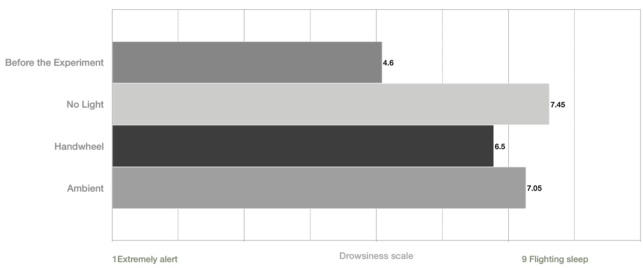
The Impact of Light Position on Drowsiness As shown in Figure 6, the results of the KSS showed that drowsiness was sli- ghtly more potent after each condition compared to before the experiment score in the questionnaire. Meanwhile, drowsiness after prolonged driving was more pronounced for participants when only voice stimulation was avai- lable. Comparatively, the handle light condition resulted in lower levels of drowsiness. In addition, we analyzed whether the KSS score differed after experiencing each stimulus. We found that the effect was identical for all three stimuli (p = .082 > .05). Also, according to the results from the inde- pendent sample t-test, there is no significant difference between the three stimuli evaluation scale by gender (p = .0821 > .05) and driving frequency (p = .0621 > .05).
Assuming that each person is different and the ambient light affected par- ticipants differently, we separated the subjects into three groups according
14 Zhang and Lee
Figure 6: Results of the Karolinska Sleepiness Scale.Table 2. Results from repeated measures ANOVA of subjective evaluation test.
to the awake score of KSS (yes, neither, no) during the ambient light sti- mulus. We tested if there was a difference in KSS score after experiencing ambient light. As a result, each participant had no significant difference (p = .613 > .05).
However, there was a significant effect between the before experiment’s KSS score and ambient score (p = .013 < .05) and handwheel score (p = .003< .005). This means using ambient and handwheel lights would significantly reduce driver drowsiness in automatic driving.
Subjective Evaluation of Lighting Position We conducted a repeated-measures ANOVA for each emotional item to deter- mine whether there were distinct effects (see Table 2). Excited, Anxious, Angry, and Strange responded similarly to each stimulus. The total rating indicated that the participants did not experience these emotions. However, the p-Value for Awake (p = .029 < .05) and Surprised (p = .003 < .05) was less than 0.05, so we performed a post hoc test to determine if there was a significant difference.
Consequently, we used Bonferroni to adjust the Pairwise Comparison for multiple comparisons (see Table 3). Regarding Awake, we could not identify a recognizable significance (p > .05). All three stimuli had the same effect on the Awake sensation. For Surprise, we found a significant difference between
Drowsiness Prevention System in Automatic Driving – Effects of Light Position 15
Table 3. Results from Bonferroni pairwise comparisons of awake and surprised.
Table available in the original PDF paper.
Bonferroni Pairwise Comparisons Awake p-Value Surprised p-Value No Light Handwheel 0.071 No Light Handwheel 0.012 Ambient 0.139 Ambient 0.890 Handwheel No Light 0.071 Handwheel No Light 0.012* Ambient 1 Ambient 0.036* Ambient No Light 0.139 Ambient No Light 0.890 Handwheel 1 Handwheel 0.036
*p < .05.
the Handwheel and No Light (p = .012 < .05) and between the Handwheel and Ambient (p = .036 < .05). The effect of the Handwheel in the feeling of Surprise was different from the effect of No Light and Ambient.
CONCLUSION
As the results showed, different combinations of light position and voice had no effect on driver concentration (p = .547 > .05). Meanwhile, neither novice nor experienced drivers had any change in driving concentration due to the lights (p = .575 > .05). However, the use of ambient lights (p = .013 < .05) and handwheel lights (p = .003 < .05) would significantly reduce driver drow- siness in autonomous driving. The drowsiness prevention stimulus with only voice reminders is far less effective than the audible combination with the light stimulus.
Furthermore, we identified the same effect of the three stimulus combinati- ons on the perception of “wakefulness”. Regarding “surprise”, the evaluation of the audiovisual experience was significantly influenced by the position of the light: participants felt more surprised when the handwheel light was displayed than with the other two stimuli (no light, p = .012; ambient, p = .036).
The findings of this study compare the effects of different light positions on the audiovisual experience and provide reference suggestions for the visual placement of drowsiness prevention systems.
ACKNOWLEDGMENT
This research was supported by the Toyota project. The author wishes to thank the subjects for participating in the experiment and the research technicians for their assistance.
REFERENCES
Ann, I.-S., 2018. A study on warning sound for drowsiness driving prevention system.
J. Acoust. Soc. Am. 143, 1961–1961. https://doi.org/10.1121/1.5036446 Balandong, R.P., Ahmad, R.F., Mohamad Saad, M.N., Malik, A.S., 2018. A Review on EEG-Based Automatic Sleepiness Detection Systems for Driver. IEEE Access 6, 22908–22919. https://doi.org/10.1109/ACCESS.2018.2811723
16 Zhang and Lee
Bazilinskyy, P., Petermeijer, S.M., Petrovych, V., Dodou, D., de Winter, J.C.F., 2018.
Take-over requests in highly automated driving: A crowdsourcing survey on audi- tory, vibrotactile, and visual displays. Transp. Res. Part F Traffic Psychol. Behav. 56, 82–98. https://doi.org/10.1016/j.trf.2018.04.001 Dinges, D.F., Maislin, G., Brewster, R.M., Krueger, G.P., Carroll, R.J., 2005. Pilot Test of Fatigue Management Technologies. Transp. Res. Rec. J. Transp. Res. Board 1922, 175–182. https://doi.org/10.1177/0361198105192200122 Janssen, C.P., Iqbal, S.T., Kun, A.L., Donker, S.F., 2019. Interrupted by my car? Impli-
cations of interruption and interleaving research for automated vehicles. Int. J. Hum.-Comput. Stud. 130, 221–233. https://doi.org/10.1016/j.ijhcs.2019.07.004 Jarosch, O., Bellem, H., Bengler, K., 2019. Effects of Task-Induced Fatigue in Prolonged Conditional Automated Driving. Hum. Factors J. Hum. Factors Ergon. Soc. 61, 1186–1199. https://doi.org/10.1177/0018720818816226 Lichstein, K.L., Riedel, B.W., Richman, S.L., 2000. The Mackworth Clock Test: A Computerized Version. J. Psychol. 134, 153–161. https://doi.org/10.1080/00223980009600858 Mardi, Z., Ashtiani, S.N., Mikaili, M., 2011. EEG-based drowsiness detection for
safe driving using chaotic features and statistical tests. J. Med. Signals Sens. 1, 130. https://doi.org/10.4103/2228-7477.95297 McDonald, A.D., Lee, J.D., Schwarz, C., Brown, T.L., 2018. A contextual and temporal algorithm for driver drowsiness detection. Accid. Anal. Prev. 113, 25–37. https://doi.org/10.1016/j.aap.2018.01.005 Murata, A., 2016. Proposal of a Method to Predict Subjective Rating on Drowsiness
Using Physiological and Behavioral Measures. IIE Trans. Occup. Ergon. Hum. Factors 4, 128–140. https://doi.org/10.1080/21577323.2016.1164765 Richman, J.S., Moorman, J.R., 2000. Physiological time-series analysis using approximate entropy and sample entropy. Am. J. Physiol.-Heart Circ. Physiol. 278, H2039–H2049. https://doi.org/10.1152/ajpheart.2000.278.6.H2039 Sahayadhas, A., Sundaraj, K., Murugappan, M., 2012. Detecting Dri- ver Drowsiness Based on Sensors: A Review. Sensors 12, 16937–16953. https://doi.org/10.3390/s121216937 Schwarz, C., Gaspar, J., Miller, T., Yousefian, R., 2019. The detection of dro-
wsiness using a driver monitoring system. Traffic Inj. Prev. 20, S157–S161. https://doi.org/10.1080/15389588.2019.1622005 Slater, J.D., 2008. A definition of drowsiness: One purpose for sleep? Med.
Hypotheses 71, 641–644. https://doi.org/10.1016/j.mehy.2008.05.035 Veksler, B.Z., Gunzelmann, G., 2018. Functional Equivalence of Sleep Loss and Time on Task Effects in Sustained Attention. Cogn. Sci. 42, 600–632. https://doi.org/10.1111/cogs.12489 Zhang, H., 2020. A User-centered Auditory Design in Interaction Between Ele-
ctric Vehicle and Pedestrian. Int. J. Affect. Eng. 19, 217–226. https://doi.org/doi: 10.5057/ijae.TJSKE-D-19-00037 Zhou, F., Alsaid, A., Blommer, M., Curry, R., Swaminathan, R., Kochhar, D., Talamonti, W., Tijerina, L., Lei, B., 2020. Driver fatigue transition prediction in highly automated driving using physiological features. Expert Syst. Appl. 147, 113204. https://doi.org/10.1016/j.eswa.2020.113204
LISTED IN THE AHFE DIGITAL BOOKSTORE CATALOGUE
Explore the complete digital volume
Intelligent Human Systems Integration (IHSI 2023): Integrating People and Intelligent Systems
Read this individual research paper free through the original publisher, or explore the full digital proceedings book.
ISBN 978-1-958651-45-2
Explore this ISBN in the AHFE Bookstore ↗Listed in the July 2026 bookstore catalogue; search by ISBN to confirm current availability · Digital book purchase optional