Zhefan Yu, Jianping Luo, Han Zhang, Ruotian Zhang, Seung Hee Lee (2022). Development of Teleoperation System for Overhead Handling Cranes. In: Ergonomics In Design. AHFE Open Access, vol. 47, pp. 248–256. https://doi.org/10.54941/ahfe1001943
To offer the possibility to achieve the teleoperation of electric overhead travelling (EOT) crane by human operators and avoid in-site hazardous operations, this study presented a technical prototype of tele-operated overhead handling (TOH) crane system using a three-axial robot. To evaluate the usability of the proposed TOH crane system, this study aimed to investigate the satisfaction of human operators during teleoperation. Specifically, we surveyed the subjective feedback of a novice group including 21 University participants and an expert group including 11 professional EOT crane operators regarding the teleoperation system. The subjective feedback was collected through a designed 7-point Likert questionnaire comprised of 11 standard questions. A typical side-to-side handling task condition was tested. The feedback of the novices in each dimension was compared with the experts. The feedback of the experts was used to evaluate the reproducibility of the prototype. The results showed that although most of the novices and experts (over 80%) agreed that the prototype TOH crane system was simple to learn and operate, the positioning assistance displaying critical information on the visual display interface (VDI) such as the relative location of items in relation to the loading area and the alignment, was crucial for the novices’ teleoperations. 91% of the experts gave positive feedback on the reproducibility of the technical prototype. The results of prototyping demonstrated the system features and explored possibilities before the in-site constructions. The results of the investigation of operators’ subjective feedback provided suggestions for developing the features of TOH cranes in the future.
The use of teleoperation regarding mechanical aids has been frequently developed in recent decades to reduce the hazardous operation of human operators in hostile environments such as factory or the construction field (Alonso et al. 2008; Tiwari et al. 2013; Kim et al. 2009; Kim et al. 2009; Hanna et al. 2013; Hannu et al. 2012; and Karvonen et al. 2014). The manu- ally operated electric overhead traveling (EOT) cranes are widely applied
Development of Teleoperation System for Overhead Handling Cranes 249
for objects handling in heavy engineering, which translates in-site human commands into three-axial crane movements through a limited distance on the shopfloor (Sen et al. 2000; Lee 1998). Although mechanical improve- ments such as body and hoist stabilization (Chen et al. 2007; Masoud 2009; Ju et al. 2006) has been frequently made, the safety issue of human operators resulted from mid-air operations still exists. Previous studies rarely discussed the teleoperation specified with EOT cranes. Therefore, the development of technical prototype system associates with a tele-operated overhead hand- ling (TOH) crane used to evaluate the usability and feasibility before in-site construction, has become the motivation of this study.
In related works of teleoperations, the prototype has been commonly developed in demonstrating the system features and explore possibilities before employing with the part’s complete development, and gaining essen- tial insights into the desires of human operators in natural Human-machine interaction. (Chi et al. 2001; Chi et al. 2014) used a rapid prototype to eva- luate and compare the effect of interfaces on task performances regarding industrial applications. A 6 DoF KUKA robotic arm was used to simulate a tower crane’s mechanism. Four installed IP cameras sensed environment information were equipped, providing human operators with multiple angles of view related to in-site operations. (Mower et al. 2019) applied a 7DoF KUKA LWR, dedicating to properly simulate the tele-operated constrained tasks. The tasks were extracted to a series of multi-directional tasks assigned with human operators. Notably, the purposes of mentioned studies were to enable human operators quite from dangerous laboring environments to a main control room.
To optimize general experiences in operating, the concept of Human- centered Design has been declared in previous studies (Scheneider et al. 1980, Kling 1977). On the one hand, overall HFE (Human factors & Ergonomics) concern can quantitatively verify how the workloads, performance, and other human-related issues are affected (Chen et al. 2007; Murphy et al. 2004; Voshell et al. 2005). For example, (Doisy et al. 2017) identified the effects of control interfaces for cameras and motions of a robot on human operators in a tele-operated maze travelling task. On the other hand, flexible, labor- saving, and light weighted investigation approaches for gaining feedback from users were widely used at the stage of usability test, in previous studies. (Chi et al. 2012) surveyed the subjective feedback of participants comprised novices and experts to a teleoperation system of the tower crane through a standard 7-point Likert questionnaire (Chi et al., 2012). To that regard, the design of a Human-centered system should consider not only the demands from the professions, but also the needs of the beginners. Moreover, impro- vements of satisfaction regarding the usability of the teleoperation system has been addressed in many previous studies (Son et al. 2013; Sano et al. 2001; Penizzotoo et al. 2015).
Compared to previous research, this study tended to introduce a techni- cal prototype of TOH crane system by modifying a three-axial robot named MK3S+ (Prusa research. access: 2021, Amza et al. 2017). Additionally, this study aimed at investigating and comparing the subjective feedback and satisfactions of participants regarding the usability of the prototype
system. Following that, we conducted the experiments with a 21-participant novice group and a 11-participant expert group. A simulated iron blocks’ handling task was remotely operated by each participant with a typical side- to-side layout. After the tasks, the subjective feedback and satisfaction to the prototype system, were collected through a standard 11-question Likert questionnaire proposed by (Chi et al. 2012).
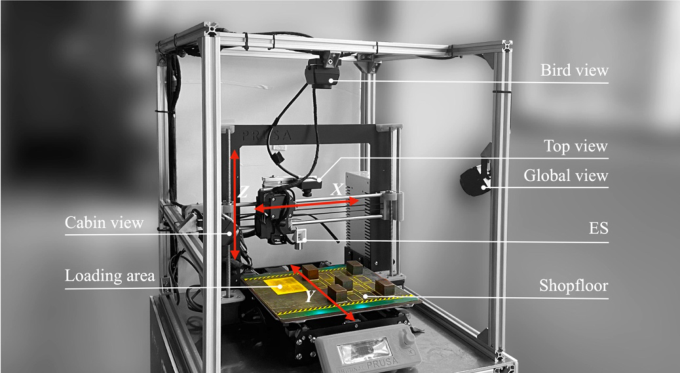
DEVELOPMENT OF PROTOTYPE SYSTEM Each EOT crane has three main controls: longitudinal traveling (LT) of the crane itself; cross-traveling (CT) of the trolly; hoisting control (HC) of the spreader (Sen and Das. 2000; Lee 1998). A trolly-mounted electromagnet spreader (ES) is frequently used to attract ferromagnetic materials such as iron. Because of the safety protocol in factories, it was difficult to manually operate a real crane for experiment-use. To that regard, we found that a three-axial robot named MK3S+ (Prusa research. access: 2021) has a similar mechanism to the EOT crane. The X, Y, and Z axial movements of MK3S+ can be accordingly translated into the CT, LT, and HC control of the EOT crane. The open-source and structurally editable features of MK3S+ has been suggested by a previous study, which were appropriately customized in a Bio-printer accomplishing precise fabrications (Bessler et al. 2019).
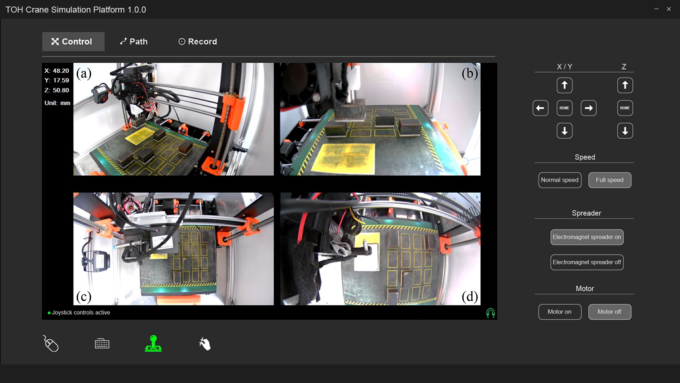
A mechanical modification was made into MK3S+. A 1W 10N 12V cup- like electromagnet spreader (ES), 8 = 12 mm, was connected to the modified extruder (trolly). Four views streamed through four mounted mini-sized IP cameras, which were employed for environmental sensing: general informa- tion including the equipment, shopfloor, and objects was provided by global view; a conventional observing position from the EOT crane was provided by cabin view; general coordinating information at the top was provided by the bird view; detailed coordination between objects and the shopfloor was pro- vided by the top view synchronized with the movement of trolly. Four views are shown in Figure 1. The prototype system was driven by a programmed micro controller board named Raspberry Pi 4B. A designed controller sof- tware was pre-installed on a PC, enabling operators remotely interact with the equipment through the interface menu in a teleoperation room (TR). The iconic control menu including movements control, ES control, two levels of speed control, was located next to the four views. Contents displayed on a monitor was compared to the visual display interface (VDI), displaying envi- ronment information and control information. The spatial parameters were sensed from the actual lifting and handling filed (LHF) by an original Super- PINDA sensor. A typical side-to-side handling trial was simulated by a coated build plate (shopfloor). In that case, five iron blocks were handled from fixed positions to a loading area on the other side by operators. Dimensions were scaled accordingly.
METHODS
A novice group including 21 University students (MAge = 24.3 ± 2.7 years old) participated in the experiment. The expert group including
Development of Teleoperation System for Overhead Handling Cranes 251
Figure 1: Lifting and handling field (LHF).
11 professional EOT crane operators (MAge = 39.5 ± 4.5 years old) com- pared the subjective feedback and satisfaction to the system with novices. In addition, the reproducibility of the prototype system was evaluated by the feedback from the experts.
Participants remotely operated the handling tasks in a separated TR. The distance between the TR and LHF was 15m. The LHF was in a standard lab environment. The experiment was performed in a LAN environment with the peak download speed of 432.47 Mbps, while the peak network latency was 3 milliseconds, where unsynchronized movements could be barely sensed. As for the handling task, Participants were required to remotely handle all five iron blocks to the loading area.
The subjective feedback and satisfaction to the prototype system were col- lected the from participants by using a 7-point Likert questionnaire after the task. There are 11 standard questions in the questionnaire, which were employed by the previous study (Chi et al. 2012): Q1: Overall, I am satisfied with how easy and simple is it to use this system. Q2: I can effectively complete tasks using this system. Q3: I feel comfortable with using this system. Q4: It was easy to learn and to use this system. Q5: The system provides simple and straight forward information for me to load objects accurately. Q6: The system gives enough accurate position cue on VDI which clearly helps me to make adjustment. Q7: Information that I need is easy to find. Q8: Information on Visual display interface (VDI) is easy to comprehend. Q9: All functions that I expect to gain are integrated in this system. Q10: Overall, I am satisfied with using this system. Q11: Generally, I think this system is reproducible to the reality.
Figure 2: (a) Visual display interface (VDI).
Satisfaction was defined by Q10. From Q1 to Q10 were used for evaluating the usability of the prototype system from both novices and experts, while Q11 was specified for the participants from the expert group, which were used for identifying whether the prototype system was reproducible to the real situation in the field. The last question was specified for the participants from the expert group, which were used for identifying whether the prototype system was reproducible to the real situation in the field.
RESULTS
Figure 2 shows the results of subjective feedback survey regarding the pro- totype system, in percentage. Feedback above “neither agree nor degree” was defined as positive, while the others below “neither agree nor degree” was negative.
As for the novice group, most of negative feedback was given in Q6: “The system gives enough accurate positioning cue which clearly helps me to make adjustment”and Q9: “All functions that I expect to gain are integrated in this system”. The participants from the novice group gave 50% negative feed- back and 17% positive feedback in having enough positioning cue from the visual display interface (VDI), 23% of them were dis-satisfied with the mis- sing functions such as visual assistance that could aid them to ad-just the attracting and releasing process accurately. Contrarily, as for the participants from the expert group, they gave over a half positive feedback on each scale of questions. Compared with the novices, 81% positive feedback and 1% negative feedback were given by the participants from the expert group in Q6, while 82 % of them thought all expected functions were integrated with the prototype TOH crane system, in Q9. Generally, over 80% of the parti- cipants from the novice group and the ex-pert group were satisfied with the prototype TOH crane system. Specifically, over 80% of the participants were agreed with how-easy-to-learn-and-use the prototype system was as well.
Development of Teleoperation System for Overhead Handling Cranes 253
Figure 3: The results of subjective feedback survey regarding the prototype system, in percentage.
Figure available in the original PDF paper.
Moreover, in terms of the extended Q11 for the experts: “Overall, I think this system is reproducible to the reality”, 91% of the experts thought the prototype system was reproducible enough to the real situation in the field.
A regression analysis was conducted with the novices to deduce the importance of answered questions (subjective feedback) for the general sati- sfactions. Questions were applied as predictor of satisfaction. As for the novice group, Q1 (p = .535), Q2 (p = .311), Q3 (p = .682), Q4 (p = .398), Q5 (p = .919), Q6 (p = .194), Q7 (p = .470), Q8 (p = .088) were found no significance. Q9: “All functions that I expect to gain are integrated in this system” (p < .0001) was found be statistically significant, and its coefficient was β = .751, respectively.
DISCUSSION & CONCLUSION
Figure 3 shows the comparison of subjective feedback and satisfaction to the prototype TOH crane system between questions, in percentage. As for the experts, they gave more than 80% positive feedback in each question. Spe- cifically, the experts gave less than 10% negative feedback in lack of visual positioning cue on visual display interface (VDI) due to their over five-years experiences. However, the novices were dissatisfied with the missing features of positioning assistance on VDI, because they were strongly discomforted with locating the position of the crane through limited angles of view. Com- pared with the experts, the novices had little to no experience in finding references in the environment. To solve this issue, critical information from the environment must be recognized, such as the relative location of items in relation to the loading area and the alignment of the ES with the objects.
In order to assist those operators who were lack of operation experiences, there are two potential techniques could be applied. First, displaying such critically informative VDI by using augmented path plan similar to the fea- ture proposed by (Chi et al. 2012), which might enable operators focus on the key control of operations instead of being distracted by the real time posi- tions between the objects and construction field such as alignment. Second, because of the visual limitations during cranes’ teleoperations addressed by (Abdullah and Handroos. 2017), the improvements on available visual infor- mation provided by previous studies (Jouppi 2002) might assist to the human perception (Burke et al. 2004; Turro et al. 2001).
Based on importance of Q9: “All functions that I expect to gain are inte- grated in this system” suggested by the results of regression analysis, to build a novice friendly TOH crane system, the integration of expected functions has to be prioritized, otherwise the satisfaction of the beginners significantly affected in teleoperation. To that regard, although the consideration towards technical feasibility in real situation, engineers and researchers are suppo- sed to identify and cluster the required functions and features from novice operators.
Due to the lack of operation experiences, half of the novices encountered positioning and locating issues through limited angles of view in teleopera- tion. In that case, the critical information indicating the relative coordination between objects and the environment on the VDI, providing visually availa- ble telepresence has become necessary. This study explored the possibilities to build a reproducible prototype TOH crane system before in-site constructi- ons. To construct a novice-friendly TOH crane system in the future, this study provided suggestions to optimize the level of integration regarding system features and improve the visual accessibility of interface menus on the VDI.
ACKNOWLEDGMENT
This research was supported by JST SPRING, Grant Number JPMJSP2124. We would like to thank Shengxian Hu, Ye Tian for data collection and all participants for helping complete this study. We would like to thank TQCC Co., Ltd of China for providing technical supports.
REFERENCES
Abdullah, U.N.N., and Handroos, H. (2017), “Investigation on sense of control parameters for joystick interface in remote operated container crane application.” Proc. AIP Conf, 1885, 020077. Alonso, D., Sánchez, P., Ortiz, F., Pastor, J., Álvarez, B., and Iborra, A. (2008), “Expe-
riences Developing Safe and Fault-Tolerant Tele-Operated Service Robots: A Case Study in Shipyards.” Serv. Robot, 159–182. Amza, C.G., Zapciu, A., and Popescu, D. (2017), “Paste Extruder—Hardware Add- On for Desktop 3D Printers.” Technologies, 5, 50. Bessler, N., Ogiermann, D., Buchholz, M.B., et al. (2019), “Nydus One Syringe
Extruder (NOSE): A Prusa i3 3D printer conversion for bioprinting applications utilizing the FRESH-method.” HardwareX, 6, e00069.
Development of Teleoperation System for Overhead Handling Cranes 255
Burke, J.L., Murphy, R.R., Coovert, M.D., and Riddle, D.L. (2004), “Moonlight in Miami: Field study of human-robot interaction in the context of an urban sea- rch and rescue disaster response training exercise.” Hum.-Comput. Interact, 19, 85–116. Chen, J.Y.C., Haas, E.C., and Barnes, M.J. (2007), “Human performance issues and
user interface design for teleoperated robots.” IEEE Trans. Syst. Man Cybern Part C Appl. Rev, 37, 1231–1245. Chen, S.J., Hein, B., and Wörn, H. (2007), “Swing attenuation of suspended objects transported by robot manipulator using acceleration compensation.” In Procee- dings of IEEE/RSJ International Conference on Intelligent Robots and Systems, San Diego, CA, USA, 29 October–2 November, 2919–2924. Chi, H., Kim, J., Chen, Y., Kang, S., Song, J., and Hsieh, S. (2012), “Development of
user interface for tele-operated cranes.” Adv. Eng. Inform, 26, 641–652. Chi, H.L., Kang, S.C., and Hsieh, S.H. (2001), “Experiences on designing user interfaces for a tele-operated crane.” In Proceedings of 11th International Con- ference on Construction Ap-plications of Virtual Reality, Weimar, Germany, 3–4 November, 413–424. Chi, H.L., Kang, S.C., Hsieh, S.H., and Wang, X. (2014), “Optimization and eva-
luation of automatic rigging path guidance for tele-operated construction crane.” In Proceedings of the ISARC, the International Symposium on Automation and Robotics in Construction, Sydney, Australia, 9–11 July, 31, 1. Doisy, G., Ronen, A., Edan, Y. (2017), “Comparison of three different techniques for camera and motion control of a teleoperated robot.” Appl. Ergon, 58, 527–534. Hanna, K., Hannu, K., Helena, T. (2013). User experience targets as design drivers:
A case study on the development of a remote crane operator station. In Proce- edings of the 31st European Conference on Cognitive Ergonomics, New York, USA, 26–28 August, 25, 1–9. Hannu, K., Hanna, K., and Jaakko, H. (2012), “Enhancing the user experience of the crane operator: Comparing work demands in two operational settings.” In Pro- ceedings of the 30th European Conference on Cognitive Ergonomics, New York, USA, 28–31 August, 37–44. Jouppi, N.P. (2002), “First steps towards mutually-immersive mobile teleprese-
nce.” In Proceedings of the 2002 ACM Conference on Computer Supported Cooperative Work, New York, NY, USA, 16–20 November, 354. Ju, F., Choo, Y.S., and Cui, F.S. (2006), “Dynamic response of tower crane induced by the pendu-lum motion of the payload.” Int. J. Solids Struct, 43, 376–389. Karvonen, H., Koskinen, H., Tokkonen, H., and Hakulinen, J. (2014), “Evaluation of
User Experience Goal Fulfillment: Case Remote Operator Station.”In Proceedings of Virtual, Augmented and Mixed Reality, LNCS, 8526. Kim, D., Kim, J., Lee, K., Park, C., Song, J., Kang, D. (2009). Excavator tele-operation system using a human arm. Autom. Constr. 18, 173–182. https://doi.org/10.1016/j.autcon.2008.07.002. Kim, D., Oh, K.W., Hong, D., Kim, Y.K., and Hong, S-H. (2013), “Motion control
of excavator with tele-operated system.” In Proceedings of the 26th International Symposium on Automation and Robotics in Construction (ISARC), Austin, TX, USA, 24–27 June, pp. 341–347. https://doi.org/10.22260/ISARC2009/0055. Kling, R. (1977), “The organizational context of user-centered software designs.”
MIS Q, 1, 41–52. https://doi.org/10.2307/249021. Lee, H.H. (1998), “Modeling and control of a three-dimensional overhead crane.”
J. Dyn. Syst. Meas. Control, 120, 471–476.
Masoud, Z.N. (2009), “Effect of hoisting cable elasticity on anti-sway controllers of quay-side container cranes.” Nonlinear Dyn, 58, 129–140. Mower, C.E., Merkt, W., Davies, A., and Vijayakumar, S. (2014), “Comparing
Alternate Modes of Teleoperation for Constrained Tasks.” In Proceedings of the IEEE 15th International Conference on Automation Science and Engineering, Vancouver, BC, Canada, 22–26 August, 1497–1504. Murphy, R.R. (2004), Human-Robot interaction in rescue robotics. IEEE Trans.
Syst. Man Cybern. Part C Appl. Rev, 34, 138–153. Penizzotto, F., Slawiñski, E., Salinas, L.R., and Mut, V.A. (2015), “Human-centered control scheme for delayed bilateral teleoperation of mobile robots.” Adv. Robot, 29, 1253–1268. Prusa Research: Prusa i3 MK3S+. Available online: https://www.prusa3d.com/
(accessed on 13 March 2021). Sano, A., Fujimoto, H., and Takai, T. (2001), “Human-centered scaling in micro-teleoperation.” In Proceedings of 2001 ICRA, IEEE International Confe- rence on Robotics and Automation, Seoul, Korea, 21–26 May, 1, 380–385. Schneider, M.L., Arble, F.B., Olson, N., and Wolff, D. (1980), “An overview of ergo-
nomic considerations in computer systems.” In Proceedings of the 7th Annual Computer Personnel Research Conference, 116–124. Sen, R.N., and Das, S. (2000), “An ergonomics study on compatibility of controls of overhead cranes in a heavy engineering factory in West Bengal.” Appl. Ergon, 31, 179–184. Son, H.I., Franchi, A., Chuang, L.L., Kim, J., Bulthoff, H.H., and Giordano, P.R.
(2013), “Human-Centered Design and Evaluation of Haptic Cueing for Teleope- ration of Multiple Mo-bile Robots.” IEEE Trans. Cybern, 43, 597–609. Tiwari, R., Knowles, J., and Danko, G. (2013), “Bucket trajectory classification of mining excavators.” Autom. Constr, 31, 128–139. Turro, N., Khatib, O., and CosteManiere, E. (2001), “Haptically Augmented
Teleoperation.” In Proceedings of the 2001 ICRA, IEEE International Conference on Robotics and Automation, Seoul, Korea, 21–26 May, 1, 386–392. Voshell, M., Woods, D.D., and Phillips, F. (2005), “Overcoming the keyhole in human-robot coordination: Simulation and evaluation.” Proc. Hum. Factors Ergon. Soc. Annu. Meet, 49, 442–446.
LISTED IN THE AHFE DIGITAL BOOKSTORE CATALOGUE
Explore the complete digital volume
Ergonomics In Design
Read this individual research paper free through the original publisher, or explore the full digital proceedings book.
ISBN 978-1-958651-23-0
Explore this ISBN in the AHFE Bookstore ↗Listed in the July 2026 bookstore catalogue; search by ISBN to confirm current availability · Digital book purchase optional