Saga Masaki, Kurashiki Tetsusei (2026). Analysis of resource requirements in business planning using Futurability Education approach. In: Creativity, Innovation and Entrepreneurship. AHFE Open Access, vol. 206, pp. 77–84. https://doi.org/10.54941/ahfe1007385
This paper examines the organizational and methodological resources required for business enterprises to formulate business plans and product concepts based on the principles of Future Design. While Future Design emphasizes long-term and intergenerational perspectives in decision-making, little empirical research has systematically analysed the resources needed for its practical application in business planning contexts. To address this gap, this study analyses a Future Design–based workshop conducted in a corporate setting. The workshop was designed as a short-term, educational intervention that enabled participants to explore business plans from both an extended present perspective and a future-oriented perspective more than 20 years ahead. Visual facilitation through graphic recording was incorporated to support shared understanding and reflection. Empirical analysis draws on questionnaire responses from participants and video recordings of workshop discussions, allowing for both quantitative and qualitative examination of deliberative processes. The findings identify several key resources that support effective Future Design–based planning in business settings, including structured facilitation, visual representation of discussions, and diverse team composition. These elements enhance reflective dialogue, clarify trade-offs between present and future perspectives, and improve the overall quality of decision-making. This study contributes to the literature on Future Design by clarifying the resources necessary for its implementation and provides practical implications for long-term-oriented business and innovation planning.
RESEARCH OBJECTIVES With the rise of GAFA (Google, Apple, Facebook and Amazon) leading to increasingly prominent de facto standardization, Europe shows contrasting movements. Through the EU Commission, technological standardization policies are becoming the glue binding national strategy, academic strategy, and business strategy. Regarding European technology standardization, for instance, they are seeking countermeasures through de jure standardization. Examples include the General Data Protection Regulation (GDPR) for personal information protection and the “European Green Deal” framework for environmental issues, aiming to achieve European carbon neutrality by 2050 and reflecting this goal in national legislation. These European trends
78 Saga and Kurashiki often incorporate elemental technologies based on long-term strategies. We consider long-term strategies particularly important, as they prioritize not only the gains of the current generation but also the interests of future generations, aiming to hand down a sustainable society to them. Therefore, focusing on Future Design as described later, we conducted workshops to examine long-term corporate strategies. The objective of this research was to analyse shifts in awareness from the perspectives of both the current generation and hypothetical future generations.
FUTURABILITY EDUCATION AS RESEARCH BASIS Future Design is an academic discipline that explores the design and implementation of societal structures enabling people to realize their potential in the future (Saijo, 2016).
One approach within Future Design is the concept of “hypothetical future generations” (Saijo, 2020). This involves creating hypothetical future generations within the current generation to represent the perspective of future generations. By thinking from the perspective of these hypothetical future generations about what the current generation should do for the interests of future generations, we can hold the expectation that even if the present becomes one year later, the points of evaluation will likely change only slightly. This approach is expected to be useful for business strategy planning, product roadmap development, and long-term technology strategy.
Furthermore, research is being conducted on Futurability Education as a new field of practice to activate human future potential. Kurashiki defines Futurability Education as “education that draws out and recognizes the future potential inherent in all people to varying degrees, cultivating decision- making through thinking training and trade-off exercises.” He emphasizes the importance of education that nurtures this future potential through exercises incorporating the perspective of a hypothetical future generation, thereby developing the capacity to apply it to solving societal problems and making decisions. While this research was implemented in educational settings constrained by timeframes, similar application is expected in business contexts where time for thorough deliberation is often limited.
FEATURES OF THIS STUDY This section describes the positioning of this study relative to previous research. As a practical application of future design in industry, using Business Model Campus (Hereinafter referred to as BMC) as a business tool within workshops for new business development has confirmed that discussions involving a hypothetical future generation reveal shifts in the perspectives prioritized compared to discussions by the current generation, along with increased awareness of a broader range of stakeholders.
However, when using business frameworks like BMC for business planning or product roadmap development, understanding these frameworks becomes a prerequisite for participation. This can lead to uneven discussions due to
Analysis of Resource Requirements in Business Planning 79 varying levels of participant comprehension. Additionally, there is a concern that reevaluating such discussions a year later would require significant time for reflection.
This study focuses on analysing the verbal information and video footage of workshop participants to examine differences between the current generation and hypothetical future generations, specifically for business planning based on future design principles.
RESEARCH METHOD In general, it is often reported that predicting the future frequently induces anxiety. Zaleski et al. (2019), while developing the Dark Future Scale (DFS) as a short version of the Future Anxiety Scale, demonstrated that both the temporal dimension and the negativity dimension influence feelings. This DFS has been adapted into various language versions, for example, Zhang (2026) developed in Japanese. Based on this, we compare differences in the time dimension and negativity between the current generation and a hypothetical future generation.
Furthermore, Ishii reported that workshops using graphic recording positively impact the discussion process itself, such as reducing dissatisfaction with speaking time and promoting shared understanding of key points (2022). The use of graphic recording as a method to reduce negativity and enhance meaningful discussion will be analysed within the timeframe dimension.
Therefore, this study will proceed by deriving the necessary functions to leverage the essence of Future Design within a short timeframe while engaging stakeholders, based on the following two points.
1. Analysis based on questionnaires completed by participants 2. Analysis of workshop discussion dynamics via video/audio recording Specifically, the process incorporates visualizing participants’ spoken content through graphic recording. Furthermore, a facilitator is explicitly assigned to identify how roles function within the group.
WORKSHOP The workshop serving as the analytical starting point for this research was structured around the theme “Considering Green Transition.” To ensure equal opportunities for participation in the discussion and to create an environment where each participant could speak freely and interact fully, the workshop was implemented by dividing the eight participants into two groups of four. Both groups discussed the same theme, materials, procedures, and time allocation; the grouping itself was not intended to have any comparative experimental significance.
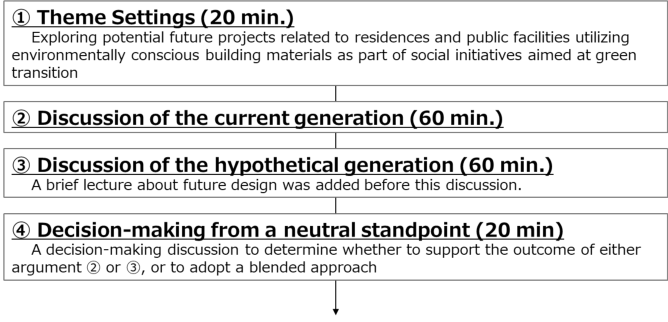
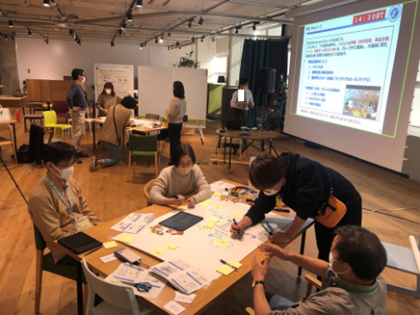
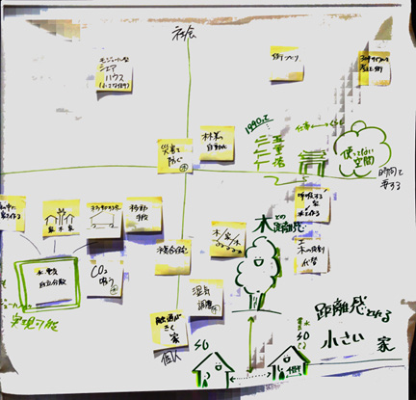
The workshop flow consisted of the four parts shown in Figure 1. Figures 2 and 3 illustrate workshop scenes and examples of outputs.
Figure 1: Workshop flow.Figure 2: Workshop scene.Figure 3: Example of output from graphic recorder.
ANALIYSIS USING QUESTIONNAIRES THROUGH THE WORKSHOP Participants completed questionnaires at three points:
1) before discussion, 2) after discussion within their generation, and 3) after neutral decision-making.
Changes in responses regarding fulfilment and anxiety levels during deliberation were analysed. The results are shown in Figure 4. The questionnaire used a 5-point scale (5: Fully satisfied - 1: Anxious).
Figure 4: Summary of satisfaction/anxiety levels and seated time.
While positive changes were observed in participants’ attitudes toward “Green Transition” from a state of relatively low personal sensitivity, following discussions about the current generation, anxiety levels increased slightly after discussions about hypothetical future generations and after making decisions from a neutral standpoint. This shift in awareness is also observable when comparing seated time during discussions. This suggests a need for measures to alleviate anxiety about long-term perspective deliberations through some means.
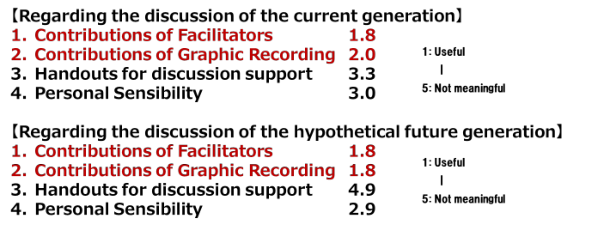
Additionally, we surveyed participants on the useful functions for each work session—discussions with the current generation and discussions with the hypothetical future generation—and analysed effective functions. The survey used a 5-point scale (1: Useful - 5: Not very meaningful). The results are shown in Figure 5.
Figure 5: Responses on useful features for group work.
Both the current generation and the hypothetical future generation showed high facilitator contributions. Furthermore, graphic recording contributed to discussions about the hypothetical future generation, as evidenced by
82 Saga and Kurashiki improved scores. This result aligns with Ishii’s research and suggests that using graphic recording to predict and discuss an uncertain future has a positive effect on the temporal dimension. The discussion cards (pre- provided information) prepared for the discussions also suggest they were not particularly useful when considering the future in 2050. On the other hand, the pre-provided information served only to share foundational knowledge. Even in the graphic recording, the pre-provided information remained as keywords, but these were extremely small compared to the objects depicted.
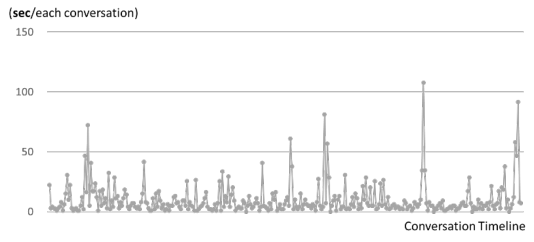
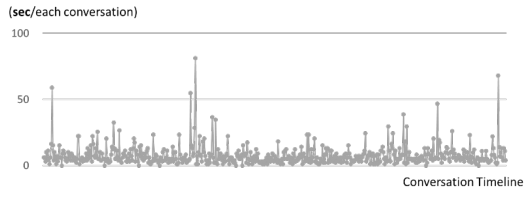
ANALYSIS USING VIDEO/AUDIO THROUGH THE WORKSHOP From the video and audio recorded during the workshop, we plotted the time speakers made statements against the elapsed time axis to compare discussions in the current generation with those in the hypothetical future generation. Results are shown in Figures 6 and 7 and Tables 1 and 2.
In the discussions of the hypothetical future generation, both the group as a whole and each individual member spoke for shorter durations. Furthermore, the variation in speaking time among members was smaller. It was also evident that the frequency of speakers was less skewed.
In the discussions of the current generation, speakers sometimes incorporated their own experiences, resulting in numerous instances where a single utterance exceeded 50 seconds in length. Conversely, in discussions among the hypothetical future generation, survey responses revealed anxiety about envisioning the future. This led to shorter individual speaking times. Furthermore, comments in the open-ended questionnaire sections indicated an increase in speech related to others’ contributions, rather than relying on personal feelings, which also contributed to shorter speaking times. Additionally, the discussions among the hypothetical future generation suggest that discussions can progress even with less frequent intervention by the facilitator to manage the session.
Figure 6: Changes in speaking time during group work. (Discussion as the current generation).Figure 7: Changes in speaking time during group work. (Discussion as hypothetical future generation).Table 1: Summary of member speeches during group work. (Discussion as the current generation).
Table available in the original PDF paper.
Person Total Speaking Time (sec)
Number of Times Spoken (Times)
Average Speech Duration (sec)
Standard Deviation A 1327 128 10.37 15.16
B 905 85 10.65 11.88 C 398 49 8.11 7.39
D 431 44 9.80 17.16
Table 2: Summary of member speeches during group work. (Discussion as hypothetical future generation).
Table available in the original PDF paper.
Person Total Speaking Time (sec)
Number of Times Spoken (Times)
Average Speech Duration (sec)
Standard Deviation A 908 156 8.23 10.67
B 918 162 7.38 5.72 C 300 66 6.02 4.58
D 909 152 7.14 5.62
CONCLUSION
This study conducted workshops aiming for business consideration within industry using Future Design concepts. It focused on participating members and deliverables to identify their respective usefulness, characterized particularly by the use of graphic recording.
Considering from the perspective of a hypothetical future generation corresponds to long-term perspective consideration. However, it suggested that measures are needed to alleviate members’ anxieties through some means. Adding real-time visual information, such as graphic recording, was suggested as a means to dispel this anxiety.
Furthermore, discussions from the perspective of a hypothetical future generation suggested that progress could be made without excessive facilitator intervention, through participants supplementing or building upon each other’s statements, or by utilizing visual information.
These insights suggest that incorporating visual information, such as graphic recording, into discussions about hypothetical future generations
84 Saga and Kurashiki that leverage the temporal dimension could alleviate participants’ anxieties, foster psychological safety, and facilitate the progression of discussions.
Moving forward, it is necessary to validate this as an effective function when introducing future design concepts into industry through multiple approaches. These include analysing survey responses, examining the content and atmosphere of statements made during visual information utilization in workshops, and comparing findings across various workshops.
REFERENCES
General Data Protection Regulation (GDPR) (2016): https://gdpr-info.eu/ The European Green Deal, European commission (2019): https://commission.
europa.eu/strategy-and-policy/priorities-2019-2024/european-green-deal_en Tatsuyoshi Saijo,et al (2015) “Future Design A society looking ahead to the 7th generation”, Keiso Shobo. Tatsuyoshi Saijo (2020), “Future Design: Toward Sustainable Nature and Society for
Future Generations”, JJILA 84(1), 2020. Teteusei Kurashiki, “Futurability Education Based on Future Design”, JSEE 70-2 pp. 94–99 (2022). Tomohiro Hosomi, Motoki Kondo, Kazuhito Wakamoto, Keishiro Hara, Tetsuo
Kurashiki, (2023) “Effectiveness Verification of Future Design for New Business Proposals in Companies,” Research and Technology Planning Vol. 38, No. 1 Zaleski, Z., Sobol-Kwapinska, M., Przepiorka, A., & Meisner, M. (2019).
Development and validation of the Dark Future scale. Time & Society, 28(1), 107–123. Ze Zhang, Takashi Horiuchi, and Małgorzata Sobol, “Development and Validation of the Japanese Version of the Dark Future Scale”, The Japanese Journal of Personality 2026, Vol. 34, No. 3, 247–249. Yoko Ishii, Momoko Nakatani and Masahiro Watanabe(2022), “Effectiveness of
Graphic Recording in Co-Creative Meeting”, Human Interface 24(1) pp. 37–52.
LISTED IN THE AHFE DIGITAL BOOKSTORE CATALOGUE
Explore the complete digital volume
Creativity, Innovation and Entrepreneurship
Read this individual research paper free through the original publisher, or explore the full digital proceedings book.
ISBN 978-1-964867-82-3
Explore this ISBN in the AHFE Bookstore ↗Listed in the July 2026 bookstore catalogue; search by ISBN to confirm current availability · Digital book purchase optional