Innovation activities in companies are essential for maintaining competitiveness in the market. In the early stages of innovation, which is known as “Fuzzy Front End”, diversity is crucial aspect. However, managing this diversity can be challenging due to conflicts caused by factors related to differences in positions or expertise. This paper introduce three types of Boundary Media (BM), which are panels explaining existing ideas, idea sketch sheets for activity participants to describe their ideas, and artist-created artworks, they were introduced into the early stages of two corporate innovation activities and researchers verified their effects. The artist conducted interviews to understand activity background, challenges, and vision of each innovation activity and created unique artworks that embodied the themes of the innovation activities based on the inspiration gained from the interviews. These works were introduced in idea creation workshops conducted for each innovation activity, and their effects were examined. The results showed that the artworks served as powerful sources of inspiration, eliciting participants' tacit knowledge, providing new perspectives, and facilitating intrinsic motivation for innovation. The workshops generated an average of more than two ideas per participant, yielding ideas and perspectives different from those of conventional models, which will be considered afterward. Notably, one of the two companies, recognized that the artist's work expressed the essence of their innovation activity and resonating with it, subsequently artists commissioned to create a logo for the innovation activity. This indicates that the artist-created works influenced the long-term direction of the innovation activity. The results of this study suggest that artists creating unique works that embody innovation activities and intervening in innovation activities as Boundary Media can stimulate the tacit knowledge of activity members, appeal to their creativity, and encourage them to recapture the essential concepts of the innovation activities, potentially fostering innovation activities. Future research will clarify the specific qualities and unique characteristics of artworks and the mechanisms of intervention effects on innovation activities to encourage practitioners foster innovation activities.
Innovation is a central challenge in modern corporate management strate- gies, requiring collaboration with diverse stakeholders and the management of that diversity (Anderson et al., 2014). The early stages of innovation, often
referred to as the Fuzzy Front End, which involve high level of uncertainty and requires diverse perspective to explore new opportunities and generate novel ideas (Gassmann and Schweitzer, 2014; Sanders et al., 2008). How- ever, managing this diversity can be challenging due to conflicts arising from differences in position and expertise within the organization (Bissola and Imperatori, 2011).
An interview survey conducted by the author with nine experienced inno- vation activity participants, the interview revealed that various media were ultimately used in corporate innovation activities, facilitating innovation. Based on this finding, researchers defined BM as media intentionally intro- duced at the boundaries of diverse stakeholders to facilitate collaboration in innovation activities. Workshops with diverse participants confirmed that BM, such as sculptures and idea sketches, foster catalyzing new value cre- ation by mediating information and meanings and provide inspiration for their representations (Kamiya, 2023). However, there was a clear lack of practical evidence in actual corporate projects environment.
This paper aims to examine the effects of introducing three types of BM in the early stages of two real-world corporate innovation activities which are: panels explaining existing ideas, idea sketch sheets for activity partici- pants to describe their ideas, and artworks. In particular, this paper focuses on verifying the effect of introducing artist-created artworks as BM. The study collaborated with Yoshitaka Yazu, a Japanese contemporary artist, to create the artworks. Based on insights gained from interviews with innova- tion activity stakeholders, the artist created unique works embodying each innovation activity. These works were used in idea creation workshops con- ducted for each innovation activity, and their effects were confirmed through post-implementation questionnaires and follow-up interviews.
Background: Managing Diversity in Innovation Activities With the increase in importance of diversity in innovation activities, more and more researchers started focusing on studying effective management. Chesbrough (2003) proposed the concept of open innovation, emphasizing the importance of incorporating external ideas and technologies to facili- tate an organization’s innovation activities. Additionally, Vargo and Lusch (2004) service-dominant logic highlights the importance of value co-creation with customers, providing a new perspective on innovation. Prahalad and Ramaswamy (2004) also pointed out to the importance of co-creation expe- riences for companies and customers, stating that dialogue, transparency, and risk-sharing are essential for new value creation. These studies under- score the importance of collaboration and co-creation with external parties in innovation activities.
Boundary Objects (BOs) are media that facilitate collaboration among diverse actors (stakeholders) by being flexible enough to be interpreted differently by each actor while still functioning as a common basis for under- standing (Star and Griesemer, 1989; Star, 2010). Although BOs are frequently referenced in innovation research and their role in innovation activities has been reported (Caccamo et al., 2022; Carlile, 2002; Rhinow et al., 2012),
Fostering Corporate Innovation Activities Through Artist-Created Boundary Media 157
the specific mechanisms through which media function as effective BOs still remain unexplored.
Media that mediate communication can facilitate social interaction in diverse ways, depending on their format and characteristics. McLuhan (1964) stated that “the medium is the message,” pointing out that the inherent char- acteristics of the medium are more important than the content. Based on this idea, it has been argued that media itself influence communication, and that individuals and groups construct meaning through media (Daft & Lengel, 1986; Blumer, 1986). This suggests that in innovation activities, the format and expression of the media introduced can impact communication and cre- ativity. In fact, in the research field of artistic interventions, An and Youn (2018) investigated the impact of art appreciation on individuals’ idea gen- eration and found that inspiration gained through art appreciation, which stimulates creative thinking and facilitates the generation of new business ideas. This research confirms the potential for artworks themselves to as contributors and elements to innovation, particularly in a business context.
Building on previous studies, this paper aims to examine the effects of introducing three types of BM, including artist-created works, in real-world corporate innovation activities. By investigating the mechanisms through which artist-created BM facilitate collaboration and idea creation among diverse stakeholders, this study seeks to contribute to diversity management in innovation activities and foster innovation activities.
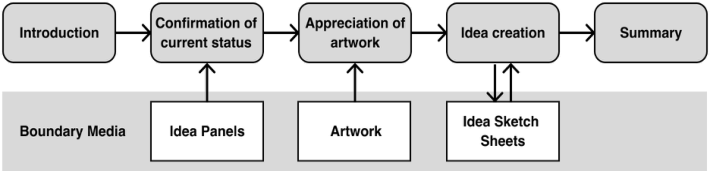
The Intervention Effects of Artist-Created Boundary Media In this paper, we introduced idea panels, idea sketch sheets, and artworks as BM for two corporate innovation activities (Activity A and Activity B) and conducted idea creation workshops. Six participants attended the workshop for Activity A, and four participants attended the workshop for Activity B. Figure 1 shows the idea creation workshop process and the BM introduced. In the workshops, after explaining the existing ideas using panels, the art- works created by the artist were presented, and the workshop participants reviewed the works and shared their insights. Subsequently, two idea cre- ation sessions were conducted. During idea creation, participants viewed the panels and artworks while drawing and writing business ideas on idea sketch sheets and sharing their ideas with each other.
Figure 1: Idea-creation workshop process.
The panels contributed to sharing existing formal knowledge, while the idea sketch sheets not only shared new ideas, but further enabled participants
158 Kamiya
to share their intentions and related knowledge behind the ideas when dis- cussing them with each other. The following explains the intervention effects of artworks as BM, from their creation to their impact after the workshops.
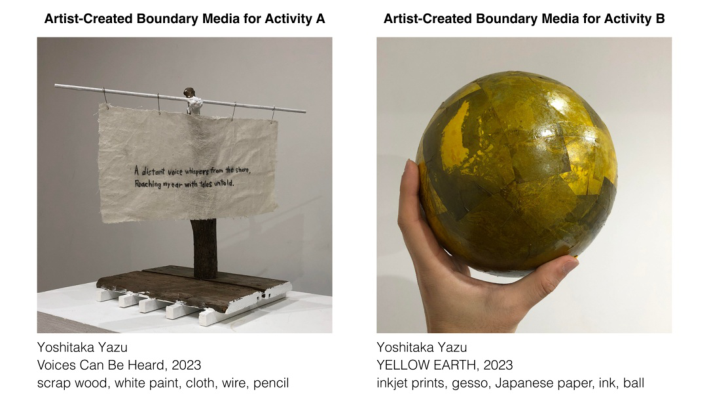
Furthermore, when creating the artwork, the artist conducted interviews for each innovation activity to gain deep understanding of the activity back- ground, challenges, and vision of each project. Based on the inspiration gained from these interviews, the artist create original works embodying each innovation activity as shown in the example artwork in Figure 2.
Figure 2: Artist-created boundary media for innovation activities.
In this study, Activity A focused on the social implementation of plant- power generation technology. Inspired by the principles and essential mean- ing of the technology, the artist created a sculptural piece titled “Voices Can Be Heard” (See Figure 2). This work created using scrap wood components, white paint, cloth, wire, and pencil. The sail of this raft-themed work is engraved with the following poem generated by ChatGPT: “A distant voice whispers from the shore, Reaching my ear with tales untold.”
The artist’s statement for this work includes the following description: “A voice that can be heard forever, no matter where you are A remote place From a place where no one is, forever”
In an interview conducted after the workshop, the artist explained his cre- ative intent as follows: “I thought that this technology might enable constant transmission of something even in a situation where there is no connection to anywhere. I imagined a poetic scene where voices continue to be heard forever from something like a drifting raft, and I created the work based on that.”
Fostering Corporate Innovation Activities Through Artist-Created Boundary Media 159
While Activity B aimed to develop new business using proprietary digital twin technology for service robots. Inspired by the principles and essential meaning of the technology, the artist created a sculptural work titled “YEL- LOW EARTH.” This work was created using inkjet prints, gesso, Japanese paper, ink, and a ball. The artist’s statement for this work includes the following description: “What becomes possible from another Earth Between the yellow Earth and the blue Earth, there may exist robots A space that is being robotization”
In an interview conducted after the workshop, the artist explained his creative intent as follows: “By controlling a virtual reality-like space, it is reflected in the real world... (omitted)... I imagined another Earth. It’s yellow, which is the complementary color of blue... (omitted)... Yellow is a relatively new color...”
Those artist statements and interview excerpts demonstrated how the artist abstracted and embodied the themes of the innovation activities, highlighting the essential concepts and possibilities of the activities. The works stimu- late the creativity of the participants who appreciate them and elicit new perspectives and interpretations of the innovation activities.
The aforementioned works created by the artist introduced into the idea creation workshops for each innovation activity. Participants engaged in idea creation after appreciating in the works and sharing the perspectives and interpretations gained from the appreciation through dialogue with each other. Through the idea creation workshops, the works served as power- ful sources for inspiration, stimulating participants’ tacit knowledge and providing new perspectives on the ideas pursued in the innovation activities.
The effect of the artworks as BM created by the artist were evident from the ideas created in the workshops. In Activity A, for example, 17 ideas cre- ated. While previously, there were many ideas about converting and utilizing the electricity obtained from plant-power generation into light, after appreci- ating the artwork, ideas based on interpretations such as transmitting, sound, and dialogue with nature were substantial and creative. In Activity B, 11 ideas were created. After investigating the artwork, interpretations of the technol- ogy developed, such as lightness, scale, and domination, led to the discovery of new perspectives and insights on the technology, resulting in the creation of ideas with a higher vantage point. In addition, there were cases where personal interpretations and awareness of issues reflected in the ideas.
Following-up on the interviews conducted, and four months after the workshops, researchers revealed the long-term impact of the BM created by the artist on the innovation activities. Participants reported that the works continued to serve as a source of ongoing inspiration and a reference point for ongoing discussions and decision-making. Notably, in Activity B, the com- pany conducting the activity pointed out that the artist’s work expressed the essence of the innovation activity and resonated with it, leading them to com- mission the artist to create a logo for the innovation activity. This clearly demonstrates the lasting influence of the work on the direction of the inno- vation activity. In Activity A, it was also reported that when explaining the
160 Kamiya
principles and meaning of the technology being pursued in the innovation activity to customers, using the artwork to communicate ideas, they were able to achieve further discussions and elicit knowledge.
The intervention process and effects of the artist-created works in this study suggested the potential for artistic BM to foster quality corporate inno- vation activities. As evidenced by the artist statements and interviews, the artist’s unique interpretations and the resulting works function as powerful BM, stimulating participants’ tacit knowledge and provide new perspectives through artistic intervention in the innovation activities. By collaborating with artists to create unique interpretations of project themes, companies will be able to introduce potent catalysts for idea generation and collaboration in the Fuzzy Front End of innovation projects. This study reveals the value of new approach to fostering innovation through the fusion of art and busi- ness, as demonstrated by the intervention process and effects of artist-created works.
DISCUSSION
The findings of this study highlights the potential of artist-created BM to stimulate and elicit tacit knowledge, provide new perspectives, and facilitate intrinsic motivation among participants in corporate innovation activities. The artworks, based on the artist’s unique interpretations of innovation activ- ity themes, served as catalysts for idea creation and collaboration in the Fuzzy Front End of innovation.
The process of artist interview further innovation activity for stakehold- ers about project overviews and vision, creating artworks based on those interviews, allowed for the abstraction and embodiment of essential con- cepts and possibilities within the innovation activities. As evidenced by the artist statements and post-workshop interviews with the artist, the art- works incorporated diverse perspectives, which are unique to the artist that were not explicitly stated in the innovation activities. The multi-layered meanings of the artworks envisioned projects in novel ways, facilitating diverse interpretations and encouraging participants to approach challenges from new angles and generate ideas that will differentiate them from conventional ones.
The effectiveness of the artist-created BM was evident in the quantity, qual- ity, and diversity of ideas generated during the workshops. Participants drew inspiration from the artworks, creating ideas that reflected personal inter- pretations and awareness of issues that matter the most, demonstrating the ability of the artworks to stimulate individual creativity and intrinsic moti- vation. Moreover, the artist-created BM, which contributed to facilitating short-term and long-term collaboration within and outside the innovation activities through the workshops, which is considered to function as BOs.
Notably, the impact of the artist-created BM extended beyond the initial workshops, influencing ongoing discussions, decision-making, and stake- holder engagement, which were related to the innovation activities. This suggests that the strategic use of artist-created BM can be a valuable approach for fostering innovation in the Fuzzy Front End of projects.
Fostering Corporate Innovation Activities Through Artist-Created Boundary Media 161
While the effectiveness of artist-created BM may depend on various fac- tors, such as artist background, characteristics, project nature, and partic- ipant receptivity, this study provides compelling evidence to highlight the potential of artistic interventions for fostering innovation in corporate set- tings. By embracing the unique perspectives and interpretive abilities of artists, companies can access new sources of creativity and insights. The fusion of art and business represents a promising approach to innovation that merits further exploration and development.
CONCLUSION
This paper introduced three types of BM - panels explaining existing ideas, idea sketch sheets for activity participants to describe their ideas, and art- works - into the early stages of two real-world corporate innovation activities and verified their effects through idea creation workshops. The results of this study illustrated that artist-created BM can facilitate collaboration in cor- porate innovation activities by providing new perspectives, stimulating tacit knowledge, and fostering intrinsic motivation, ultimately fostering innova- tion activities. These findings suggests that artistic interventions, where BM embodying the themes of innovation activities are created and introduced into the idea creation process in the Fuzzy Front End of innovation, which is a promising approach for facilitating idea creation and collaboration.
This paper contributes to innovation management research by empiri- cally demonstrating the effectiveness of artist-created BM in the context of actual corporate innovation. By introducing artworks as BM and investi- gating their effects on idea generation and collaboration in the Fuzzy Front End of innovation, this research offers novel insights into the potential of artistic interventions to foster innovation activities. The findings will extend our understanding of how artist-created BM can stimulate tacit knowledge, provide new perspectives, and facilitate intrinsic motivation among partici- pants in corporate innovation settings. However, a limitation of this study is its focus on a small number of innovation activities within specific contexts. Future research could explore the generalizability of these findings by inter- vening with artist-created BM and evaluating their effects in a wider range of corporate environments or different industries and contexts. Furthermore, investigating the perspectives of artists involved in such interventions may provide insights into the process of creating effective BM and the unique contributions that artists can bring to innovation activities. By clarifying the mechanisms of the effects of artistic interventions on innovation activities, practitioners can be encouraged to implement BM interventions as a hub, which will ultimately contribute to fostering innovation activities.
ACKNOWLEDGMENT
We would like to express our deepest gratitude to all those involved in the two innovation activities for their invaluable cooperation in this project. We also extend our sincere appreciation to contemporary artist Yoshitaka Yazu for
162 Kamiya
his significant contributions. Their support and collaboration were essential to the development of this article.
REFERENCES
An, D., & Youn, N. (2018). The inspirational power of arts on creativity. Journal of Business Research, 85, 467–475. Anderson, N., Potoˇcnik, K., & Zhou, J. (2014). Innovation and Creativity in
Organizations. Journal of Management, 40(5), 1297–1333. Bissola, R., & Imperatori, B. (2011). Organizing Individual and Collective Creativity: Flying in the Face of Creativity Clichés. Creativity and Innovation Management, 20(2), 77–89. Blumer, H. (1986). Symbolic Interactionism: Perspective and Method. University of
California Press. Caccamo, M., Pittino, D., & Tell, F. (2022). Boundary objects, knowledge integration, and innovation management: A systematic review of the literature. Technovation, 102645. Carlile, P. R. (2002). A pragmatic view of knowledge and boundaries: Boundary
objects in new product development. Organization Science, 13(4), 442–455. Chesbrough, H. W. (2003). Open innovation: The new imperative for creating and profiting from technology. Harvard Business Press. Daft, R. L., & Lengel, R. H. (1986). Organizational information requirements, media
richness and structural design. Management Science, 32(5), 554–571. Gassmann, O., & Schweitzer, F. (2014). Management of the Fuzzy Front End of Innovation. Springer Science & Business Media. Kamiya, T. (2023). Facilitating Knowledge Creation in Innovation Activities with
Boundary Media. Proceedings of AHFE 2023 Conference. McLuhan, M. (1964). Understanding media: The extensions of man. McGraw-Hill. Prahalad, C. K., & Ramaswamy, V. (2004). Co-creation experiences: The next practice in value creation. Journal of Interactive Marketing, 18(3), 5–14. Rhinow, H., Koeppen, E., & Meinel, C. (2012). Design prototypes as boundary
objects in innovation processes. In DRS Biennial Conference Series. Sanders, E. B.-N., & Stappers, P. J. (2008). Co-creation and the new landscapes of design. CoDesign, 4(1), 5–18. Star, S. L. (2010). This is not a boundary object: Reflections on the origin of a
concept. Science, Technology & Human Values, 35(5), 601–617. Star, S. L., & Griesemer, J. R. (1989). Institutional ecology, ‘translations’ and boundary objects: Amateurs and professionals in Berkeley’s Museum of Vertebrate Zoology, 1907–39. Social Studies of Science, 19(3), 387–420. Vargo, S. L., & Lusch, R. F. (2004). Evolving to a new dominant logic for marketing.
Journal of Marketing, 68(1), 1–17.
LISTED IN THE AHFE DIGITAL BOOKSTORE CATALOGUE
Explore the complete digital volume
Creativity, Innovation and Entrepreneurship
Read this individual research paper free through the original publisher, or explore the full digital proceedings book.
ISBN 978-1-964867-01-4
Explore this ISBN in the AHFE Bookstore ↗Listed in the July 2026 bookstore catalogue; search by ISBN to confirm current availability · Digital book purchase optional