Yuqi Liu, Tiantian Li, Zhiyong Fu (2023). Computational creativity: The Innovative Thinking, Practical methods and Aesthetic Paradigms of AI-driven Design. In: Artificial Intelligence, Social Computing and Wearable Technologies. AHFE Open Access, vol. 113, pp. 238–248. https://doi.org/10.54941/ahfe1004196
The development of artificial intelligence has greatly unleashed AI creativity and is profoundly transforming the thinking process, practical methods, and aesthetic forms of future design innovation. This study provides an in-depth analysis of computers’ innovative thinking, design practice, and aesthetic paradigms driven by artificial intelligence, namely computational thinking in the cognitive field, computational design in the practical field, and computational aesthetics in the aesthetic field. Starting from the concept of computational thinking, the article analyzes six general processes of computational thinking, including decomposition, abstraction, algorithm, debugging, iteration, and generalization. Secondly, three common types of computational design were compared and analyzed, namely parametric design, generative design, and algorithm design. Among them, algorithm design is a generation process that generates design results through algorithm writing and rule formulation; Parametric design is an interactive process where the components of the design model are interrelated, allowing for real-time updates and modifications throughout the entire design process; Generative design is an iterative process where software generates many creative results and solutions for designers to make decisions and choices. Finally, the study analyzed the aesthetic forms and carriers of computational aesthetics. Among them, aesthetic forms include organic growth, geometric repetition, mathematical rhythm, dynamic order, heterotypic novelty, science fiction grandeur, and fractal deconstruction; Aesthetic carriers include form, structure, texture, pattern, layout, visual dynamic effects, etc. This study is a highly refinement to innovative thinking, design practice, and aesthetic paradigms in the era of artificial intelligence, highlighting important directions for future design development.
The rapid development of artificial intelligence will bring tremendous changes to the design field, not only emerging new design thinking meth- ods, but also shaping new design paradigms and aesthetic forms (Mira and Pugnale, 2022; Celik, 2023). In the past two years, numerous gen- erative AI design tools derived from artificial intelligence technology have gradually evolved the relationship between computer and design from
computer-aided design to AI-driven design (Christensen and Lombardi, 2020; Yang et al., 2023). In terms of design thinking, the era of artificial intel- ligence places more emphasis on data-driven, algorithmic generation, and interdisciplinary thinking (Garcia et al., 2019). In terms of design paradigms, it has shifted from traditional “human design” to “human-machine col- laboration design” (Jarrahi, Lutz and Newlands, 2022). At the same time, design paradigms also pay more attention to repeatability, scalability, and intelligence, which providing more efficient and intelligent design solutions through artificial intelligence technology. In terms of design aesthetics, AI makes the diversity and personalization of aesthetics become possible. At the same time, design aesthetics also give increasingly emphasis on the sense of technology and futuristic. This study summarizes the changes in design inno- vation brought about by artificial intelligence as computational creativity and explores it from three important aspects: computational thinking in innova- tive thinking (Dohn et al., 2022), computational design in design practice (Goltl, 2022), and computational aesthetics in aesthetic paradigms (Zhang, Harrell and Ji, 2012).
COMPUTATIONAL THINKING IN THE AGE OF ARTIFICIAL INTELLIGENCE The concept of computational thinking first appeared in 1980, proposed by Seymour Papert in his book “ MINDSTORMS—Children, Computers, and Powerful Ideas” (Papert, 2020). In this book, Papert discusses how to use computers to promote “powerful thinking methods”. He proposed the term “computational thinking”, which is defined as a problem-solving method of thinking that utilizes computer programming languages and algorithms to solve problems (Tykhonova and Koshkina, 2021). However, the true study of computational thinking as an independent concept was proposed by Pro- fessor Jeannette M. Wing, the head of the Computer Science Department at Carnegie Mellon University in the United States, in 2006. She wrote an arti- cle titled “Computational Thinking” in the journal Communications of the ACM, which for the first time explicitly proposed and explained the concept of computational thinking (Wing, 2006). She believes that computational thinking is a way of thinking that analyzes and solves problems by designing and using algorithms, which can be applied to multiple fields (Wing, 2008). Since then, computational thinking has attracted widespread attention and research. Many scholars and educational institutions have begun to incorpo- rate computational thinking into education and training (Huang and Qiao, 2022) to cultivate students’ computational thinking abilities when solving problems (Sun, Hu and Zhou, 2022). The development history of computa- tional thinking indicates that it has become an important concept and one of the future development trends in various fields such as education, technology, and business, from its initial concept to its widespread application.
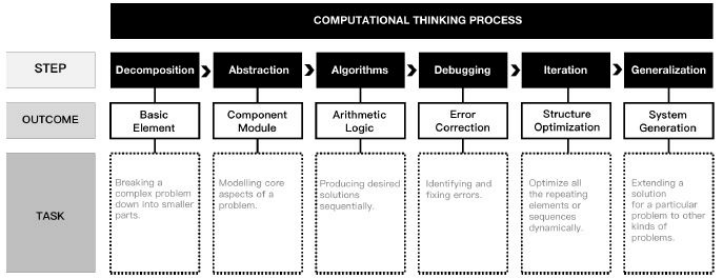
Figure 1 is a flowchart of computational thinking, as well as the main tasks and output content of each step. There are a total of 6 steps, including: Step 1 Decomposition: The main task of this step is to break a complex problem down into smaller parts, and the output content is “Basic Element”; Step 2 Abstract: The main task of this step is to model core aspects of a problem, and
the output content is the “Component Module”; Step 3 Algorithm: The main task of this step is to produce desired solutions sequentially, and the output content is “Arithmetic Logic”; Step 4 Debugging: The main task of this step is to identify and fix errors, and the output content is “Error Correction”; Step 5 Iteration: The main task of this step is to optimize all the repeating elements or sequences dynamically, and the output content is “Structure Opti- mization”; Step 6 Generalization: The main task of this step is to extend a solution for a specific problem to other types of problems, and the output content is “System Generation”. Computational thinking is a very beneficial thinking mode that can help people better understand problems, innovate, solve problems, and improve interdisciplinary abilities.
Figure 1: Computational thinking process.
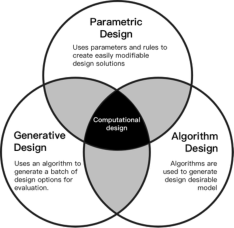
COMPUTING DESIGN IN THE AGE OF ARTIFICIAL INTELLIGENCE Computational design is a design approach that has gradually emerged in recent years. It introduces computing technology into design field and uses computer programming to design products that meet people’s needs. It imi- tates the designer’s decision-making process and generates the optimized design results based on algorithms. Computational driven algorithms and parameters have exponentially improved the entire design process, mak- ing them more efficient, sustainable, and user-centric (Caetano and Leitao, 2020). Currently, there are three subcategories of computational design: parametric design, generative design, and algorithm design(Caetano, Santos and Leitão, 2020).
Figure 2: Three types of computational design.
Computational Creativity 241
Parametric Design The origin of parametric design can be traced back to the 1980s. Parametric design is the process of describing geometric shapes, spaces, skins, and struc- tures by controlling parameters, and obtaining optimized designs that meet specific requirements through parameter adjustments. This method trans- forms the entire design element into a certain functional variable, and by changing the function or algorithm to establish a program, the design prob- lem is transformed into a logical reasoning problem. In the 1990s, with the continuous upgrading of computer hardware and software, more and more architects began to use parametric design methods. This design method not only generates complex geometric shapes, but also optimizes the structure, performance, and aesthetics of buildings by adjusting parameters, realizing standardized design and industrial processing production. All of these have realized information management and improving the efficiency and quality of construction in architectural design. Entering the 21st century, paramet- ric design has gradually developed into a global trend, widely used in fields such as architecture, product design, standardized design, industrial process- ing and production, and information management. With the development of artificial intelligence and other digital technologies, parametric design will further develop and be widely applied. For example, in the field of cloth- ing design, different styles of clothing, shoes, and hats can be designed by changing parameters. In the field of artistic creation, parametric design can be used to create unique artistic patterns or sculptures. In the field of engi- neering design, parametric design can help designers optimize design schemes by modifying parameters, such as optimizing structural parameters in bridge design to improve its load-bearing capacity.
Generative Design Generative design is a design method based on artificial intelligence and computer-aided design (CAD) technology, which uses algorithms to explore and generate design solutions. This design method can consider various fac- tors in the early stage of design, such as functional requirements, material selection, manufacturing costs, and production processes, to optimize the design scheme. Generative design can be traced back to the 1960s, when artificial intelligence and computer-aided design began to develop. In the 1970s and 1980s, some designers began exploring the use of artificial intel- ligence to generate design solutions. These early explorations included using techniques such as genetic algorithms, neural networks, and fuzzy logic to acquire design solutions. Generative design can improve product perfor- mance, reduce manufacturing costs, and reduce environmental impact by computing optimization. In the 21st century, with the continuous upgrad- ing of computer hardware and software, as well as the rapid development of AI, generative design has begun to be widely applied in fields such as archi- tecture, industrial design, product design, and artistic creation. For example, in the field of architecture, generative design can be used to design building appearances, interior spaces, and do urban planning; In the field of industrial design, generative design can be used to design product appearance, structure,
materials and function, etc. Generative design can also be applied to other off-design fields, such as bioscience, finance, and healthcare. In the field of biological science, generative design can be used to study the structure and function of biological molecules; In the financial field, generative design can be used to predict market trends and formulate investment strategies; In the medical field, generative design can be used to research and design drugs, medical devices, and treatment plans, etc.
Algorithm Design The origin of algorithm design can be traced back to the ancient Greek math- ematician Euclid in 300 BC. He proposed the convolutional division method, which is an algorithm used to find the maximum common divisor of two pos- itive integers. Since then, with the passage of time, algorithms have gradually developed and evolved in terms of design and practice. Over time, algorithm design has gradually developed into an important branch of computer sci- ence. It involves designing and constructing algorithms based on specific problems or requirements, so that these algorithms can effectively, reliably, and efficiently solve practical problems. Algorithm design plays an important role in various fields of computer science, such as data structure, compu- tational theory, computer graphics, artificial intelligence, network theory, etc. The main function of algorithm design is to provide effective, reliable, and efficient solutions for complex problems or tasks. It can decompose a complex problem into a series of smaller problems and obtain a solution to the original problem by solving these small problems. The algorithm design aims to find an optimal solution to the problem, so that under given condi- tions, tasks can be completed with the minimum resources, time, and error. It can simplify complex problems into manageable small problems and solve them through effective instructions or steps. Algorithm design is also widely applied in various fields of computer science, including data structure, com- putational theory, computer graphics, artificial intelligence, network theory, etc. In these fields, algorithm design is an indispensable part used to solve var- ious practical problems, such as sorting, search, image processing, machine learning, network security, etc.
Overall, parameterized design, algorithm design, and generative design each have similarities and differences. Parametric design is an interactive process - the components of the design model are interrelated, allowing for real-time updates and modifications throughout the entire design. This process uses software plugins that rely on precise input parameters and com- ponent relationships. Generative design is an iterative process - software produces many results, sorted by user provided constraints or success metrics. This process uses advanced algorithms and artificial intelligence, but still requires human intuitive judgment to ultimately determine design choices. Algorithm design is a generative process - using algorithms to generate design results. If these algorithms rely on a set of parameters, they can also be con- sidered a parameterized design. Parameters and rules are key components of parametric design and generative design. These two design methods also rely on powerful input data to produce reliable results.
Computational Creativity 243
The most used field of computational design is the architectural design industry, particularly highly regarded by world-renowned construction and design masters, such as Zaha Hadid. But what is very interesting is that there is a natural kinship between architectural design and other design field. Since the concept of computational design was proposed, it has been applied to a wide range of design applications (Yang, Zhang and Jiang, 2022). At the same time, the rise of artificial intelligence technology and generative AI tools has greatly promoted the popularization of computational design, extending from the creation of 3D objects to 2D objects, physical objects to virtual objects, and realism style to the surrealism style. The current application fields of computational design include but are not limited to interior design, installation design, display design, industrial design, product design, visual communication design, user experience design, digital media art design, etc.
COMPUTING ESTHETIC IN THE AGE OF ARTIFICIAL INTELLIGENCE The origin of computational aesthetics can be traced back to the first half of the 20th century, when American mathematician George D. Birkhoff pro- posed the formula “M=O/C”, which is “Measure=Order/Complexity”, in his book “Aesthetics Measure”, where M is the “Aesthetics measure”, O is “order”, and C is “complexity” (Birkhoff, 1933). Berkshaw pointed out that he believes the idea of using the ratio between ordinal numbers and complex- ity as an aesthetic measure is a new method for measuring aesthetic effects. This means that ordered and simple objects seem more beautiful than chaotic or complex objects. Berkshaw applied this formula to evaluate the beauty of polygons and artworks, such as vases and poetry, and he is considered a pioneer in modern computational aesthetics field.
In the 1950s, German philosopher M. Bense and French engineer A. Moles independently combined Berkhov’s work with C. Shannon’s information the- ory to develop a scientific approach to quantitative aesthetics. Shannon was not only a major participant in the 1956 Dartmouth Conference, but also one of the main leaders in AI research in the last century. As a result, com- putational aesthetics gradually approached AI research institutes, and this idea of scientific evaluation of aesthetic research found its place in computer- generated art. In the 1990s, the International Society for Mathematical and Computational Aesthetics (IS-MCA) was established, specializing in design that emphasizes functionality and aesthetics, and attempting to become a bridge between science and art. German aestheticians such as C. Schipfer offi- cially proposed “Computational Aesthetics” in the 2003 issue of the Journal of Music Informatics, marking the formal establishment of computational aesthetics as a discipline. In the 21st century, computational aesthetics has become a mature area and gradually evolved into an interdisciplinary involv- ing computer science, art, design, mathematics, and other field. Its research content includes art, music, design, literature, and etc (Bo, Yu and Zhang, 2018).
Computational Aesthetics Style In terms of computational visual aesthetics, it mainly involves computer vision and computer graphics technology, analyzing, calculating, and sim- ulating visual art to study visual aesthetics, artistic styles, etc. In terms of
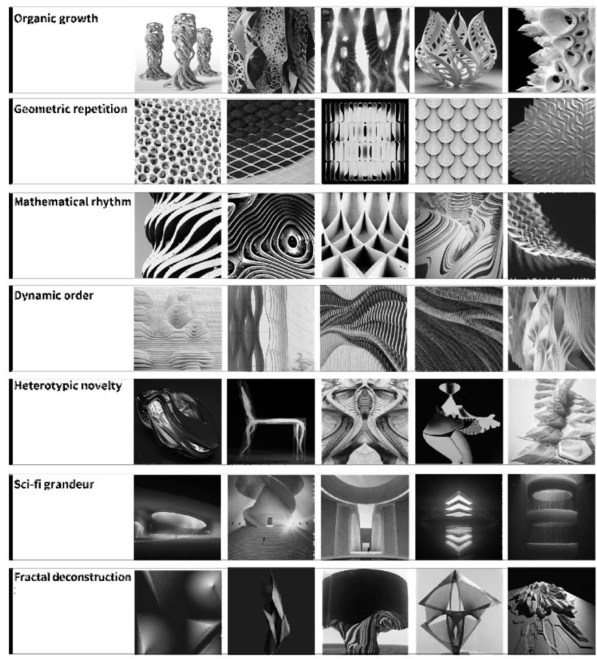
computational music aesthetics, the main research focuses on the applica- tion of computers in music creation, performance, and sound processing, including music information retrieval, music generation algorithms, music data analysis, etc. In terms of computational art aesthetics, the main research focuses on the application of computers in art creation, display, and inter- action, involving digital art, interactive art, virtual reality, and so on. In the field of computational literary aesthetics, the focus is on the applica- tion of computers in literary creation, analysis, and cross media applications, including automated writing, text mining, and cross media narrative. The fol- lowing mainly explores and summarizes seven common design aesthetic styles in computational aesthetics from a design perspective, namely “Organic Growth”, “Geometric Repetition”, “Mathematical Rhythm”, “Dynamic Order”, “Heterotypic Novelty”, “Science Fiction Grandeur”, and “Fractal Deconstruction”.
Organic Growth: The organic growth style is an aesthetic style that empha- sizes natural growth, flow, and change. It originates from the growth and evolution process of natural biological forms, as well as the expression of vitality. This style of work often presents a natural, harmonious, and vibrant visual effect, allowing viewers to feel the organic and growing power of life. In computational aesthetics, organic growth styles are typically achieved through parameterized design and generation algorithms, such as using genetic algorithms and simulating natural growth processes. This style of design has a high degree of complexity, diversity, and variability, providing a rich creative and expressive space for the field of computational aesthetics.
Geometric Repetition: The geometric repetition style is an aesthetic style characterized by the repetition, combination, and variation of geometric shapes. It creates a highly ordered and harmonious visual effect by regu- larly repeating and combining simple geometric shapes. In computational aesthetics, the style of geometric repetition is usually achieved through the combination of simple geometric shapes and rules, such as the use of peri- odicity, frequency, and other laws for graphic stitching and repetition. This style of work has a strong sense of abstraction and form, providing a concise, regular, and rhythmic expression for computational aesthetics.
Mathematical Rhythm: The mathematical rhythm style is an aesthetic style that emphasizes numbers and mathematical laws. It combines numbers, mathematical formulas, and geometric shapes to create an abstract, ratio- nal, and logical visual effect. In computational aesthetics, the mathematical rhythm style is usually achieved through mathematical models, algorithms, and computer simulations, such as using mathematical concepts such as fractal and topology for graphic generation. This style of work has strong scientific and rational thinking, providing a creative expression based on mathematical principles for computational aesthetics.
Dynamic Order: The dynamic order style is an aesthetic style that empha- sizes dynamics, change, and order. It creates a visual effect with a high sense of order and dynamic balance by regularly organizing and controlling the dynamic changes and motion trajectories of graphics. In computational aesthetics, the dynamic order style is usually achieved through dynamic sim- ulation, parametric design, and interactive techniques, such as using physical
Computational Creativity 245
simulation, motion capture, and other techniques to dynamically gener- ate graphics. This style of work has strong dynamism and appreciation, providing a dynamic and dynamic expression for computational aesthetics.
Heterotypic Novelty: The heterotypic novelty style is an aesthetic style that emphasizes novelty, uniqueness, and alien beauty. It creates highly personal- ized and unique visual effects through innovative design and combination of graphic forms, structures, and materials. In computational aesthetics, novel and unconventional styles are often achieved through techniques such as computer graphics and 3D modeling, such as using methods such as biolog- ical simulation and biomimetics to design the shape of graphics. This style of work has strong exploration and innovation, providing a way to break through tradition and pursue novelty in computational aesthetics.
Science Fiction Grandeur: The science fiction grandeur is an aesthetic style that emphasizes futurism, science fiction, and grandeur. It creates visually stunning and futuristic effects through imagination and representation of future technology, outer space, and massive scales. In computational aesthet- ics, the grand style of science fiction is usually achieved through technological means such as computer graphics and virtual reality, such as using themes such as cosmic galaxies and future cities for graphic creation. This style of work has a strong sense of futuristic and sci-fi, providing a way for computational aesthetics to transcend reality and explore the future.
Fractal Deconstruction: The fractal deconstruction style is an aesthetic style that emphasizes fractal structure, complexity, and deconstruction reor- ganization. It creates highly complex and diverse visual effects by disas- sembling, reassembling, and innovatively designing the fractal structure and complexity of graphics. In computational aesthetics, the fractal deconstruc- tion style is usually achieved through techniques such as fractal generation algorithms and complex systems, such as using recursion, self-similarity, and other laws for fractal generation of graphics. This style of work has strong complexity and challenge, providing a way for computational aesthetics to explore complexity and pursue innovation.
Computational Aesthetics Carrier From the perspective of computational aesthetics, the aesthetics carrier refers to the elements or objects that can reflect and convey aesthetics generated by computer technology. Common computational aesthetics carriers include six types: form, structure, texture, pattern, layout, and visual dynamics. Among them, the form carrier refers to an object or medium that spreads beauty through its appearance or shape; Structural carrier refers to an object or medium that expresses beauty through its internal structure or organization; Texture carrier refers to an object or medium that expresses beauty through the texture or texture of its surface; Pattern carrier refers to an object or medium that expresses beauty through flat or three-dimensional graphics composed of various shapes and lines; Layout carrier refers to an object or medium that expresses beauty through the position, arrangement, and com- bination of objects in space; Visual dynamic effect carriers refer to objects or media that perform aesthetic expressions through dynamic effects such as translation, rotation, scaling, deformation, etc.
Figure 3: Seven common computational aesthetics styles.
CONCLUSION
With the rapid development of artificial intelligence technology, the relation- ship between computers and designers has undergone significant evolution, from “computer-aided design” to “human-machine collaborative design”. Design innovation is increasingly reflected in a form of computational cre- ativity. This study analyzes computational creativity in the era of artificial intelligence from the perspectives of computational thinking, computational design, and computational aesthetics. Firstly, the study starts with the concept exploration of computational thinking and analyzes the six basic processes of computational thinking, namely decomposition, abstraction, algorithms, debugging, iteration, and generalization. Secondly, the study analyzed and compared three typical computational design types, namely parametric design, generative design, and algorithm design. Finally, from the perspective of computational aesthetics, the article analyzes seven common styles and six common carriers of computational aesthetics. The seven aesthetic styles are Organic Growth, Geometric Repetition, Mathematical Rhythm, Dynamic Order, Heterotypic Novelty, Science Fiction Grandeur and Fractal Decon- struction while the six aesthetic carriers are Form, Structure, Texture, Pattern, Layout, and Visual Dynamics. This study is a comprehensive exploration of
Computational Creativity 247
innovative thinking, design practice, and aesthetic paradigms driven by arti- ficial intelligence, and is of great significance for exploring the development direction of future design.
REFERENCES
Birkhoff, G. D. (1933) Aesthetic measure. Harvard University Press. Bo, Y. H., Yu, J. H. and Zhang, K. (2018) ‘Computational aesthetics and applications’, Visual Computing for Industry Biomedicine and Art, 1(1). Caetano, I. and Leitao, A. (2020) ‘Architecture meets computation: an overview of
the evolution of computational design approaches in architecture’, Architectural Science Review, 63(2), pp. 165–174. Caetano, I., Santos, L. and Leitão, A. (2020) ‘Computational design in architecture: Defining parametric, generative, and algorithmic design’, Frontiers of Architectural Research, 9(2), pp. 287–300. Celik, I. (2023) ‘Exploring the Determinants of Artificial Intelligence (AI) Literacy:
Digital Divide, Computational Thinking, Cognitive Absorption’, Telematics and Informatics, 83. Christensen, D. and Lombardi, D. (2020) ‘Understanding Biological Evolution Through Computational Thinking a K-12 Learning Progression’, Science & Education, 29(4), pp. 1035–1077. Dohn, N. B. et al. (2022) ‘Survey: Artificial Intelligence, Computational Thinking
and Learning’, Kunstliche Intelligenz, 36(1), pp. 5–16. Garcia, J. D. R. et al. (2019) ‘Developing Computational Thinking at School with Machine Learning: An exploration’, 2019 International Symposium on Com- puters in Education (SIIE). Minist Educ & Formac Profes, INTEF, Madrid, Spain. Goltl, F. (2022) ‘Three Grand Challenges for the Computational Design of Hetero-
geneous Catalysts’, Journal of Physical Chemistry C, 126(7), pp. 3305–3313. Huang, X. D. and Qiao, C. C. (2022) ‘Enhancing Computational Thinking Skills Through Artificial Intelligence Education at a STEAM High School’, Science & Education. Jarrahi, M. H., Lutz, C. and Newlands, G. (2022) ‘Artificial intelligence, human
intelligence and hybrid intelligence based on mutual augmentation’, Big Data and Society, 9(2). Mallasi, Z. (2019) ‘Designing with pixels: parametric thinking for patterning dynamic building facades’, Engineering Construction and Architectural Manage- ment, 26(4), pp. 668–688. Papert, S. A. (2020) Mindstorms: Children, computers, and powerful ideas. Basic
books. Sun, L. H., Hu, L. L. and Zhou, D. H. (2022) ‘The bidirectional predictions between primary school students’ STEM and language academic achievements and computational thinking: The moderating role of gender’, Thinking Skills and Creativity, 44. Tykhonova, T. V and Koshkina, H. L. (2021) ‘Etymology, Genesis and Essence of
the Concept “Computational Thinking”‘, Information Technologies and Learning Tools, 84(4), pp. 1–20. Wing, J. M. (2006) ‘Computational thinking’, Communications of the ACM, 49(3), pp. 33–35. Wing, J. M. (2008) ‘Computational thinking and thinking about computing’,
Philosophical Transactions of the Royal Society A: Mathematical, Physical and Engineering Sciences, 366(1881), pp. 3717–3725.
Yang, M. L. et al. (2023) ‘Data-driven intelligent computational design for products: method, techniques, and applications’, Journal of Computational Design and Engineering, 10(4), pp. 1561–1578. Yang, M. L., Zang, T. S. and Jiang, P. Y. (2022) ‘Social Computational Design Method
for Generating Product Shapes with GAN and Transformer Models’, IFAC Paper- sonline. Xi An Jiao Tong Univ, State Key Lab Mfg Syst Engn, Xian 710049, Peoples R China, pp. 281–286. Zhang, K., Harrell, S. and Ji, X. (2012) ‘Computational Aesthetics: On the Complexity of Computer-Generated Paintings’, Leonardo, 45(3), pp. 243–248.
LISTED IN THE AHFE DIGITAL BOOKSTORE CATALOGUE
Explore the complete digital volume
Artificial Intelligence, Social Computing and Wearable Technologies
Read this individual research paper free through the original publisher, or explore the full digital proceedings book.
ISBN 978-1-958651-89-6
Explore this ISBN in the AHFE Bookstore ↗Listed in the July 2026 bookstore catalogue; search by ISBN to confirm current availability · Digital book purchase optional