Jean Cao, Hao Jiang, Jiangjingjing Xu, Yu Hong, Tiantian Li (2022). Age-friendly Digital Express Service Experience Design Framework. In: Ergonomics In Design. AHFE Open Access, vol. 47, pp. 679–689. https://doi.org/10.54941/ahfe1001998
The rapid development and popularization of logistics digitalization in China risks excluding the elderly who often find it hard to use digital express services due to the lack of digital knowledge and physical impairment. Design for an ageing population has become an essential social requirement. Through desk research, observation, interviews and thematic analysis, this paper provides insights into the physical and psychological barriers of elderly users in digital express service scenarios. It examines user needs from the dimensions of five barriers: perception, physical, mobility, cognitive, and psychological. This study puts forward the design strategy and experience framework model of age-friendly express services from service process, space design, hardware design, interaction design and emotional durability design. We improve service acceptance, emotional satisfaction by enhancing information recognizability, understandability, operation convenience and spatial accessibility. The optimized service system proposes a new service experience for the Cainiao Post to improve the satisfaction of elderly users.
The rapid development and widespread usage of digitization logistics tech- nology has changed the Chinese lifestyle. Most adults use express dispatch services to send and receive goods, and have become frequent users of the logistics industry for shopping and sending or receiving gifts, or retur- ning unwanted or defective items. However, lack of internet knowledge and physiological degradation can make the elderly feel excluded from digital express services. Therefore, age-friendly design has become an essential social demand.
At present, there are three main drop-off methods: making an appointment for an “one-hour door to door” pickup service online, contacting the courier or other express company by phone and visiting dispatch points and dropping off packages. In our survey, we found that 70% of elderly users tend to drop off parcels in the dispatch points, preferring offline service because the whole process can be seen and touched. They trust the visual experience more and can get help from the staff there.
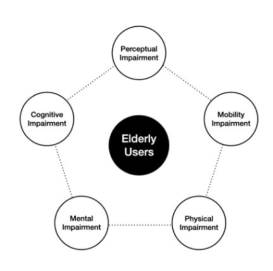
Figure 1: Disabilities of elderly users in digital service.
Cainiao Post is a comprehensive community service point where custo- mers can send or collect parcels and make group buying, laundry, recycling, etc. However, staff are not always available to help users, meaning the user satisfaction of the service is low. Furthermore, the complexity of the existing operation process means senders can wait for a long time in line, reducing the satisfaction further.
Therefore, we plan to explore a better drop-off experience suitable for the elderly so that they can dispatch parcels more conveniently. The new service can strengthen the interaction between relatives and friends and enhance their happiness, and lead to increased use of the service in future.
ANALYSIS ON THE ELDERLY Research on Barriers to Digital Services for Elderly Users
The Cambridge Inclusive Design Toolkit divides user capabilities into five categories: vision, hearing, thinking, reach and dexterity, and mobility. It quantifies and compares the population based on their different needs, which can significantly help commercial companies understand the number of potential users.
We integrated vision, hearing, and speaking into perception based on the above research. We found that psychological barriers also have an important impact on the elderly’s experience of digital services. Therefore, arrived at five categories.
Perceptual Impairment. Due to the degeneration of physical functions, the elderly may not see the interface or hear the software’s voice prompts (Díaz-Bossini and Moreno, 2014). At the same time, China is home to several dialects in different regions, leading to specific language barriers in communication.
Physical Impairment. Due to aging of the body, muscle atrophy and other reasons, the elderly cannot easily grab heavy objects or complete refined and complex operations. There is a certain degree of difficulty in stretch- ing upward and picking up. In terms of software interaction, the elderly also have certain interactive behaviour obstacles such as pressing, clicking, dragging, and sliding on-screen items.
Age-Friendly Digital Express Service Experience Design Framework 681
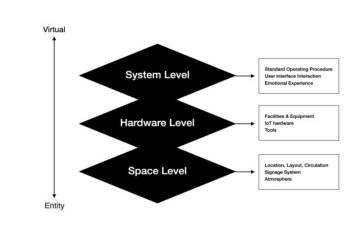
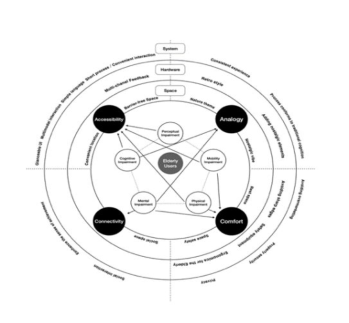
Figure 2: The design elements.
Mobility Impairment. With the decline of limb strength and balance, the unassisted walking distance of the elderly will be greatly shortened, and it will become more and more difficult to climb stairs. Standing is also tiring.
Cognitive Impairment. Cognitive impairment in the elderly is also pro- nounced due to reduced perception ability, so attention is more easily distracted, long-term memory deteriorates, and reading comprehension and expression are reduced. In terms of cognitive ability, it is divided into fluid intelligence and crystallized intelligence (Kaufman et al., 2009). Fluid intelligence is more likely to fluctuate due to age changes, while crystal- lized intelligence can remain stable for a long time, accumulating with experience.
Mental Impairment. Physiological degradation will affect the accuracy of the information input of the elderly. On the one hand, it may lead to errors in decision-making and judgment. On the other hand, it may cause com- munication barriers, leading to emotional problems, such as depression, irritability, anxiety, loneliness etc. (Myerson et al, 1990). After retirement, many older adults lack a sense of achievement, feel lonely, and miss their past lives. Their emotional needs will increase. It is easy for the elderly to feel frustrated, overwhelmed, and reluctant to learn new things when digital services are poorly designed. Moreover, deceptive marketing meth- ods and dark design patterns are now increasing on the Internet, adding to the insecurity and uncertainty of digital services among the elderly (Susser et al, 2019).
Age-Friendly Design Elements Based on the above research, we found that digital products and services are no longer just a single dimension of the interface; it has become more three-dimensional, requiring us to think from multiple dimensions regarding the service process, interaction, and design. Jianzhong and Xiangyang use Burke’s “Five-in-One” theory of drama, to summarize people, actions, pur- poses, scenes and media into five basic elements of service design (Cao and Xin, 2018).
In the context of age-appropriate design, we sum up the design contents into system, hardware, and space from the entity to the virtual level.
System. Focus on standardized operating procedure, specific actions, inter- face interaction and visual design. The emotional experience of elderly users is one of the core elements of this part.
Hardware. Focus on facilities and equipment, including IoT hardware, auxiliary tools, Etc.
Space. Focus on the environmental factors of service, including layout, circulation and signage system, etc. Bitner (1992) sums it up as internal atmosphere (temperature, lighting, smell, color, etc.). In addition, due to the mobility impairment of the elderly, the location of the drop-off points is also critical.
INSIGHTS To understand the drop-off experience of the elderly, we conducted questi- onnaires and received 139 valid results. 50% of respondents use drop-off services once a month or a quarter, and 25% never use this service. In addi- tion to returning goods, more than 50% were sending home specialties, daily necessities, etc., to children, relatives and friends. 77% of the elderly will cho- ose to drop off offline. 77% of the elderly will dispatch by themselves and do not want to trouble their children. 7.69% of elderly users will directly send the items that need to be sent to their children and let them operate on their behalf. The overall delivery satisfaction rate is 76.9%; the most satisfying rea- sons are that the delivery site is close to home (85%). The minor reasons are the staff’s inefficiency (66%), the poor attitude, and the dirty environment.
Through on-site interviews, we found that the personality, values, past experiences, educational background, living habits, income, geographical location, family situation, social goals, etc., have a great impact on the digital life of the elderly. Differences between urban and rural areas and the imbala- nce of regional economic development, income levels, family members, and whether they live with their children also affect the use of digital products by the elderly.
Based on the above research, we analyzed the pain points in the service process, summed up the two dimensions of the classification of elderly users, and established three types of personas.
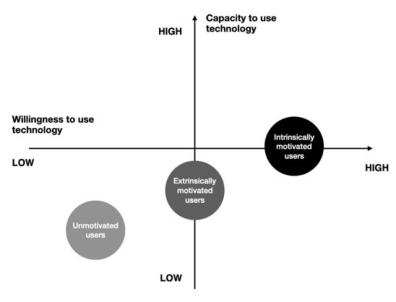
User Segmentation We extracted two core dimensions based on the survey: capacity to use technology and willingness to use technology (Carlos et al., 2007).
And then we established four quadrants, replacing the traditional classi- fication of elderly users by age. We propose to divide users into three types of Personas: “Intrinsically motivated users”, “extrinsically motivated users”, and “unmotivated users”.
Intrinsically motivated users. They are extroverted, like to try new things, have high income, and have a strong willingness to use technology. How- ever, their capacities to use technology are not strong. Due to the increase of age, the deterioration of vision and physical ability, and the decline of memory, these users have certain obstacles to using technology.
Age-Friendly Digital Express Service Experience Design Framework 683
Table 1. Capacity to use technology and willingness to use technology.
Table available in the original PDF paper.
Capacity to use technology
Whether older users can use existing digital products. For example, whether you can see the information clearly, understand the meaning of the text, complete specific interactions, and know different interaction gestures (for example, long press, drag, click, etc.)
Willingness to use technology
Willingness to use and explore digital services. For example, do you prefer to go online or offline for shopping, do you prefer to use online car-hailing or wait on the side of the road for taxis, and whether there is a strong willingness to express on social media
Figure 3: Aging user character axis for digital services.
Extrinsically motivated users. Their willingness to use technology is rela- tively neutral. With the rapid development of society, they are actively or passively exposed to digital services. At the same time, their abilities to use technology are relatively weak, and they need the help of others to use electronic devices.
Unmotivated users. These older adults are unwilling to use technology or even feel resistant. They live in a more closed environment, tend to be content with the status quo, and are very conservative. The ability of these older people to use new technologies is weak, and most of them are used to traditional offline behaviors. Their physical functions begin to degrade, requiring others to take care of their daily lives.
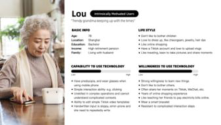
Personas Based on the above research, we abstract user information and summarize three typical personas, which provide basic information and empathy for the next step.
Figure 4: Three types of personas.Figure 5: Service design framework for elderly users.
THE AGE-FRIENDLY DROP-OFF SERVICE DESIGN CODE Based on the digital capacity impairment, sensory impairment, physical impairment, mobility impairment, cognitive impairment, and psychological impairment of older adults, we propose an age-appropriate logistics expe- rience design strategy for drop-off services. The core provides age-friendly dropping-off services for “extrinsically motivated users” and “unmotivated users” and suggests a more inclusive design expression for service systems, hardware, and space.
Accessibility
Easy to identify. For the sensory impairment of the elderly, information should be intuitive (including recognizable icons, suitable font size, spa- cing for reading, and avoiding the terminology and emerging Internet languages). The signage system is self-explanatory. It is necessary to use a more contrasting communication method (Houts et al, 2006). Further- more, the service adopts multi-channel feedback (color, light, sound, etc.). The grid layout is better than the vertical form, which is easier to read (Green and Petre, 1996). It needs to be displayed still or switched slowly when conveying information.
Easy to comprehend. For the cognitive impairment of the elderly, the service avoids complex functional modules; procedures are tailored to the characteristics and needs of older adults. Information communication maintains consistency and simplicity. Beyond that, the design should avoid irrelevant information. Steps are easy to accomplish.
Age-Friendly Digital Express Service Experience Design Framework 685
Easy to operate. For the physical and movement impairments of the elderly, the operation is simplified and using fewer steps to com- plete the whole process. Drop-off points should be located within the scope of the daily activities of the elderly, with facilities such as toilets and rest areas. The spatial layout is fluent. The circulation is indepen- dent, avoiding complex and cross paths, thereby reducing confusion and anxiety caused by the complicated and disordered space.
Analogy In response to cognitive and psychological impairment, this paper proposes the design principle of analogy. Its purpose is to provide users with a similar experience that aligns with users’ logical expectations and is consistent with the application habits of mainstream products on the market.
Its characteristics are:
It conforms to traditional cognition, reduces the cognitive difficulty, and reduces learning cost (Carbonell, 1983).
The design scheme has nostalgic elements, added emotional value, and resonance.
The service avoids being too simple and intelligent in space design, crea- ting a sense of intimacy in appearance. Furthermore, the design introduces natural elements such as plants, sunlight, and warm colors into space to give people a sense of warmth; classic tunes are played as background music to enhance the emotional experience.
Comfort This paper proposes safety design principles for movement impairments and psychological impairments. The code is as follows:
At the system level, the content is: ensuring property safety, avoiding deceptive advertisements and pop-up windows and avoiding permission settings beyond basic requirements.
At the hardware level, the content is: ensuring facility security, eliminating sharp corners and meeting the physical needs of the elderly.
At the space level, its content is: setting suitable shelf heights, setting rest area and safety seats in the space and the floor should be flat with less slope or obstructions, avoiding slippery.
Connectivity The connectivity design principle is proposed for psychological disorders. Yue (2014) surveyed the emotional needs of the urban elderly, and the results showed that the elderly are more eager to be cared for by their children. Among them, 95.3% of the elderly are willing to communicate with their families and friends and express their concerns; 72.6% of the elderly are eager to make friends. Learning, cultural and entertainment needs account for the highest proportion of the spiritual needs of the elderly. Online inte- ractions can bring older adults closer family ties, more social activities, and more positive emotional experiences. According to our research, 70% of the
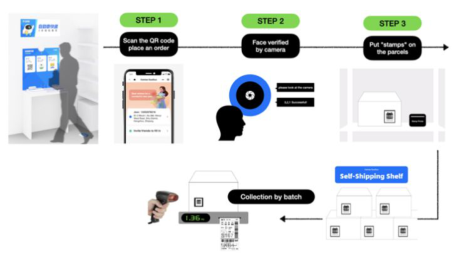
Figure 6: “Cainiao mini self-service express” service process.
parcel-sending needs of the elderly come from relatives and friends. Also, as a public place, Cainiao Post is designed to provide rest areas for the elderly and improve social possibilities. Some specific measures are as follows:
Setting up older adult volunteer service teams so that they can help peers. In this way, the elderly can still find their value after retirement and main- tain a good psychological state and a sense of achievement. According to research, the elderly have a higher degree of trust in their peers and have more patience and understanding with each other.
Providing senior citizen derivative services, such as giving VIP cards for the elderly or reminding their children to send gifts in advance before their birthday. It can stimulate a better emotional experience in the elderly.
THE AGE-APPROPRIATE DROP-OFF SERVICE DESIGN PRACTICE The optimized service is called Cainiao Mini Self-Service Express. This paper reflects the solution design from three dimensions: system, hardware, and space.
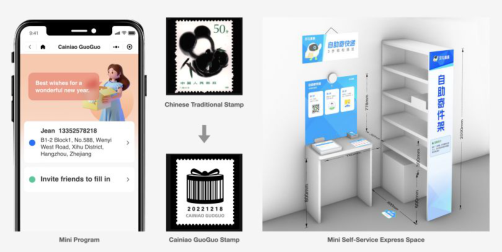
System. We simplified the complicated and synchronous operation to an asynchronous design. Users only need to scan the code to place an order, do the face recognition, and put “stamps” on the parcels (3 steps); after completion, the staff can efficiently complete the entire dispatch service by batch. Moreover, the interface clarifies the information hierarchy. The font size, color, etc., all adopt the interface design specification suitable for aging. The Mini program supports sharing with relatives and friends (recipients) to fill in the address, strengthening the interaction and emoti- onal link between senders and receivers. Sticking stamps is consistent with traditional mailing methods, creating a pseudo-similar experience. At the same time, Cainiao Post has also launched an elderly volunteer service, allowing intrinsically motivated users to help other types of elderly users, assisting them to better complete drop-off tasks and live a better digital life.
Age-Friendly Digital Express Service Experience Design Framework 687
Figure 7: The design of self-service express.
Hardware. This service adds multi-channel feedback in the dimension of accessibility. The design supports voice reminders while the camera guides users to face recognition, making it easier for the elderly to identify infor- mation. The design adds a physical stamp as a carrier in the dimension of analogy. The sender can leave a message to the recipient on the “stamps”. As a nostalgic delivery element, “stamps” make the service more intere- sting and design temperature. Human-friendly forms such as chamfered rectangles and circles are adopted in the overall hardware facilities. The size of the facility is in line with the body size of elderly users, avoi- ding excessive bending and squatting, lifting, carrying and other laborious actions.
Space. Cainiao Mini Self-Service Express Space creates an asynchronous service in the community station, which is close to the living area of the elderly. The overall spatial layout of the station is simple and accessible, with a clear and fluent circulation.
The overall wayfinding system is recognizable, thus avoiding increased perceptual and cognitive load. The information hierarchy of the navigation system is precise: Top-level, in the guidance of the location, the information is straightforward and friendly. Medium-level informs the specific dispatch process, using simple prompt words and relative graphics, which is self- explanatory. Low-level, designed to visually express the content that needs to be read in detail.
The decoration style of the station is warm and friendly, avoiding the exces- sive sense of technology and creating a cordial and nostalgic atmosphere. The ground is flat and non-slip. The arrangement and placement of items in the station are reasonably planned to keep the path unobstructed, thereby impro- ving safety. The resting space is set up in the station, where elderly users can rest while queuing and communicate with others. The spatial design provides a hospitable social environment and improves connectivity.
CONCLUSION
This paper has an insight into the disability of older users in terms of the physical and psychological dimensions of digital services. It optimizes the former drop-off service through the system level, hardware level, and space
level to improve the experience of digital dispatch services. The types of users and personas in digital service scenarios are proposed through in-depth rese- arch. According to the characteristics of elderly users, a design framework for digital dispatch services is created to bring an age friendly experience that is accessible, analogous, comfortable, and connective. The design framework is applied to the project of dispatch service in Cainiao Posts.
In the context of an aging population, we need to pay more attention to the digital service experience of elderly users. In the research and design process, we found that not only the elderly needs such convenient digital services, but also younger users or users from other countries. Drop-off service provides more than just sending a package out; it helps to maintain the emotional bond between the sender and the recipient. Although this paper takes aging-friendly research as an entry point, this design is not named as an aging-friendly dispatch service but a self-service drop-off service process that focuses on convenient operation. After all, an age-friendly design is an everyone-friendly design.
REFERENCES
Bitner, M.J., 1992. Servicescapes: The impact of physical surroundings on customers and employees. Journal of marketing, 56(2), pp. 57–71. Burrows, A. B. (2018). Designing out-of-box experiences for older adults: exploring
the boundaries of inclusive design (Doctoral dissertation). Cao, J. and Xin, X., 2018. The five elements of service design: exploration based on the theory of dramatistic pentad. Des. Educ. Explor.(55), pp. 59–64. Carbonell, J.G., 1983. Learning by analogy: Formulating and generalizing plans from
past experience. In Machine learning (pp. 137–161). Springer, Berlin, Heidelberg. Carlos, C., John, C., Pat, L., Umesh, P. and Sam, W., 2007. User capabilities. [online] www-edc.eng.cam.ac.uk. Available at: <https://www-edc.eng.cam.ac.uk/downlo ads/idtoolkit.pdf> [Accessed 14 February 2022]. Crews, D. E. and Zavotka, S. (2006) Aging, disability, and frailty: implications
for universal design. Journal of Physiological Anthropology, Vol. 25, No. 1, pp. 113–118. Design Council. 2022. Inclusive Design Education Resource. [online] Available at: <https://www.designcouncil.org.uk/inclusive-design-education-resource> [Accessed 14 February 2022]. Díaz-Bossini, J.M. and Moreno, L., 2014. Accessibility to mobile interfaces for older
people. Procedia Computer Science, 27, pp. 57–66. Elton, E., & Nicolle, C. A. (2010). The importance of context in inclusive design.
Anderson, M. Contemporary Ergonomics and Human Factors, 232–240. Green, T.R.G. and Petre, M., 1996. Usability analysis of visual programming environments: a ‘cognitive dimensions’ framework. Journal of Visual Languages & Computing, 7(2), pp. 131–174. Houts, P.S., Doak, C.C., Doak, L.G. and Loscalzo, M.J., (2006). The role of
pictures in improving health communication: a review of research on attention, comprehension, recall, and adherence. Patient education and counseling, 61(2), pp. 173–190. Kaufman, A.S., Kaufman, J.C., Liu, X., and Johnson, C.K., (2009). How do educational attainment and gender relate to fluid intelligence, crystallized intelligence, and academic skills at ages 22–90 years?. Archives of Clinical Neuropsychology, 24(2), pp. 153–163.
Age-Friendly Digital Express Service Experience Design Framework 689
Myerson, J., Hale, S., Wagstaff, D., Poon, L.W. and Smith, G.A., (1990). The information-loss model: a mathematical theory of age-related cognitive slow- ing. Psychological review, 97(4), p. 475. Susser, D., Roessler, B. and Nissenbaum, H., (2019). Online manipulation: Hidden
influences in a digital world. Geo. L. Tech. Rev., 4, p. 1. Tenneti, R., Johnson, D., Goldenberg, L., Parker, R. A., & Huppert, F. A. (2012).
Towards a capabilities database to inform inclusive design: Experimental investi- gation of effective survey-based predictors of human-product interaction. Applied ergonomics, 43(4), 713–726. Wang, S., Bolling, K., Mao, W., Reichstadt, J., Jeste, D., Kim, H. C., & Nebeker, C.
(2019, June). Technology to support aging in place: older adults’ perspectives. In Healthcare (Vol. 7, No. 2, p. 60). Multidisciplinary Digital Publishing Institute. Yue,Y, 2014. 城市老年人精神需求的调查[A survey on the emotional needs of the urban elderly] Chinese Journal of Gerontology, Vol.18. [online] Available at: <http://www.cnki.com.cn/Article/CJFDTotal-ZLXZ201418107.htm> [Acces- sed 14 February 2022].
LISTED IN THE AHFE DIGITAL BOOKSTORE CATALOGUE
Explore the complete digital volume
Ergonomics In Design
Read this individual research paper free through the original publisher, or explore the full digital proceedings book.
ISBN 978-1-958651-23-0
Explore this ISBN in the AHFE Bookstore ↗Listed in the July 2026 bookstore catalogue; search by ISBN to confirm current availability · Digital book purchase optional