Jae Sun Yi, Suah Cho (2022). Development of a weight management service that considers individual physical characteristics and psychological factors. In: Ergonomics In Design. AHFE Open Access, vol. 47, pp. 329–337. https://doi.org/10.54941/ahfe1001953
In modern society, life expectancy has increased, and the digital healthcare industry has grown up as people are more interested in health. Moreover, the recent spread of COVID-19 has increased the time spent at home, increasing the demand for weight control such as diet and nutrition-related products, exercise & fitness services. In the United States and Europe, weight management is mainly implemented to improve health or reduce health risk factors, whereas, in Korea, weight management is highly focused on external appearance alone. The purpose of this study is to propose a healthy weight management service design for users in their 20s and 30s in Korea who experience severe health problems in their weight management program by analyzing their needs and pain points in the process and defining fundamental problems. This study applied the double diamond model, a service design methodology, and divided the research process into discover, define, develop, and deliver. We conducted a digital ethnography of 20 selected weight management videos and in-depth interviews with 9 people who actively use the weight management process in order to collect user's verbal and non-verbal raw data and define service directions based on users' pain points and need & wants. Furthermore, we could substantiate specific solutions for service directions, the psychology types of each user, and the behavior inducement; and finalize the service architecture. Finally, we organized two sets of usability test of the service prototype of wireframes and developed the user interface design by applying heuristic evaluation criteria and analysis of the user observation from the test.As a result, we decided to use a smart mirror as a service platform based on the insight that visual observation is more effective than numerical value for weight management and the study that mirror exposure therapy is used to change users' behavior for actual weight management. In addition, We chose DTC genetic testing to identify the innate body information of each user and suggest appropriate nutrients, diets, and exercises for them. Not only that, but also, it was analyzed that in order for the user to continue weight management, it is necessary to habituate through user behavior improvement and gain motivation. Therefore, in order to form new habits of users, 1) 66 days were set as one unit, 2) the correct behavior model is to be presented to users, 3) persuasive technologies such as simplifying actions or going through steps were applied. Lastly, motivation is needed to maintain the habits, which must meet three factors: autonomy, relationship, and capability; for this reason, we provided functions according to user tendencies, provoked user interactions by sharing information and communicating with others, and comprised accomplishment process of one's goals. This study, applying DTC genetic testing results and using a smart mirror with strengthening users' experiences through the formation of digital and non-face-to-face platforms, differentiates from existing services in the healthcare industry.
In modern society, life expectancy has increased, and the digital healthcare industry has grown up as people are more interested in health. Moreo- ver, the recent spread of COVID-19 has increased the time spent at home, increasing the demand for weight control such as diet and nutrition-related products, exercise & fitness services. In the United States and Europe, weight management is mainly implemented to improve health or reduce health risk factors, whereas, in Korea, weight management is highly focused on external appearance alone. The purpose of this study is to propose a healthy wei- ght management service design for users in their 20s and 30s in Korea who experience severe health problems in their weight management program.
This study follows the double diamond model process, one of the service design methodologies. First, we conduct a digital ethnography and in-depth interviews to collect users’ verbal and non-verbal raw data during the wei- ght management process of target users and define service directions based on users’ pain points and needs. Furthermore, based on prior research, the study substantiates specific solutions for service directions, the psycholo- gical factors, and the behavior inducement and develops the service flow
and wireframes. Finally, we implement service staging utilizing the service prototype to collect user behavior data based on the heuristic evaluation and discover service improvement requirements.
USER ANALYSIS Digital Ethnography and In-Depth Interviews
This study presided digital ethnography using image data, one of the obse- rvational research methods, to find users’ behavior context and needs in their 20s and 30s by observing weight management behaviors occurring in actual living environments. Based on the Purposeful Sampling (Patton, 2014), we selected 20 daily weight management videos among the videos searched by the keywords; weight management, diet, weight loss, health, and v-log on YouTube. The total length of the selected video is 215 minutes and 37 seconds, and the number of subscribers is from 10,000 to 100,000. The observation accompanied collecting raw data of users’ verbal and non-verbal behaviors on nutrition, physical activity, weight measurement. Furthermore, proceeding in-depth interviews of 9 people with various weight management experiences in diet, exercise, medicine, and programs provided further infor- mation such as behavior cause and personal emotion. As comprehensively analyzing the collected data, the user’s weight management behavior appears in four stages: determination, preparation, execution, and continuation, and users have different pain points and needs in each stage.
1) In the determination stage, users often have difficulties setting an appro- priate goal. Sometimes their goal is hard to reach; they regard it as a task to solve and quickly feel burdened. For example, the user makes excuses not having enough time to execute the weight management behavior during the daytime because of other work and becomes passive in setting up a plan. Likewise, users often compare their achievements or progress with others’, which causes demotivation. Not only the fear of failure but also inferiority from comparing make users hesitate to determine fulfillment of weight mana- gement. The user needs to set a feasible goal based on the user’s body data and lifestyle.
2) In the preparation stage, numerous users take more time preparing behavior than the execution. For example, users spend more time choo- sing exercise tutorial videos than practicing time, and on some occasions, their attention does not last enough, and they fail to practice. Furthermore, users must go through trial and error to identify suitable and effective weight management methods. Some users even spend 3 to 10 years finding appro- priate methods enduring all the side effects. In this regard, simplifying the process between determination and execution encourages the completion of the intended task. With a micro perspective, the user needs a shortcut to react. At the same time, with a macro perspective, the user needs a solution to detect appropriate methods for healthy weight management without difficulty.
3) In the execution stage, diverse self-inducing methods appear on user behaviors. For instance, the user lying down decides to start with the wor- kout lying down motion, and it leads to performing other exercises; users watch the picture of low-fat diet posted by others and decide to resist their
Development of a Weight Management Service 331
appetite. In this manner, a positive trigger changes one’s behavior. However, many users cannot objectively assess their actions, and they instantly make an excuse when a negative trigger happens. To illustrate, one of the users ordered a low-fat diet and received high-calorie food as a free gift. The user gets blinded by the negative trigger and easily falls to comfort itself to rati- onalize the behavior. In conclusion, the user needs a proper trigger and an element objectifying one’s behavior.
4) In the continuation stage, the majority of users have a cumbersome expe- rience recording and confirming their process. However, many users show they feel positive emotions when checking their efforts and time records. Consequently, improving the process of recording and visualizing the user’s behavior helps the user persist in weight management. In addition, each user has a different preference on the type of methods depending on user ten- dency. To be specific, salient features came from the following: workout alone/workout together, positive feedback/negative feedback, scheduled on the list/concentrate on one. Thus, considering user tendency and offering options is essential to provoke user motivation.
DEFINING PROBLEMS AND SERVICE SOLUTIONS We defined the following problems based on the user’s needs found ear- lier. 1) Users have difficulty identifying their innate physical characteristics and measuring physical changes. 2) Users have difficulty making weight management activities a part of their lives. 3) The existing weight manage- ment method does not induce behavior through motivation and relies on the user’s will. 4) No platform can accommodate weight management beh- avior that considers users’ biological, behavioral, social, and environmental factors.
Selection of Technology to Identify Innate Physical Characteristics In order to solve the inability of the user to identify their body features and find a suitable way for them, goals should be set based on the person’s innate body information when entering the preparation stage. Many peo- ple believe that ice cream increases human blood sugar more than brown rice. However, according to the study of Eran Segal (Segal et al., 2015), some people react higher to blood sugar when ingesting brown rice show- ing different reactions to diet. Additionally, according to Samsung Hospital’s Genetic Research Institute (Cha et al., 2018), efficient diet methods were different for each individual depending on the combination of genetic mutati- ons. As a results, individuals should understand their physical characteristics and accept diet methods that suit them. Representative body identification technologies include Gut microbiome testing, Sasang constitutional medicine, Body composition analysis, and DTC(Direct-to-Consumer) genetic testing, and their characteristics are described in (Table 1).
DTC genetic testing allows individuals to take a test at home by sending the testing kits to testing institutions without going through medical institutions. Moreover, it can identify 70 genetic features, including FTO related to obesity, MC4R related to appetite suppression, and relevant factors in exercise and
332 Sun Yi and Cho
Table 1. Body identification technologies.
Table available in the original PDF paper.
Technology Features Suitability Gut microbiome testing It helps prevent obesity and adult diseases by balancing intestinal microorganisms called microbiome.
To check the changes intestinal microorganisms, through body stool should be checked every two weeks. Sasang constitutional medicine
Results may appear differently depending on the subjectivity of oriental medicine doctors.
A constitutional analysis medicine according to the structure of eight strong and weak arrangements of organs in the human body Body composition analysis
Results may appear differently depending on the user’s lifestyle before measurement.
A test that quantitatively analyzes the body composition balance state, and body moisture, protein, minerals, and body fat
Information does not change throughout life.
DTC Genetic testing
A test reveals 70 characteristics of an individual’s body based on genetic information
Weight Management Service Platform Selection Identifying body changes and responding to the change is crucial during wei- ght management progress. Users mainly check body changes in two ways: numerical changes by weight measurement and body composition analysis, and visual changes by mirroring the body. According to Rhee Sang-youl’s research team (Chin et al., 2016), people who continuously record their body changes on smart devices lose 1kg more than those who did not. Moreover, according to a research team at the University of Maastricht (Jansen et al., 2016), observing external body changes with the eyes acts as a visual stimu- lus and helps improve body satisfaction by resolving negative perceptions of the body. Therefore, using a smart device to monitor numerical and visual data is practical in weight management. Naked Labs (2018) had developed a smart mirror with an infrared camera scanning the body into a 3D model and measuring the body circumference. Moreover, it collects body composi- tion measurements with a scale connected to a smart mirror based on IoT technology. As we consider the usage of the smart mirror for weight manage- ment, it is the ideal device for visualizing and displaying data using a sufficient sized interface and automating acquiring body change data. In addition, in a situation challenging to use sports facilities for social distancing due to COVID-19, smart mirrors have the advantage of running in individual spaces without space restrictions.
Habituation of Weight Management by Improving User Behavior According to Ahn (2016), the fundamental cause of the user’s failure in weight management habits is the chain action of hormones affected by a
Development of a Weight Management Service 333
disorganized lifestyle which breaks down the hormone secretion system crea- ting a vicious cycle. Therefore, to restore the user’s hormone secretion system, the user needs to improve the improper weight management behavior.
Consequently, we propose a service function by applying persuasive tech- nology to improve weight management behavior. The persuasive technologies proposed by Fogg (2009) include reduction, suggestion, cue, surveillance, and tunneling. 1) For ‘reduction’, customizing automation of physical data mea- surement, physical activity, and nutrients can reduce the level of behavior of users 2) ‘cue’, ‘suggestion’ aims to provide a suitable behavior model by evaluating and advising user behavior. 3) ‘Surveillance’ provides a visualized page of users’ service usage for self-monitoring, allowing users to apprehend their progress objectively. 4) By designing a user’s weight management pro- cess by assigning level and grade satisfaction conditions for ‘tunneling’, the user can go through a series of processes to reach the goal.
Motivation for Continuing User Behavior In order to propose a motivation element to the user is vital to induce con- tinuous behavior. Fowler (2017) explained that autonomy, relatedness, and competence should be satisfied as motivating users. Autonomy is a desire to have a choice, and one’s actions come from one’s will, relatedness is a desire to pay attention to or receive from others, and competence is a desire to feel that one is growing over time. When all of this is satisfied, it creates positive motivation for intrinsic motivation.
First, to meet the user’s autonomy, we provide detailed options and services within the category provided as personalized to give the feeling that users can choose what they want. By giving these options, autonomy can be fulfilled and induce continuous participation.
Second, the competence element is strengthened by giving appropriate feedback and rewards according to the user’s behavior to feel a sense of accomplishment. According to Kim Sung-il et al. (2005), feedback plays a decisive role in competence formation by providing standards and informa- tion for determining competence. Thus, we assumed that providing feedback based on measurement data according to the user’s behavioral performance and body change and positive rewards such as levels will strengthen the user’s competence.
Third, to impart a relatedness, activating interaction between user and users and user and device by utilizing digital and non-face-to-face plat- forms can be a solution. Recently, many users have had difficulty managing weight management and making new relationships since social distancing creates space constraints. Forming a platform within a smart mirror and communicating with other users in real-time can strengthen the relatedness.
PROPOSAL OF SERVICE DESIGN Developing Service Architecture
The above service content aims to form a user’s weight management habit. According to Lally et al. (2009), 66 days is required for a new behavior to
334 Sun Yi and Cho
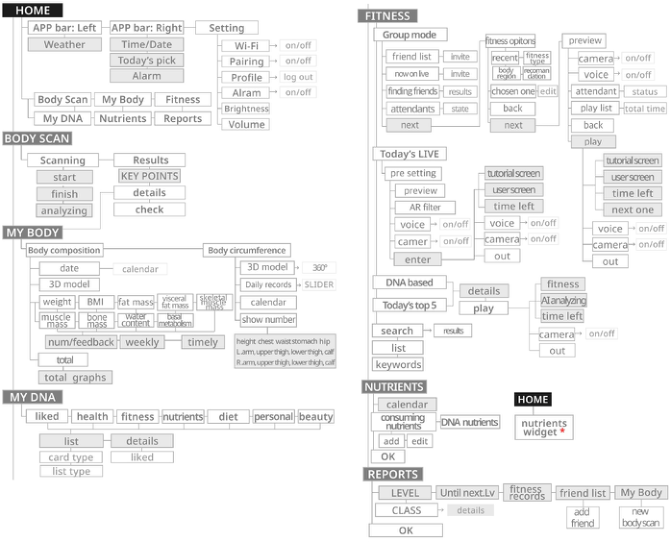
Figure 1: Service flow.Figure 2: Information architecture.
become a habit for the user, and we set 66 days as 1 unit of service. To maxi- mize service contents’ availability, we referred to the lifestyle improvement model devised by Ajou University’s research team (Jo et al., 2014) to design service flow (see figure 1). First of all, DTC genetic test results, body composi- tion analysis of smart mirrors, and 3D scans provide ‘awareness’ of individual body information.
We reflected ‘Foundation work on self’ and ‘setting the focus’ through recommending activities based on individual body data and ‘steady attem- pts’ through contents such as ‘fitness,’ ‘nutrition,’ and ‘today’s recommended activities’. Reports generated by accumulated physical activity and body measurement data while using the service ‘Body Scan’ leads to ‘deeper work on self’. Suggesting continuous behavioral models such as customi- zed activities and feedback helps users form the proper habits and ‘Lasting lifestyle change’. Furthermore, we structured information architecture in Figure 2.
Development of a Weight Management Service 335
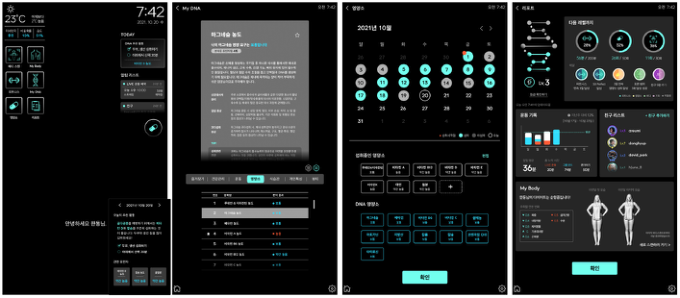
Figure 3: Smart mirror GUI (1–5).
Service contents and user interface Based on the previous study, we derived six main functions: Fitness, My DNA, Body scan, My body, Nutrient and Reports, and additional service contents using DTC genetic testing and smart mirror interfaces. First of all, 1) Six main function icons were placed on the home screen, and alarm wid- gets and basic information were displayed together to give the user a sense of control. 2)Today’s customized recommendation activity proposes behavi- oral models such as diet and exercise to be executed on the same day based on the user’s DTC genetic test and acquired body data, and is placed on the home screen to help the user set goals first when accessing the smart mirror. 3)My DNA provides essential information on genes, effects on the body, and TIP for management to help understand genetic test results and actively uti- lize them in real life. 4) The Nutrition page displays nutrients that are likely to be deficient based on their genetic testing. Users can compare themselves with the nutrients they are currently taking and review their shortcomings. Additionally, a notification widget is displayed on the home screen to help continuous management. 5) On the Reports page, the user can objectively grasp the level of satisfaction process and body changes within a month by visualizing the user’s service usage history.
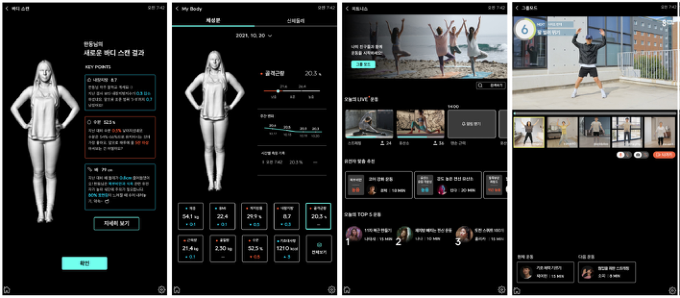
6) In Body scan, the user’s body change is measured. It provides immediate feedback based on body change data. 7) My body visualizes changes in body composition and circumference and 3D body model changes by accumulating body data obtained through body scans. It rotates the 3D model 360 degrees, observes one’s body, narrows the gap between cognitive and actual body type recognition, and increases user convenience by automatically recording body changes. 8) The Fitness page provides physical activity content. In the group mode and the Live exercise, the user may invite another user or share their respective screens in real-time to exercise together. In addition, we guarantee users’ privacy by granting a live exercise AR filter function.
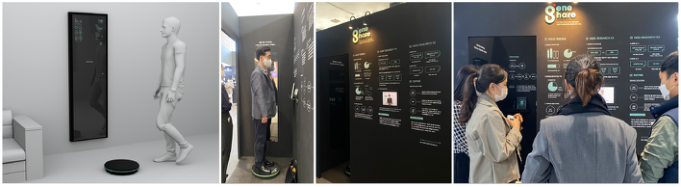
The 3D modeling of the smart mirror interface is depicted in Figure 5. We conducted offline service staging by making service prototypes for stakeholders and weight management performers. From October 29 to
336 Sun Yi and Cho
Figure 4: Smart mirror GUI (6-8).Figure 5: 3D model of the smart mirror & service staging.
November 3, 2021, about 320 people experienced it by the following order. 1) service background and service flow description 2) performing the smart mir- ror prototype, including six main functions. The service staging allowed us to obtain feedback on body change data visualization, non-face-to-face exe- rcise platforms, and future research directions. Participants were delighted with grasping their innate information through DTC genetic testing and wei- ght management function based on precise information. Additionally, they predicted that the visual data utilization of the 3D model would be highly performed.
CONCLUSION
This study analyzed insights by applying the service design methodology and proposed the service design of individual weight management healthcare services based on the research in the implementation of healthy weight mana- gement. We utilized DTC genetic testing, body composition analysis, and 3D body scan to combine innate body data and acquired data for service con- tents and used a smart mirror to strengthen users’ experiences through digital and non-face-to-face platforms. This study, user behavior inducement and habituation based on the study of psychological factors and user type, and visualizing body data, differentiates from existing services in the healthcare industry. Moreover, it has the potential to expand the service by combining them with other smart devices and smart mirrors based on IoT. Future study
Development of a Weight Management Service 337
will develop the service design by reflecting user behavior gained from the service staging of 320 people and analyzing user behavior based on heuristic evaluation standards.
REFERENCES
Ahn, J. J. (2016) If you know Leptin, You’re not afraid of ‘obesity’, The Science Times, Available at: https://url.kr/nl5ogf.html [accessed: 13 April 2021]. Cha, S., Kang, J.H., Lee, J.-H., Kim, J., Kim, H., Yang, Y.J., Park, W.-Y., Kim, J.
(2018), “Impact of Genetic Variants on the Individual Potential for Body Fat Loss” Nutrients 10, no. 3: 266. Chin, S.O., Keum, C., Woo, J., Park, J., Choi, H.J., Woo, J.T. and Rhee, S.Y. (2016), “Successful weight reduction and maintenance by using a smartphone application in those with overweight and obesity.” Scientific reports, 6(1), 1–8. Fogg, B. J. (2009), “A behavior model for persuasive design.” In Proceedings of the
4th International Conference on Persuasive Technology. 1–7. Fowler, S. (2017), Why Motivating People Doesn’t Work . . . and What Does: The New Science of Leading, Energizing, and Engaging. Berrett-Koehler Publishers, Oakland. Jansen, A., Voorwinde, V., Hoebink, Y., Rekkers, M., Martijn, C., & Mulkens, S.
(2016), “Mirror exposure to increase body satisfaction: Should we guide the focus of attention towards positively or negatively evaluated body parts?” Journal of behavior therapy and experimental psychiatry, 50, 90–96. Jo, W. D., Yang, S. G., Choi, S. T., Baek, J. S., Min, M. G., Lee, Y.K., Park, G.C., Lee, K.P. (2014), “Life Log Big Data-based Lifestyle (Life pattern) Analysis and Wellness Prediction Care Service System Using IoT.” The Journal of The Korean Institute of Communication Sciences, 31(12), 17–24 Kim, J. E. (2013), “Can your precious scale obesity be inherited? Stop the inheritance
of obesity The reason why you gain weight even if you eat a little is “obesity gene”.” Korea Association of Health Promotion, 37(1), 14–15 Kim, S. I., So, Y. H., Yoon, M. S., Kim, W. S., Lim, K. R., Lee, W. G. Lee, M. J. (2005), “The Effects of Types of Performance Feedback, Perceived Competence, and Goal Orientation on Task Interests and Performance Satisfaction”, The Korean Journal of Educational Psychology, 19, 1 115–133. Lally, P., Van Jaarsveld, C.H., Potts, H.W. and Wardle, J. (2010), “How are habits
formed: Modelling habit formation in the real world.” European journal of social psychology, 40(6), 998–1009. Ministry of Health and Welfare (MOHW). (2020), Expected to expand to 70 items of direct (DTC) genetic testing for consumers and improve access to non- medical health care services, Ministry of Health and Welfare. Available at: https://url.kr/63sqgk [accessed: 03 April 2021]. Naked Labs (2018). Available at: https://nakedlabs.com/naked-home-body- scanner.html [accessed: 08 August 2021]. Patton, M. Q. (2014). Qualitative research & evaluation methods: Integrating theory
and practice. Sage publications. Zeevi, D., Korem, T., Zmora, N., Israeli, D., Rothschild, D., Weinberger, A., … & Segal, E. (2015), “Personalized Nutrition by Prediction of Glycemic Responses”. Cell, 163(5), 1079–1094.
LISTED IN THE AHFE DIGITAL BOOKSTORE CATALOGUE
Explore the complete digital volume
Ergonomics In Design
Read this individual research paper free through the original publisher, or explore the full digital proceedings book.
ISBN 978-1-958651-23-0
Explore this ISBN in the AHFE Bookstore ↗Listed in the July 2026 bookstore catalogue; search by ISBN to confirm current availability · Digital book purchase optional