Zhongjie Xue, Danhua Zhao (2022). Design Innovation Based on Classification Model of Intelligent Products. In: Ergonomics In Design. AHFE Open Access, vol. 47, pp. 169–178. https://doi.org/10.54941/ahfe1001934
Rencently, with the development and application of IoT, AI, and Internet technology, traditional products have been transformed into intelligent products with different levels of intelligence and improved human life’s quality. However, it does not provide a comprehensive and holistic design method for new intelligent products. The overall aims of service design are to system and experience and design research based on users, technologies, user-behaviors, environment, etc. it can provide guidance and direction for the designer and upgrading of the complex intelligent system. In this paper, we used service design thinking to give intelligent product suggestions for the design process from dependent factors, like the user behavior, technologies, material. We selected the target users, used the user journey map analyzed the stakeholder's activities, and think to extract the user value. Finally, this paper proposes a design process based on service design, which takes into account the value of the different levels of intelligent products.
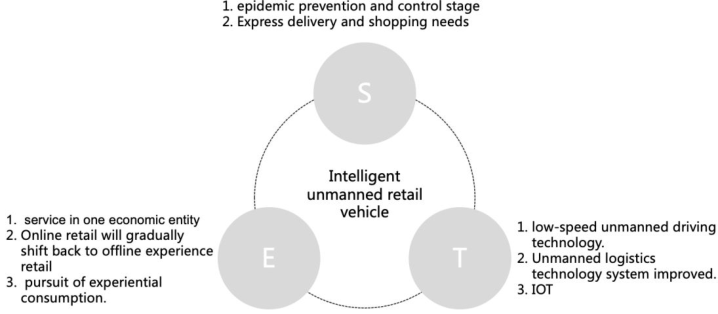
With the development of intelligence levels, Internet, big data, and other technologies. The IoT have promoted the popularization of smart and inter- net products. the continuous improvement of our social and economic level, consumer demand for the original inherent product model and function has shifted to experience, commodity circulation into the new retail era. In this context, we first verify our design object thought set factor analysis – the intelligent unmanned retail vehicle. As a complex intelligent product, the intelligent unmanned retail vehicle need to consider three important elements: users’ need, technology, and scenario (Figure 1). The current product design method to deal with the challenges of the three elements is difficult to inte- grate resources to create an intelligent design solution. so this paper in a variety of technical backgrounds, to provide the intelligent level of judgment
Figure 1: SET analysis to find design opportunities.
to the user-centric integration of user needs; technology; scene of application, and concept design. This paper (1) through service design thinking to deter- mine the multi-stakeholder use of intelligent unmanned retail vehicle needs in different scenarios; (2) from the product opportunity point to intelligent product level judgment, through the demand into the intelligent level, to carry out the judgment to derive intelligent product design across that on hey. (3) applied in practice to integrate design resources and design intelligent unmanned retail vehicles.
SET Factor Analysis The SET factor analysis method was proposed by Craig Vogel and Jonathan Cagan, which includes the factor analysis of Society, Economy, and Tech- nology (Cagan and Vogel, 2018). First through a comprehensive analysis of the analysis of SET factors to find the product opportunities to find the opportunity—the intelligent unmanned retail vehicle. During the epidemic prevention and control stage, the closed management of the park has brou- ght new problems. Express delivery and shopping for everyday goods have become an integral part of the park, which may bring security risks and mana- gement pressure to the park service provider. The park urgently needs a set of intelligent from shopping to delivery solutions to create a safe(non-contact), orderly, technological and convenient smart living area.
CLASSIFICATION OF INTELLIGENT PRODUCTS Early definitions of intelligent products by Serge A. Rijsdijk and Erik Jan Hultink conceptualized intelligence as a combination of dimensions such as autonomy, adaptability, responsiveness, versatility, cooperativeness, human interaction, and personality, and the range of products that possess one or more of these dimensions. (Rijsdijk and Hultink, 2009) Porter, Me and Heppelmann, define smart products as Intelligent connected products that all share three core elements: physical components (e.g., mechanical and
Design Innovation Base on Classification Model of Intelligent Products 171
electrical components); intelligent components (sensors, microprocessors, data storage, controls, software, embedded operating systems, and digital user interfaces) and connected components (ports, antennas, protocols, and networks that enable communication between the product and the product cloud, which runs on a remote server and contains the product’s external operating system). (Porter and Heppelmann, 2015) Manuel Holler, Falk Uebernickel, Walter Brenner, believe that Intelligent product is the result of a multidisciplinary intersection, which includes the field of computers, sensor memory program sets, digital systems, intelligent connection systems (sen- sors), intelligent network systems and proposed a framework for research and development of intelligent products applied to the business sector. (Hol- ler, Uebernickel and Brenner, 2016), T. Novak, D. Hoffman proposed that a Smart Object is a physical device or a collection of devices (Novak and Hoffman, 2019).
In summary, we can see that with the upgrading of technology, the concept of intelligent products while following the iterative development of intel- ligence products with different capabilities and roles. Intelligent products begin to involve complex operations, users may need to learn how to make them work, it’s including mobile terminals, remote control, intelligent panels, and other operations. Intelligent products through various types of sen- sors to perceive and process, then feedback information to the user, and when it interacts with the user, the intelligent product may show the cha- racteristics of anthropomorphic user interaction will be different if the user communicates with different features and intelligence level of intelligent products.
The most significant distinction between new retail and traditional retail is that the status of merchants and consumers has changed. Users will focus not only product itself, they pay more attention to the service and buying experi- ence. The new retail cart contains a complex series of operations of multiple roles such as producers, managers, and users, especially users and other stake- holders in the process of using the unmanned cart, their behavior is a dynamic change process. Compared with the traditional static process, new intelligent unmanned retail vehicles led to a new challenge full of uncertainty during the interaction process. We hope that through the service design thinking- special analyze user behavior during the usage process to sort out the overall process by multi-user behavior’s generation and occurrence, summarize the multi-stakeholder needs into the intelligent level’s judgment so that we are able to use new and improving techniques for enhancing coverage accuracy, friendly, and emotional.
We propose to analyze the existing products’ intelligence level to derive specific functions to be used and operated by users, and judge and design the intelligence level of the product so that the functions in the intelligent product can be effectively configured and reasonably allocated to form the optimal solution of the intelligent unmanned retail vehicle’s structure. Design tasks, the process of design, technical configuration, and the vehicle’s structure will be clarified through intelligent level judgment. we identify the primary design goal of each stage in this phase.
172 Xue and Zhao
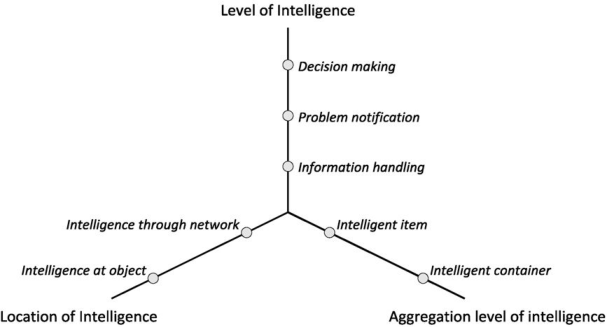
Figure 2: Classification model of Intelligent Products. (Meyer, Främling and Holmström, 2009).
Category of Intelligent Products Based on Classification Model of Intelligent Products with the development of intelligent products and intelligent industries, pro- ducts incorporate new technologies and form a complex system during every iteration of the product. the technical manuals and operations standards con- flict with user usage and behaviors, they are harder for users to manipulate. At the same time, due to the lack of professional technical knowledge, desi- gners lack experience in conceptualizing technical pathways and assessing technical feasibility during the conceptual design phase (SUN et al., 2020).
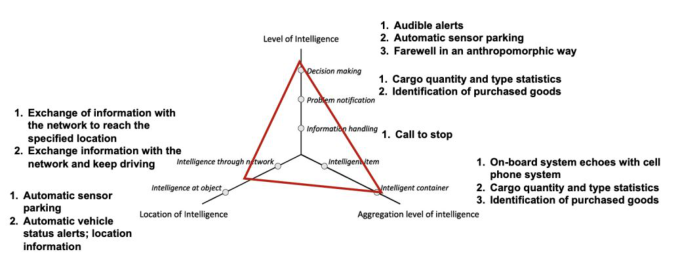
Gerben G. Meyera Kary Främlingb et al. developed a classification model for Intelligent products based on three dimensions: Level of intelligence: Information management; location of intelligence: The Aggregation level of intelligence (Meyer, Främling and Holmström, 2009). By classifying the dif- ferent intelligence levels of intelligent products, designers can retrieve similar design solutions based on the existing design cases and get the basic archi- tecture when designing a complex system of smart products, and then make corrections according to the actual design requirements and finally output the design module (XU and GAO, 2000).
As shown in the Figure 2, Meyer’s framework for determining intelligence levels defines: (1) Level of intelligence: Information management (2) location of intelligence (3) The Aggregation level of intelligence
Identifying Intelligent Unmanned Retail Vehicle Infrastructure Through Intelligent Product Classification From the beginning, the designer can search the classified database before starting the conceptual design phase of the intelligent product, to find a similar technical structure in the database, so as to quickly and effectively find the low-cost technical structure that can be realized, and accumulate the design ideas for the next step.
Design Innovation Base on Classification Model of Intelligent Products 173
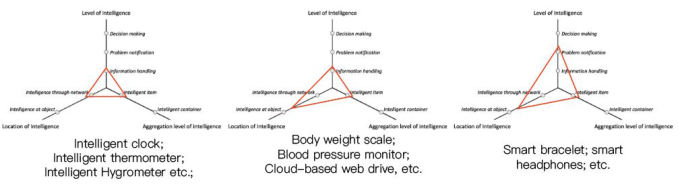
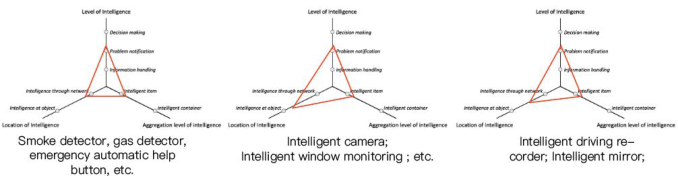
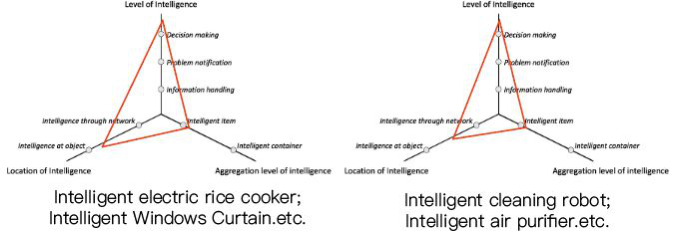
Figure 3: Classification model of Intelligent Products- Personal intelligent products.Figure 4: Classification model of Intelligent Products- Intelligent security products.Figure 5: Classification model of Intelligent Products- Home intelligent products.
Personal Intelligent Products (Figure 3) Personal intelligent products are usually simple intelligent products.
Intelligent Security Products Intelligent security products (Figure 4) for emergency situations, once the dangerous information is sensed will timely alarm, and product integrated with behavior recognition algorithm, can identify and judge the behavior of people or vehicles in the moment.
Home Intelligent Products Home intelligent products (Figure 5) have gradually developed from home automation products to the intelligence IoT home intelligent system. The product can sense the environment and dealing with the date,then upload the information to the networks to achieve control of intelligent devices.
174 Xue and Zhao
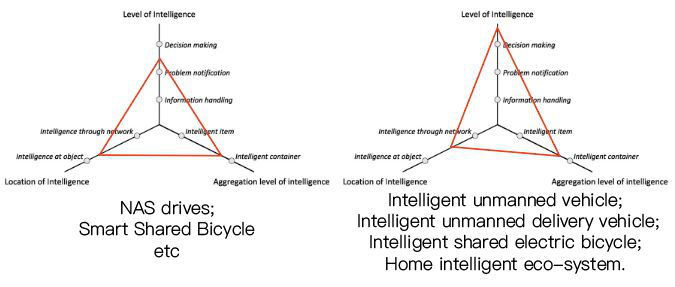
Figure 6: Classification model of Intelligent Products- Shared intelligent products.Figure 7: By comparison Classification model of Intelligent Products get the functions of intelligent unmanned retail vehicle.
Sharing Intelligent Products Intelligent sharing products (Figure 6) generally indica a system of sharing intelligent products. They through the Internet, big data, and cloud tech- nologies, realize products’ data exchange. Intelligent Sharing is often in autonomous mode, they send information to the cloud in real-time, and com- putation and data handing are usually performed in the cloud. Then transport the data to the intelligent product. The cost of this type of intelligent product with new computing way was reduced.
After the analysis, we conclude that intelligent unmanned retail vehicles integrated many different technologies. Intelligent product with the rapid development of technology of communication and internets the intelligent retail vehicle can make decisions through networks and with many informa- tion and sharing and the information interactive convenience quick methods and the platforms. Like road facilities, other vehicles, cloud platforms, etc. Through platforms and methods to achieve complex environmental awareness, collaborative control, and other functions.
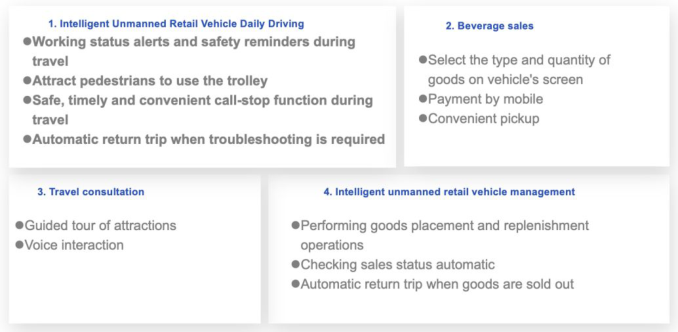
Figure 7 shows that the Intelligent unmanned retail vehicle has to support a series of complex activities at the system level such as path
Design Innovation Base on Classification Model of Intelligent Products 175
Figure 8: Intelligent unmanned retail vehicle design main processes.Figure 9: Intelligent unmanned retail vehicle design main processes.
planning, intelligent dispatching, operation management, and purchase acti- vity support.
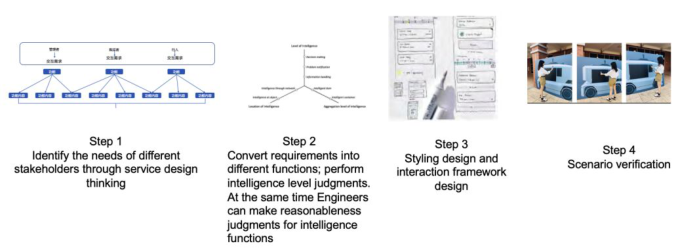
INTELLIGENT UNMANNED RETAIL VEHICLE DESIGN PROCESS Based on intelligent products intelligent level judgment framework, the intel- ligent unmanned retail vehicle’s design process will be divided into four main steps as Figure 8 shows.
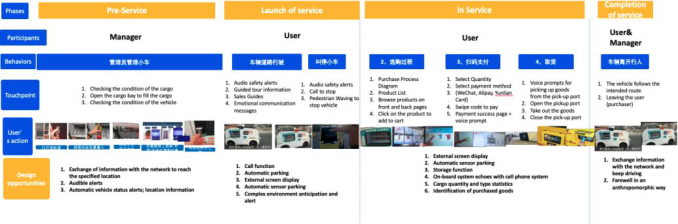
1) A service system design model for intelligent unmanned retail vehicles is established to build three dimensions— as stakeholder needs, users journeys, and touchpoints (Figures 9 and 10 shows).
- From a multi-user scenario perspective, a scenario is used to analyze multi-user journeys and gain systematic insight into the user pain points of different users in the scenario; (multi-user part of the service blueprint) - From the perspective of a product system - From the perspective of multitasking, focus on the scenarios of the user’s interaction model. - Integrated and applicator with many intelligent interaction technolo- gies
2) Combining the user requirements, the functions of the intelligent unman- ned retail vehicle are framed in the intelligent level. At the same time the technical feasibility of the functions under the intelligent level is judged
by the engineering staff. The functions in the intelligent product are effe- ctively configured and reasonably allocated to form the optimal solution of the intelligent unmanned retail vehicle structure concept scheme. 3) Scenario verification in order to rationalize under the complex context and integrate different needs of multi-stakeholder, it’s a way to describe and certificate the design objective, the method, the function, and the data flow of the System.
Aggregation Level of Intelligent The aggregation level of intelligent unmanned retail vehicle depends on the human-computer interaction element, intelligent unmanned retail vehicle and human interaction is mainly divided into three aspects. The consumer’s purchase interaction operation respectively: the products selection, input information, and the intelligent unmanned retail vehicle feedback to the user.
Location of Intelligent The goal of the Intelligent unmanned retail vehicle is to improve the sending of retail goods and the user receiving or purchasing. Therefore, we use RFID tagging on products for tracking and tracing goods, reducing the possibility of missing goods. The intelligent unmanned retail vehicle has both locations of intelligence for the statistical calculation of the number of goods purchased, while with the intelligence through the network to deliver the information to the central processor in real-time, and through network computing, derive the path planning to arrange the replenishment of goods during transportation.
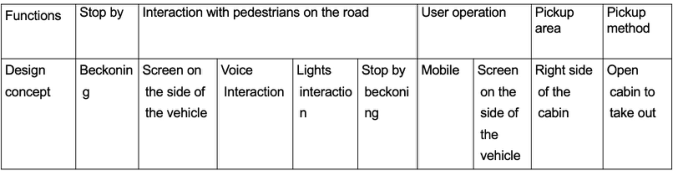
Level of Intelligence The routine of intelligent unmanned retail vehicles: route planning, dea- ling with obstacles, and a series of other driving tasks require intelligent unmanned retail vehicles to have the ability to collect information, make judgments and ultimately make decisions. Intelligent unmanned retail veh- icles need to interact with passersby on the road in real-time to attract their attention and serve as a safety alert for pedestrians with vehicles approa- ching. A higher intelligence level can help the vehicle make different voice and expression feedback in different scenarios, thus giving the user a new experience.
During the design process, the analysis method of usability in engineering is a better way to obtain the validity of the design. The project is based on the chassis of the existing unmanned slow trolley and the design of the exterior
Design Innovation Base on Classification Model of Intelligent Products 177
of the intelligent unmanned retail vehicle with retail function added to the architecture, after proposing the intelligent level function distribution map (Figure 11) and communicating with the technical engineering department several times, the structure finally was been determined.
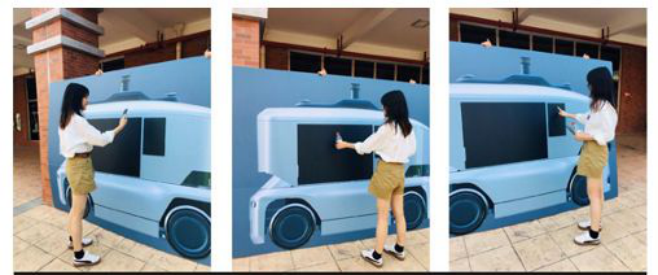
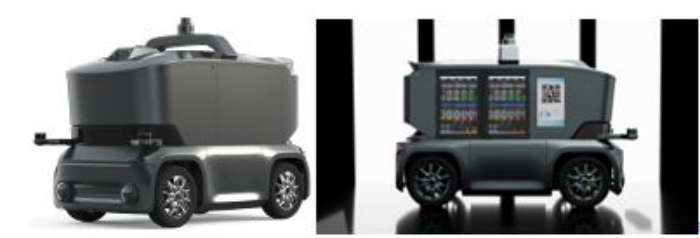
Intelligent Unmanned Retail Vehicle Styling Design The intelligent unmanned retail vehicle with simple visualization elements can directly achieve the purpose of functional priority while allowing users to feel the intelligent semantics involved. We separated the carriage and cabin to satisfy engineering requirements. The storage refrigerator is located on
178 Xue and Zhao
the side of the vehicle, users and administrators can easily take and manage goods by opening the door (Figures 12 and 13). And the front screen uses a long bar screen to display the selling information of the Intelligent unmanned retail vehicle and anthropomorphic expressions hoping to give the feeling of a pedestrian on the road.
CONCLUSION
As intelligent products in the Internet of Things environment gradually enter our daily life, the lifestyle of people is also affected to a certain extent. People prefer to make intelligent products become life partners instead of using tools to enhance the experience through intelligent products rather than just satisf- ying the needs, therefore, how to make intelligent products more humane and easier to understand so as to better serve people is a problem that designers should consider. Intelligent product level classification has an irreplacea- ble role as a tool to express, explore, test, and evaluate intelligent product design. With the development of technology and the continuous emergence of various platforms, we analyze stakeholders’ behavior through service design thinking, find design opportunities, and build Intelligent product functional prototypes through the intelligent classification framework, while technical personnel makes judgments in a way that will be increasing, reasonable and effective. The method of building intelligent classification under the hiera- rchy can assist designers to get rid of the shackles of technology and means of implementation and considering the relationship between intelligent products and people, society and environment in a broader perspective in design.
ACKNOWLEDGMENT
This research is supported by Paradigm Construction and Theoretical Boun- dary of Design Research, National Social Science Foundation (20BG103).
REFERENCES Cagan, J. and Vogel, C.M. (2018) Creating Breakthrough Products: Revealing the Secrets that Drive Global Innovation. Holler, M., Uebernickel, F. and Brenner, W. (2016) Understanding the Business Value
of Intelligent Products for Product Development in Manufacturing Industries. Meyer, G.G., Främling, K. and Holmström, J. (2009) Intelligent Products: A survey.
Computers in Industry, 60(3), pp. 137–148. Novak, T. and Hoffman, D. (2019) Relationship journeys in the internet of things: a new framework for understanding interactions between consumers and smart objects.]. Porter, M.E. and Heppelmann, J.E. (2015) How Smart, Connected Products Are
Transforming Companies. Harvard Business Review, 93(10), p. 96. Rijsdijk, S.A. and Hultink, E.J. (2009) How Today’s Consumers Perceive Tomorrow’s Smart Products. Journal of Product Innovation Management, 26(1), pp. 24–42. Sun, L.Y. et al. (2020) Current Situation and Development Trend of Intelliaent Pro-
duct Desian under the Backaround of Human-centered AI Packing Engineering, 41(02), pp. 1–6. Xu, X.Z. and Gao, A.G. (2000) Design and implementation of an intelligent decision support system for complex product solution. Application Research of Computer, (09), pp. 23–24. Gao, X.J. (2016) Chinese intelligent hardware industry development status and
construction. High-Technology&Commercialization, (02), pp. 80–85.
LISTED IN THE AHFE DIGITAL BOOKSTORE CATALOGUE
Explore the complete digital volume
Ergonomics In Design
Read this individual research paper free through the original publisher, or explore the full digital proceedings book.
ISBN 978-1-958651-23-0
Explore this ISBN in the AHFE Bookstore ↗Listed in the July 2026 bookstore catalogue; search by ISBN to confirm current availability · Digital book purchase optional