Toshiya Sasaki (2024). How to set up design skills appropriate for each organization. In: Human Factors, Business Management and Society. AHFE Open Access, vol. 135, pp. 158–162. https://doi.org/10.54941/ahfe1004941
In recent years, the definition of design has expanded with changes in the social environment. Companies are faced with the challenge of setting up the necessary design skills in accordance with the changes in their business and organization. Against this background, I organize examples of design skills that can be used as references and propose how to set up design skills.
As the social environment changes, the definition of design has been extended and various design approaches have been proposed.
Companies are required to train people to utilize design skills, and the challenge is to set up the necessary design skills for each organization in accordance with changes in business and organization.
The definition of design skills in this research is the ability to think and practice to create strategy, scope, structure, skeleton, and surface regarding all assets of a company.
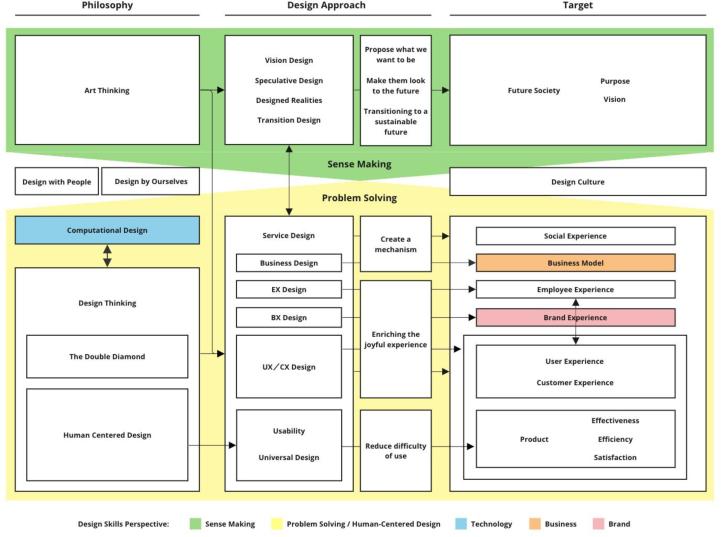
Organizing Design Skills In order to comprehensively organize design skills, based on the lit- erature review, I organized the overall picture of design approaches from the perspective of the philosophy underlying the various design approaches and the target of design (see Figure 1).
After organizing the overall design approach, I investigated the elements of design skills in terms of sense making, problem solving and human-centered design, business, brand, technology and human, and organized them into the following 10 skills (see Table 1).
Design Skills Skills Overview Skill Perspective Problem solving and human- centered design Conception Ability to go through trial and error until the concept is put into practice. Prototyping Ability to create and evaluate prototypes to determine if product and service design proposals are suitable for users. Information Architecture
Ability to design structures that make it easier for users to understand information based on required specifications. Design Research Ability to research and analyze to understand the stakeholders’ situation, essential requirements, product, and business, and to evaluate whether the proposed design is appropriate for the user. Business Business Model Design
Ability to visualize the elements and flows involved in the business in order to consider design from both the user and business perspectives. Brand Brand Experience Design
Ability to design a consistent user experience so that users can recognize the link between brand symbols and value. Technology Technology Adaptability
Ability to utilize new technologies and paradigms for products and services.
(Continued)
160 Sasaki
Table 1. Continued Design Skills Skills Overview Skill Perspective
Table available in the original PDF paper.
Sense making Conception Ability to go through trial and error until the concept is put into practice. Human Design Management
Ability to manage projects and teams to utilize design in management. Technical Communication
Ability to convey your thoughts so that others can understand to facilitate the project.
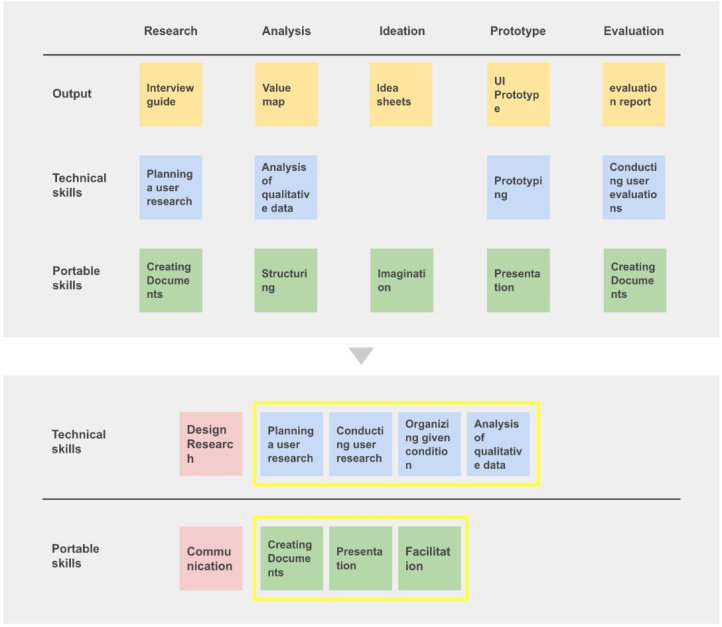
How to Set Up Design Skills Considering that design skills can be classified in a variety of ways, the skills are set up in two steps (see Figure 2).
1) Identify for each workshop participant the outputs required for each step of the work and the technical and portable skills needed for the outputs. Technical skills are the specialized skills of designers, while portable skills are those required regardless of the type of work. 2) Classify the skills identified by all workshop participants. Categorize the skills by technical skills and portable skills, and name the skills.
Figure 2: How to set up design skills.
How to Set Up Design Skills Appropriate for Each Organization 161
METHODS
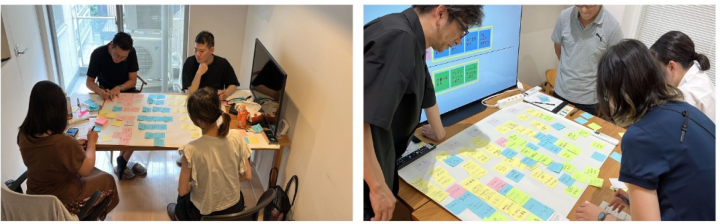
I experimented with a two-hour workshop for eight designers from various companies. Workshop participants were divided into two teams, and each team set up design skills for a fictitious company (see Figure 3).
Figure 3: The scene of the workshop conducted.
RESULTS
As a result of the workshop, design skills were established for each team as shown in Table 2 (see Table 2). In addition, the following comments were observed in the questionnaire regarding what was learned.
It is hard to verbalize skills.
It gave me an opportunity to learn how other people think about their skills. I would like to review my company’s skills and my own skills based on the examples of design skills that will serve as references.
I could notice areas where I want to break down my skills further and areas where I want to improve resolution.
I also learned from the grouping of skills.
I honestly enjoyed being able to think together with people from different backgrounds. I would like to try this at our company immediately.
I learned that we need to be able to set up the necessary skills by ourselves.
Table 2. Design skills set up in the workshop.
Table available in the original PDF paper.
Team A B Digital product design company Smartphone app production company Assumed fictitious company
Set up design skills
Insight Excavation Skills
Analytical skills
Visualization and visual creation
Knowledge and experience
Material vision skills (UI creation / art direction / expert review)
Design facilitation
Driving force (adaptability / team management / leadership skills)
It is believed that having reference design skills will make it easier to set up the design skills needed for their organization.
Since what constitutes a specialized skill varies from organization to orga- nization, design skills may be set without separating technical and portable skills.
For example, some abilities may be seen as sense, such as “being able to find essential awareness”. Considering that sense can be honed through diverse experiences, it could be set as a conceptual skill.
Familiar terms vary from organization to organization, and it can be diffi- cult to verbalize the image of a skill. In such cases, it may be easier to set skill names that are appropriate for the organization by sharing specific scenes of work in which the skills are utilized.
CONCLUSION
Through experimentation on how to set up design skills with the help of organized examples of design skills, it was found that it is possible to set up a rough draft of design skills appropriate to the organization. After the workshop, it may be possible to establish design skills appropriate for the organization by refining the definition of terms and categorization of skills.
REFERENCES
D. A. Norman. (2013). The Design of Everyday Things: Revised and Expanded Edition, NY: Basic Books. Ezio Manzini. (2015). Design, When Everybody Designs: An Introduction to Design
for Social Innovation, Cambridge, MA: The MIT Press. Human Centered Design Organization, (2022). HCD Specialty Qual- ification Competence Map (FY2022). https://docs.google.com/ presentation/d/1Ih3csqcwDGHD6Q0tCGurjdiXCgB_QQaE0ZmESACWN- c/edit#slide=id.g100eaeb2460_0_0 Jesse James Garrett. (2010). The Elements of User Experience: User-Centered Design for the Web and Beyond, Second Edition, Berkeley, CA: New Riders. John Maeda. (2023). Design in Tech Report 2023. https://designintech.report/wp-
content/uploads/2019/01/dit2018as_pdf.pdf Masaki Iwabuchi, Daijiro Mizuno. (2020). Speculation of the Purpose of Life in 2050 from Kyoto: Case Study on Transition Design in Japan, PIVOT 2020: Full Research Papers. Noboru Konno, Ikujiro Nonaka. (2018). Methodology of Conceptual Power, Nikkei
BP.
LISTED IN THE AHFE DIGITAL BOOKSTORE CATALOGUE
Explore the complete digital volume
Human Factors, Business Management and Society
Read this individual research paper free through the original publisher, or explore the full digital proceedings book.
ISBN 978-1-964867-11-3
Explore this ISBN in the AHFE Bookstore ↗Listed in the July 2026 bookstore catalogue; search by ISBN to confirm current availability · Digital book purchase optional