Skip to article
AHFE AHFE Discoveries AHFE International Open Access Journal
AHFE OPEN ACCESS OPEN ACCESS CONFERENCE PROCEEDINGS PAPER

“The Vision Picnic”: A Metaphor-Driven Workshop Framework for Personal Vision-Making through Collaborative Self-Exploration

X Design Academy, 4-1-35, Kudankita, Chiyoda-Ku, Tokyo, 102-0073, Japan ↗
Publication year
Digital Object Identifier10.54941/ahfe1007143

Abstract

In a rapidly changing contemporary society saturated with diverse choices, individuals often find themselves in a "food court where they don't know what they truly want to eat." In this environment, it has become increasingly difficult for individuals to draw a clear future for themselves (to make a "handmade bento"). This study proposes and reports on the design and implementation of "The Vision Picnic," a novel workshop framework that takes a human-centered approach to this challenge. The primary objective of this workshop is to support participants in a process of self-exploration and future-self conceptualization in an enjoyable and intuitive manner by employing the familiar and creative metaphor of "making a bento for a picnic." This paper analyzes this framework and its impact on participants, and considers its effectiveness and future challenges.The workshop is designed as a journey for participants to create their own "special future bento." The process is structured into three main steps, designed to elicit fundamental abilities for vision-making: Subjective Ability (the ability to find purpose and value from a subjective and original perspective = "a tongue that trusts one's 'likes'"), Imaginative Ability (the ability to expand the image of a desirable world = "a recipe book for drawing unseen 'feasts'"), and Practical Ability (the ability to organize means to realize the formed image = "the skill to 'cook' ideas").Step 1 is Ingredient Gathering (Self-Exploration). In this step, participants open their "refrigerator of the heart" to take out "ingredients," which represent their personal "likes" and "strengths." The specific task is to freely list about 20 things they "like" or find "fun." Participants are given hints, such as using word association, and are encouraged to include simple daily pleasures as valuable ingredients. This is followed by a dialogue session where pairs "taste-test" each other's ingredients. Through questions like, "What kind of flavor (enjoyment) does that ingredient have?" and "Do you have any 'soul food' you've loved since childhood?", participants examine their ingredients (= things they like and enjoy).Step 2 is Recipe Making (Vision-Making). This step involves combining the gathered ingredients to create an exciting "original recipe," which represents a desired future self. For example, participants might combine "expanding knowledge," "beer," and "cafe" into a recipe for a "Knowledge Brewery Cafe Owner." To stimulate recipe ideas, the workshop includes an exercise called the "'Food Report' from a Future Gourmet," where participants imagine themselves at 80 years old as a "gourmet who has savored life to the fullest" and write a letter of advice to their present self.Step 3 is Packing the Lunch Box (Action Planning). Based on the completed recipe, this final step is about deciding on the "first bite" that can be taken starting from the next day. To realize their created vision, participants write down a concrete action plan of what they can do "Today," "This Week," "This Month," and "This Year." Emphasis is placed on defining an immediate, small first step, such as "Today: Find one beer bar online for reference."Qualitative feedback from participants and analysis of their work yielded several key findings. First, the effectiveness of the metaphor-based experience design was demonstrated. The friendly metaphors of a "picnic" and "bento" lowered the psychological barrier to the introspective theme of vision-making and encouraged participants to engage with the process enjoyably. Second, the importance of dialogue integrated into the process was confirmed. Through "taste-testing" with others, participants gained a higher resolution of their own values and preferences that they might not have noticed alone, with one participant noting it was "an opportunity to realize what kind of flavor I liked!" Dialogue was effective in deepening self-exploration and helping individuals find a direction for their vision. At the same time, several challenges became apparent. The "Recipe Making" step was particularly difficult, and some participants were unable to formulate a satisfactory vision within the allotted time. Feedback such as, "I thought there might be recipes that become visible by talking with various members," suggested room for improvement in how dialogue pairs are formed.
INTRODUCTION

In a rapidly changing contemporary society saturated with diverse choices, individuals often find themselves in a “food court where they don’t know what they truly want to eat.” In this environment, it has become increasingly difficult for individuals to draw a clear future for themselves (to make a “handmade bento”). This study proposes and reports on the design and implementation of “The Vision Picnic,” a novel workshop framework that takes a human-centered approach to this challenge. The primary objective of this workshop is to support participants in a process of self-exploration and future-self conceptualization in an enjoyable and intuitive manner by employing the familiar and creative metaphor of “making a bento for a picnic.” This paper analyzes this framework and its impact on participants, and considers its effectiveness and future challenges.

METHODS

The workshop is designed as a journey for participants to create their own “special future bento.” The process is structured into three main steps.

“The Vision Picnic”: A Metaphor-Driven Workshop Framework 829 This structure is designed to elicit three fundamental abilities for vision- making, which we identified as essential for the process.

The first is Subjective Ability, the capacity to find purpose and value from a subjective and original perspective. This is metaphorically described as having “a tongue that trusts one’s ‘likes’,” emphasizing the importance of trusting one’s own intrinsic feelings and preferences as a valid starting point. The second is Imaginative Ability, the skill to expand the image of a desirable world beyond current constraints. This is represented by “a recipe book for drawing unseen ‘feasts’,” encouraging participants to freely envision possibilities. The third is Practical Ability, the competence to organize means to realize the formed image, or “the skill to ‘cook’ ideas,” which focuses on translating an abstract vision into concrete, actionable steps.

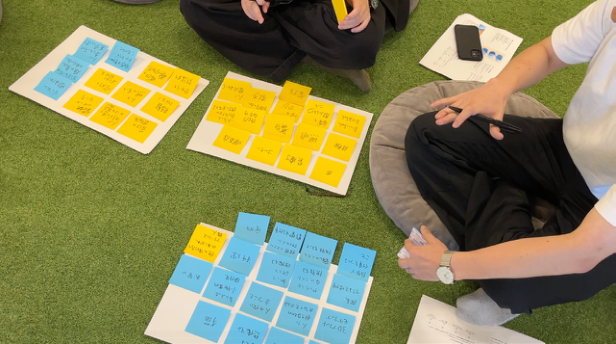
Step 1 is Ingredient Gathering (Self-Exploration) In this step, participants open their “refrigerator of the heart” to take out “ingredients,” which represent their personal “likes” and “strengths.” The specific task is to freely list about 20 things they “like” or find “fun.” Participants are given hints, such as using word association, and are encouraged to include simple daily pleasures as valuable ingredients. This is followed by a dialogue session where pairs “taste-test” each other’s ingredients. Through questions like, “What kind of flavor (enjoyment) does that ingredient have?” and “Do you have any ‘soul food’ you’ve loved since childhood?”, participants examine their ingredients (= things they like and enjoy) (Figure 1).

Figure 1: Participants engaged in Step 1, “ingredient gathering,” listing their personal “likes” and “strengths”.
Original PDF Figure 1:

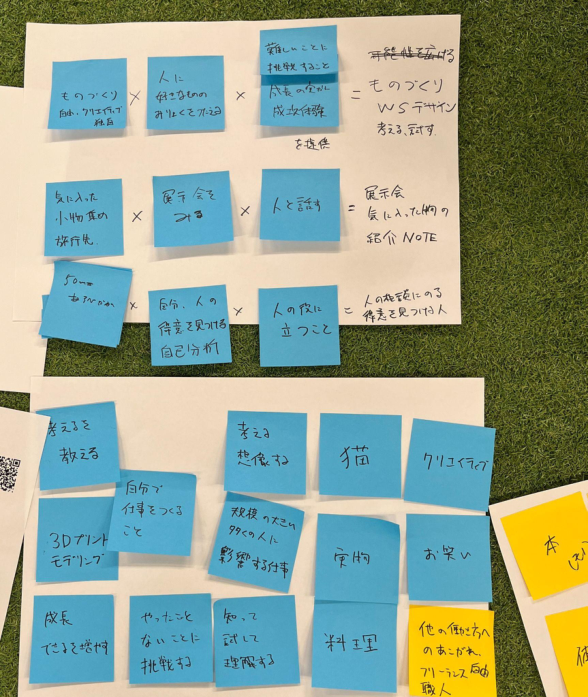
Step 2 is Recipe Making (Vision-Making) This step involves combining the gathered ingredients to create an exciting “original recipe,” which represents a desired future self (Figure 2). For example, participants might combine “expanding knowledge,” “beer,” and

830 Sasaki “cafe” into a recipe for a “Knowledge Brewery Cafe Owner.” To stimulate recipe ideas, the workshop includes an exercise called the “‘Food Report’ from a Future Gourmet,” where participants imagine themselves at 80 years old as a “gourmet who has savored life to the fullest” and write a letter of advice to their present self.

Figure 2: The “Recipe Making” step, where participants combine their gathered “ingredients” (sticky notes) to construct a future vision.
Original PDF Figure 2:

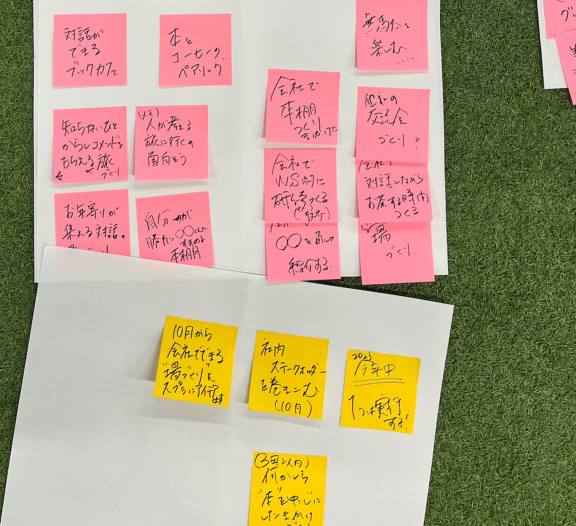
Step 3 is Packing the Lunch Box (Action Planning) Based on the completed recipe, this final step is about deciding on the “first bite” that can be taken starting from the next day. To realize their created vision, participants write down a concrete action plan of what they can do “Today,” “This Week,” “This Month,” and “This Year.” Emphasis is placed on defining an immediate, small first step, such as “Today: Find one beer bar online for reference” (Figure 3).

“The Vision Picnic”: A Metaphor-Driven Workshop Framework 831

Figure 3: A participant’s completed action plan from Step 3, “Packing the Lunch Box,” outlining concrete next steps for today, this week, and this month.
Original PDF Figure 3:

RESULTS

Qualitative feedback from participants and analysis of their work yielded several key findings. First, the effectiveness of the metaphor-based experience design was demonstrated. The friendly metaphors of a “picnic” and “bento” lowered the psychological barrier to the introspective theme of vision-making and encouraged participants to engage with the process enjoyably. Second, the importance of dialogue integrated into the process was confirmed. Through “taste-testing” with others, participants gained a higher resolution of their own values and preferences that they might not have noticed alone, with one participant noting it was “an opportunity to realize what kind of flavor I liked!” Dialogue was effective in deepening self-exploration and helping individuals find a direction for their vision. At the same time, several challenges became apparent. The “Recipe Making” step was particularly difficult, and some participants were unable to formulate a satisfactory vision within the allotted time. Feedback such as, “I thought there might be recipes that become visible by talking with various members,” suggested room for improvement in how dialogue pairs are formed.
DISCUSSION

Vision-making is an abstract and often intimidating task. By framing it as the familiar, creative, and tangible process of “making a bento,” this metaphor lowers the psychological barrier to entry. This approach makes it easier for participants to engage with complex self-exploration not as a

832 Sasaki daunting challenge, but as a playful activity. The metaphor helps to organize thoughts about one’s values (“ingredients”), desired future self (“recipe”), and immediate actions (“packing the lunch box”).

Furthermore, the dialogue (“taste-testing”) phase provided external perspectives that were crucial for participants to refine their own ideas. Articulating their “likes” into words forces the translation of internal feelings into explicit language, a process that in itself clarifies thought. Feedback and questions from their peers helped them see their own values from new angles, leading to moments of insight, as one participant noted, “an opportunity to realize what kind of flavor I liked!”

However, the bottom-up approach, starting purely from personal “likes,” has a tendency to result in visions that are confined to the realm of personal interests, potentially lacking a connection to broader societal needs or challenges. While essential for intrinsic motivation, this focus can limit the potential impact of the individual’s vision.

CONCLUSION

This study introduced “The Vision Picnic,” a metaphor-driven workshop framework designed to support personal vision-making. Through a three- step process centered on metaphor and collaborative dialogue, the framework was shown to effectively enhance participant engagement and enrich the process of self-exploration. The findings indicate that this human-centered approach can successfully lower the psychological barriers associated with abstract future-planning.

A key challenge is to bridge the gap between personal passions and broader societal contexts. Therefore, future research will focus on refining the framework to encourage participants to connect their intrinsic motivations with external factors, such as societal issues or themes they wish to address. We believe that evolving this support from simply “making a delicious bento for oneself” to “preparing a bento for a picnic to be shared with others” can foster the vision-making of visions with greater and more sustainable social impact.

REFERENCES

Cameron, Julia. (1992). The Artist’s Way: A Spiritual Path to Higher Creativity. New York: Tarcher/Putnam. (Translated in Japanese by Y. Suga, 2001, Tokyo: Sunmark Publishing). Konno, Noboru and Nonaka, Ikujiro. (2018). Kōsōryoku no Hōhōron [The

Methodology of Visioning Power]. Tokyo: Nikkei BP. Miyake, Naomi, Tsukiyama, Takashi, Mishina, Kazuhiro, Ota, Hajime, Miyanaga, Hiroshi and NIRA (National Institute for Research Advancement). (2013). Kōsōryoku ni Kagaku ga Idomu, Watashi no Kōsō [Science Challenges Visioning Power, My Vision]. Tokyo: NIRA.

Cover of the proceedings volume Intelligent Human Systems Integration (IHSI 2026): Disruptive and Innovative Technologies

Explore the complete digital volume

Intelligent Human Systems Integration (IHSI 2026): Disruptive and Innovative Technologies

Read this individual research paper free through the original publisher, or explore the full digital proceedings book.

ISBN 978-1-964867-76-2

Explore this ISBN in the AHFE Bookstore Listed in the July 2026 bookstore catalogue; search by ISBN to confirm current availability · Digital book purchase optional

Explore Related Research

Related research 8 matches

More papers from this volume

← Back to Research ExplorerBrowse the full library →