Iris Gräßler, Alena Tušek (2024). Case study on the software-supported development of competences in Scenario-Technique. In: Human Systems Engineering and Design (IHSED2024): Future Trends and Applications. AHFE Open Access, vol. 158, pp. 250–258. https://doi.org/10.54941/ahfe1005548
The content of university teaching in engineering sciences, particularly in product creation, is characterised by the development of application skills. Changing working conditions require new teaching concepts that are oriented towards the needs of students and practice and consider the acquisition of soft skills. A key method to be considered in this context is the Scenario-Technique. In this paper, a one-day workshop based on a software tool for the Scenario-Technique is presented that focusses on competence development for Scenario-Technique in form of a learning concept. Based on a systematic literature analysis, existing approaches for learning the Scenario-Technique are identified and requirements for a subsequently developed software-supported Scenario-Technique workshop are established. Using a case study, the learning concept is validated in two test phases for comprehensibility, user-friendliness, and practical suitability. The result is a concept that enables practice-oriented learning of the Scenario-Technique.
The use of Scenario-Technique in companies is important for future competitiveness and as decision support (Bain & Company, Inc. 2023; Mietzner, 2009). However, the consistent and sustainable use of Scenario- Technique is not widespread due to the complexity of the method and the associated training and (recurrent) preparation cost. The difficulty of application can be countered by targeted competence development. There is potential for improvement, particularly in reducing complexity and effort as well as in independent use and empowerment. Such a qualification must be prepared through academic knowledge transfer and established in a practice-oriented concept (Barton et al., 2017).
University teaching on methods of product creation requires both teaching of theoretical foundations and development of expertise in practice (Haralanova and Fafner, 2019). In particular, the ever more rapidly changing working conditions, for example through intermedia and location- independent work, require new concepts for the teaching of competences,
Case Study on the Software-Supported Development of Competences 251
which are oriented to the needs and abilities of students as well as to practice (Care et al., 2018). At the same time, soft skills are crucial for later application and must be implicitly taken into account (Haralanova and Fafner, 2019).
These challenges apply in particular regarding strategic product planning using Scenario-Technique. The reason for this is that Scenario-Technique focuses on the increasingly important competence of foresighted thinking. Scenario-Technique anticipates future developments based on interdependent influence factors. The future is thought through comprehensively and systematically. Another special feature of Scenario-Technique is the soft skills to be learnt, such as decision-making and teamwork (Mietzner, 2009; Gräßler et al., 2020).
The aim of the research presented in the paper at hand is the development of a Scenario-Technique Workshop using a software tool for practice-oriented competence transfer of the contents of Scenario-Technique, considering the soft skills to be acquired by engineers. The following research question sums this up: What features must a software support for Scenario-Technique contain in order to support the development of Scenario-Technique competences?
This paper is divided into five sections. The introduction (section 1) is followed by the research design chosen to answer the research question (section 2). Then the fundamentals and requirements for a software- supported workshop are presented (section 3). A learning concept and its implementation in a case study is then presented (section 4). Finally, the results are summarised and an outlook on further research perspectives is given (section 5).
RESEARCH DESIGN The research design is divided into four steps (Fig. 1). In a first step, a literature analysis according to the PRISMA 2020 statement (Page et al., 2021) is conducted to identify and analyse existing descriptions of competence transfer in Scenario-Technique. The search terms consist of a combination of Scenario-Technique and competence development as well as synonyms linked with Boolean operators. The literature analysis is based on the databases of Scopus and Web of Science.
In a second step, requirements for a practice-oriented concept of competence development are derived. The requirements are based on the literature, on experiences and problem descriptions from exercises in university teaching and from the practice of Scenario-Technique Workshops in industrial projects. The requirements include soft skills for engineers as well as framework conditions for acquiring competences in Scenario- Technique. Based on these requirements, a practice-orientated concept for a one-day workshop with a Scenario-Tool is developed in step three. The workshop maps all steps of Scenario-Technique and thus enables the derivation of scenarios and is supplemented by a software tool. In the final step, the developed Scenario-Technique Workshop with the associated software tool is evaluated in a case study with two experimental test
252 Gräßler and Tušek
phases and by using the workshop content and the software tool in a plant engineering company.
Figure 1: Research methodology.
Figure available in the original PDF paper.
FUNDAMENTALS AND REQUIREMENTS The following chapter deals with the basics of Scenario-Technique and the competence transfer of the method, resulting from the literature analysis described above. In addition, a list of requirements is drawn up for a practice- oriented concept for teaching the content of Scenario-Technique.
Scenario-Technique is a method by which future scenarios can be defined based on influence factors and corresponding projections, i.e. future characteristics. The resulting scenarios are used to support decision-making to develop strategies and measures to be prepared for possible future scenarios. Based on an influence analysis, the influence factors are evaluated to select representatives, so-called key factors, based on this evaluation. Projections are then assigned to each key factor. The projections of each key factor are evaluated in a consistency analysis with the projections of the other key factors. Consistent combinations of projections of each key factor are aggregated to alternative future scenarios. In order to derive strategies and implement measures, a scenario transfer is carried out on the basis of these future scenarios (Gräßler et al., 2020).
The Scenario-Technique can be supported by software tools and an Integrated Scenario Data Model to utilise data from previous projects (Gräßler et al., 2017).
Competence Transfer in Scenario-Technique The literature analysis revealed 131 sources to be analysed. The sources analysed do not describe any studies in the field of engineering or in the corporate context and only one deals with a didactic concept for Scenario- Technique. A large number of the sources deal with topics in the medical field and the handling of various scenarios in hospitals. However, these sources do not deal with the application and learning of the contents of Scenario- Technique, but with learning based on potential scenarios. For this reason, requirements for a more practice-oriented concept for engineers for learning Scenario-Technique were collected, in particular from the experiences from teaching as well as from experiences from corporate projects in which the Scenario-Technique has already been applied. After a screening, a search to find and an assessment of eligibility, six hits remained, which were considered in more detail for the establishment of requirements. The results of the literature analysis are shown in Table 1.
Case Study on the Software-Supported Development of Competences 253
Table 1. Results of the literature analysis.
Table available in the original PDF paper.
Content Source (Fiala et al. 2018)
Didactic concept of a university course in Scenario-Technique with small groups of students, each with a real-world case and illustration of the results of different futures
Teaching to convey the content in advance and continuous support during the processing of the case
(Meyerowitz et al. 2018)
Description of barriers and enablers of Scenario-Technique in emerging markets
(Ghodsvali et al. 2022)
Test and visualise the decision-making process of resulting scenarios using game theory
(Pattinson and Sood 2010)
Description of how to use scenarios in marketing planning
Description of a workshop structure that is divided into 4 phases from the collection of ideas to the scenario report.
(Burandt and Barth 2010)
Scenario-Technique as a didactic tool for building competences in dealing with climate change
(Benichou and Mayr 2014)
Scenario-Technique as a didactic tool for modelling energy supply and demand
Requirements for a Practice-Oriented Concept Requirements were set for the Scenario-Technique workshop and tool based on literature, experience from existing courses and exercises as well as practice in industrial projects. The industrial projects relate to projects carried out by the Chair of Product Creation with a large company from the mechanical and plant engineering sector. The requirements are shown in Table 2.
Table 2. Requirements for a practice-oriented concept of Scenario-Technique.
Table available in the original PDF paper.
Requirement Origin The content of the concept must address a real-world problem. (Fiala et al. 2018)
university teaching
The workshop must contain a clear task with predefined boundary conditions for processing and solving a problem.
It must be possible to work on the tasks of the workshop in small groups. (Fiala et al. 2018) university teaching All steps of the Scenario-Technique from influence analysis to scenario transfer must be taught: Technical terms, intermediate steps and calculations must be presented in an understandable and transparent manner.
industrial projects
The task must be completed within a defined time frame, compliant with realistic boundary conditions.
The participants should be encouraged to exchange and discuss the results. (Meyerowitz et al. 2018) The implementation should be applicable in the corporate context. industrial projects
The workshop should be supported by textual and visual modules. (Ghodsvali et al. 2022), industrial projects
254 Gräßler and Tušek
LEARNING CONCEPT FOR SCENARIO-TECHNIQUE The learning concept consists of a realistic example with a task for implementing Scenario-Technique and a supporting software tool. The tool provides a step-by-step approach of the Scenario-Technique and supports the calculation of scenarios.
Workshop Concept The Scenario-Technique workshop consists of a task in which the participants are asked to slip into the role of a strategy team at a waste disposal company. The participants deal with reverse logistics: looking at all logistical processes in which goods originate from the (end) customer and return to the supply chain. They conduct a Scenario-Technique workshop in a small group of four to six people to develop scenarios for the world of Recycling in 2040.
All the steps of the Scenario-Technique, from defining influence factors to describing the resulting scenarios in prose text, are required in the task. The time required to complete the task is one day. Participants are provided with Metaplan boards with pens and post-its as well as a Scenario-Tool on a multi-touch table.
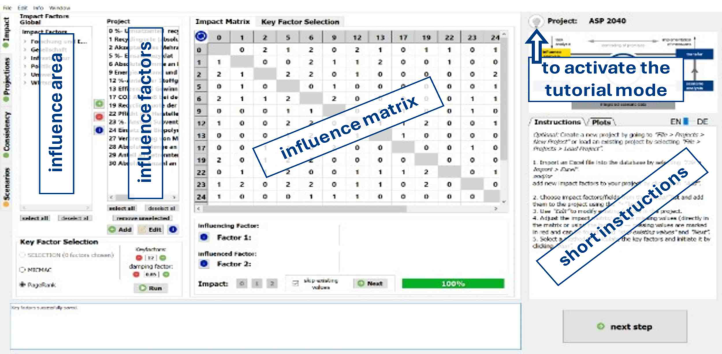
Scenario-Tool The one-day-workshop is supported by a Scenario-Tool (ScenTecTool) developed by the authors (Figure 2) that covers all steps of the Scenario- Technique from the definition of areas of influence and influence factors with subsequent evaluation in an influence matrix to the selection of key factors with respective projections and evaluation in a consistency matrix as well as the generation of the most consistent scenarios (Gräßler et al., 2018). The steps are mapped in the tool via following pages: Impact, Projections, Consistency and Scenarios. The tool is supported by an integrated scenario database (Gräßler et al., 2017) and can be extended by AI applications such as the connection to a WordNet (Graessler et al., 2022).
The tool starts on the Impact page with the influence analysis, where existing data from a database file or a pre-filled Excel file can be loaded into the tool. It is possible to start without existing data, but this was not focused on in the one-day-workshop to focus on develop Scenario-Technique competences and not on time-consuming data searches. The tool allows to select, deselect, and add influence factors for the respective project to be processed to create an influence matrix for the scenario project. Missing values in the influence matrix must be filled in or completed to select key factors. Key factors can be selected manually or supported by calculation using MICMAC or PageRank algorithm (Gräßler et al., 2019).
In the next step, projections are assigned to key factors. This assignment can be supported by data and visualised. A subsequent consistency assessment is carried out on a scale from -2 to 2 (total inconsistency to total consistency). The database also provides support in this step, guiding users through the workshop in a time-efficient manner. In a final step, raw scenarios are calculated and summarised using filters and clusters to create possible future scenarios based on the consistency sum.
Case Study on the Software-Supported Development of Competences 255
Figure 2: Excerpt of the ScenTecTool.
Short instructions are provided in each step of the tool to introduce the individual steps of Scenario-Technique and guide through the tool. In addition, an integrated tutorial mode provides further detailed explanations for a more guided learning process. The tutorial mode enables learning even without external guidance: every step of the Scenario-Technique is explained, and terminology is introduced. In tutorial mode the learning can be tested simultaneously, and sub-tasks of the task can be done in parallel.
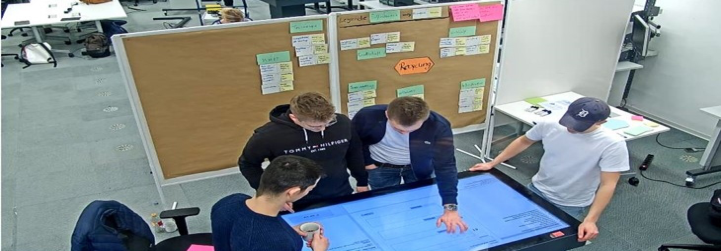
Case Study The developed Scenario-Technique Workshop with the associated software tool was evaluated in two experimental test phases (Figure 3) and evaluated by using the workshop content and the software tool in a plant engineering company. The experiments were analysed using software-supported, time- synchronized acquisition and recording of video data streams, including screen capturing at the Smart Innovation Lab. Participants also answered a SUS (System Usability Scale) questionnaire (Brooke 1995) for a comparable evaluation of the software support.
The first test phase was carried out with 29 master students of mechanical engineering and industrial engineering in 5 groups on different days. During the first test phases, the added value of the concept was already confirmed, and small changes were made to the tool to improve the understanding of the training. Based on the evaluation of the first test phase, a tutorial mode was added to the tool between test phases one and two to enable learning without instructions. Also, a bigger set of data, in the form of entries in the influence matrix and the consistency matrix were added in order to increase motivation during the workshop. Evaluation of the influence matrix und consistency matrix is now carried out based on a few exemplary entries, leaving more time for other tasks in the workshop. For the second test phase a task für the scenario transfer is added.
256 Gräßler and Tušek
A second test phase was carried out with further 20 master students in 5 groups. The tutorial mode was now opened to the participants – without any further introduction to the Scenario-Technique – so that they could go through the Scenario-Technique and test the steps in the tool at the same time.
Parallel to the experimental test phases, the workshop content and, after the test phases, the ScenTecTool were evaluated with a plant engineering company. The duration of the workshop was extended in the industrial project, but the content served as a target and orientation for the content of the one-day-workshop to ensure practical orientation. The transfer of the workshop to more detailed tasks and issues in the corporate context and the associated expansions and discussion points were indicated in the tutorial mode and anticipated using predefined data from an Integrated Scenario Data Model. This allowed an understanding of the details and the work involved, while keeping the focus on the key issues.
Figure 3: Experimental test phase of the Scenario-Technique workshop.
The focus of the evaluation was on the comprehensibility, user-friendliness, and practical suitability of the workshop. Practical suitability was ensured by working on a real problem and the tasks that arise in industrial practice. The tasks in the second test phase were further expanded by focussing on the transfer of the scenarios in the form of the elaboration of promising business ideas.
The comprehensibility of the results of the workshop was improved in scenario generation: In the tutorial mode, further explanations on filtering were added as well as the possibility to select the maximum number of identical projections in the comparison of the resulting scenarios. The traceability was thus confirmed, particularly in discussions during the industrial project.
Also, a slightly modified SUS questionnaire was completed by the respondents in the two test phases, which was supplemented with questions on the added value of the methodology application. This addition was made to evaluate the learning concept for better understanding and competence building in Scenario-Technique in relation to the user-friendliness and the overall added value of the workshop.
Case Study on the Software-Supported Development of Competences 257
The added value of the workshop was particularly evident in comments made by the students: “The workshop really helped me to deepen my knowledge of the Scenario-Technique. I also enjoyed the discussions in the group, which also taught me how to recognise connections (e.g. with the influence matrix) as well as how to discuss with fellow students and reach a common consensus”. Based on the assumption of the SUS questionnaire that a score of over 68 indicates good usability and a score of over 80.3 indicates excellent usability (Chojecki et al., 2023), the results were analysed The evaluation revealed good usability with a score of over 70 in both test phases. When considering the added value of the methodology application, it was even possible to achieve an excellent rating with a score of around 81 in both test phases.
CONCLUSION
The developed Scenario-Technique Workshop and the associated ScenTecTool led to an improved understanding of and ability to use Scenario-Technique for students and employees in the company, especially engineers. The concept developed makes it possible to achieve sustainable competence in the use of Scenario-Technique without extensive preparatory work and to ensure its regular use in companies. In addition to the tool and tutorial mode, students requested further example cases that can be adapted to different company issues by integrating them into a scenario database, so that industry-specific cases can also be played.
ACKNOWLEDGMENT
The experimental test phase was conducted in the Smart Innovation Lab of the Chair of Product Creation at Heinz Nixdorf Institute in Paderborn, using the Major Research Instrumentation funded by the Deutsche Forschungsge- meinschaft (DFG, German Research Foundation) – INST 2014/177-1.
REFERENCES
Bain & Company, Inc. (Hrsg.) (2023). Scenario Analysis and Contingency Planning.
Available online at https://www.bain.com/insights/management-tools-scenario-an d-contingency-planning/ (accessed 9/6/2023). Barton, Dominic/Manyika, James/Koller, Timothy/Palter, Robert/Godsall, Jonathan/Zoffer/Joshua (2017). Measuring the economic impact of short-termism. Benichou, L./Mayr, S. (2014). Rogeaulito: A world energy scenario modeling tool for transparent energy system thinking. Frontiers in Energy Research 1 (JAN). Brooke, John (1995). SUS: A quick and dirty usability scale. United Kingdom. Burandt, S./Barth, M. (2010). Learning settings to face climate change. Journal of
Cleaner Production 18 (7), 659–665. Care, Esther/Griffin, Patrick/Wilson, Mark (Eds.) (2018). Assessment and Teaching of 21st Century Skills. Cham, Springer International Publishing. Chojecki, Paul/Strazdas, Dominykas/Przewozny, David/Gard, Niklas/Runde, Detlef/Hoerner, Niklas/Al-Hamadi, Ayoub/Eisert, Peter/Bosse, Sebastian (2023). Assessing the Value of Multimodal Interfaces: A Study on Human-Machine Interaction in Weld Inspection Workstations. Sensors (Basel, Switzerland) 23 (11).
258 Gräßler and Tušek
Fiala, V./Freyer, B./Klimek, M./Fahringer, A. (2018). How do you teach transdisciplinary competences for food and farming systems research? Insights from the course “System Analysis and Scenario Technique”. Open Agriculture 3 (1), 553–566. Ghodsvali, M./Dane, G./Vries, B. de (2022). An online serious game for decisionmaking on food-water-energy nexus policy. Sustainable Cities and Society 87. Graessler, Iris/Tusek, Alena Marie/Thiele, Henrik/Preuß, Daniel/Grewe, Benedikt/Hieb, Michael (2022). Literature study on the potential of Artificial Intelligence in Scenario-Technique. ISPIM Conference Proceedings. Gräßler, Iris/Pottebaum, Jens/Scholle, Philipp (2018). Influence Factors for Innovation in Digital Self-Preparedness Services and Tools. International Journal of Information Systems for Crisis Response and Management 10 (1), 20–37. https://doi.org/10.4018/IJISCRAM.2018010102. Gräßler, Iris/Scholle, Philipp/Pottebaum, Jens (2017). Integrated process and data
model for applying scenario-technique in requirements engineering. In: Anja Maier/Stanko Škec/Harrison Kim et al. (Eds.). DS 87-Abstracts. Proceedings of the 21st International Conference on Engineering Design, ICED 17, Vancouver, Canada, 21.-25.08.2017. Design Society, 261–270. Gräßler, Iris/Scholle, Philipp/Thiele, Henrik (2020). Scenario Technique. In: Sándor Vajna (Ed.). Integrated design engineering. Interdisciplinary and holistic product development. Cham, Springer. Gräßler, Iris/Thiele, Henrik/Oleff, Christian/Scholle, Philipp/Schulze, Veronika
(2019). Method for Analysing Requirement Change Propagation based on a Modified Pagerank Algorithm. Proceedings of the Design Society: International Conference on Engineering Design 1 (1), 3681–3690. https://doi.org/10.1017/ds i.2019.375. Haralanova, Valentina/Fafner, Göran (2019). learning about methods or working methodically. In: Education and New Developments 2019, International Conference on Education and New Developments. In Science Press, 306–308. Meyerowitz, D./Lew, C./Svensson, G. (2018). Scenario-planning in strategic decision-
making: Requirements, benefits and inhibitors. Foresight 20 (6), 602–621. Mietzner, Dana (2009). Strategische Vorausschau und Szenarioanalysen. Methodenevaluation und neue Ansätze. Zugl.: Potsdam, Univ., Diss., 2009. Wiesbaden, Gabler. Page, Matthew J./McKenzie, Joanne E./Bossuyt, Patrick M./Boutron, Isabelle/Hoffmann, Tammy C./Mulrow, Cynthia D./Shamseer, Larissa/Tetzlaff, Jennifer M./Akl, Elie A./Brennan, Sue E./Chou, Roger/Glanville, Julie/Grimshaw, Jeremy M./Hróbjartsson, Asbjørn/Lalu, Manoj M./Li, Tianjing/Loder, Elizabeth W./Mayo-Wilson, Evan/McDonald, Steve/McGuinness, Luke A./Stewart, Lesley A./Thomas, James/Tricco, Andrea C./Welch, Vivian A./Whiting, Penny/Moher, David (2021). The PRISMA 2020 statement: An updated guideline for reporting systematic reviews. BMJ (Clinical research ed.) 372, n71. Pattinson, H. M./Sood, S. C. (2010). Marketers expressing the future: Scenario planning for marketing action. Futures 42 (4), 417–426.
LISTED IN THE AHFE DIGITAL BOOKSTORE CATALOGUE
Explore the complete digital volume
Human Systems Engineering and Design (IHSED2024): Future Trends and Applications
Read this individual research paper free through the original publisher, or explore the full digital proceedings book.
ISBN 978-1-964867-34-2
Explore this ISBN in the AHFE Bookstore ↗Listed in the July 2026 bookstore catalogue; search by ISBN to confirm current availability · Digital book purchase optional