Sari Tappura (2021). OHS Management Skill Development and Continuing Learning. In: Human Systems Engineering and Design (IHSED2021): Future Trends and Applications. AHFE Open Access, vol. 21. https://doi.org/10.54941/ahfe1001139
Occupational Health and Safety (OHS) management focuses on employee safety and health; OHS legislation establishes the requirements for OHS management competencies. This study aims to identify measures for developing OHS management skills during a management career to support managers’ competence development and continuing learning. A qualitative multiple-case study of seven industrial companies in the energy and processing industries and industrial services was conducted. Measures for developing OHS management skills during the following stages of a management career were identified: 1) recruitment, 2) orientation, 3) competence assessment, 4) competence development, 5) performance assessment and measurement, and 6) incentives and rewards. This study suggests practical organizational measures for developing managers’ OHS competence at different career stages as general management competencies. Developing managers’ OHS competence provides them with knowledge of their responsibilities and expectations, as well as company-wide OHS objectives and practices to improve OHS and operational efficiency.
Human Systems Engineering and Design (IHSED 2021) https://openaccess.cms-conferences.org/#/publications/book/978-1-7923-8987-0
INTRODUCTION
The intended outcomes of Occupational Health and Safety (OHS) management are to prevent work-related injury and ill health and to provide safe and healthy workplaces for employees (738/2002, ISO 45001:2018). OHS is a moral obligation imposed by modern society and organizations’ social responsibility (Corcoran & Shackman 2007). Moreover, OHS issues are increasingly associated with operational efficiency, quality, competitiveness, and reputation of organizations (Boyd 2003, Fernández- Muñiz et al. 2009, Köper et al. 2009).
Managing OHS includes establishing company-specific OHS policies, objectives, processes, and procedures to be integrated into the company’s management and business processes (EU-OSHA 2010, ISO 45001:2018). Managers represent the employer within the scope of their duties and powers; OHS management is an area of managerial work in all types of organizations (EU-OSHA 2012, Veltri et al. 2013). Managers’ resources, competence, and commitment are important in establishing successful OHS management (Conchie et al. 2013, Fruhen et al. 2013, Hale et al. 2010, Hardison et al. 2014, Simola 2005, Tappura et al. 2017). Managers at different organizational levels need knowledge and tools as well as leadership skills to promote OHS in the workplace (Simola 2005, Tappura & Hämäläinen 2012, Tappura et al. 2016). Thus, OHS management skills should be considered general management skills and developed accordingly.
Managers’ active role is commonly considered a key element of successful OHS management and performance (Biggs et al. 2013, Fernández-Muñiz et al. 2007, Griffin & Hu 2013, Hale et al. 2010). Through their actions and examples, managers can support employees’ behaviors and activities in OHS. Senior management has the power to delegate authority and provide resources for OHS within the organization (ISO 45001:2018). Therefore, senior managers should encourage and support other management roles in their OHS work in their areas of responsibility. Managers’ commitment to OHS may be promoted by organizational measures, such as increasing their OHS awareness and emphasizing their OHS responsibilities with inspirational and participative management training (Tappura et al. 2017). Increasing managers’ awareness is central to the development of OHS management skills, for example, through training, management support, and mutual cooperation and peer support between managers (Simola 2005, Tappura 2017, Tappura & Hämäläinen 2012). To ensure managers have adequate OHS competence, their OHS responsibilities and duties should be defined (Tappura et al. 2016). Once they are defined, it is possible to consider what skills a manager must have to perform these duties. The basis for OHS management competence requirements is laid by OHS legislation (738/2002), and managers at all levels should be aware of these requirements. In addition, competence needs can be identified based on the organization’s OHS policies and practices, as well as successful OHS management practices and voluntary OHS management systems (Hale et al. 2010, Hardison et al. 2014, ISO 45001:2018, Tappura & Kivistö-Rahnasto 2018). Moreover, managers’ roles and responsibilities can be defined based on their organizational level to support their awareness and commitment (Tappura et al. 2016).
Human Systems Engineering and Design (IHSED 2021) https://openaccess.cms-conferences.org/#/publications/book/978-1-7923-8987-0
OHS management procedures and practices are the collective and organizational- specific competence of managers (Sydänmaanlakka 2004). Learning by doing and participating, as well as collective problem-solving, are generally the key ways to learn at work (Tikkamäki 2006). Competence self-assessment also supports a person’s learning in the form of self-reflection (Viitala 2005). The development of management skills is typically acknowledged in the recruitment, orientation, training, assessment of competence and performance of managers, and development discussions (Hätönen 2003). Correspondingly, OHS management skills should be considered during different phases of the management career. In addition to developing OHS management skills, possible development measures (e.g., trainings) should focus on improving managers’ OHS awareness (Simola 2005, Tappura 2017, Tappura & Hämäläinen 2012). Tappura and Hämäläinen (2011) suggested that effective OHS training for managers includes joint discussions with colleagues, demonstrations, and hands-on techniques to strengthen managers’ commitment to OHS procedures. Fruhen et al. (2013) proposed that senior managers’ training and guidance should focus on their problem-solving abilities and perception of others in order to support them in demonstrating OHS commitment.
In this study, management refers to management and leadership, and managers include all levels of management from shop floor supervisors to senior management. OHS management competence refers to managers’ ability to perform OHS-related management activities and behaving appropriately for the required OHS performance. This study aims to identify measures for developing OHS management skills during a management career to support managers’ competence development and continuing learning.
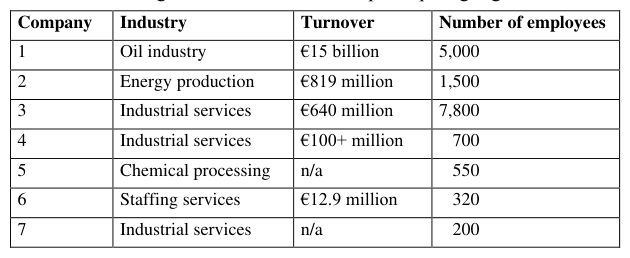
MATERIAL AND METHODS In this study, a qualitative multiple-case study of seven industrial companies in the energy and processing industries and industrial services was conducted (see Table 1). The companies were motivated to participate in the study because they needed better support for managers in their roles to improve OHS.
Table 1: Background information of the participating organizations Company Industry Turnover Number of employees
Human Systems Engineering and Design (IHSED 2021) https://openaccess.cms-conferences.org/#/publications/book/978-1-7923-8987-0 professionals at the participating companies. Thematic analysis was used to qualitatively examine and categorize the interview data under the main themes (Boyatzis 1998). In addition, a workshop for the OHS professionals was organized to review the interview data and to supplement organizational measures that support managers’ OHS competence development.
RESULTS
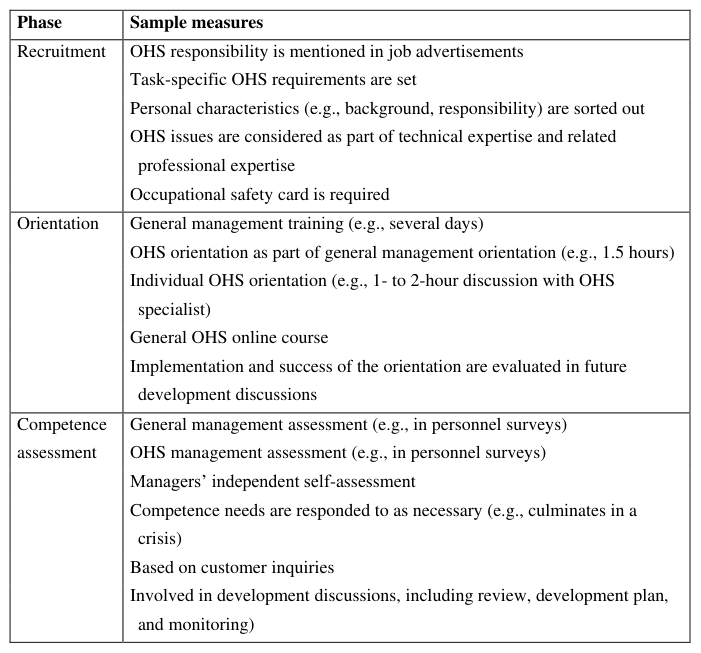
Based on the interviews and the workshop, measures for developing OHS management skills were identified during the following phases of a management career: 1) recruitment, 2) orientation, 3) competence assessment, 4) competence development, 5) performance assessment and measurement, and 6) incentives and rewards. The phases and examples of the measures are presented in Table 2.
Table 2: Examples of measures for developing OHS management skills at different phases of the management career
Human Systems Engineering and Design (IHSED 2021) https://openaccess.cms-conferences.org/#/publications/book/978-1-7923-8987-0
In the recruitment phase, the manager candidate’s OHS competence and attitude can be determined when it is a selection criterion. Defining OHS responsibilities in the job advertisement or describing OHS objectives in the company description
Human Systems Engineering and Design (IHSED 2021) https://openaccess.cms-conferences.org/#/publications/book/978-1-7923-8987-0 emphasizes the company’s expectations for the candidate’s attitude toward OHS. In addition, the information serves as input later in the orientation, so that it can be better focused.
If the manager does not have previous OHS training or experience, OHS responsibilities must be emphasized in the early phase of the management career. Typically, an OHS briefing is conducted by the company’s OHS specialist. At its best, however, the orientation is handled by the manager’s supervisor, who has operational responsibility for the area in question (including OHS). Orientation supports internalization of the company’s OHS culture and practices, as well as an understanding of the im-portance of OHS. The success of the orientation should be evaluated, for example, in a feedback discussion with the manager’s supervisor or in a future development discussion. During these discussions, the need for additional orientation or other competence development is assessed. At this stage, the role of the manager’s super-visor as an example, setting the direction and setting goals, is also emphasized for OHS.
After the orientation phase, managers’ OHS skills must be continuously assessed and developed. This is especially necessary for managers who missed it during the orientation phase. Also in connection with job changes, key OHS issues, such as OHS risks and objectives of the new job area, must be reviewed. Competence mirrors the competence requirements defined in the task description or elsewhere. The evaluation could use traditional tools (e.g., personnel surveys, 360-degree assessments, customer feedback, self-assessment, or development discussions) more widely. For example, a 360-degree assessment of managers may include OHS responsibilities; in which case, the manager’s closest work community (supervisor, colleagues, and subordinates) will also assess OHS management. Another way is to extend personnel surveys to include OHS issues. When the assessment is performed as part of another management assessment, no separate OHS management assessments are required. Similarly, it is important that the identified OHS management development needs should be included in the development of managers’ general competences, such as management training.
When OHS objectives are included in evaluation of the management performance, OHS tasks and related expectations are more prominently included in the managerial work. Following the monitoring of quantitative indicators (e.g., number of safety walks completed), the next step is to assess and improve the content and quality of the OHS work. Encouraging and rewarding managers for OHS work typically focuses on complimentary feedback and applause for successful OHS work (e.g., highlighting good units). A positive message and an emphasis on successes also encourage continued OHS work.
DISCUSSION
OHS management is an integral part of management activities in organizations (EU- OSHA 2010, ISO 45001:2018), and OHS management competencies should be developed to achieve improvements in OHS. This study suggests organizational
Human Systems Engineering and Design (IHSED 2021) https://openaccess.cms-conferences.org/#/publications/book/978-1-7923-8987-0 measures for the development of managers’ OHS skills at different stages of their careers, from recruitment and orientation to continuous competency development and learning. Managers’ commitment to OHS can be induced by enhancing the managers’ own understanding of their OHS tasks and supporting their resources such as competence (Tappura et al. 2016). Assessing and developing managers’ OHS skills provide them with knowledge of their OHS responsibilities and expectations, company-wide OHS procedures, and tools for promoting OHS. At its best, this also supports managers’ commitment to OHS development through increased awareness and expertise.
Defining OHS responsibilities, implementing inspiring and inclusive OHS management training, and acknowledging successful OHS work, combined with the support of colleagues, the manager’s supervisor, and OHS experts help managers to commit to OHS work (Tappura et al. 2017). Supporting managers’ desired safety attitudes from the beginning of their career (recruitment and orientation) and in later training further fosters their commitment to OHS management. Learning by doing and collective problem-solving, such as discussion with colleagues, are key ways to learn at work (Tappura & Hämäläinen 2011, Tikkamäki 2006). Management forums and peer-to-peer meetings are especially important for inexperienced managers who are facing new and perhaps difficult situations for the first time. The lack of OHS awareness and competence can hinder a manager’s performance or burden the supervisor (Tappura et al. 2017).
Senior management’s commitment to OHS provides other managers with the support they need for their day-to-day OHS work. Managers are not left alone. The organization creates tools and practices to help them and makes investments to im- prove their skills. Incorporating the OHS management perspective into managers’ overall assessment and development reduces the need for separate OHS management development procedures. Moreover, OHS issues should be part of the overall performance evaluation and reward system.
This study adds to literature by presenting a model for continuing learning of OHS management skills and examples of related practical measures. The measures presented can be utilized in general management development at different stages of managerial careers, from recruitment and orientation to continuous development of competences. Incorporating OHS issues into managers’ performance goals, development discussions, and training can improve their commitment to OHS management and help companies to achieve improvements in OHS and operational efficiency.
ACKNOWLEDGMENTS
Funding from the Finnish Work Environment Fund, participating companies, and Tampere University of Technology is gratefully acknowledged.
Human Systems Engineering and Design (IHSED 2021) https://openaccess.cms-conferences.org/#/publications/book/978-1-7923-8987-0
REFERENCES
738/2002 Työturvallisuuslaki (Occupational Safety and Health Act) (2002) Biggs, S.E., Banks, T.D., Davey, J.D., Freeman, J.E. (2013). Safety leaders’ perceptions of safety culture in a large Australasian construction organization. Safety Science 52, 3-12. Boyatzis, R. (1998). Transforming Qualitative Information: Thematic Analysis and
Code Development. Thousand Oaks, CA: Sage. Boyd, C. (2003). Human Resource Management and Occupational Health and Safety.
London: Routledge. Conchie, S.M., Moon, S., Duncan, M. (2013). Supervisors’ engagement in safety leadership: Factors that help and hinder. Safety Science 51, 109-117. Corcoran, D.J., Shackman, J.D. (2007). A theoretical and empirical analysis of the
strategic value of beyond compliance occupational health and safety programs. Journal of Business Strategies 24, 49-68. EU-OSHA (European Agency for Safety and Health at Work) (2010). Mainstreaming OSH into business management. Luxembourg: Office for Official Publications of the European Communities. EU-OSHA (European Agency for Safety and Health at Work) (2012). Healthy
workplaces. Working together for risk prevention. Campaign guide. Management leadership and worker participation in occupational safety and health. Fernández-Muñiz, B., Montes-Peón, J., Vázquez-Ordás, C. (2007). Safety culture: analysis of the causal relationships between its key dimensions. Journal of Safety Research 38(6), 627-641. Fernández-Muñiz, B., Montes-Peón, J., Vázquez-Ordás, C. (2009). Relation between
occupational safety management and firm performance. Safety Science 47, 980- 991. Fruhen, L.S., Mearns, K.J., Flin, R., Kirwan, B. (2013). Skills, knowledge and senior managers’ demonstrations of safety commitment. Safety Science 69, 29-36. Griffin, M.A., Hu, X. (2013). How leaders differentially motivate safety compliance
and safety participation: The role of monitoring, inspiring, and learning. Safety Science 60, 196-202. Hale, A.R., Guldenmund, R.F., van Loenhout, P.L.C.H., Oh, J.I.H. (2010).
Evaluating safety management and culture interventions to improve safety: Effective intervention strategies. Safety Science 48(8), 1026-1035. Hardison, D., Behm, M., Hallowell, M.R., Fonooni, H. (2014). Identifying construction supervisor competencies for effective site safety. Safety Science 65, 45-53. Hätönen, H. (2003). Osaamiskartoituksesta kehittämiseen (in Finnish). Helsinki:
Edita. ISO 45001:2018. Occupational health and safety management systems. Requirements with guidance for use. International Organization for Standardization. Köper, B., Möller, K., Zwetsloot, G. (2009). The occupational safety and health
scorecard – a business case example for strategic management. Scandinavian Journal of Work, Environment & Health 35, 413-420.
Human Systems Engineering and Design (IHSED 2021) https://openaccess.cms-conferences.org/#/publications/book/978-1-7923-8987-0
Simola, A. (2005). Turvallisuuden johtaminen esimiestyönä. Tapaustutkimus pitkäkestoisen kehittämishankkeen läpiviennistä teräksen jatkojalostustehtaassa (in Finnish). Dissertation. University of Oulu, Oulu, Finland. Sydänmaanlakka, P. (2004). Älykäs organisaatio: tiedon, osaamisen ja suorituksen
johtaminen (in Finnish). 7th edition. Helsinki: Kauppakaari. Tappura, S., Hämäläinen, P. (2011). Promoting occupational health, safety and wellbeing by training line managers. In: Lindfors, J, Savolainen, M., Väyrynen, S. (eds.) Proceedings of the 43th Annual Nordic Ergonomics Society Conference NES 2011, pp. 295-300. University of Oulu, Oulu, Finland. Tappura, S., Hämäläinen, P. (2012). The occupational health and safety training
outline for the managers. In: Vink, P. (ed.) Advances in Social and Organizational Factors. Advances in Human Factors and Ergonomics Series, vol. 9, pp. 356-365. Boca Raton: CRC Press. Tappura, S., Kivistö-Rahnasto, J. (2018). Assessing and developing safety management competence. International Journal of Occupational and Environmental Safety 2, 39-48. Tappura, S., Nenonen, N., Kivistö-Rahnasto, J. (2017). Managers’ viewpoint on
factors influencing their commitment to safety. An empirical investigation in five Finnish industrial organisations. Safety Science 96, 52-61. Tappura, S., Teperi, A.-M., Kivistö-Rahnasto, J. (2016). Safety Management Tasks at Different Management Levels. In: Kantola, J.I., Barath, T., Nazir, S., Andreet, T. (eds.) Advances in Human Factors, Business Management, Training and Education. Advances in Intelligent Systems and Computing vol 498, pp. 1147- 1157. Springer. Tappura, S. (2017). The Management of Occupational Health and Safety: Managers’
Perceptions of the Challenges, Necessary Support and Organisational Measures to Support Managers. Dissertation, Tampere University of Technology, Tampere, Finland. Tikkamäki, K. (2006). Työn ja organisaation muutoksissa oppiminen - etnografinen löytöretki työssä oppimiseen (in Finnish). Dissertation, University of Tampere, Tampere, Finland. Veltri, A., Pagell, M., Johnston, D., Tompa, E., Robson, L., Amick III, B.C., Hogg-
Johnson, S., Macdonald, S. (2013). Understanding safety in the context of business operations: An exploratory study using case studies. Safety Science 55, 119-134. Viitala, R. (2005). Johda osaamista! Osaamisen johtaminen teoriasta käytäntöön (in Finnish). Keuruu: Inforviestintä.
Human Systems Engineering and Design (IHSED 2021) https://openaccess.cms-conferences.org/#/publications/book/978-1-7923-8987-0
LISTED IN THE AHFE DIGITAL BOOKSTORE CATALOGUE
Explore the complete digital volume
Human Systems Engineering and Design (IHSED2021): Future Trends and Applications
Read this individual research paper free through the original publisher, or explore the full digital proceedings book.
ISBN 978-1-7923-8987-0
Explore this ISBN in the AHFE Bookstore ↗Listed in the July 2026 bookstore catalogue; search by ISBN to confirm current availability · Digital book purchase optional