Minna Rantala, Maria Lindholm, Sari Tappura, Jouni Kivistö-Rahnasto (2023). Identifying occupational health and safety risk assessment development needs in Finnish case companies. In: Human Systems Engineering and Design (IHSED 2023): Future Trends and Applications. AHFE Open Access, vol. 112, pp. 299–309. https://doi.org/10.54941/ahfe1004141
Risk assessment is a key tool in occupational safety work at workplaces. A systematic risk assessment can be used to meet the statutory obligation to determine and assess the hazard and risk factors for the safety and health of employees in companies of all sizes. Furthermore, by developing risk assessments, workplaces can reduce accidents and improve the safety and healthiness of working conditions. Since a lot of time and resources are used for risk assessment at workplaces, the assessment should be efficient and successful. With risk assessment, companies can simultaneously improve job productivity and competitiveness and support the preservation of workers' ability to work. Previous studies have suggested that risk assessment development needs include, for example, the development of resourcing and improvement of communication, competence and knowledge. This study aims to produce knowledge of Finnish workplaces' risk assessment development needs related to safety and health at work in order to better meet the company's own needs. The material was acquired with a new questionnaire that aids organizations in finding out personnel's perceptions of the practices and development needs of occupational safety risk assessment. Based on the responses, development targets can be identified, and risk assessment skills in different parts of an organization can be compared. The questionnaire can be used to determine, for example, whether the objectives of risk assessment have been understood within an organization. The questionnaire includes both closed and open-ended questions. The open-ended questions clarify previous selections and for example, suggest ways to arrange training to an organization. The questionnaire was part of a larger project, and the questions were based on previous phases of the project. Four companies piloted the questionnaire. After receiving feedback, a few modifications were made. The process and methods of creating the questionnaire will be described in more detail in the article. The final questionnaire was sent to three organizations. The first is a part of a public organization, the second is a private company in the transport sector, and the third organization provides maintenance services for industrial companies. The companies' contact persons forwarded the link to the questionnaire respondents, and 348 responses were received. The results were analyzed both quantitatively and qualitatively. The revealed development needs generally concerned, among others, the planning of risk assessment, which includes for instance risk assessment goals and frameworks planned by the organizations. Regarding the definition of measures, the determination of risk assessment and management was raised. In addition, communication about the progress of the determined measures, going through the risk assessment with the employees, giving feedback to those conducting the assessment, and clearly documenting the results were among the identified development needs. Next, a practical model for workplaces to develop their occupational health and safety risk assessments will be developed.
Risk assessment is an essential part of occupational safety management. The development of occupational health and safety (OHS) risk assessments at a workplace can reduce accidents at work and improve the health and safety of working conditions, improve the productivity and competitiveness of the workplace, and support workers’ ability to work (Aldana 2001; Shearn 2003; Leitao et al. 2018). Moreover, legislation obliges an employer to ensure safe working conditions for its employees (23.8.2002/738 2002; 89/391/EEC 1989). On the basis of previous research, it is important to develop, inter alia, the necessary expertise and support for OHS risk assessment skills (Abu- dayyeh et al. 2006). Training is also needed with regard to existing methods, such as the use of risk matrices (Peace 2017). Huang et al. (2021) raised the importance of safety attitudes, awareness, and knowledge to avoid accidents resulting from, for example, carelessness or negligence in the use of protective equipment. On the other hand, this can be viewed from a different perspec- tive. Some of the violations may be due to deficiencies in terms of instructions
or the equipment. Although workers strive to do their work efficiently and safely, they may not be able to follow the procedures (Reason 1998).
Furthermore, risk assessment is a multi-stage process that needs develop- ment in all its phases. If an incomplete or inaccurate result is obtained during one of the phases of the risk assessment process, it may lead to inappropri- ate results regarding the overall risk assessment (Pinto et al. 2013). When developing the risk assessment process, attention should be paid to its differ- ent phases. The risk assessment process is affected by many factors, such as hazard identification (Bahn 2013) and safety risk performance (Pandit et al. 2019), frequency, consequence and risk estimation (Arunraj and Maiti 2007), the composition of the risk assessment group, resources, and consul- tations with different stakeholders (Pinto et al. 2013). In addition, Backlund and Hannu (2002) considered the requirement specification, scope defini- tion, and planning and documentation phases as important factors. The aim of this study is to identify the OHS risk assessment development needs in three Finnish companies.
METHODS AND MATERIALS The OHS risk assessment development needs were studied using a ques- tionnaire designed as part of a larger project (Rantala et al. 2022). The questionnaire examines staff perceptions and their levels of competence related to OHS risk assessment. The questions are based on interviews, the Delphi survey technique, and a self-evaluation tool (Rantala et al. 2022) that was developed for assessing the success of OHS risk assessments. The main themes included in the questionnaire are as follows: 1) why risk assessment is carried out; 2) what experience the person has in carrying out risk assess- ment; 3) investment in risk assessment; and 4) how to further develop risk assessment.
The themes of the questionnaire were presented at the steering group meeting of the project, and the questions were designed according to the wishes of the steering group members. The questionnaire was piloted in the companies involved in the project. The 11 questions and 25–44 statements were presented in slightly different formats depending on each respondent’s background (employee, supervisor, risk assessor, organization’s responsible person, or employee within the OHS organization). Based on the answers (n = 25), the questionnaire was finalized, and the questions and statements were formulated in such a way as to suit all the respondents, regardless of each respondent’s background.
The final questionnaire (Appendix A, only the questions discussed in this paper) consists of 11 questions and 45 statements and was sent to 3 com- panies outside of the original project (Table 1), and 348 responses were received. The questionnaire was available in digital form via Lime Survey. Three companies were selected for the survey because they were interested in developing their OHS risk assessment. Almost all the companies had back- grounds involving organizational or management changes, and they were interested in obtaining a better understanding of the current state of OHS risk assessment.
Identifying Occupational Health and Safety Risk Assessment Development Needs 301
Table 1. Background information on the companies.
Table available in the original PDF paper.
Company Industry Number of employees
Number of respondents Company A Transport services 80 22 Company B Industrial maintenance services 450 32 Company C Public, educational, cultural services 5000 294
RESULTS
Why Risk Assessment Is Carried Out Regarding the open question on why OHS risk assessment is carried out, 263 responses that focused on anticipating and identifying harmful elements and hazards and reducing the risks arising from them were received. The mention of anticipation in safety work included the anticipation of problems, the anticipation of risks, or preparation for different situations.
In one company, a comfortable and safe working environment was also acknowledged as part of improving occupational safety for employees, cus- tomers, and other stakeholders. In the context of ensuring the safety of one’s workmates and outsiders, safe daycare and pre-school education for children, as well as the safety of pupils and personnel, were also mentioned.
A few respondents had not heard of risk assessment or felt that the results of such assessment did not lead to action. Some of the answers to the question about why OHS risk assessment is carried out were rather narrow, such as ‘to avoid accidents,’ ‘in order to avoid the realization of risks,’ and ‘in order to know how to anticipate disruptive situations.’ A few respondents considered the question more broadly and brought up the following legal obligation: ‘Risk assessment is the systematic identification of hazards. The obligation to carry out a risk assessment comes from the Occupational Safety and Health Act. An identified risk is one that can be prepared for and managed.’
What Experience the Person Has in Carrying Out Risk Assessment Almost all the respondents felt that they recognized the risks associated with their own work. In addition, situations where risk assessment should be car- ried out were perceived to be fairly well identified. The respondents had also identified risk or risk factors in the risk assessment that had led to correc- tive actions. More than half of the respondents acknowledged that they did not know how to use their company’s risk assessment form or tool and that they had not received adequate training. However, the risk assessment lead- ers mainly felt that they were conducting risk assessments fluently. One-third of the respondents were unaware of their roles and tasks in risk assessment, and the objectives of risk assessment and the responsibilities regarding risk assessment and management were perceived to be unclear.
The respondents’ training needs were addressed with an open question. Overall, there was a desire for general training in risk assessment, reflected by comments such as ‘I need information on the whole subject,’ ‘More training is never bad when you do not use the risk management program every day,’ and
‘Compact and visual.’ The forms of training mentioned included remote and local training, practical training through workshops for the persons respon- sible, training based on examples, choosing the right protective equipment in different situations to avoid over- or under-protection, workplace and cus- tom orientation training, increasing one’s understanding of risks, and other training related to attitudes.
In their view, the respondents did not understand all the terminology and concepts used in OHS risk assessment. The understanding of terms and concepts was addressed by three questions in addition to the other knowledge-related questions. One-third of the respondents disagreed with the following statement: ‘I understand what the different probabilities and consequences mean in the risk assessment.’ Almost half of the respondents replied that they did not know how to determine the magnitude of risk or how to assess the significance of a risk.
Based on the answers, it would seem that the terms are more familiar in industrial work, where, as a rule, less than one-fifth of the respondents dis- agreed with the statements. More than half of the respondents working in a non-industrial environment disagreed with the following statements: ‘I know how to determine the magnitude of risk’ and ‘I know how to assess the significance of the risk.’
Investment in Risk Assessment With regard to investment in OHS risk assessments, it emerged that almost all the respondents agreed that risk assessment would improve safety at work, that they would improve safety at work by taking part in risk assessments. Respondents felt it was important for workers, experts, and persons with decision-making powers to participate in risk assessment. As a general rule, participation in OHS risk assessments is considered important in the work- place, conducting OHS risk assessments is encouraged, and it is important for the respondents to feel that their participation in OHS risk assessments is valued.
However, half of the respondents were of the opinion that not enough time had been set aside to prepare for the risk assessment and that the necessary background materials were not provided for them to familiarize themselves with beforehand. In addition, their own risk assessment skills and training were considered insufficient, and a third of the respondents felt that the people participating in the risk assessment had not received enough OHS risk assessment-related training, which can be interpreted as low investment in the knowledge and experience of the persons participating in such risk assessment. Nevertheless, nearly 80% of the respondents considered that the risk assessment leader had the necessary skills and training to carry out and manage the OHS risk assessment.
Half of the respondents acknowledged that the review of risk assessments in their organizations did not include a comparison of the risk assessments of different locations or entities. Furthermore, a third of the respondents felt that members from different stakeholder groups did not participate in the OHS risk assessment and that it was not monitored and reviewed regularly. There were also shortcomings in terms of communication as the results of the OHS
Identifying Occupational Health and Safety Risk Assessment Development Needs 303
risk assessment were not reviewed with the employees, and progress regard- ing corrective measures was insufficiently communicated. A third of the respondents did not agree that representatives of different stakeholders (i.e., employees, experts, and people with decision-making power) participated in the OHS risk assessment.
However, the answers varied greatly due to the different industries of the companies. For example, nearly one-third of the respondents disagreed that residual risk assessment is part of the OHS risk assessment, as the practice of companies in terms of dealing with residual risks varies widely. In addition, in one company, one-third of the respondents were of the opinion that par- ticipation in risk assessment was not considered important in their company. In two other companies, the respondents either agreed or somewhat agreed that participation in risk assessment was considered important. There was also a company-specific difference in terms of encouraging and monitoring and reviewing OHS risk assessments. In one company, more than a third of the respondents disagreed with the above-mentioned statements, while the other two companies’ respondents were somewhat in agreement.
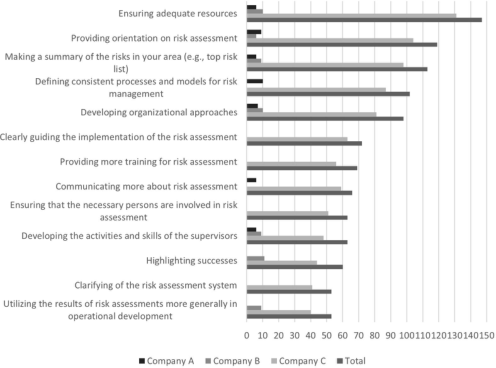
How to Further Develop Risk Assessment The respondents were asked to choose up to five ways they would like to develop OHS risk assessment at their workplaces. Ensuring adequate resources was considered the most important way to develop OHS risk assessment. Next were chosen providing orientation on OHS risk assessment and summarizing the risks in one’s area (e.g., a top risk list) and defin- ing consistent processes and models for risk management and developing organizational approaches. Figure 1 shows deviations from company-specific responses. If the number of company replies is five or less, the total amount is taken into account, but the company-specific graph is missing. For exam- ple, company B raises the frequency of highlighting successes, which was not mentioned as often in companies A and C.
Figure 1: The deviations in the answers from companies A, B, and C and the total number of answers.
Moreover, the ways identified to improve OHS risk assessment skills var- ied between companies. Companies A and C preferred providing easy-to-use tools, whereas company B highlighted providing expert support. In addi- tion, the respondents from companies B and C chose to provide orientation on risk assessment, but those from company A preferred to carry out risk assessment together with employees and experts and supervisors from differ- ent regions/sites/units. Clearly guiding the implementation of risk assessment and providing expert support were the next most popular ways to improve OHS risk assessment skills.
DISCUSSION AND CONCLUSION The results of the study show that the development of risk assessment should focus on training and raising awareness, resource management, com- munication and the comparison of risk assessments at different locations. The respondents considered it important to involve different stakeholders, but they felt that their risk assessments did not currently do so. Aware- ness can be enhanced by promoting communication and regular reviews of risk assessments and discussing the results of the same and the progress of corrective measures with workers. The methods proposed for the devel- opment of risk assessments varied widely between the companies, and the responses from the two smaller companies did not match those from the larger company. In terms of the method, a questionnaire was seen as the most applicable tool to easily gather opinions from three companies’ personnel.
The results of this study are similar to those acquired through interviews (Lindholm et al. 2022; Rantala, Lindholm, and Tappura 2022). In a previous study, Bahn (2013) identified the need to train employees and managers and suggested regular training. Even when risk assessors are trained to use risk matrices, as Peace (2017) suggests, criticisms regarding their use still exist (Cox 2008; Ball and Watt 2013). Utilizing a risk register to prioritize the risks and count the key performance indicators (KPIs) throughout an organization enables top management to effectively monitor and provide feedback (Leva et al. 2017).
This study is limited by the small response percentage and the size differ- ence between the companies. The response rate in one company was 28%, but in the other two, it was only slightly above 5%. An adequate response time was considered to be two weeks, so a reminder was sent at the beginning of the second week. One of the surveys was performed during the sum- mer holiday season, which reduced the number of responses. In addition, the questionnaire’s choice of words or, in other words, how the respondents understood the questions, the respondents’ choice of words in relation to their open answers, and how the researchers interpreted and classified the answers might all have influenced the results. Further research is needed on whether the survey is suitable for all industries or if differences exist between differ- ent sectors. The applicability of the survey should be tested in companies of different sizes and outside of Finland. In addition, it should be verified that
Identifying Occupational Health and Safety Risk Assessment Development Needs 305
the development targets identified through the questionnaire are relevant to such companies.
APPENDIX A
Identifying Occupational Health and Safety Risk Assessment Development Needs 307
If you feel that the training you have receive and your skills in performing a risk assessment are insufficient, what kind of training or orientation do you need?
If you feel that those involved in risk assessment have not received enough risk assessment training, what kind of additional training or orientation do you think they need?
If you feel that the risk assessment leader does not have sufficient skills and training to perform and lead the risk assessment, what kind of additional training or orientation would she/he need?
ACKNOWLEDGMENT
The authors would like to acknowledge the funding received from the Finnish Work Environment Fund and Tampere University for this research and thank the participating companies and individual respondents.
REFERENCES
23.8.2002/738. (2002). Työturvallisuuslaki 23.8.2002/738 (Occupational Safety and Health Act 2002/783).
Identifying Occupational Health and Safety Risk Assessment Development Needs 309
89/391/EEC. (1989). Counsil Directive 89/391/EEC of 12 June 1989 on the intro- duction of measures to engourage improvements in the safety and health of work. Abudayyeh, O., Fredericks, T. K., Butt, S. E. and Shaar, A. (2006). An investigation of management’s commitment to construction safety. International Journal of Project Management, 24, pp. 167–174. Aldana, S. G. (2001). Financial impact of health promotion programs: A compre-
hensive review of the literature. American Journal of Health Promotion, 15(5), pp. 296–320. Arunraj, N. S. and Maiti, J. (2007). Risk-based maintenance-Techniques and applications. Journal of Hazardous Materials, 142(3), pp. 653–661. Backlund, F. and Hannu, J. (2002). Can we make maintenance decisions on risk
analysis results?. Journal of Quality in Maintenance Engineering, 8(1), pp. 77–91. Bahn, S. (2013). Workplace hazard identification and management: The case of an underground mining operation. Safety Science, 57, pp. 129–137. Ball, D. J. and Watt, J. (2013). Further Thoughts on the Utility of Risk Matrices. Risk
Analysis, 33(11), pp. 2068–2078. Cox, A. L. (2008). What’s wrong with risk matrices? Risk Analysis, 28(2), pp. 497–512. Huang, C. F., Tsai, Y. L. and Lu, W. H. (2021). Relationships among perceived con-
trol, safety attitude, and safety performance: a case study on wastewater treatment plant workers. Sustainability (Switzerland), 13(22), pp. 1–18. Leitao, S., Mc Carthy, V. J. C. and Grener, B. A. (2018). Health and safety practitioners’ health and wellbeing — The link with safety climate and job demand-control-support. Accident Analysis and Prevention, 119, pp. 131–137. Leva, M. C., Balfe, N., McAleer, B. and Rocke, M. (2017). Risk registers: Structuring
data collection to develop risk intelligence. Safety Science, 100, pp. 143–156. Lindholm, M., Rantala, M. and Tappura, S. (2022). Development needs for risk assessment – A case study of five Finnish companies. In: 13th International Conference on Applied Human Factors and Ergonomics (AHFE 2022). Pandit, B., Albert, A., Patil, Y. and Al-Bayati, A. J. (2019). Impact of safety climate
on hazard recognition and safety risk perception. Safety Science, 113, pp. 44–53. Peace, C. (2017). The risk matrix: Uncertain results?. Policy and Practice in Health and Safety, 15(2), pp. 131–144. Pinto, A., Ribeiro, R. A. and Nunes, I. L. (2013). Ensuring the quality of occupational
safety risk assessment. Risk Analysis, 33(3), pp. 409–419. Rantala, M., Lindholm, M., Nenonen, N., Tappura, S. and Kivistö-Rahnasto, J. (2022). Kuinka tukea riskienarviointiosaamista ja arvioida riskienarvioinnin onnistumista. Tampere. Rantala, M., Lindholm, M. and Tappura, S. (2022). Supporting Occupational Health
and Safety Risk Assessment Skills: A Case Study of Five Companies. International Journal of Environmental Research and Public Health, 19(3), p. 1720. Reason, J. (1998). Achieving a safe culture: Theory and practice. Work & Stress, 12(3), pp. 293–306. Shearn, P. (2003). Case Examples: Business Benefits Arising From Health & Safety
Interventions. Broad Lane, Sheffield: Health and Safety Laboratory.
LISTED IN THE AHFE DIGITAL BOOKSTORE CATALOGUE
Explore the complete digital volume
Human Systems Engineering and Design (IHSED 2023): Future Trends and Applications
Read this individual research paper free through the original publisher, or explore the full digital proceedings book.
ISBN 978-1-958651-88-9
Explore this ISBN in the AHFE Bookstore ↗Listed in the July 2026 bookstore catalogue; search by ISBN to confirm current availability · Digital book purchase optional