Susanna Mattila, Sari Tappura, Elli Karttunen (2022). Promoting Occupational Safety, Health, and Well-Being in SME Manufacturing Companies. In: Safety Management and Human Factors. AHFE Open Access, vol. 64, pp. 191–197. https://doi.org/10.54941/ahfe1002645
Small and medium-sized enterprises (SMEs) play a significant role in the EU economy and account for a large number of employment opportunities. Improvements in the working conditions and well-being of employees in SMEs are crucial for the development of businesses, societies, and workers. This study investigated and developed the safety, health, and well-being (SHW) of employees in SME manufacturing companies. The proposed company-specific development process involved four companies and consisted of an e-survey, interviews, and a workshop. Both employers and employee representatives participated in the process. The process revealed a good working community and support received from others as resources in the studied companies. The factors needing development were found to be work posture and movement, workplace thermal environment, communication, haste, orderliness, and tidiness. This study provides knowledge about SHW risks, resources, and development measures in manufacturing SMEs.
Vast majority (99.8 %) of enterprises in the European Union’s (EU) non- financial business economy in 2019 were small and medium-sized enterprises (SME). They employed 64.3 % of the EU’s non-financial business economy workforce and contributed 52.3 % of the total gross value added in that economy. (Eurostat, 2022a) SMEs had about 2 million accidents at work in the EU in 2018 (Eurostat, 2022b). Improvements in the working conditi- ons and well-being of employees in SMEs are crucial for the development of businesses, societies, and workers (Vinberg, 2020).
However, the frequency of occupational injury in SMEs was found to be higher than in larger companies (Fabiano et al., 2004). This is especi- ally the case for fatal and other severe injuries (Fabiano et al., 2004; Hasle and Limborg, 2006; Holizki et al., 2015). Small private independent compa- nies typically have worse physical working conditions than larger companies (Sørensen et al., 2007). Furthermore, safety management practices are often inadequate in SMEs (Champoux and Brun, 2003; Unnikrishnan et al., 2015). Compared to large companies, the quality of occupational health and safety
(OHS) management systems and workplace assessments in small companies is worse (Sørensen et al., 2007). Small enterprises typically have limited awa- reness, resources, time, and competence in managing occupational safety and health (Masi and Cagno, 2015; Unnikrishnan et al. 2015; Walters et al. 2018). In particular, small enterprises lack the capacity to effectively assess and control risks (Champoux and Brun, 2003; Hasle and Limborg, 2006).
Improvements in OHS management in SMEs can be achieved by establi- shing preventive activities focusing on, for example, heightening the commi- tment and leadership of upper management, training employees, controlling occupational risks, and engaging in continuous improvement (Tremblay and Badri, 2018). More employee participation in safety management could be beneficial to small firms (Champoux and Brun, 2003). There is still a need for more research into tools that are suitable for different SMEs based on contextual factors. There is also a need for more studies into participatory development processes in which employees and managers work together to generate improvements.
Employers are responsible for employees’ health and safety at work. They must identify hazards, analyze workload factors, and reduce risks and over- load at work. (Työturvallisuuslaki 738/2002, 2002) Moreover, employers must consider employees’ well-being at work to support employees’ work ability and productivity. Thus, a holistic view regarding the development of safety, health, and well-being (SHW) at work is needed. The aim of this study is to investigate and develop the SHW of employees in SME manufacturing companies.
MATERIALS AND METHODS
A company-specific development process was conducted with the involve- ment of four manufacturing companies and consisted of a risk assessment e-survey, interviews, and a workshop facilitated by researchers. All com- panies were small and medium sized, with a workforce of 20–130. The number of responses to the survey totaled 58 and that of interviewees tota- led 32. Altogether, 33 employees and employer representatives participated in the workshops at three companies. One of the companies will arrange a workshop after the manuscript of this article is written.
The e-survey included 25 hazard items for which respondents responded whether 1) the hazard causes a risk that needs to be managed, 2) the risk caused by the hazard is under control, or 3) the hazard does not exist. More- over, company employees and management representatives were interviewed. The thematic group interviews delved into SHW resources and stress factors originating from work, the work community, and the worker. The aim of the interviews was to figure out how employees and management represen- tatives perceive the SHW and factors influencing it. The other aim was to enable employees and management representatives to be heart and give them an experience of participation in the development process.
Finally, the results from the surveys and interviews were discussed in a workshop. The participants of the workshop listed resources and develo- pment needs under three themes: 1) work environment and tools, 2) work
Promoting Occupational Safety, Health, and Well-Being 193
content and arrangements, and 3) work community. The participants pri- oritized the development needs that emerged during the surveys, interviews, and group discussions. They also brainstormed measures to manage risks and promote SHW and then made an action plan to realize the chosen measures. A timetable and responsible persons were assigned to these measures. The researchers did not participate in realizing the plans, since it was out of the scope of this study.
RESULTS
Interviews The results showed that the working community and support received from co-workers were considered the most essential job resources at all four com- panies. A good work atmosphere was perceived to positively impact work motivation and improve work productivity. The interviewees agreed that safety in the workplace, particularly work equipment safety, is necessary and everyone’s responsibility.
When discussing job resources, equality in the workplace and participation at work also emerged as factors of consideration in the interviews. Intervie- wees noted equal treatment in the workplace and similar appreciation for all work assignments as essential factors.
The interviews highlighted that physical stressors at work included lif- ting heavy loads, awkward job postures, monotonous work movements, and manual work with hands. In addition, most interviewees identified the workplace thermal environment, especially heat, as a physical stressor.
Other stressors that were brought up during the interviews included com- munication difficulties, constant rushing, inconvenient working hours, and demanding goals from an employer. The interviews showed that communi- cation difficulties appeared to be a significant problem for each company. Interviewees reported that problems with the breakdowns of information caused, in particular, rapid changes in work contents and therefore stress. As such, improving communication appeared to be an essential issue that the interviewees wished to address.
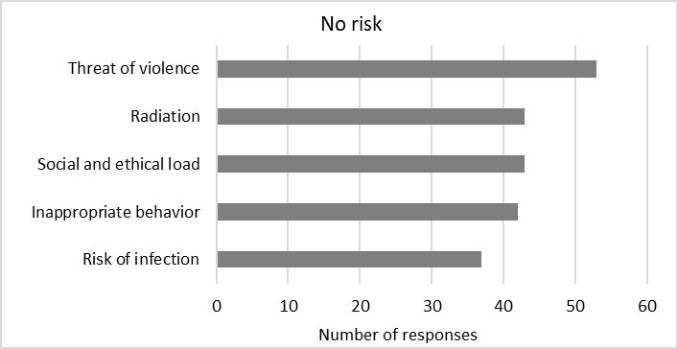
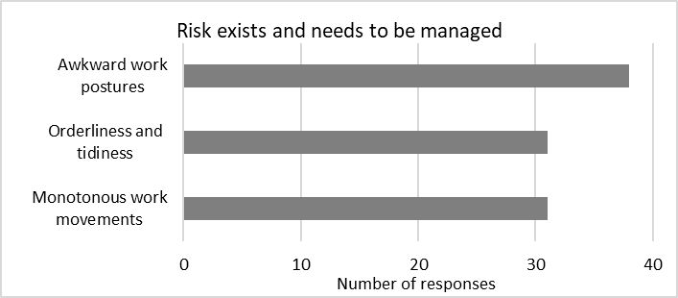
Survey Altogether, 58 people responded to the survey. According to the responses, the manufacturing companies studied had no significant risks caused by the threat of violence, radiation, social and ethical loads, inappropriate behavior, or risk of infection. However, awkward work postures, monotonous work movements, and orderliness and tidiness were found to yield risks that require management. Figure 1 shows the items that were most often rated as “the hazard does not exist” (i.e., “No risk”) and the numbers of these responses. Figure 2 shows the items that were most often rated as “the hazard causes a risk that needs to be managed” (i.e., “Risk exists”) and the numbers of these responses.
Figure 1: Items that were most often rated as “No risk” and the numbers of responses.Figure 2: Items that were most often rated as “Risk exists” and the numbers of these responses.
Workshop Participants mentioned many resources in the workshops. Resources rela- ted to work environment and tools were for example air source heat pump, good lighting, reduced noise, modern factory building, orderliness and tidi- ness, and safety markings. Resources mentioned regarding the work content and arrangements were for example long-term planning, flexible workma- tes, possibility of job rotation, diverse products, robots, and innovativeness. Examples of the resources listed under the theme work community were the sense of humor, community spirit, diversity of work tasks and job rotation, flexibility, support from others, and info TV. The participants’ development plans included improvements to the community spirit between departments, the flow of information within a company, order and tidiness, orientation, accessways, meetings, air conditioning, work well-being, training, a special production process, and haste.
Promoting Occupational Safety, Health, and Well-Being 195
DISCUSSION
This study revealed the risks, resources, and development needs in promoting SHW at four SME manufacturing companies. The study was implemen- ted as company-specific development processes consisting of an e-survey, interviews, and a workshop. The process was based on the principle that development needs should be specified by the working community. The actions to develop these topics were co-created with the employees and mana- gement in a workshop in which the researchers acted only as facilitators. An action plan was created based on the most relevant development needs. A company-specific development process can also be carried out by a company itself without an external facilitator, since external OHS resources availa- ble to SMEs are often limited. The development processes underlined how important it is for each company to find individual practices that best serve its development goals regarding SHW.
Improving the SHW of employees is a regulatory and moral obligation for employers imposed by modern society, and it is agreed to be a posi- tive value for individuals and organizations (Corcoran and Shackman, 2007; Työturvallisuuslaki 738/2002, 2002). As OHS in SMEs is often worse, and SMEs have fewer resources to develop SHW compared to larger companies (e.g., Masi and Cagno, 2015; Sørensen et al., 2007; Vickers et al., 2005; Walters et al., 2018), more effort is needed to develop SHW in SMEs. This study investigated tools, such as risk assessment surveys, interviews, and workshops, and measures to support SHW that SMEs require based on their contextual factors. When comparing these tools, the interviews, surveys, and workshops disclosed as a result some similar issues of resources and deve- lopment needs, but they also raised different issues. Moreover, this study discusses workers’ experiences of health and safety, which have seldom been addressed by OHS research into small companies (Walters and Wadsworth, 2016). The results showed that the main stress factors at work were related to physical factors, such as awkward job postures and monotonous work movements. In addition to physical factors, psychosocial factors, such as con- stant rushing, pressure, and communication problems, were also highlighted during the interviews. Furthermore, when discussing resource factors, the interviewees’ responses emphasized increasingly psychosocial factors, such as a positive work atmosphere and support from co-workers. This is in line with the results of a similar study on emergency medical services (Mattila et al., 2021). This indicates that psychosocial factors play a vital role in interviewees’ well-being at work.
According to Fan et al. (2020), OHS research has traditionally mainly focused on physical factors, but attention has recently been diverted to psych- osocial factors and their importance for individual productivity. Hakanen et al. (2019) suggested that enabling job feedback and preventing high wor- kloads can enhance the vitality of workers. When examining SHW, it is necessary to consider the completeness that covers both physical and psych- osocial factors related to work to achieve a broad picture of well-being at work.
Based on these findings, this study suggests that improving a positive work atmosphere and facilitating communication can promote SHW in SMEs. Motter and Santos (2017) stated that good communication among workers improves workers’ ability to meet deadlines, the quality of their work, and safety in work situations. Narayan and Nair (2021) also found that succes- sful communication will bolster a positive work atmosphere and therefore positively impact OHS.
The small number of companies involved is a limitation of this study. As this study comprised only four companies, it is hard to extrapolate the results to SME manufacturing companies in general. More companies and different industries could be studied in the future. Another limitation of this study is that the implementation of the action plan was beyond the scope of this study and hence was not evaluated. In future studies, the implementation of development activities could be studied.
This study provides valuable information about SHW risks, resources, and stress factors in SMEs in the manufacturing context. Moreover, it suggests tools and measures for promoting SHW. The results can be used by different kinds of SMEs, even in other industries.
CONCLUSION
This study revealed the risks, resources, and development needs in promoting SHW at four SME manufacturing companies. The study was implemented as company-specific development processes consisting of an e-survey, intervi- ews, and a workshop. Participants in companies emphasized a positive work atmosphere and support from co-workers as job resources in their work. Risks and development needs were related to physical strain, communication difficulties, constant rushing, order and tidiness and thermal environment. The action plan for promoting safety, health and well-being was co-created with the employees and management in each participated company.
ACKNOWLEDGMENT
The authors thank the workers and managers of the companies for participa- ting in the project. The authors also acknowledge the European Social Fund and Tampere University for their research funding.
REFERENCES
Champoux D. and Brun J.-P. (2003) Occupational health and safety management in small size enterprises: An overview of the situation and avenues for intervention and research. Safety Science, 41, 301–318. Corcoran, D.J. and Shackman, J.D. (2007) A theoretical and empirical analysis of the
strategic value of beyond compliance occupational health and safety programs. Journal of Business Strategies, 24, 49–68. Eurostat (2022a) Structural business statistics overview. Available at: https://ec.europa.eu/eurostat/statistics-explained/index.php?title=Structural_ business_statistics_overview (Accessed: 20 May 2022).
Promoting Occupational Safety, Health, and Well-Being 197
Eurostat (2022b) Accidents at work by NACE Rev. 2 activity and size of enterprise.
Available at: https://ec.europa.eu/eurostat/databrowser/view/HSW_N2_05__cus tom_2763217/default/table?lang=en (Accessed: 20 May 2022). Fabiano, B., Currò, F., and Pastorino, R. (2004) A study of the relationship between occupational injuries and firm size and type in the Italian industry. Safety Science, 42, 587–600. Fan D., Zhu, C.J., Timming, A.R., Su, Y., Huang, X., and Lu, Y. (2020) Using the
past to map out the future of occupational health and safety research: where do we go from here? The International Journal of Human Resource Management, 31(1), 90–127. Hakanen, J.J., Ropponen, A., De Witte, H., and Schaufeli, W.B. (2019) Testing demands and resources as determinants of vitality among different employment contract groups: A study in 30 European countries. International Journal of Environmental Research and Public Health, 16, 4951. Hasle, P. and Limborg, H.J. (2006). A review of the literature on preventive occu-
pational health and safety activities in small enterprises. Industrial Health, 44(1), 6–12. Holizki, T., McDonald, R., and Gagnon, F. (2015) Patterns of underlying causes of work-related traumatic fatalities—Comparison between small and larger companies in British Columbia. Safety Science, 71, 197–204. Masi, D. and Cagno, E. (2015) Barriers to OHS interventions in small and medium-
sized enterprises. Safety Science, 71, 226–241. Mattila, S., Kinnari, I., Tappura, S., and Lehto, M. (2021) Promoting occupational safety, health, and well-being in emergency medical services. In: Arezes, P.M. and Boring, R.L. (Eds.) Advances in safety management and human performa- nce. Proceedings of the AHFE 2021 Virtual Conferences on Safety Management and Human Factors, and Human Error, Reliability, Resilience, and Performance, July 25–29, 2021, USA. Springer. Lecture Notes in Networks and Systems 262. p. 324–330 Motter, A.A. and Santos, M. (2017) The importance of communication for the main-
tenance of health and safety in work operations in ports. Safety Science, 96, 117–120. Narayan, R. and Nair, V.K. (2021) The roles of communicative language mechanisms in occupational health and safety milieu in reducing workplace hazards. Journal of Language Teaching and Research, 12(2), 264–274. Sørensen, O.H., Hasle, P., and Bach, E. (2007) Working in small enterprises—Is there
a special risk? Safety Science, 45, 1044–1059. Tremblay, A. and Badri, A. (2018) Assessment of occupational health and safety performance evaluation tools: State of the art and challenges for small and medium-sized enterprises. Safety Science, 101, 260–267. Työturvallisuuslaki 738/2002 (2002) Occupational Safety and Health Act 2002/738. Unnikrishnan, S., Iqbal, R., Singh, A., and Nimkar, I. M. (2015) Safety management
practices in small and medium enterprises in India. Safety and Health at Work, 6, 46–55. Vickers, I., James, P., Smallbone, D., and Baldock, R. (2005) Understanding small firm responses to regulation. Policy Studies, 26(2), 149–169. Vinberg, S. (2020) Occupational safety and health challenges in small-scale enterpri-
ses. Industrial Health, 58, 303–305. Walters, D. and Wadsworth, E. (2016) Contexts and arrangements for occupational safety and health in micro and small enterprises in the EU – SESAME project. European Agency for Safety and Health at Work. Walters, D., Wadsworth, E., Hasle, P., Refslund, B., and Ramioul, M. (2018)
Safety and health in micro and small enterprises in the EU: Final report from the 3-year SESAME project. European Risk Observatory Report. European Agency for Safety and Health at Work.
LISTED IN THE AHFE DIGITAL BOOKSTORE CATALOGUE
Explore the complete digital volume
Safety Management and Human Factors
Read this individual research paper free through the original publisher, or explore the full digital proceedings book.
ISBN 978-1-958651-40-7
Explore this ISBN in the AHFE Bookstore ↗Listed in the July 2026 bookstore catalogue; search by ISBN to confirm current availability · Digital book purchase optional