Minna Rantala, Maria Lindholm, Sari Tappura, Jouni Kivistö Rahnasto (2022). Criteria for Successful Occupational Health and Safety Risk Assessment: A Systematic Review. In: Safety Management and Human Factors. AHFE Open Access, vol. 64, pp. 184–190. https://doi.org/10.54941/ahfe1002644
The use of the different kind of occupational health and safety risk assessment (OHS risk assessments) methods has become a standard procedure in the workplaces. A vast number of methods exist and some of them are even standardized. As an example, the prevailing practice in Finland has been to utilize the Workplace Risk Assessment Workbook, consisting of the hazard identification checklists and the risk matrix-based decision-making protocol. Even though OHS risk assessments are widely used in the workplaces, not much is known about the factors contributing to the success of the assessments nor are there definite criteria for a successful OHS risk assessment. Furthermore, previous studies show that often companies do nothing to assess the success of the risk assessments. In this study, a systematic literature review was carried out to determine the factors contributing to the success of the OHS risk assessment process. The research covers existing full text and peer-reviewed literature in Scopus and Web of Science databases. Due to the several and devastating accidents in the 1970s, which led to the need for international occupational health and safety standards, the literature review was extended to cover the past 50 years. References were loaded and duplicates were removed. All articles addressing the quality or success of the OHS risk assessment were selected. The PRISMA (Preferred Reporting Items for Systematic Reviews and Meta-Analyses) -flowchart was applied to describe the search process and the number of search results. In addition, the 16-item PRISMA for Searching (PRISMA-S) -checklist was applied when documenting and reporting the search. A complete list of the articles and findings will be presented at the conference. Preliminary results suggest that factors affecting the quality (including process factors and methodological factors as well as team and individual factors) of OHS risk assessment appear to be, for example, the design phase, the quality of the background information, the selected method, the identification of hazards, the accuracy of the frequency and consequence analysis, resources, the completeness of documentation and consultation and cooperation with relevant stakeholders. Some publications also adduced the importance of the composition of the OHS risk assessment team. Attention should be paid to the number of participants and how their knowledge and skills affect the results. In the literature, there were also studies from the early 1990s on the quality of risk analysis. (QUASA-method). It was suggested that the requirements for a safety analysis vary case by case and therefore the multiple sets of criteria are needed to cover all situations. The QUASA-method aimed to provide guidance for assessing the quality of the risk assessment process in different situations.
Several methods for assessing occupational health and safety (OHS) risks have become common practice in the workplace, some of which are even standardized (Brocal and Reniers 2018; Khan and Abbasi 1998; SFS-EN IEC 31010 2019). Most of these risk assessment methods are related to, for exam- ple, process safety (Boonthum et al. 2014; Summers 2003), decision-making (Hopkins 2011), and assessment of risk acceptability and tolerability (Melch- ers 2001; Tchiehe and Gauthier 2017). Furthermore, various risk indicators and evaluation criteria for selecting risk metrics have been suggested (Johan- sen and Rausand 2014), and there are studies concerning the quality of risk analysis (Rouhiainen 1992). Some recent studies also highlight the factors
Criteria for Successful Occupational Health and Safety Risk Assessment 185
undermining the success of OHS risk assessment (Carter and Smith 2006; Nenonen et al. 2021).
Despite the vast literature on industrial risk assessment in general, little is known about the success criteria and factors of OHS risk assessments. In this study, a systematic literature review was conducted to elucidate the factors influencing the success of the OHS risk assessment process. The study’s rese- arch questions were: RQ1 “What criteria exist, if any, to assess the success of OHS risk assessment?” and RQ2 “What factors support the success of the risk assessment?”.
MATERIALS AND METHODS
A systematic literature review was conducted in January 2022 based on the updated Preferred Reporting Items for Systematic Reviews and Meta- Analyses (PRISMA) statement (Page et al. 2021). Such a review consi- sts of a versatile search of all prospective relevant articles using clear and reproducible selection criteria (Cook et al. 1997). Two researchers formulated the research questions and decided to cover the years 1971– 2021 and to include peer-reviewed and full-text articles from the Scopus and Web of Science databases. Search words were selected and combined using the logical operators AND and OR. The applied search-query strings were: Scopus: TITLE-ABS-KEY((”risk assessment” OR (hazard AND (recogni- tion OR identification)) AND (“occupational health and safety” OR ohs OR osh OR “occupational safety and health”) AND (criteri* OR success*))).
Web of Science: (((TS=(”risk assessment” OR (hazard AND (recognition OR identification)))) AND TS=((“occupational health and safety “ OR ohs OR osh OR “occupational safety and health”) )) AND TS=( (criteri* OR success*))).
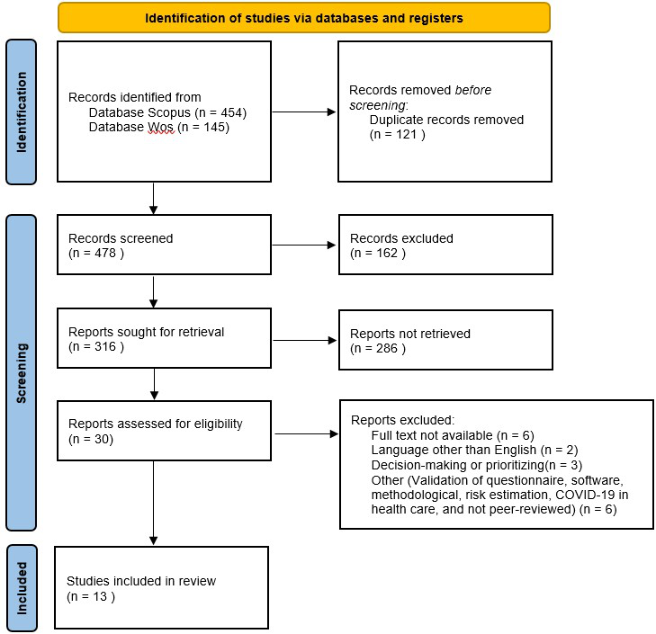
The selection process followed the PRISMA 2020 flow diagram (Figure 1) (Page et al. 2021). One researcher searched the databases and transferred the data in csv format to MS Excel. No automation tools were used. The table consisted of publication information, abstracts, and keywords.
After duplicates were removed, 478 articles remained. A total of 316 arti- cles were included based on their titles. The abstracts were then analyzed, and 30 articles were included. Six were unavailable. Hence, a total of 24 articles were read, looking for answers to the study’s research questions. Notes for each article were added to the search table, as well as information regarding whether the article answered the research questions. A more detailed, qua- litative analysis was conducted on 13 articles. Eight did not match either of the research questions and were thus omitted.
The selected articles answered RQ1 only partially. Therefore, the research- ers discussed the possibility of loosening the inclusion criteria. As a result, all the titles were carefully read and were rejected only if they were entirely unrelated to OHS risk assessment. The abstracts were also read closely and considered if it seemed that the research questions could be addressed at least to some extent.
Figure 1: The systematic review in the PRISMA flowchart (Page et al. 2021).
RESULTS AND DISCUSSION
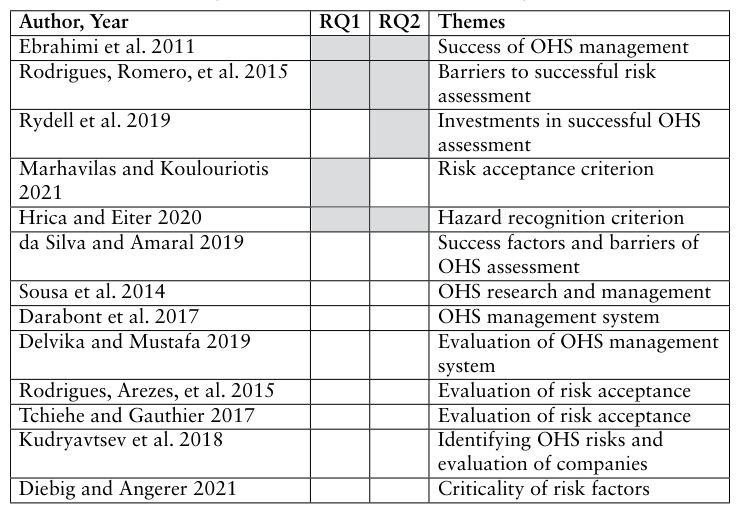
The content of 13 chosen articles was carefully examined. The research- ers thus concluded that only five studies discussed criteria for assessing the success of OHS risk assessments, success factors, or barriers to success (Table 1).
The criteria for determining a successful OHS risk assessment were menti- oned in four studies (Ebrahimi et al. 2011; Hrica and Eiter 2020; Marhavilas and Koulouriotis 2021; Rodrigues, Romero, et al. 2015). Ebrahimi et al. (2011) and Hrica and Eiter (2020) discussed success factors. In addition, two studies (Rodrigues, Romero, et al. 2015; Rydell et al. 2019) revealed limitations and barriers to successful OHS risk assessment, concluding that a minimum of these aspects should be taken into account.
Criteria of OHS Risk Assessment Success Based on a complete literature review, Ebrahimi et al. (2011) identified 68 criteria for a successful OHS system by benchmarking Alberta’s OHS stan- dards, and used interviews to weight the categories obtained. Hrica and Eiter (2020) highlighted the importance of hazard identification in their frame- work, where several competencies and characteristics are found necessary
Criteria for Successful Occupational Health and Safety Risk Assessment 187
Table 1. Included articles, distribution of the inclusion criteria, and themes.
to recognize hazards in high-risk work. However, further scientific evidence would be required to confirm the results of these studies. Ebrahimi et al. (2011) do not explain the reasons to use the Alberta’s OHS standards to audit OHS practices in connection to the construction of the Iranian subway. In Hrica and Eiter (2020), more transparency about the hazard recogni- tion competence framework would be valuable, as their study references an unpublished source.
The study of Marhavilas and Koulouriotis (2021) mentioned various tech- nical documents concerning OHS risk acceptance criteria, which addressed techniques, mathematical and software tools and methods, but did not set out the criteria for a successful risk assessment. Rodrigues, Romero, et al. (2015) approached the issue of OHS risk assessment success by developing a questionnaire for OHS practitioners to classify barriers and limitations focu- sing on factors for the quality of the risk assessment process. As Marhavilas and Koulouriotis (2021) found in relation to the acceptability of risks, there is plenty of literature in different fields, but very few studies that look at OHS activity.
Success Factors in OHS Risk Assessment Ebrahimi et al. (2011) turned their 68 criteria into eight categories, one of which was named “Hazard identification and assessment—components of an effective system”. Other categories were related to the success of the OHS system more commonly. According to the results by Ebrahimi et al. (2011), the most important ones were “Hazard identification and assessment” and “Hazard control”. The former consisted of criteria such as “job inventory”, “hazards identification”, “hazards evaluation”, “workers involvement”,
“access to records”, “training”, “hazard review”, and “results communi- cation”. Moreover, the health and safety experts described in a study of Hrica and Eiter (2020) work-site practices and competencies that support the suggested hazard recognition competencies framework. The success factors identified included categories such as “general hazard knowledge”, “site- specific hazard knowledge”, and “situational awareness”. Motivation and experience were also seen as key factors (Hrica and Eiter 2020). Although, the two studies approached hazard identification on a slightly different scale, they included similar factors for successful risk assessment.
In their analysis of the factors limiting OHS risk assessment, Rodrigues, Romero, et al. (2015) found that the time availability, the criteria included in the risk assessment methodologies, and the information available to carry out an objective assessment proved to be barriers. The identified limitations in a successful risk assessment should be taken into account, but this alone is not enough to guarantee a successful risk assessment. Moreover, in a work environment investment study, Rydell et al. (2019) identified risk assessment as one of the seven critical elements for the success of OHS activities. Their study revealed that a large proportion of companies made investments in the work environment before the risk assessment required by law and that a large proportion of the assessments were informal and did not meet the require- ments of Swedish legislation. The reasons for not conducting statutory risk assessments varied and included, for example, managers’ insufficient kno- wledge and understanding of the importance of risk assessment, as well as financial constraints (Rydell et al. 2019). These findings are in line with those of Rodrigues, Romero, et al. (2015) concerning the barriers to successful risk assessment.
CONCLUSION
The criteria revealed in this literature review were related to successful OHS risk assessment were that OHS risk assessment is a part of the OHS system, hazards identification framework, several technical documents concerning OHS risk acceptance criteria without criteria for a successful risk asses- sment, and a questionnaire for OHS practitioners to classify barriers and limitations. Regarding the factors for assessing the success of the risk asses- sment two studies by literature review approached hazard identification from a slightly different point of view, hence, they included similar factors for successful risk assessment. In addition, another two studies were in line with concerning barriers to successful risk assessment. Detected success factors included, for example, identifying and evaluating hazards, involving emplo- yees, training, accessing stored data, reviewing hazards, communicating results, general and work-specific awareness, and situational awareness. On the contrary, founded barriers were limited time, criteria concerning risk assessment methodologies, availability of information, inadequate know- ledge and understanding of the importance of risk assessment, and financial constraints.
Accordingly, this study confirmed the original suspicion that there is a gap in the literature concerning the success factors of the OHS risk assessment.
Criteria for Successful Occupational Health and Safety Risk Assessment 189
In the literature, the success of OHS management and risk assessment in different industrial installations and related quality criteria have been stu- died, as have decision-making methods and risk acceptability. In many cases, OHS risk assessments differed from major accident-related industrial risk assessments. The main limitation of the study is the paucity of available sci- entific evidence. Therefore, further research is recommended to determine the criteria and success factors for OSH risk assessment.
ACKNOWLEDGMENT
The authors would like to acknowledge the funding received from the Finnish Work Environment Fund and Tampere University for this research.
REFERENCES
Boonthum, N., Mulalee, U.and Srinophakun, T.(2014). A systematic formulation for HAZOP analysis based on structural model. Reliability Engineering and System Safety, 121, pp. 152–163. Brocal, F. and Reniers, G.L.L. (2018). Standardized risk assessment techniques : A
review in the framework of occupational safety. In: Safety and Reliability – Safe Societies in a Changing World. Haugen et. London: Taylor & Francis Group, pp. 2889–2895. Carter, G. and Smith, S.D. (2006). Safety Hazard Identification on Construction Projects. , 2006. Cook, D.J., Mulrow, C.D. and Haynes, R.B. (1997). Systematic reviews: Synthe-
sis of best evidence for clinical decisions. Annals of Internal Medicine, 126(5), pp. 376–380. da Silva, S.L.C. and Amaral, F.G. (2019). Critical factors of success and barriers to the implementation of occupational health and safety management systems: A syste- matic review of literature. Safety Science, 117(November 2018), pp. 123–132. Darabont, D.C., Antonov, A.E. and Bejinariu, C. (2017). Key elements on imple-
menting an occupational health and safety management system using ISO 45001 standard. MATEC Web of Conferences, 121, pp. 1–7. Delvika, Y. and Mustafa, K. (2019). Evaluate the Implementation of Occupational Health and Safety (OHS) Management System Performance Measurement at PT. XYZ Medan to minimize Extreme Risks. IOP Conference Series: Materials Science and Engineering, 505(1). Diebig, M. and Angerer, P. (2021). Description and application of a method to
quantify criterion-related cut-off values for questionnaire-based psychosocial risk assessment. International Archives of Occupational and Environmental Health, 94(3), pp. 475–485. Ebrahimi, S., Fazlali, M. and Hosseini, S.J. (2011). Enhancement of Current Procedures and Policies of OHS System in Iran Subway Construction through Developing an Auditing Tool. Innovation, Management and Service, Icms 2011, 14, pp. 166–171. Hopkins, A. (2011). Risk-management and rule-compliance: Decision-making in
hazardous industries. Safety Science, 49(2), pp. 110–120. Hrica, J.K. and Eiter, B.M. (2020). Competencies for the Competent Person: Defining Workplace Examiner Competencies from the Health and Safety Leader’s Perspective. Mining, Metallurgy and Exploration, 37(6), pp. 1951–1959.
Johansen, I.L. and Rausand, M. (2014). Foundations and choice of risk metrics.
Safety Science, 62, pp. 386–399. Khan, F.I. and Abbasi, S.A. (1998). Techniques and methodologies for risk analysis in chemical process industries. Journal of Loss Prevention in the Process Industries, 11(4), pp. 261–277. Kudryavtsev, S.S., Yemelin, P. V. and Yemelina, N.K. (2018). The Development of
a Risk Management System in the Field of Industrial Safety in the Republic of Kazakhstan. Safety and Health at Work, 9(1), pp. 30–41. Marhavilas, P.K. and Koulouriotis, D.E. (2021). Risk-acceptance criteria in occupational health and safety risk-assessment—the state-of-the-art through a systematic literature review. Safety, 7(4). Melchers, R.E. (2001). On the ALARP approach to risk management. Reliability
Engineering and System Safety, 71(2), pp. 201–208. Nenonen, N., Tappura, S., Rantala, M. and Lindholm, M. (2021). Workplace Hazards Difficult to Identify and Manage. Springer International Publishing. Page, M.J. et al. (2021). The PRISMA 2020 statement: An updated guideline for
reporting systematic reviews. The BMJ, 372. Rodrigues, M., Arezes, P.M. and Leão, C.P. (2015). Defining risk acceptance criteria in occupational settings: A case study in the furniture industrial sector. Safety Science, 80, pp. 288–295. Rodrigues, M., Romero, J., Arezes, P. and Soriano-Serrano, M. (2015). Limitations
and improvements to the risk assessment process in Olive Oil Mills: the views of OSH practitioners. In: International Symposium on Occupational Safety and Hygiene. pp. 309–311. Rouhiainen, V. (1992). QUASA: A method for assessing the quality of safety analysis.
Safety Science, 15(3), pp. 155–172. Rydell, A., Andersson, I.M., Bernsand, C.O. and Rosén, G. (2019). Work environment investments: Critical elements for success in optimizing occupational health and safety effects. Work, 64(1), pp. 107–116. SFS-EN IEC 31010. (2019). Risk Management. Risk assessment techniques (Riskie-
nhallinta. Riskien arviointimenetelmät). Sousa, V., Almeida, N.M. and Dias, L.A. (2014). Risk-based management of occupational safety and health in the construction industry - Part 1: Background knowledge. Safety Science, 66, pp. 75–86. Summers, A.E. (2003). Introduction to layers of protection analysis. Journal of
Hazardous Materials, 104(1–3), pp. 163–168. Tchiehe, D.N. and Gauthier, F. (2017). Classification of risk acceptability and risk tolerability factors in occupational health and safety. Safety Science, 92, pp. 138–147.
LISTED IN THE AHFE DIGITAL BOOKSTORE CATALOGUE
Explore the complete digital volume
Safety Management and Human Factors
Read this individual research paper free through the original publisher, or explore the full digital proceedings book.
ISBN 978-1-958651-40-7
Explore this ISBN in the AHFE Bookstore ↗Listed in the July 2026 bookstore catalogue; search by ISBN to confirm current availability · Digital book purchase optional