Sari Tappura, Maria Linsholm (2022). Occupational Safety and Health Affected by Climate Change: Future Challenges and Research Agenda. In: Intelligent Human Systems Integration (IHSI 2022): Integrating People and Intelligent Systems. AHFE Open Access, vol. 22. https://doi.org/10.54941/ahfe100997
The global Vision Zero approach aims to reduce work-related injuries, dis-eases, and deaths as much as possible. Proactive planning of work and the working environment as well as early identification of emerging risks and workload factors will promote the occupational safety and health (OSH) of employees. In the future, climate change may both directly and indirectly in-fluence OSH. This study investigates the OSH effects that have been identi-fied in interdisciplinary studies related to climate change. Moreover, it exam-ines various ways of adjusting to climate change. The methods consist of a literature review and a qualitative content analysis of documents. This inter-disciplinary study expands on the current knowledge of future challenges concerning OSH with respect to climate change. Practical means of adapting to climate change have rarely been suggested at the organizational level. Fu-ture studies should explore approaches to adapting to climate change and de-velop related practices.
Intelligent Human Systems Integration (IHSI 2022): Integrating People and Intelligent Systems https://openaccess.cms-conferences.org/#/publications/book/978-1-7923-8988-7
INTRODUCTION
Occupational safety and health (OSH) regulations aim to prevent work-related illnesses and injuries as well as maintain employees’ physical and mental health and ability to work throughout their careers (738/2002, 89/391/EEC, EC 2021). Achieving these goals requires the development of diverse elements of work and the working environment in cooperation with employers, employees, and occupational health care services. The OSH regulations also emphasize the need for employers to adequately design work and the working environment to account for impacts on the safety and health of employees (738/2002).
The global and European Vision Zero approach seeks to reduce work-related injuries, diseases, and deaths as much as possible (ISSA 2021). At the same time, the International Labour Organization objectives promote decent and safe work and contribute to United Nations Sustainable Development Goal 8 by addressing indicator 8.8 regarding a safe working environment (United Nations 2021). OSH have a crucial role in helping organizations protect lives and manage disability risks, competitiveness, business continuity, and sustainability (EC 2021, Sauni 2019).
Proactive planning of work and the working environment as well as early identification of emerging risks and workload factors can support the OSH of employees (Sitowise 2021). The human-centered design (HCD) approach prioritizes people and their needs, motivations, emotions, behavior, and perspectives in the development of work design (Maguire 2001). Interactive planning of the working environment can be used to obtain design solutions that benefit employees’ OSH, well-being, and performance at work. Preventive and systematic planning of work requires common practices and operating approaches as well as resources for planning work. The general policies defined by the organization for designing working environments would improve equality and lay the foundation for continuous planning (Sitowise 2021).
The future of work will be influenced by changes due to four main factors: technology, demographics, globalization, and climate change (EC 2021, Mattila-Wiro et al. 2020). These factors impact OSH both independently and collectively. The Finnish Ministry of Social Affairs and Health policy for the work environment and well-being at work until 2030 (Sauni 2019) highlights future challenges concerning OSH and well-being at work. The European Strategic Framework on Health and Safety at Work 2021–2027 (EC 2021) sets out key priorities and actions for improving OSH as the notion of a traditional workplace environment changes due to, for example, climate change and green transitions. The framework focuses on three interrelated objectives: managing change resulting from green, digital, and demographic transitions and changes in the traditional work environment; enhancing the prevention of accidents and illnesses; and increasing preparedness for any potential future crises. To deliver on these objectives, action is needed at the EU, national, sectoral, and company levels (EC 2021).
This interdisciplinary study expands on the current knowledge of future challenges concerning OSH with respect to climate change. It specifically focuses on HCD to emphasize
Intelligent Human Systems Integration (IHSI 2022): Integrating People and Intelligent Systems https://openaccess.cms-conferences.org/#/publications/book/978-1-7923-8988-7 employees’ needs in the development of work and the work environment, which has not been a common perspective in research on the future of work. The aim of this study is to investigate the OSH effects that have been identified in interdisciplinary studies related to climate change. Moreover, it examines various ways of adjusting to climate change at the organizational level. The study concludes with suggestions for further research to meet challenges in the near and distant future.
MATERIALS AND METHODS
The research material is comprised of topical communications, studies, and reports by the European Commission, OSH authorities, and OSH researchers and experts. The methods consist of a literature review as well as a qualitative content analysis of documents. The literature review encompasses recent studies and reports on the subject of OSH and climate change, while the document analysis considers main European and national political communications, strategies, and programs. The data for analysis derive from the main findings, results, and conclusions of articles, reports, and other materials (i.e. identified OSH effects related to climate change and ways of adjusting to them). The material was divided by themes according to the direct, indirect, and other impacts that were revealed in the initial reading.
RESULTS
Climate change directly and indirectly affects employees’ health and well-being in a range of fields, including agriculture, construction, industry, fishing, forestry, mining, rescue, and social and health care (Marchetti et al. 2016, Mattila-Wiro et al. 2020, Meriläinen 2021). The impacts of climate change are typically categorized into three groups: direct impacts, cascading impacts, and transition impacts (Hakala et al. 2021). Direct impacts refer to damage to people and infrastructure caused by natural phenomena. In the category of cascading impacts, climate factors are combined with political, economic, and cross-border effects. Finally, transition impacts reflect the repercussions of climate change mitigation and adaptation.
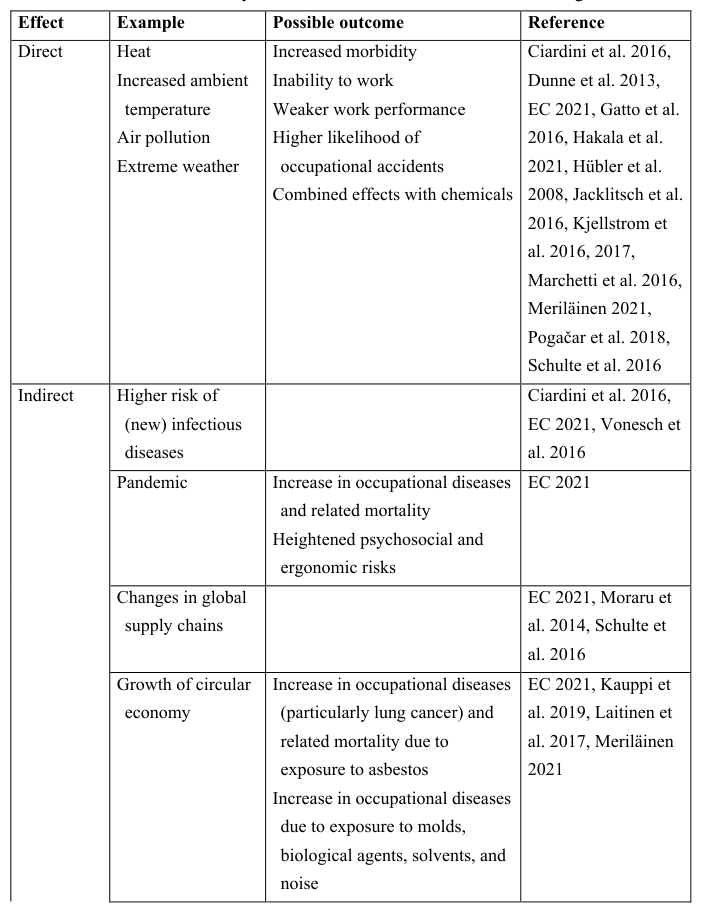
The results of this study indicate that OSH effects related to climate change can be divided into direct, indirect, and other (e.g. cascading and transition) effects (see Table 1). Direct OSH effects caused by climate change may include heat, extreme weather conditions, floods, and natural calamities, which present OSH-related risks, especially for outdoor workers including emergency responders (Ciardini et al. 2016, EC 2021, Gatto et al. 2016, Hakala et al. 2021, Kjellstrom et al. 2016, 2017, Marchetti et al. 2016, Meriläinen 2021, Pogačar et al. 2018). Extreme weather conditions (e.g. heat) can lead to increased morbidity, inability to work, and diminished work performance (Dunne et al. 2013, Hübler et al. 2008,), a higher likelihood of occupational accidents due to fatigue or concentration lapses (Jacklitsch et al. 2016, Schulte et al. 2016), and combined effects with chemicals (Gatto et al. 2016, Meriläinen 2021, Schulte et al. 2016). Indirect effects relate to, for example, infectious
Intelligent Human Systems Integration (IHSI 2022): Integrating People and Intelligent Systems https://openaccess.cms-conferences.org/#/publications/book/978-1-7923-8988-7 diseases, changes in global supply chains, the energy supply, and industries such as renewable energy technology and new materials and technologies (Ciardini et al. 2016, EC 2021, Kauppi et al. 2019, Laitinen et al. 2017, Meriläinen 2021, Moraru et al. 2014, Schulte et al. 2016, Valenti et al. 2016, Vonesch et al. 2016).
Table 1: Summary of the OSH effects related to climate change Effect Example Possible outcome Reference
Intelligent Human Systems Integration (IHSI 2022): Integrating People and Intelligent Systems https://openaccess.cms-conferences.org/#/publications/book/978-1-7923-8988-7
The Finnish Ministry of Social Affairs and Health (Meriläinen 2021) has assessed the current state of adaptation and the structures that support it to identify and concretize current and new adaptation measures in the health care sector, which include a heat-wave warning system, guidelines, intersectoral action, risk assessments, education, and communication. Workplaces and occupational health care providers must evaluate their current competences to respond to OSH-related effects of climate change.
Several authors have suggested adjustments and improvements to risk management (Kirin et al. 2015, Meriläinen 2021, Schulte et al. 2016, Valenti et al. 2016) to prepare for and contend with the impacts of climate change as well as multidisciplinary research on climate change and its OSH effects (Gatto et al. 2016, Kjellstrom et al. 2016, Pogačar et al. 2018, Schulte et al. 2016, Tang 2021, Vonesch et al. 2016). Adaptive responses could entail preventive programs, administrative procedures, or technological developments (Schulte et al. 2016). Tang (2021) has offered recommendations for workplace adaptation, which should account for OSH in building designs, coastline protection, and adaptive responses (e.g. indoor air quality design, identification of the vulnerable employees, designing of personal protective equipment and clothing, early warning systems, and increased preparedness). However, scholars have questioned whether workplaces, organizations, and management are adequately prepared for the inevitable changes (Lindholm et al. 2020).
Regarding OHS risk assessment, a comprehensive assessment of emergent risks due to climate change is advised. These risks include heat exposure (hot work), exposure to extreme weather conditions, biological agents and related health risks, psychosocial and ergonomic risks, new materials and technologies, and hazardous substances (EC 2021, Meriläinen 2021, Valenti et al. 2016). Risk assessments must further consider how working in extreme conditions and high temperatures can have combined effects with regard to occupational safety and chemical exposure (Gatto et al. 2016, Jacklitsch et al. 2016, Meriläinen 2021, Schulte et al. 2016). Moreover, organizations and workplaces should learn from the COVID- 19 pandemic when preparing for future health crises (EC 2021). These measures could include increased hygiene, improvements to emergency procedures, non-pharmaceutical
Intelligent Human Systems Integration (IHSI 2022): Integrating People and Intelligent Systems https://openaccess.cms-conferences.org/#/publications/book/978-1-7923-8988-7 interventions, and interventions to promote mental health and mitigate mental illness at work (EC 2021).
Measures to prevent adverse effects due to thermal conditions include health inspections, identification of at-risk individuals, programs to support active adaptation to the ambient temperature, the designation of rest periods and work breaks, maintenance of the water balance, and controlling thermal conditions through active air conditioning (Meriläinen 2021).
Exposure to hazardous substances should be lowered and the limit values re-viewed in emerging sectors in order to decrease the OHS risks due to green transition (EC 2021). These measures are relevant to lead and cobalt, as these hazardous substances are frequently used in renewable energy technologies and the production of batteries. Furthermore, exposure to asbestos is still a significant health risk factor in the renovation wave.
With respect to the circular economy, researchers have outlined sector-specific adaptation measures and safe procedures (e.g. Ervasti et al. 2018, Kauppi et al. 2019, Laitinen et al. 2017). To ensure safety, the design of a plant should be based on regulatory requirements, standards, and good design practices as well as hazard identification and risk assessment. In addition to process hazards, hazards throughout the value chain (e.g. collection, transport, and storage in material recycling) must be identified (Ervasti et al. 2018). According to Ervasti et al. (2018), typical methods of hazard identification and risk assessment in the process industry are suitable for circular economy plants as well, and specific checklists can be applied to each type of plant.
DISCUSSION
This article has examined the OSH implications of and adaptation to climate change through a literature review and document analysis. To ensure the safety, health, and well-being of employees, decision-making regarding climate change should account for the health effects of the phenomenon and necessary adaptations (Meriläinen 2021). There is a need for additional studies on industry-related exposure and OSH risks.
Climate change poses new and intensified OSH hazards that necessitate reconsideration of the risk levels of certain occupations (Tang 2021). It is important to be prepared for variations in the weather and climate and for the effects of extreme weather and climate conditions to ensure decent and safe work, even under the current circumstances (Meriläinen 2021). Such preparedness can facilitate adaptation to future climate variation and changes. One possible response to climate change is to expand the circular and green economy, which would require profiling and addressing the associated OSH risks and emphasizing safe and decent work, as new dangers in more traditional fields or traditional dangers in new fields may not be detected.
Despite several recommendations, practical means of adapting to climate change have rarely been presented with respect to OSH. Regarding the national security impacts of climate
Intelligent Human Systems Integration (IHSI 2022): Integrating People and Intelligent Systems https://openaccess.cms-conferences.org/#/publications/book/978-1-7923-8988-7 change, recommendations include cultivating more cross-sectoral dialogue, increasing environmental expertise in preparedness, and incorporating climate change concerns into security planning (Hakala et al. 2021). These recommendations can be applied to OHS as appropriate.
Climate change can impact the work environment and working conditions in multiple ways, such as through heat, radiation, air pollution, and extreme weather conditions as well as the spread of illnesses, allergens, and insects. The application of human-centered design can allow organizations and individual employees to adapt to new and unfamiliar work environments in, for instance, sustainable development and renewable energy production (Lindholm et al. 2020, Sitowise 2021). A Malaysian study (Palermo & Hernandez 2020) has described an adaptation framework that features a high-potential participatory method whereby stakeholders (civil servants) from various municipalities engage in “safety walks” through the city to identify climate risk hotspots. Such activities could be applied to support OHS.
As a stable and wealthy society, Finland has the ability to adapt to climate change; still, preparedness for the combined effects may be inadequate (Hakala et al. 2021). To address this issue, the Finnish Ministry of Social Affairs and Health (Meriläinen 2021) has designed an Adaptation Plan (2021–2031) that specifies 43 objectives and 92 recommendations for measures at the national level. However, workplaces may need more concrete and direct guidance regarding their adaptation measures.
In conclusion, future studies on OSH should investigate approaches for adapting to climate change at the European, national, and organizational levels. In addition, related practices and tools should be developed. It is imperative to deliver targeted guidance and raise awareness with a focus on small and medium-sized organizations to support them in a green transition while ensuring strong protection of workers, the achievement of sustainable solutions, and preservation of competitiveness (EC 2021). The OSH legislation and mandates differ across European countries. Given the global nature of the challenges in the future of work, this study may provide an impetus for future research on working environments and OSH in the European context.
REFERENCES
738/2002. Työturvallisuuslaki (Occupational Safety and Health Act, in Finnish). 89/391/EEC. Counsil Directive 89/391/EEC of 12 June 1989 on the introduction of measures to encourage improvements in the safety and health of workers at work. Ciardini, V., Contessa, G.M., Falsaperla, R., Gómez-Amo, J.L., Meloni, D., Monteleone, F., Pace, G., Piacentino, S., Sferlazzo, D., di Sarra, A. (2016). Global and Mediterranean climate change: a short summary. Ann. Ist. Super. Sanita 52(3), 325- 337. Dunne, J.P., Stouffer, R.J., John, J.G. (2013): Reductions in labour capacity from heat
stress under climate warming. Nature Clim. Change 3, 563-566.
Intelligent Human Systems Integration (IHSI 2022): Integrating People and Intelligent Systems https://openaccess.cms-conferences.org/#/publications/book/978-1-7923-8988-7
EC (European Commission) (2021). EU strategic framework on health and safety at work 2021-2027. Occupational safety and health in a changing world of work. COM (2021) 323. Brussels: European Commission. Ervasti, O., Bergman, H., Vauhkonen, I., Karinen, P. (2018). Safety risks of circular
economy plants (in Finnish). Final Report. Helsinki: Finnish Safety and Chemicals Agency. Gatto, M.P., Cabella, R., Gherardi, M. (2016). Climate change: the potential impact on occupational exposure to pesticides. Ann. Ist. Super. Sanita 52(3), 374-385. Hakala, E., Erkamo,S., Pyykönen, J., Tuomenvirta, H., Tynkkynen, O., Berninger, K.,
Vihma, A. (2021). Climate change and Finland’s security: Threats and preparedness in the model of comprehensive security (in Finnish). Helsinki: Finnish Prime Minister’s Office. Hübler, M., Klepper, G., Peterson, S. (2008). Costs of climate change: The effects of rising temperatures on health and productivity. Germany Ecol. Econ. 68, 381-393. ISSA (The International Social Security Association) (2021). Vision Zero [online].
Available from: https://visionzero.global/ [accessed 27 September 2021]. Jacklitsch, B., Williams, W.J., Musolin, K., Coca, A., Kim, J.-H., Turner, N. (2016).
NIOSH criteria for a recommended standard: occupational exposure to heat and hot environments. Revised criteria 2016. Cincinnati: National Institute for Occupational Safety and Health. Kauppi, S., Bachér, J., Laitinen,S., Kiviranta, H., Suomalainen, K., Turunen, T., Kautto, P., Mannio, J., Räisänen, M., Lautala, K., Porras, S., Rantio, T., Salminen, J., Santonen, T., Seppälä, T., Teittinen, T., Wahlström, M. (2019). Safe and sustainable circular economy (in Finnish). Helsinki: Prime Minister’s Office. Kirin, S., Božić, M., Brzaković, M., Vučetić, I. (2015). Challenges of future research in the
area of industrial safety. Struct. Integr. Life 15(2), 71-78. Kjellstrom, T., Briggs, D., Freyberg, C., Lemke, B., Otto, M., Hyatt, O. (2016). Heat, Human Performance, and Occupational Health: A Key Issue for the Assessment of Global Climate Change Impacts. Annu. Rev. Public Health 37(1), 97-112. Kjellstrom, T., Lemke, B., Otto, M. (2017). Climate conditions, workplace heat and
occupational health in South-East Asia in the context of climate change. WHO South East Asia J. Public Health 6(2), 15-21. Laitinen, S., Rissanen, R., Santonen, T. (2017). Work-related risks of exposure in circular economy (in Finnish). Helsinki: Finnish Institute of Occupational Health. Lindholm, M., Reiman, A., Väyrynen, S. (2020). On future occupational safety and health
challenges in industrialized countries — a systematic literature review. International Journal of Occupational and Environmental Safety 4(1), 108-127. Maguire, M. (2001). Methods to support human-centred design. Int. J. Human-Computer Studies 55, 587-634. Marchetti, E., Capone, P., Freda, D. (2016). Climate change impact on microclimate of
work environment related to occupational health and productivity. Ann. Ist. Super. Sanita 52(3), 338-342. Mattila-Wiro, P., Samant Y., Husberg, W., Falk, M., Knudsen, A., Saemundsson, E.
(2020). Work today and in the future: Perspectives on Occupational Safety and Health challenges and opportunities for the Nordic labour inspectorates. Helsinki: The Ministry of Social Affairs and Health. Meriläinen, P., ed. (2021). Climate change in the healthcare and social welfare sector – Ministry of Social Affairs and Health’s Climate Change Adaptation Plan (2021– 2031). Helsinki: Ministry of Social Affairs and Health.
Intelligent Human Systems Integration (IHSI 2022): Integrating People and Intelligent Systems https://openaccess.cms-conferences.org/#/publications/book/978-1-7923-8988-7
Moraru, R.I., Bǎbuţ, G.B., Stelea, M.P. (2014). Approaching occupational safety and health emerging risks categories and prevention. Qual. - Access Success 15(139), 104-108. Palermo, V., Hernandez, Y. (2020). Group discussions on how to implement a participatory
process in climate adaptation planning: a case study in Malaysia. Ecol. Econ. 177, 106791. Pogačar, T., Casanueva, A., Kozjek, K., Ciuha, U., Mekjavić, I. B., Kajfež Bogataj, L., Črepinšek, Z. (2018). The effect of hot days on occupational heat stress in the manufacturing industry: implications for workers’ well-being and productivity. Int. J. Biometeorol 62(7), 1251-1264. Sauni, R., ed. (2019). Policy for the work environment and wellbeing at work until 2030.
Safe and healthy working conditions and workability for everyone. Helsinki: Ministry of Social Affairs and Health. Schulte, P.A., Bhattacharya, A., Butler, C.R., Chun, H.K., Jacklitsch, B., Jacobs, T., Kiefer, M., Lincoln, J., Pendergrass, S., Shire, J., Watson, J., Wagner, G.R. (2016). Advancing the framework for considering the effects of climate change on worker safety and health. J. Occup. Environ. Hyg. 13(11), 847-865. Sitowise (2021). People in designing work and the working environment. A handbook for
the proactive planning of work and design of working environments. Helsinki: Sitowise Oy. Tang K.H.D. (2021). The Effects of Climate Change on Occupational Safety and Health.
Glob. J. Civil Environ. Eng. 3, 01-10. United Nations (2021). Department of Economic and Social Affairs, Sustainable Development, The 17 goals [online]. Available from: https://sdgs.un.org/goals [accessed 27 September 2021]. Valenti, A., Gagliardi, D., Fortuna, G., Iavicoli, S. (2016). Towards a greener labour
market: occupational health and safety implications. Ann. Ist. Super. Sanita 52(3), 415-423. Vonesch, N., D’Ovidio, M., Melis, P., Remoli, M., Ciufolini, M., Tomao, P. (2016).
Climate change, vector-borne diseases and working population. Ann. Ist. Super. Sanita 52(3), 397-405.
Intelligent Human Systems Integration (IHSI 2022): Integrating People and Intelligent Systems https://openaccess.cms-conferences.org/#/publications/book/978-1-7923-8988-7
LISTED IN THE AHFE DIGITAL BOOKSTORE CATALOGUE
Explore the complete digital volume
Intelligent Human Systems Integration (IHSI 2022): Integrating People and Intelligent Systems
Read this individual research paper free through the original publisher, or explore the full digital proceedings book.
ISBN 978-1-7923-8988-7
Explore this ISBN in the AHFE Bookstore ↗Listed in the July 2026 bookstore catalogue; search by ISBN to confirm current availability · Digital book purchase optional