Alessio Silvetti, Lorenzo Fiori, Alberto Ranavolo, Giorgia Chini, Tiwana Varrecchia, Antonella Tatarelli, Adriano Papale, Ari Fiorelli, Francesco Draicchio (2022). Biomechanical risk assessment of curbside waste collection round through heart rate and GPS data. In: Social and Occupational Ergonomics. AHFE Open Access, vol. 65, pp. 213–220. https://doi.org/10.54941/ahfe1002678
Many scientific papers report that curbside waste collection is a work with high biomechanical load. Our previous papers highlighted the biomechanical risk in this activity and we identified these main risk factors: bad design of equipment, landscape and the number of households covered. The high variability of this task makes it hard to apply standardized protocols for biomechanical risk assessment. For this new experience, we used pulse rate monitors to assess cardiac effort during a full day of pick-up in two different days for two operators gathering bio-waste and glass. The first worker pick-up the waste in the same area on both days. The second worker pick-up waste on zones with different morphology and different urban density. We also recorded GPS data from the second worker. We analyzed heart rate calculating Relative Cardiac Cost (RCC) and heart rate distribution. The first worker performed the task in the municipal urban area and reported a RCC of 43 and 45%. Both values correspond to a heavy work level on the Chamoux scale. The second worker reported RCC values of 36% when collecting in the municipal urban area (quite-heavy work level) and 23% in the non-urban hilly area (moderate work level). The heart rate of the second worker exceeded 140 bpm 7.7% of the time and ranged from 110 to 130 bpm for 72.6% of the time in the municipal area. In the non-urban area, 140 bpm heart rate was never reached and heart rate values were between 110 and 130 bpm for 16.6% of the time. No differences resulted in the first worker due to the type of waste collected. For the second worker, we found a relevant difference in heart rate distribution, probably not related to the type of waste but rather to the number of households and the morphology of the landscape. GPS data seem to support these findings. In the municipal area, the worker moved 17.6 km at a mean speed of 4.8 km/h. In the non-urban area, the worker moved 40.84 Km at a mean velocity of 7.8 Km/h. The higher speed and more than twice the distance covered highlight that the worker spent much more time driving the truck in the non-urban zone than in the municipal one resulting in a reduced biomechanical workload. In conclusion, combined data from heart rate monitor and GPS allowed us to highlight the different workloads between the two zones, municipal and non-urban. We suggest alternating the workers between them to reduce biomechanical risk.
Kerbside waste collection, as reported in our previous studies (Silvetti, 2020; 2021a; 2021b), and the references mentioned, shows high biomechanical load for the joints of wrist, shoulder, elbow, and trunk. The associated risk can differ depending on several factors: the techniques of execution the task, the type of equipment used (bins, wheeled bins, vehicles, etc.), morpholo- gical peculiarities of pick-up areas, worker anthropometry, and the weight handled. For this latter factor, in particular, was highlighted a high variabi- lity throughout the seasons, for example in summer displays higher organic waste (Botti, 2020) and thus an increase in load. Oxley and colleagues found that the handling of 13 kg bins, even with proper lifting techniques, lading to exceeding the compression force threshold at L5/S1 recommended by NIOSH (Waters, 1994). On this evidence, was suggested (Oxley, 2006) a lifting wei- ght threshold of 11.38 kg for eight continuous working hours at a frequency of twice a minute. Liberty Mutual (2004) similarly recommends this level in its manual material handling risk assessment guidelines, suggesting that it would safeguard 90% of the male working population and 20% of the female working population. We confirm this also in the two cases we pre- viously investigated. The goal of our study is an ergonomic risk assessment of kerbside waste collection workers by investigating different supplies used and different environment compared with our previous papers (Silvetti, 2020; 2021a; 2021b). We recorded heart rate (HR), to analyze its distribution and determine the Relative Cardiac Cost (RCC) of the workers. We also recor- ded GPS data to measure the covered distance, and whether it may affect biomechanical load. Our results could provide information for assessing the biomechanical risk in activities where standardized protocols can not be applied and could aids health and safety service for risk mitigation in this context.
MATERIAL AND METHODS We used HR monitors (Polar s510) during the collection round on two workers on two different days. We, therefore, determined RCC from HR recordings for each worker based on the following Frimat’s formula (Frimat, 1979):
Equation reproduced from the original PDF.
Where HRmax is the maximum HR esteemed; HRmean is the mean freque- nce of the entire recording; HRrest is the rest frequence of the subject; age is the subject’s age expressed in years.
Table 1 shows the classifications of work activity levels based on the RCC values (Chamoux, 1984).
The first worker picked up the waste in the same area on both days, while the second one performed the collection round in two areas: 1) municipal urban, 2) non-urban hilly. We recorded GPS data of this worker to integrate HR and to analyze possible differences between the two zones.
Biomechanical Risk Assessment of Kerbside Waste Collection Round 215
Table 1. Activity level categorization based on RCC values according to Chamoux.
Table available in the original PDF paper.
Relative Cardiac Cost % 0-9 very light 10-19 light 20-29 moderate 30-39 quite heavy 40-49 heavy
RESULTS
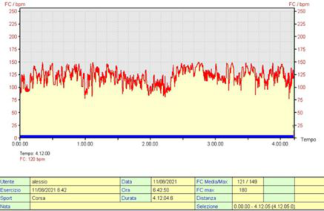
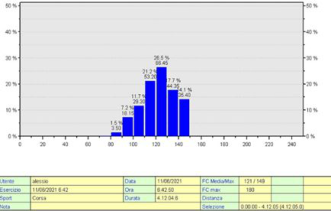
Heart Rate Hereafter (Figures 1, 2, 3 and 4) are the results of HR monitors recordings from the first worker. Figures 1 and 2 refer to HR recording in the municipal urban area picking up bio-waste. The mean HR was 121 bpm, and the peak value was 149 bpm. HR was between 90 e 110 bpm for 18.9% of the acqui- sition, between 110 and 130 bpm for 47.7%, and over 130 bpm for 31.8%. RCC value was 45%. It corresponds to a heavy level on the Chamoux scale (Chamoux, 1984).
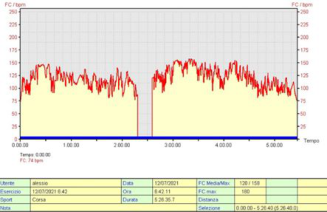
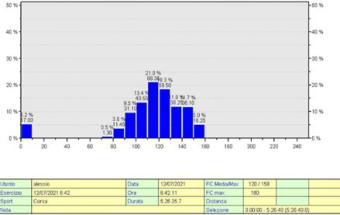
Images 3 and 4 refer to HR recording in the same area picking up the glass. The mean HR was 120 bpm, and the peak value was 158 bpm. HR was between 90 e 110 bpm for 22.9% of the acquisition, between 110 and 130 bpm for 39.3%, and over 130 bpm for 28.5%. RCC value was 43%. Also, this value corresponds to a heavy level in the Chamoux scale (Chamoux, 1984). Hereafter (Figures 5, 6, 7, and 8) are the results of HR monitors recordings from the second worker.
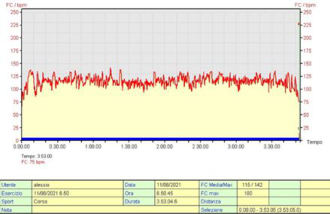
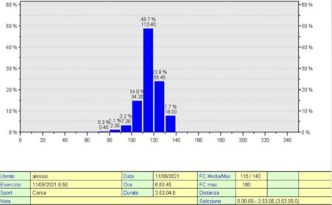
Figures 5 and 6 refer to HR recording in the municipal urban area picking up bio-waste. The mean HR was 115 bpm, and the peak value was 142 bpm.
HR was between 90 e 110 bpm for 18% of the acquisition, between 110 and 130 bpm for 72.6%, and over 130 bpm for 7.7%. RCC value was 36%, corresponding to a quite heavy level according to Chamoux (Chamoux, 1985).
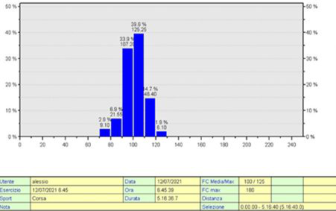
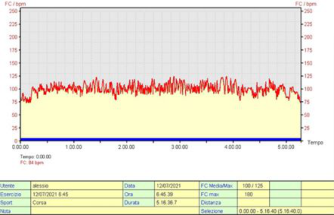
Figure 1: HR track recorded.Figure 2: HR percentage distribution in the ten bpm band. Both figures refer to the first worker in the municipal area picking up biowaste.Figure 3: HR track recorded.Figure 4: HR percentage distribution in the ten bpm band. Both figures refer to the first worker in the municipal area picking up glass.Figure 5: HR track recorded.
Biomechanical Risk Assessment of Kerbside Waste Collection Round 217
Figure 6: HR percentage distribution in the ten bpm band. Both figures refer to the second worker in the municipal area picking up biowaste.Figure 7: HR track recorded.Figure 8: HR percentage distribution in the ten bpm band. Both figures refer to the second worker in the non-urban hilly area picking up glass.
Figures 7 and 8 refer to HR recording in the non-urban hilly area picking up the glass.
The mean HR was 100 bpm, and the peak value was 125 bpm. HR was between 90 e 110 bpm for 73.5% of the time and between 110 and 130 bpm for 16.6%. HR never exceeds 130 bpm. The obtained RCC value of 23% corresponds to a moderate level on the Chamoux scale(Chamoux, 1985).
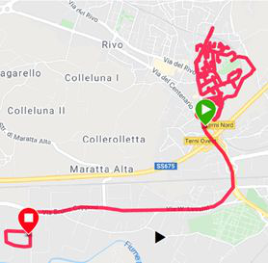
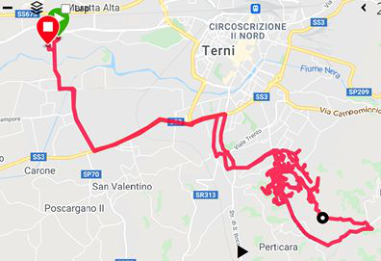
GPS Data Figures 9 and 10 show GPS recorded data of the second worker.
Figure 9 illustrates GPS data in the municipal urban area picking up bio- waste. The worker covered 17.6 km in 3h45m; the mean speed was 4.8 km/h.
Figure 9: GPS data in the municipal urban area.Figure 10: GPS data in the non-urban hilly area.
Figure 10 illustrates GPS data in the non-urban hilly area picking up the glass. The worker covered 40.84 km in 5h14m; the mean speed was 7.8 km/h.
DISCUSSION
In this new experience, the first worker reported RCC values of 43 and 45% in a municipal urban district while picking up respectively glass and bio- waste. These values correspond to a “heavy level”according to the Chamoux scale. The second worker reported RCC values of 36% in another munici- pal urban area while picking up bio-waste, corresponding to a “quiet level” according to the Chamoux scale, and 23% in the non-urban hilly area while picking up glass, corresponding to a “moderate”level according to Chamoux scale.
The different distribution of the HR results shows the difference in the RCC values for the second worker. In the urban area, HR exceeded 130 bpm for 7.7% of the time, and it was between 110 and 130 bpm for 72.6%. In the non-urban hilly area, HR data never exceeds 130 bpm and was between 110 and 130 bpm for 16.6% of the time. We did not observe differences, in the collection of two types of waste, in the same pick-up area (urban-type) for the first worker. We can mainly
Biomechanical Risk Assessment of Kerbside Waste Collection Round 219
attribute the different workloads of the second worker to the different mor- phology of the served area and the unequal number of households. GPS data would suggest that this assumption is correct since, in the urban area (Figure 9), the worker covered a shorter distance than in the hilly area (Figure 10), covering less than half of the track (17.6 vs. 40.84 km) with a lower average speed (4.8 vs. 7.8 km/h). Above all, this last data would sug- gest that the worker drove the van for a longer time, with higher rest periods, in the non-urban hilly area than in the municipal urban one.
We also found “spontaneous” ergonomics. To reduce shoulder load, the workers alternate emptying the bins between the arms. We also found an awareness of the involved workers, even not supported by empirical data, of the lower load of the non-urban hilly area.
CONCLUSION
As Teerioja claimed (Teerioja, 2012), nowadays kerbside waste collection system is six times cheaper than the modern pneumatic waste collection system. Kerbside waste collection, however, implies a high biomechanical load for workers.
The collection round workload can vary markedly depending on local morphology, worker’s health status and anthropometry, equipment characte- ristics (bins and lorry), and load handled. Moreover, seasonality is of great importance. As already highlighted (Botti, 2020), bio-waste weighs more than double in summer, in the same collection round, compared to win- ter. Although not quantified as in Botti, our informal workers’ interviews confirmed this.
In our study, we assessed biomechanical load through an HR monitor. HR is a physiological parameter that can significantly change due to seve- ral factors. In the kerbside waste collection round, major are temperature, age, anthropometry, health status, distance and slope of the paths, the weight of handled bins, and frequency of getting in and out of the lorry. To under- stand better the track that worker covers within the work shift and verify if it may affect HR outcomes, we also recorded GPS data.
We found high metabolic differences between the two different areas of pick-up. This difference could not be dues to the different types of waste (bio-organic vs. glass) but to the different morphology and density of the two areas (municipal–urban vs. non-urban hilly). As Battini suggested (Battini, 2014), alternate activities between high and low-density districts would be good practice for reducing biomechanical load.
In conclusion, it is possible to integrate HR and GPS data to better assess the biomechanical load of workers in the kerbside collection round.
ACKNOWLEDGEMENTS
This study has been supported by Rubes Triva Foundation
REFERENCES
Battini, Daria. Et al. (2014). “Innovative real-time system to integrate ergonomic evaluations into warehouse design and management”. COMPUTERS AND INDUSTRIAL ENGINEERING Volume 77 Botti, Lucia. Et al. (2020). “Door-to-door waste collection: Analysis and recommen-
dations for improving ergonomics in an Italian case study”. WASTE MANAGE- MENT Volume 109 Chamoux, Alain. Et al. (1984). “Le système Holter en pratique”. MEDICINE DU SPORT, Volume 58 No. 5 Frimat, Paul. Et al. (1979). “Le travail à la chaleur (verrerie). Etude de la charge
de travail par ECG dynamique. Applications de la Méthode de VOGT”. ARCH. MAL. PROF. Volume 40 No. 1-2 Liberty Mutual (2004). “Manual Materials Handling Guidelines. Tables for Evaluating Lifting, Lowering, Pushing, Pulling and Carrying Tasks”. USA: Liberty Mutual Group Oxley, Laraine. Et al. (2006). “Manual handling in kerbside collection and sorting
of recyclables”. HSL/2006/25 Silvetti, Alessio. Et al. (2020). “Back and shoulder biomechanical load in curbside waste workers”. Advances in Physical, Social & Occupational Ergonomics. Springer publishing. R.H.M. Goossens (ed.) Silvetti, Alessio. Et al. (2021). “Ergonomic Risk Assessment in Kerbside Waste Col-
lection Through Dynamic REBA Protocol”. Proceedings of the 21st Congress of IEA Volume IV: Healthcare and Healthy Work Silvetti, Alessio. Et al. (2021). “Kerbside Waste Collection Round Risk Assessment by Means of Physiological Parameters: sEMG and Heart Rate”. Proceedings of the 21st Congress of IEA Volume V: Methods & Approaches Teerioja, Nea. Et al. (2012). “Pneumatic vs. door-to-door waste collection systems
in existing urban areas: a comparison of economic performance”. WASTE MANAGEMENT Volume 32 Waters, Thomas et al. (1994) “Applications Manual for the Revised NIOSH Lifting Equation”. Cincinnati, OH: U.S. Department of Health and Human Services, Centers for Disease Control and Prevention, National Institute for Occupational Safety and Health, DHHS (NIOSH) Publication No. 94-110
LISTED IN THE AHFE DIGITAL BOOKSTORE CATALOGUE
Explore the complete digital volume
Social and Occupational Ergonomics
Read this individual research paper free through the original publisher, or explore the full digital proceedings book.
ISBN 978-1-958651-41-4
Explore this ISBN in the AHFE Bookstore ↗Listed in the July 2026 bookstore catalogue; search by ISBN to confirm current availability · Digital book purchase optional