One of the problems with wheelchairs is that the vibrations generated during driving can cause users to experience motion sickness, discomfort, and annoyance. Wheelchair tire pressure is considered to be one of the factors that affects the ride comfort of a wheelchair. However, it is not yet known how much influence the tire pressure of a wheelchair has. One of the reasons for this is that it is not possible to accurately measure tire pressure with the English valve used in wheelchairs. Therefore, we created a tire pressure indicator to accurately measure the tire pressure of wheelchairs. The purpose of this study is to use the tire pressure display to evaluate the impact of changes in tire pressure on assistive wheelchairs on vibration. In addition, in this experiment, we created a device to push the assistive wheelchair using an electric wheelchair in order to make the assistive wheelchair move at a constant speed, aiming to improve the reliability of the data. In this paper, we examined the effects of different running speeds on ride comfort.In this study, we use a triaxial accelerometer to measure the vibration of the tire pressure of a manual attendant-controlled wheelchair in four patterns: 80kPa, 160kPa, 240kPa, and 320kPa. This measurement is performed at three different running speeds: low speed, medium speed, and high speed. FFT analysis is performed on the acceleration in three directions measured by the triaxial accelerometer, and the maximum power spectrum, frequency and integral value at the maximum power spectrum are determined. From these values, evaluate the trends caused by changes in tire air pressure. Verify the relationship with tire pressure. Riding comfort was evaluated using the SD method, and two types of evaluation were performed: stationary and running. The evaluation items consisted of three items, sitting comfort, sense of security, and sitting comfort of the buttocks, for both static and running conditions, and four items, including the strength of shaking while running. Responses were obtained on a five-point scale from 1 to 5. In this study, we verified the results of vibration measurements and sensory evaluations, and verified ride comfort due to differences in driving speed and tire air pressure.
As of 2016, Japan’s population with physical disabilities was estimated to be approximately 4.28 million, a number that has been steadily increasing. This includes 1.93 million people have been reported to have significant physical disabilities. With Japan’s aging population, the demand for assistive devices is projected to increase annually. Wheelchairs, which are essential for mobil- ity, are widely used by the elderly and individuals with physical disabilities. These include both assistance-type and self-propelled wheelchairs, the latter of which is often operated by caregivers. A notable issue with wheelchair
About Ride Comfort Due to Differences in Running Speed 83
use is the discomfort caused by vibrations during motion, potentially lead- ing to motion sickness and annoyance, as documented in previous studies (Di Giovine et al., 2015a; 2015b; Cook and Polgar, 2008; Kitazaki and Griffin, 1998; LaPlante et al., 2010; Wilder et al., 1994; Booka et al., 2015). This research posits that tire pressure significantly affects wheelchair ride comfort. However, the extent of this impact remains unclear, partly because of the challenges in measuring tire pressure accurately using the conven- tional English valve system in wheelchairs. To address this gap, we developed a tire pressure indicator in collaboration with the Hiroshima International University (Shoichiro et al., 2019; 2020; 2021; 2022). This study aims to evaluate how changes in tire pressure affect vibrations in assistive wheelchairs using this newly developed tire pressure display. Additionally, we designed a device to propel an assistive wheelchair at a constant speed using an electric wheelchair to enhance data reliability. This study investigated the impact of tire pressure on the ride comfort of wheelchairs, focusing on the reduction of vibration-induced discomfort.
VIBRATION MEASUREMENT EXPERMENT Experiment Method
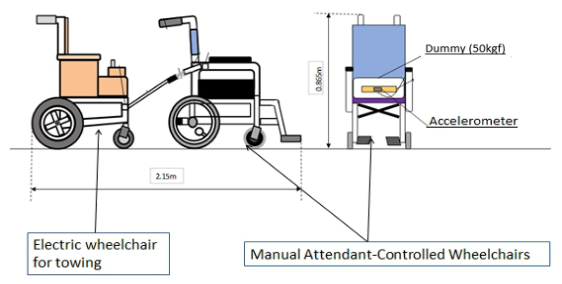
A dummy heavy object was placed on the seat of the assisted wheelchair with the vibration measurement device, and a triaxial accelerometer was attached to it. In addition, an electric wheelchair was run at a constant speed on uneven road surfaces at regular intervals. Fig. 1 shows the outline of the vibration- measuring device manufactured in this study.
Vibration Measurement The tire pressure indicators made for this study were attached to both sides of the rear wheels of the assistive wheelchair, and a 50-kgf dummy weight was placed on the seat. Acceleration in three directions, up-down, front–back and left–right, was measured by a three-axis accelerometer attached on the heavy object.
On a dummy heavy object installed in an assisting manual wheelchair
50 80 10 160 240 320
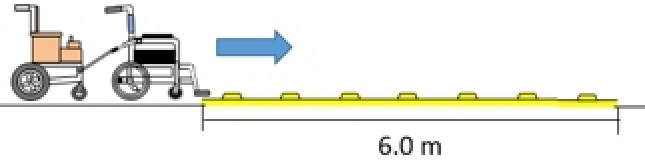
Experimental Methods The vibration-measuring device shown in Fig. 1 is run on a linear block. A linear block of 300-mm square was used. When spread, it is 6.0 m long and 0.9 m wide. The manual assistive wheelchair was pushed out by the electric wheelchair so that the traveling speed was 0.33 m/s. Fig. 2 shows the out- line of the experiment. The tire pressure of the manual assistive wheelchair was measured in four pressure conditions: 80, 160, 240, and 320 kPa. Ten trials were made for each tire pressure, totaling to 40 times. Table 1 shows the measurement pattern. The FFT analysis was performed using numerical analysis software for acceleration in three directions measured by a triax- ial accelerometer. MATLAB (MathWorks Inc., Natick, USA) was used for the numerical analysis. The maximum power spectrum, frequency at the maximum power spectrum, and integral value from the FFT-analyzed data were obtained. Then, how they change with changes in tire pressure was evaluated.
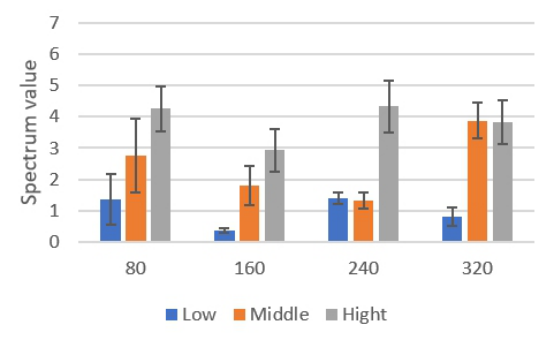
Experimental Results FFT analysis was performed on the measured acceleration data in three direc- tions: front and back, left and right, and up and down. Based on the results, comparisons between each tire air pressure and the integrated value of the power spectrum of the manual wheelchair for assistance are shown in Fig- ures 3. It can be seen that the longitudinal and vertical vibrations are larger than the horizontal vibrations. It can be seen that vibration is suppressed between 80kPa and 240kPa at low and medium speeds. In particular, 240kPa is the lowest. Conversely, at medium speeds, the vibration is strongest at 320kPa. It can be seen that at high speeds, the values remain almost the same.
About Ride Comfort Due to Differences in Running Speed 85
Figure 3: Spectrum integral value.
RIDE COMFORT EVALUATION EXPERIMENT Overview of Evaluation Experiment
The experiment involved 44 healthy subjects for the stationary evaluation and 16 subjects for the dynamic evaluation at different speeds: low (0.33 m/s), medium (0.66 m/s), and high (1.00 m/s). The semantic differential (SD) method was used for evaluation in two scenarios: stationary and motion. The common evaluation criteria in both scenarios were sitting comfort, sense of security, and buttock comfort. An additional criterion, that is, the strength of shaking, was assessed during motion. Responses were recorded on a 9-point scale ranging from −4 to +4. Four tire pressure settings were tested: 80, 160, 240, and 320 kPa.
Evaluation Method An electric wheelchair was used to maintain consistent speed while pushing the manual assistance wheelchair (Figure 1). The test track consisted of linear blocks spaced 6.0 m apart. Participants were first seated in a stationary man- ual assistive wheelchair at each tire pressure setting and then responded to a questionnaire. They then repeated the process after driving in the wheelchair, totaling 12 trials across 4 tire pressures and 3 running speeds.
Evaluation Experiment Results
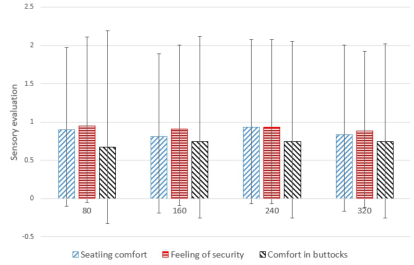
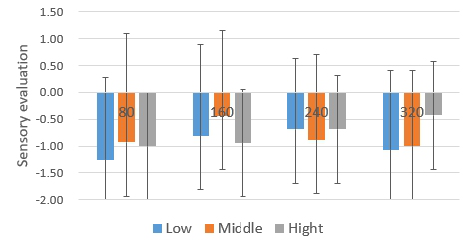
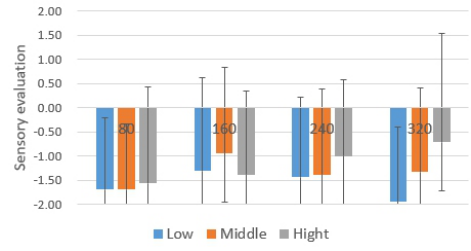
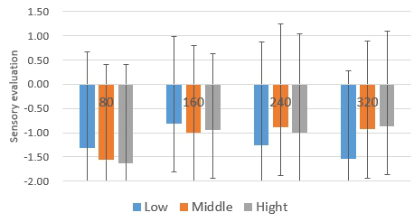
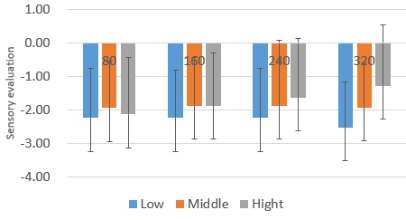
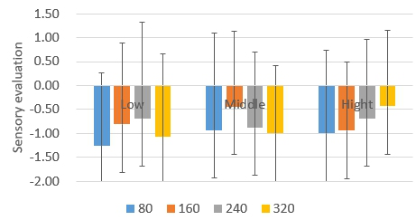
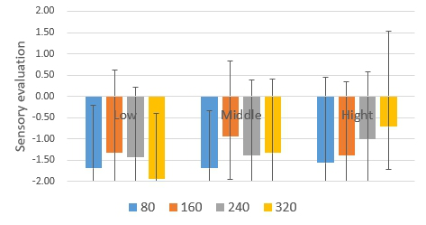
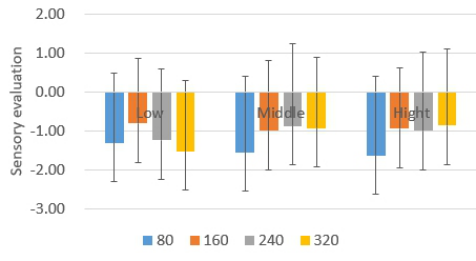
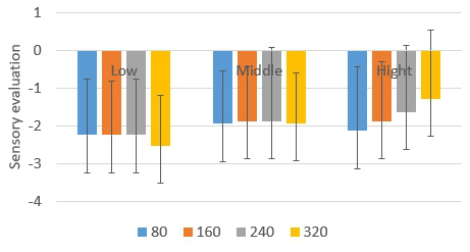
Figure 4 illustrates the impact of tire pressure on sitting comfort, sense of security, and buttock comfort when stationary, showing no significant vari- ation owing to tire pressure changes. Figures 5–8 present the outcomes for the same comfort parameters, including shaking strength, across different tire pressures at low, medium, and high speeds. Notably, at low speeds, tire pressures of 160 and 240 kPa received better evaluations than the others. At medium speeds, 160 kPa was rated as the highest. At high speeds, the evalua- tions improved with an increase in the tire pressure. Figures 9–12 detail these
comfort parameters at varying speeds for each tire pressure setting (80, 160, 240, and 320 kPa), highlighting that at high speeds, higher tire pressures are favored for better comfort.
Figure 4: Sensory evaluation when stopped.Figure 5: Sensory evaluation of seating comfort based on differences in tire air pressure.Figure 6: Sensory evaluation of feeling of security based on differences in tire air pressure.
About Ride Comfort Due to Differences in Running Speed 87
Figure 7: Sensory evaluation of comfort in buttocks based on differences in tire air pressure.Figure 8: Sensory evaluation of swing strength based on differences in tire air pressure.Figure 9: Sensory evaluation of seating comfort based on differences in running speed.Figure 10: Sensory evaluation of feeling of security based on differences in running speed.Figure 11: Sensory evaluation of comfort in buttocks based on differences in running speed.Figure 12: Sensory evaluation of swing strength based on differences in running speed.
DISCUSSION OF EXPERIMENTAL RESULTS The experiment highlighted variations in sensitivity assessments influenced by driving speed and tire air pressure. However, the limited number of par- ticipants (16) during the dynamic phase of the experiment only allowed the identification of general trends. However, in vibration analysis using FFT, the strength of vibration is stronger at higher speeds, but this trend was not observed in sensory evaluation. The resonant frequency of the human body is said to be around 5Hz in the vertical direction. The running speed this time was 4.4Hz at low speed, 8.8Hz at medium speed, and 13.3Hz at high speed, and it can be seen that the low speed is close to the resonant frequency of the human body. This is presumed to be one of the reasons. In addition to this, another possible cause is that the running distance is constant at 6m. It is thought that the longer the running time, the worse the sensory evaluation becomes. It may be necessary to consider such matters.
In this experiment, linear blocks designed for the visually impaired were used to simulate a basic uneven road surface for measurement. It is important to note that real-world conditions often present more complex challenges, including various step sizes and irregular, shorter-period vibrations. In light of these findings, future experiments should be conducted. This will involve a larger cohort of elderly individuals and people with disabilities, utilizing
About Ride Comfort Due to Differences in Running Speed 89
the SD method for sensory evaluations. The aim is to further elucidate the relationship between the tire pressure and vibration.
CONCLUSION
In this study, a manual attendant-controlled wheelchair was equipped with an air pressure indicator suitable for English-style valves to measure vibra- tions at different running speeds under controlled conditions. The results indicated that vibrations tended to increase with higher tire pressures, lead- ing to decreased ride comfort. Conversely, lower tire pressures require greater effort to push the wheelchair. Future research should focus on determining the optimal tire pressure that balances the comfort and ease of use for caregivers and assistants in various operational scenarios.
REFERENCES
Booka, Masayuki, Ikuo Yoneda, Tsutomu Hashizume, Lee Hokyoo, Hidehisa Oku, & Shoichiro Fujisawa, “Effect of pressure to physical workload at operating a manual wheelchair,” Assistive Technology, Studies in Health Technology and Informatics, Vol. 217, pp. 929–934 (2015). Cook, A. M., & Polgar, J. M., “In Cook & Hussey’s assistive technologies: Principles
and practice,” Framework for Assistive Technologies, 3rd ed., Vol. 4, pp. 34–53 (2008). Di Giovine, Carmen, Amy Darragh, Theresa Berner, & Taylor Duncan, “Research on wheelchair vibration offers consumer and clinician insight,” RESNA 2015 (2015a). Di Giovine, Carmen, Amy Darragh, Theresa Berner, & Taylor Duncan, “The effect
of whole body vibration on power wheelchair mobility: A focus group,” RESNA ANNUAL CONFERENCE 2015 (2015b). Kitazaki, S., & Griffin, M. J., “Resonance behaviour of the seated human body and effects of posture,” Journal of Biomechanics, Vol. 31, No. 2, pp. 143–149 (1998). LaPlante, Mitchell P., & H. Stephen Kaye, “Demographics and trends in wheeled
mobility equipment use and accessibility in the community,” Assistive Technology, Vol. 22, No. 1, pp. 3–17; quiz 19 (2010). Shoichiro Fujisawa, Katsuya Sato, Shin-ichi Ito, Jyunji Kawata, Jiro Morimoto, Mineo Higuchi and Masayuki Booka, On Tire Pressure and Comfort of Man- ual Attendant-Controlled Wheelchaires, Technology and Disability, Vol. 31, S28, pp. 29–30 (2019). Shoichiro Fujisawa, Katsuya Sato, Shin-ichi Ito, Jyunji Kawata, Jiro Morimoto,
Mineo Higuchi, Masayuki Booka, Effects of Tire Pressure on Wheelchairs when Riding on Uneven Ground, Proceedings of the AHFE 2020 (11th International Conference on Applied Human Fsctors and Ergonomics, Advances in Intelligent Systems and Computing (AISC) 1217, pp. 920–927 (2020). Shoichiro Fujisawa, Katsuya Sato, Shin-ichi Ito, Jyunji Kawata, Jiro Morimoto, Mineo Higuchi, Yoshio Kaji and Masayuki Booka, Manual wheelchair tire pres- sure and ride comfort when pushed by a caregiver, Proceedings of the AHFE2021, LNNS, Vol 275, pp. 1144–1151 (2021). Shoichiro Fujisawa, Kenji Sakami, Masaki Okegawa, Jyunji Kawata, Jiro Morimoto,
Yoshio Kaji, Mineo Higuchi and Shin-ichi Ito, On the stimulation and visibility by blinking light emitting block for low vision, Proceedings of the AHFE2022, pp. 1–7, (2022).
Shunsuke Jyutori, Sekiya Tada, Soma Taniguchi, Ryuya Mihara, Jyunji Kawata, Jiro Morimoto, Yoshio Kaji, Mineo Higuchi, Shoichiro Fujisawa, Toru Yamamoto and Masayuki Booka, Vibration measurement and verification of ride comfort when a manual attendant-controlled wheelchairs is running, Proceedings of the AHFE2023, Vol. 87, pp. 71–76 (2023). Wilder, D. M. L., Magnusson, J. Fenwick, & M. Pope, “The effect of posture and
seat suspension design on discomfort and back muscle fatigue during simulated truck driving,” Applied Ergonomics, Vol 25, No. 2, pp. 66–76 (1994).
LISTED IN THE AHFE DIGITAL BOOKSTORE CATALOGUE
Explore the complete digital volume
Accessibility, Assistive Technology and Digital Environments
Read this individual research paper free through the original publisher, or explore the full digital proceedings book.
ISBN 978-1-958651-97-1
Explore this ISBN in the AHFE Bookstore ↗Listed in the July 2026 bookstore catalogue; search by ISBN to confirm current availability · Digital book purchase optional