Visually impaired persons walk independently using guidance support systems such as tactile walking surface indicators and traffic lights with audio devices. Tactile walking surface indicators (TWSI’s) are the most basic guidance support system, and their installation area significantly affects the range of movement of visually impaired persons, making their role extremely important. Accidents occurring at pedestrian crossings account for a large proportion of accidents involving visually impaired persons walking independently, making appropriate mobility support necessary. Tactile walking surface indicators are effective in supporting mobility when visually impaired persons walk independently. Previous studies on the effectiveness of directional display using tactile walking surface indicators alone include Takeda et al.'s study and the authors' study on the directional display performance of attention patterns (dot shape). However, when a visually impaired person crosses a crosswalk, they are first guided to the crosswalk entrance by guiding patterns (bar shape), and then they recognize that they are near the crosswalk entrance by attention patterns. Furthermore, when a visually impaired person crosses a crosswalk, they step on the step between the sidewalk and the road with the soles of their feet to determine the direction to cross. This study aims to experimentally clarify, in light of actual installations, how the continuous arrangement of bar and dotted tactile walking surface indicators and the difference in the level of the pedestrian/vehicle boundary affect the orientation of visually impaired person at pedestrian crossings when determining their direction based on the sensation of their feet. In this experiment, we verified how accurately visually impaired people can determine their direction of travel at a crosswalk entrance based on tactile information obtained from the soles of their feet. Specifically, we conducted walking experiments using three different patterns: edge steps, attention patterns, and guiding patterns, and were able to visualize and quantify the subjects' walking trajectories using posture estimation by AI. The results suggest that adding steps in combination with guiding and attention patterns is effective.
According to a 2013 report by the Ministry of Health, Labor, and Welfare, the number of visually impaired people nationwide was estimated at 316,000 as of 2011. Furthermore, 63.8% of visually impaired individuals were aged 65 Received February 10, 2026; Revised April 3, 2026; Accepted April 17, 2026; Available online July 20, 2026
Crosswalk Mobility Support for Visually Impaired Individuals 145 or older; the number of visually impaired individuals is expected to continue to increase as society ages.
According to a survey report on the frequency of outings among visually impaired individuals, 29.3% responded “almost every day,” 29.8% “two to three times a week,” 21.9% “two to three times a month,” 10.6% “several times a year,” and 6.3% “never go out.” In contrast, the percentage of people with other physical disabilities who responded “almost every day” was 41.7% for those with hearing and speech impairments, 31.5% for those with physical disabilities, and 42.3% for those with internal disabilities. These findings indicate that visually impaired individuals go out less frequently than those with other physical disabilities. Furthermore, 32% of visually impaired individuals selected “feeling unsafe due to cars and other factors” as the reason for “difficulties when going out.” The percentages of people with other physical disabilities who chose this reason were 13.9% for those with hearing or speech disabilities, 25% for those with physical disabilities, and 12.9% for those with internal disabilities, demonstrating an overwhelmingly higher proportion among visually impaired individuals. Furthermore, the percentage of visually impaired individuals was highest in the categories “inconvenience of using transportation” and “difficulty in using public places,” indicating that inconvenient walking environments and infrastructure contribute to the infrequent outings of visually impaired individuals.
Serious accidents, such as traffic collisions and fatal falls from train platforms, have occurred. In light of this situation, various research and development efforts are underway on guidance support systems for visually impaired individuals to ensure their safe mobility. Independent walking for visually impaired individuals, especially those who are completely blind, depends on using a white cane to detect surrounding obstacles. To support walking, guidance systems such as tactile walking surface indicators (TWSIs) and acoustic and tactile signals at pedestrian traffic lights installed at crosswalk entrances to indicate safe crossing directions are becoming widespread. Among these, tactile paving blocks for the visually impaired are the most basic guidance support system that requires no electricity, and their installation location greatly impacts the mobility of visually impaired individuals, making their role extremely important. However, there is no standardized method for installing blocks in Japan or worldwide, resulting in many instances of incorrect installation. In addition, there are many cases of dangerous or unnecessary installations or installations that create barriers for wheelchair users, making it difficult for visually impaired individuals to navigate around using TWSIs, leading to accidents and disorientation. In particular, most accidents occur at crosswalk entrances, highlighting the need for appropriate mobility support.
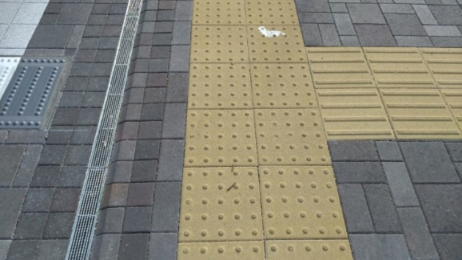
SIGNIFICANCE AND OBJECTIVES OF THE STUDY As shown in Figure 1, the two types of TWSIs include a guide block with linear protrusions and an attention/warning block with dot protrusions. Figure 2 shows an example of a crosswalk entrance with a 2 cm step at the
boundary between the sidewalk and roadway. Attention/warning blocks (dot blocks) are placed 30 cm back from the boundary step. Visually impaired individuals are guided to the crosswalk entrance by directional (linear) blocks and identify the entrance using attention-seeking blocks. The directions of the linear guide blocks and the dotted blocks enable visually impaired individuals to determine the direction to cross the roadway using their feet. Furthermore, the height difference from the roadway allows them to determine the direction to precede perpendicular to the roadway.
(a) (b)
Figure 1: Two types of tactile walking surface indicators (TWSIs). a) Guide block with linear protrusions (bar shape). b) Attention/warning block with dot protrusions (dot shape).
Article 9 (Parts of Sidewalks, Connecting to Crosswalks) of the Ministry Ordinance Establishing Standards for Road Structure Necessary for Facilitating Mobility (Ministry of Land, Infrastructure, Transport and Tourism Ordinance No. 116, December 19, 2006) provides that the edges of sidewalk sections connecting to crosswalks shall be elevated above the roadway, with a standard step height of 2 cm. In addition, sidewalks and other areas connecting to the steps mentioned in paragraph 2 must be designed to allow wheelchair users to turn around smoothly. However, steps pose an obstacle for wheelchair users, creating a trade-off. This is a recommendation- level standard, not a specification-level one. Furthermore, the Guidelines for Improved Road Mobility recommend a setback of 30 cm from the edge of the sidewalk and roadway.
Braille blocks effectively support the mobility of visually impaired individuals walking alone. Accidents frequently occur at crosswalks, making them particularly important for mobility assistance. This study aimed to experimentally clarify, through actual installations, how the continuous arrangement of linear and dotted blocks and the step-height difference at the boundary between the sidewalk and roadway affect the orientation of visually impaired individuals when determining direction based on foot sensation at a crosswalk entrance.
Figure 2: Example of tactile walking surface indicators installed at a pedestrian crossing.
EXPERIMENTAL METHOD AND RESULTS Measuring the Walking Trajectories
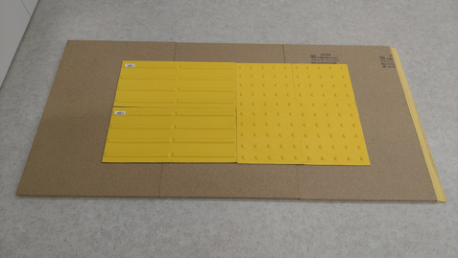
Figure 3 shows the plate used in the experiment, which simulates the TWSIs at a crosswalk entrance. The right edge of Figure 3 shows a 2 cm boundary step with the roadway. A 30 cm setback from this edge step was used to position the dot blocks. Further back, guide blocks were placed to lead pedestrians to the dot blocks at the crosswalk entrance. In this study, a walking experiment was conducted, in which ten able-bodied subjects crossed the crosswalk from three locations: the guide block, the attention/warning block, and the edge step. The subjects wore goggles to block their vision while walking. One walking experiment was conducted at each location.
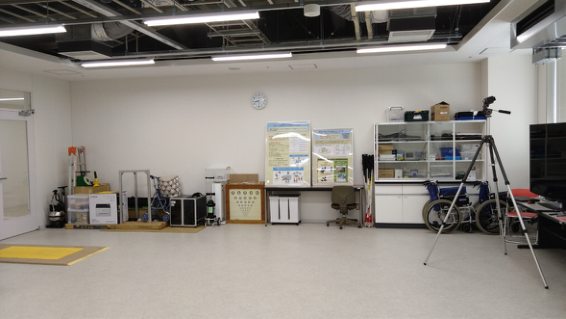
Figure 3 illustrates the experimental setup. The tactile walking surface indicator plate was positioned on the left side of Figure 4, while a video camera mounted on a tripod was installed on the right side. The video camera was positioned 5.4 m horizontally from the edge of the left tactile paving plate, at a height of 1.9 m. The subjects’ walking was videotaped. The experiment was conducted in a closed facility on the university campus, where the lighting was kept constant, and measures were taken to prevent external sounds and visual distractions.
Figure 3: The layout of the tactile walking surface indicators at the crosswalk entrance used in the experiment.Figure 4: The positions of the TWSIs and the video camera.
Walking Trajectory Analysis In recent years, artificial intelligence (AI)-based postural estimation technology has advanced significantly and is widely used for human gait analysis and movement evaluation. Representative tools, such as “OpenPose,” “MediaPipe Pose,” and “DeepLabCut,” enable noncontact, noninvasive estimation of joint positions. Fukuda et al. (2020) analyzed the walking trajectories of rehabilitation patients using “OpenPose” and demonstrated that it can quantify trajectory deviation and speed with accuracy comparable to conventional marker-based motion capture. Furthermore, quantitative indices, such as angle measurements and central-axis deviation, can be used to evaluate gait stability and directionality accurately. In this study, we employed the “PoseMeasure” method to capture walking trajectories in 2D coordinates and calculate the deviation angle of the travel direction between the start and end points. This AI technology effectively evaluates the walking behavior of visually impaired individuals and is expected to be applied to walking assist devices in the future. Recorded video data were analyzed using the AI posture estimation software “OpenMeasure.” Focusing specifically on head position data, we quantitatively determined the direction of travel and its deviation during walking.
The coordinates of the initial frame were translated to the origin (0, 0), and the walking trajectory was depicted in two-dimensional space, with the Y axis representing the forward direction and the X axis representing the left-right direction. The accuracy of the direction of travel was quantitatively evaluated by the deviation angle θ (in degrees) between the “straight line connecting the start and end points of walking” and the “Y axis.” This was used as an index reflecting the deviation between the subject’s intended and actual walking directions.
Walking Trajectory Results
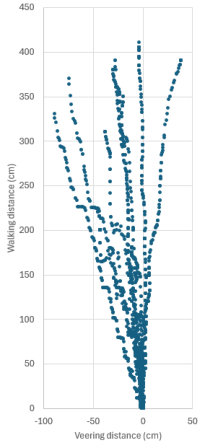
Figure 5 shows the subject’s “nose coordinates (Nose_2D_X, Nose_2D_Y)” extracted from each frame of video footage of the subject walking at three
Crosswalk Mobility Support for Visually Impaired Individuals 149 locations: (1) a guidance (linear) block, (2) a caution (point) block, and (3) a step at the sidewalk/vehicle boundary. These coordinates were then recorded as a walking trajectory. The coordinates of the initial frame were translated to the origin (0,0), and the walking trajectory was represented in two dimensions, with the Y axis defined as the forward direction and the X axis as the left/right direction.
⓵ Bar shape ⓶ Dot shape ⓷ Edge steps
Figure 5: The walking trajectory.
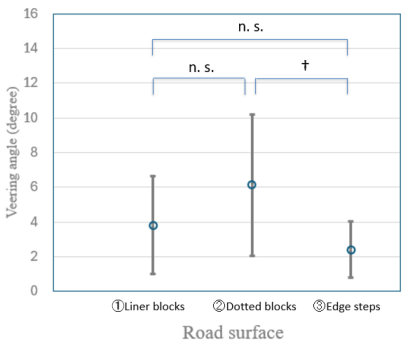
Figure 6 shows the average deviation angle from each of the three locations: (1) a guidance (bar) block, (2) an attention/warning (dot) block, and (3) a step at the sidewalk/vehicle boundary. Edge steps had the smallest mean deviation angle (2.42°) and the lowest standard deviation (1.63°) compared to the guide and linear blocks, demonstrating their effectiveness as indicators of travel direction. While the attention/warning blocks (dot blocks) were somewhat effective at recognizing direction, they exhibited a large mean deviation angle of 6.13° and a high standard deviation of 4.08°, resulting in substantial variance. The guide blocks (bar blocks) were designed to indicate the direction of travel; however, they exhibited greater error and variance than edge steps, with a mean deviation angle of 3.82° and a standard deviation of 2.82°. Furthermore, although Tukey’s test showed a trend toward significance (p < 0.10) among the three conditions, no significant difference was observed between linear blocks and dotted patterns or between linear blocks and edge steps (Fig. 6). These findings indicate that guidance blocks (bar blocks) and attention/warning blocks (dot blocks) had nearly equivalent directional guidance capabilities, while edge steps had superior directional guidance capabilities compared to both.
Figure 6: The veering angle.
CONCLUSION
When a visually impaired person determines which way to cross at a crosswalk based on tactile information from the soles of their feet, attention/ warning blocks and guide blocks have traditionally been used to provide direction cues and facilitate orientation. However, it has been shown that edge steps possess the same directional localization ability as linear or dot- like blocks. A step height of about 2 cm is considered highly tactile in the Road Mobility Improvement Guidelines, and the experiment conducted in the current study confirmed its effectiveness. The combination of TWSIs and steps at crosswalk entrances is suggested to play an important role in helping visually impaired people accurately determine the correct direction. We hope to conduct experiments with visually impaired individuals in the future.
REFERENCES
J.M. Loomis, R.L. Klatzky, R.G. Golledge, J.G. Cicinelli, J. W. Pellegrino, P. A. Fry : Nonvisual navigation by blind and sighted: Assessment of path integration ability, Journal of Environmental Psychology: General, Vol. 122, pp. 73–91 (1993). K. Hirono, T. Miyazaki, S. Ito, K. Sato, S. Fujisawa, Research on continuity among
assistive devices for personal mobility of visually impaired persons around crossings, Assistive Technology Research Series, Vol. 35, pp. 435–436 (2014). L. Fanucci, R. Roncella, F. Iacopetti, M. Donati, A. Calabro, B. Leporini, C. Santoro: Improving Mobility of Pedestrian Visually-Impaired Users, Assistive Technology Research Series, Vol. 29, pp. 595–603 (2011). R.D. Jacobson: Cognitive mapping without sight: Four preliminary studies of spatial
learning, Journal of Environmental Psychology, Vol. 18, pp. 289–305 (1998). S. Fujisawa, T. Ishibashi, K. Sato, S. Ito, O.Sueda, Evaluation of Orientation Performance of Attention Patterns for Blind Person, Studies in Health Technology and Informatics, Vol. 242, pp. 910–917 (2017).
Crosswalk Mobility Support for Visually Impaired Individuals 151 S. J. Mason, G. E. Legge, C. S. Kallie: Variability in the Length and Frequency of
Steps of Sighted and Visually Impaired Walkers, Journal of Visual Impairment & Blindness, pp. 741–754 (2005). S. Mitani, S. Fujisaw, O. Sueda: Detection and Recognition of Tactile Walking Surface Indicators by White Cane, Proceedings of The 12th International Mobility Conference, No. C2-2, pp. 1–5 (2006). W. Crandall, J. Brabyn, B. L. Bentzen, L. Myers : Remote Infrared Signage Evaluation
for Transit Stations and Intersections, Journal of Rehabilitation Research and Development, Vol. 36, pp. 341–355 (1999).
LISTED IN THE AHFE DIGITAL BOOKSTORE CATALOGUE
Explore the complete digital volume
Accessibility, Assistive Technology and Digital Environments
Read this individual research paper free through the original publisher, or explore the full digital proceedings book.
ISBN 978-1-964867-78-6
Explore this ISBN in the AHFE Bookstore ↗Listed in the July 2026 bookstore catalogue; search by ISBN to confirm current availability · Digital book purchase optional