Akinari Tahara, Tomoyuki Inagaki, Taiki Koseki, Yuuki Hashiba, Murao Mayuko, Taeko Tanida, Teppei Osada (2026). Verification of effectiveness of Road Vibration Trough for ensuring safety of visually impaired individuals when crossing LRT tracks. In: Advances in Human Factors of Transportation. AHFE Open Access, vol. 224, pp. 510–519. https://doi.org/10.54941/ahfe1007879
Light Rail Transit (LRT) is a modern urban transportation system characterized by low noise and vibration. Unlike conventional railways, LRTs operate alongside regular traffic without crossing gates. Although the Ministry of Land, Infrastructure, Transport, and Tourism of Japan has provided guidelines for general railway crossings, standardized universal design measures for crossing LRT tracks on shared roadways have not yet been established. Consequently, each operator implemented an independent measure.Visually impaired individuals rely on acoustic signals to cross roads. However, these signals are often turned off early in the morning and at night because of noise concerns, forcing users to rely on ambient sounds and increasing the risk of crossing red lights. Advanced Pedestrian Information and Communication Systems (PICS), which utilizes mobile devices and Bluetooth, is one potential solution.Meanwhile, Road Vibration Troughs (RVTs) have been installed as tactile cues. Embedded in the pavement, it communicates signal information through vibrations, voice announcements, and LED lights. By adapting Advanced PICS technology to the pavement, assistance can be provided regardless of the user's device ownership. This tool also benefits deafblind individuals.This study aimed to identify issues surrounding LRT crossing areas and to verify the effectiveness of the RVTs. We conducted an experiment involving 20 visually impaired individuals in Japan. We established four crossing conditions by combining the presence or absence of acoustic signals and the RVTs. Each participant performed 24 crossings, which were recorded using a video camera. The usefulness of the RVT and appropriateness of the Tactile Walking Surface Indicators were demonstrated via interviews of participants.
Light Rail Transit (LRT) is a modern urban transportation system characterized by low noise and vibration, and is an excellent form of public transportation from the perspective of universal design. Unlike conventional railways, LRTs Received February 7, 2026; Revised April 10, 2026; Accepted April 24, 2026; Available online July 20, 2026
Verification of effectiveness of Road Vibration Troughs 511 have unique characteristics, such as the absence of crossing gates and the ability to operate alongside regular traffic on streets. The Ministry of Land, Infrastructure, Transport and Tourism of Japan (2024) has provided specific guidelines for assisting visually impaired individuals at general railway crossings in its “Guidelines for Promoting Easily Accessible Road.”
However, when crossing LRT tracks in shared roadway sections, pedestrians face a unique environment in which they must cross both the roadway and LRT tracks. Safety considerations in this specific context have not been adequately addressed, and standardized universal design measures have not yet been established. Consequently, each operator currently implements its own independent measures.
When crossing roads, visually impaired individuals rely on tactile walking surface indicators (TWSI) and acoustic signals to determine the safe timing and direction of crossing. Nevertheless, owing to challenges in reaching a consensus with residents regarding noise, the operation of these signals is often temporarily turned off early in the morning and at night. When the sound from the acoustic signal stops, visually impaired individuals must rely solely on ambient sounds to cross the road, which poses a risk of crossing against red lights. In this context, Advanced Pedestrian Information and Communication Systems (PICS) that utilize mobile devices to receive signal information via Bluetooth are potential solutions.
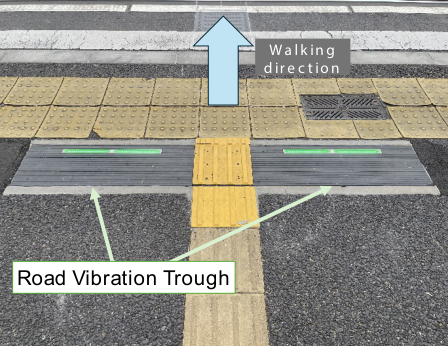
Meanwhile, Road Vibration Troughs (RVTs) (Fig. 1) that can serve as tactile cues are being installed. An RVT device is embedded in the pavement of the crossing waiting area and communicates signal information to pedestrians via vibrations. By adapting an Advanced PICS to the pavement, assistance can be provided, regardless of the user’s device ownership or operational skills. Furthermore, it serves as a road-crossing support tool that benefits not only visually impaired individuals, but also deafblinds (those with both visual and auditory impairments).
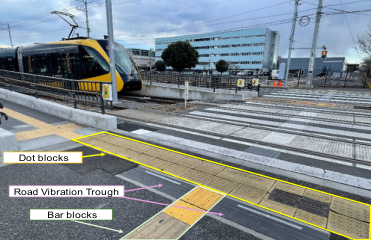
The RVT does not vibrate during the red or flashing green phases, but vibrates during the green phases. It is also equipped with functions that provide signal information through voice announcements and light emitting diodes (LEDs). RVTs were installed behind the dot blocks (on the side of the sidewalk) at the entrance of the crosswalk (Fig. 2).
This study aimed to identify issues around the crossing area connecting the LRT station and to verify the supportiveness of the RVTs by conducting walking experiments involving visually impaired individuals.
Figure 2: Enlarged view of road vibration troughs.
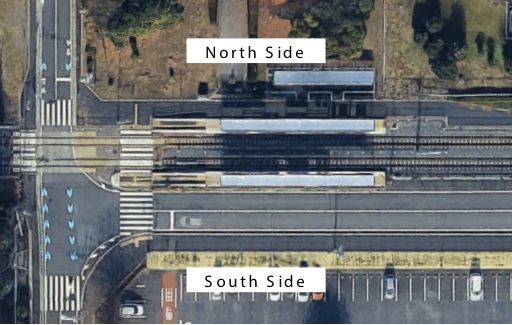
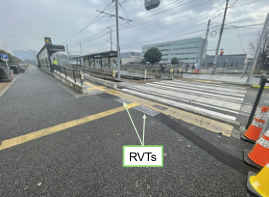
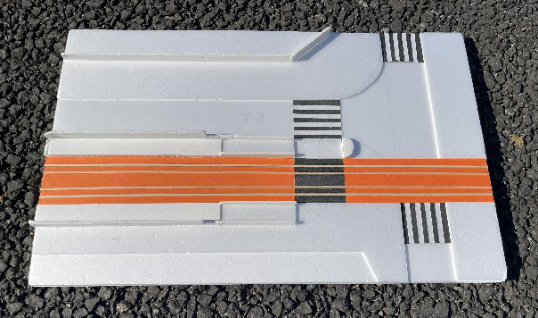
OVERVIEW OF THE EXPERIMENT The walking experiment was conducted at a crosswalk (Fig. 3) adjacent to the Seiryo High School station of the Haga Utsunomiya LRT, located in Utsunomiya City, Tochigi Prefecture. This site is structured such that pedestrians consecutively cross the roadway and dedicated LRT tracks, and is equipped with accessible pedestrian signals (acoustic signals). At the north crossing entrance (Fig. 4), the bar blocks were arranged in a single row, and delamination was observed on the dot blocks. Furthermore, because the dot blocks at the entrance were directly connected to the bar blocks of the station ramp, it was difficult for visually impaired individuals to identify the crossing center. On a traffic island (Fig. 4), the narrow width results in a high density of installed TWSI, which is expected to make spatial perception difficult. Four RVTs were installed here, with two units each on the north and south sides. The installation length of the bar blocks is insufficient for a south-crossing entrance (Fig. 4). Additionally, because the boundary between the sidewalk and roadway is curved, the dot blocks are laid out in a staggered, step-like pattern, which can hinder directional orientation. Owing to the staggered layout of the dot blocks, the RVTs were installed in an offset manner along the direction of travel.
Twenty visually impaired individuals (11 males and 9 females) walked independently and either could not see completely or had extreme difficulty seeing pedestrian signals. The mean age of participants was 62.62. According to the disability classification based on the Regulation for Enforcement of the Act on Welfare of Physically Disabled Persons, 18 participants were classified as Class 1, and two were classified as Class 2. The participants wore familiar shoes and used white canes during the experiment.
N o r t h S id e
S o u t h S id e
Figure 3: Area around seiryo high school station.
RVTs
RVTs RVTs
North Sidewalk Traffic Island South Sidewalk
Figure 4: Layout of each location.
Methods
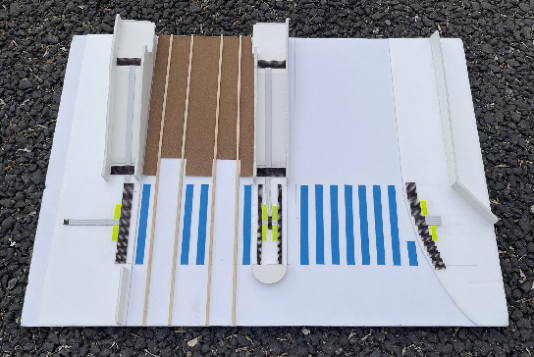
In the experiment, a total of six walking routes were set up, including round trips between the “North Station and South Sidewalk,” the “North Sidewalk and Island Station,” and the “South Sidewalk and Island Station.” In addition, we established four crossing assistance patterns by combining the presence or absence of an acoustic signal operation (Acoustic) and an RVT operation (Trough). The participants performed 24 trials covering all combinations of walking routes and crossing assistance patterns. Walking behavior was recorded using a video camera. In addition, interviews were conducted after each trial to evaluate the usefulness of the RVT and the appropriateness of TWSI configuration. Prior to the experiment, informed consent was obtained regarding the safety checklist and the handling of personal information. To ensure that the participants understood the experimental environment fully, explanations were provided using tactile kits. Two types of tactile kit were used in this study. The first was an overview kit for understanding the overall layout of the area surrounding the experimental space (Fig. 5), whereas the second was a detailed kit showing specific crossing points, such as the layout of the TWSI (Fig. 6). Moreover, an on-site explanation of the experimental space was provided, followed by a well-practiced walk.
Figure 5: Tactile kit used in the description to provide an overview of the experimental space.Figure 6: Tactile kit representing the crossing points in detail.
Evaluation Viewpoints In prior studies, experiments and interviews involving visually impaired individuals were conducted to elicit subjective evaluations to examine in greater detail the desirable position of orientation blocks relative to TWSI (Inagaki et al., 2017). Interviews were performed using a similar methodology to clarify issues related to TWSI installed both inside and outside railway crossings from the perspective of visually impaired individuals (Matsui et al., 2025). Based on these methodologies, we established interview items to verify the supportiveness of the RVT. The following items were evaluated by the participants on a seven-point scale during the trials “ease of understanding the crossing start position,” “ease of determining the crossing direction when starting to walk,” “ease of understanding the timing to start crossing,” “ease of
Verification of effectiveness of Road Vibration Troughs 515 maintaining walking direction while crossing,” “degree of feeling of relief while crossing,” “ease of understanding one’s own position on finishing the crossing,” and “ease of walking from the end of the crossing to the destination point.” In addition, following all trials, the RVT and layout of the TWSI were evaluated.
RESULTS AND DISCUSSION
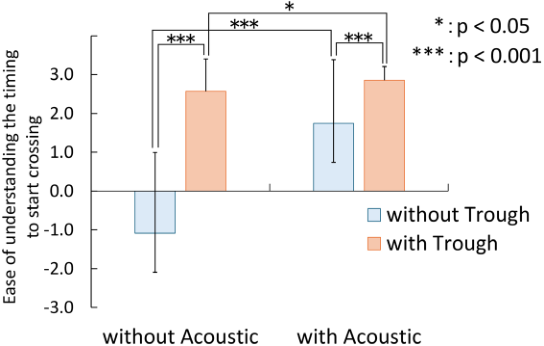
In this study, among the interview items to verify the supportiveness of the RVT, we describe the results of evaluation regarding those in which the effects were found to be significant, such as “ease of understanding the timing to start crossing,” “ease of maintaining walking direction while crossing,” and “degree of feeling of relief while crossing.” The evaluation results for the “ease of understanding the timing to start crossing” for each pattern are shown in Fig. 7. An analysis of variance (ANOVA) with “Trough” and “Acoustic” as factors revealed a main effect for “Trough” and “Acoustic” both at significance levels of 0.1%, respectively (Table 1). Furthermore, a significant interaction between “Trough” and “Acoustic” was observed. A multiple comparison using the Tukey method revealed a significant difference between without and with Trough (p < 0.001) regardless of the presence of Acoustic, as well as between without and with Acoustic (without Trough: p < 0.001, with Trough: p < 0.05) regardless of the presence of the Trough. For “without Acoustic / without Trough,” the evaluation score was negative, suggesting that judging the timing to start crossing is extremely difficult and that ambient sound alone is highly insufficient as a cue. However, when at least Acoustic or Trough was present, the evaluation scores were positive, indicating that both were effective in assisting the judgment of crossing timing.
Comparing “without Acoustic / with Trough” and “with Acoustic / with Trough” revealed that the latter received a significantly higher evaluation. Although the difference was statistically significant, it was merely 0.29 in the evaluation scores. Therefore, both patterns can be regarded as having similar high satisfaction levels. Moreover, “without Acoustic / with Trough” was rated higher than “with Acoustic / without Trough.” This is likely because the combination of the vibration and audio information provided by the RVT allows users to judge the timing to start crossing with greater confidence. Consequently, the Trough provides a higher level of support than the Acoustic, and it facilitates the judgment of crossing timing regardless of the presence of Acoustic.
Table 1: Analysis of variance results for “ease of understanding the timing to start crossing”.
Table available in the original PDF paper.
Variable df Mean Square F-Ratio Sig.
Trough 1 649.44 343.41 p < 0.001 Acoustic 1 276.82 139.05 p < 0.001
Trough*Acoustic 1 183.94 97.26 p < 0.001 Error 226 1.99 Total 455
Figure 7: Evaluation results of “ease of understanding the timing to start crossing”.
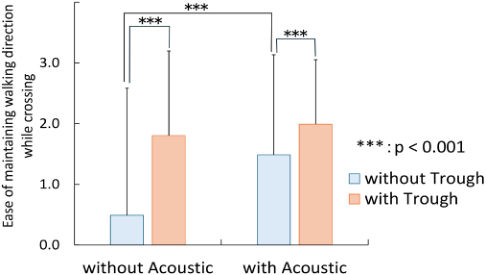
The evaluation results for the “ease of maintaining walking direction while crossing” for each pattern are shown in Fig. 8. An ANOVA with “Trough” and “Acoustic” as factors revealed a main effect for “Trough” and “Acoustic” at significance levels of 0.1% and 1%, respectively (Table 2). Furthermore, a significant interaction between “Trough” and “Acoustic” was observed. A multiple comparison using the Tukey method revealed a significant difference between without and with Trough (p < 0.001) regardless of the presence of the Acoustic, as well as the between without and with Acoustic (p < 0.001) regardless of the absence of the Trough. Both acoustic signals and the RVT contribute to the ease of maintaining direction while crossing, suggesting that participants adjust their direction using the sounds of acoustic signals and the RVT located at the end of the crossing as a cue. Comparing “without Acoustic / with Trough” and “with Acoustic / without Trough” showed that the former received a higher evaluation. Moreover, no significant difference was observed between “without Acoustic / with Trough” and “with Acoustic / with Trough,” whereas a significant difference was observed between “with Acoustic / without Trough” and “with Acoustic / with Trough.” These results indicate that the Trough provides a higher level of support than the Acoustic and sufficient support even on its own. This is likely because audio information from the RVT installed on the road surface allows for a more accurate perception of the sound source direction than the sound coming from elevated acoustic signals.
Table 2: Analysis of variance results for “ease of maintaining walking direction while crossing”.
Trough*Acoustic 1 18.60 13.65 p < 0.001 Error 225 3.65 Total 453
Figure 8: Evaluation results of “ease of maintaining walking direction while crossing”.
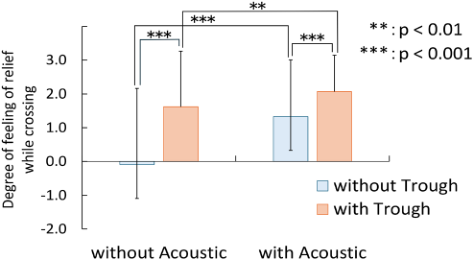
The evaluation results of the “degree of feeling of relief while crossing” for each pattern are shown in Fig. 9. An ANOVA with “Trough” and “Acoustic” as factors revealed a main effect for “Trough” and “Acoustic” both at significance levels of 0.1%, respectively (Table 3). Furthermore, a significant interaction between “Trough” and “Acoustic” was observed. A multiple comparison using the Tukey method revealed a significant difference between without and with Trough (p < 0.001) regardless of the presence of the Acoustic, as well as between without and with Acoustic regardless of the presence of the Trough (without Trough: p < 0.001, with Trough: p < 0.01).
For “without Acoustic / without Trough,” the evaluation score was negative. This is because it is difficult to check information regarding signal indications while crossing. In other words, sound information from the Acoustic or the Trough allows users to maintain awareness of the signal indications, giving them a feeling of relief while crossing. Comparing “without Acoustic / with Trough” and “with Acoustic / without Trough” showed that the former received a higher evaluation. In addition, the presence of the Trough significantly improved the evaluation, regardless of the presence of the Acoustic. Because of these two points, the Trough provides a level of feeling of relief equal to or greater than that of the Acoustic. Additionally, “with Acoustic / with Trough” received a significantly higher evaluation than “without Acoustic / with Trough,” confirming that combining the Acoustic with the Trough further improves the degree of feeling of relief. This is because the presence of multiple support tools improves the psychological feelings of relief.
Table 3: Analysis of variance results for “degree of feeling of relief while crossing”.
Table available in the original PDF paper.
Variable df Mean Square F-Ratio Sig.
Trough 1 170.26 97.85 p < 0.001 Acoustic 1 98.69 24.38 p < 0.001
Trough*Acoustic 1 26.83 15.42 p < 0.001 Error 225 4.05 Total 453
Figure 9: Evaluation results of “degree of feeling of relief while crossing”.
CONCLUSION
In this study, walking experiments involving visually impaired individuals were conducted at the crosswalk adjacent to the LRT station to verify the effectiveness of RVTs based on three interview items “ease of understanding the timing to start crossing,” “ease of maintaining direction while crossing,” and “degree of feeling of relief while crossing.” The results revealed that under “without Acoustic / without Trough,” evaluation scores for all items were low, indicating that a crossing environment dependent solely on ambient sound involves significant difficulty and anxiety. The presence of the Acoustic or the Trough was confirmed to facilitate the identification of signal phases and crossing directions, improving the degree of the feeling of relief during crossing. Moreover, it was confirmed that even when the Acoustic was present, the addition of the Trough further enhanced the level of support.
For all items, “without Acoustic / with Trough” received higher evaluation than “with Acoustic / without Trough.” The fact that the Trough was rated more highly than the Acoustic, with which visually impaired individuals are more familiar, suggests that the RVT possesses high usability. Moreover, because both “without Acoustic / with Trough” and “with Acoustic / with Trough” received high ratings with a little difference in evaluation scores, it is considered that the Trough alone provides sufficient supportiveness without Acoustic.
In the future, it will be necessary to compare subjective evaluation results to clarify the utility of the RVT for each route. Furthermore, we will analyze the walking behavior of participants recorded during the experiments to identify issues in the layout of the TWSI and objectively evaluate the utility of the RVT.
ACKNOWLEDGMENT
We would like to express our sincere gratitude to all those who provided support and cooperation in conducting this research. We also sincerely thank the participants and associated parties who generously dedicated their time to participate in this study. This study includes the results of Cross-ministerial
Verification of effectiveness of Road Vibration Troughs 519 Strategic Innovation Promotion Program (SIP) 3rd Phase, “Development of Smart Mobility Platform” promoted by Council for Science, Technology and Innovation, Cabinet Office. (Project Management Agency: New Energy and Industrial Technology Development Organization (NEDO) (Project Code JPNP23023))
REFERENCES
Ministry of Land, Infrastructure, Transport and Tourism. (2024). “Guidelines for Promoting Easily Accessible Road”. Sota Matsui, Tomoyuki Inagaki and Shoichiro Fujisawa. (2025). Subjective
Evaluation of Identifying Boundaries of Railroad Crossing by the Visually Impaired Based on Walking Experiment, Applied Human Factors and Ergonomics International, Vol. 169, pp. 59–67. Tomoyuki Inagaki, Shoichiro Fujisawa, Kazuya Takahashi, Norihiro Ikeda, Kiyohito Takeuchi, Hiroshi Ogino and Satoru Kobayakawa. (2017). Experimental observations on the optimal layout of orientation blocks for safe road crossing by the visually impaired, IATSS Research, Vol. 41, Issue 2, pp. 82–88.
LISTED IN THE AHFE DIGITAL BOOKSTORE CATALOGUE
Explore the complete digital volume
Advances in Human Factors of Transportation
Read this individual research paper free through the original publisher, or explore the full digital proceedings book.
ISBN 979-8-950676-00-0
Explore this ISBN in the AHFE Bookstore ↗Listed in the July 2026 bookstore catalogue; search by ISBN to confirm current availability · Digital book purchase optional