Tractor drivers often exposed to high-amplitude and low frequency vibrations that could impact the ride comfort. Tractor-terrain interaction emits vibrations that transmitted to the driver’s body through the seat-pan, mainly. In present study, the vibration transmissibility response (i.e. from the seat base to seat pan location) has been evaluated using Finite Element Method (FEM). Three dimensional model of the tractor seat was designed by considering the various seat elements (i.e. frame, sub-frame, cushion, Swing-arm, spring, damper, and roller) and their material properties (i.e. Density, Young’s modulus, Poisson’s Ratio) in SoildWorks 2014. Three different types of seat suspension systems of varying spring stiffness (0.3 kg/mm; 0.55 kg/mm; and 0.7 kg/mm) with damping coefficient of 1465.9 Ns/m has been considered to analyze transmissibility response. Seat cushion of Polyurethane (PU) light foam material with thickness of 54 mm; density of 68 kg/m³, seat backrest inclination of 12º with cushion thickness of 45 mm has been set uniform throughout the investigation. Vibration transmissibility responses were analyzed within the frequency range of 0-20 Hz at 0.5 m/s2 along the vertical direction. Tractor seat found to exhibit maximum transmissibility between 2 to 6 Hz frequency ranges. In addition, the seat suspension with spring stiffness of 0.55 kg/mm showed approximately 16% minimum vibration transmissibility compared to other suspension systems. In conclusion, the dominant frequency ranges found in the vicinity of natural frequency of various human body parts that may impact the ride comfort; and the spring stiffness has considerable effect on the vibration transmissibility.
Tractor has been considered as the back-bone of agricultural sector nowadays that plays an important role in carrying out on-road and off-road activities. The increase in agricultural produce demand has elevated the use of tractor and tractor mounted implements (such as plough, cultivator, harrow, rotary
Measurement and Analysis of Vibration Transmissibility Through Tractor Seat 377
tiller etc.). On the other hand, prolonged tractor driving may impact the driver’s ride comfort due to transmission of whole body vibrations into the driver’s body (Singh et al. 2019). Tractors often emit vibrations of high ampli- tude that exceeds the Directive 2002/44/EC recommended exposure action value i.e. 0.5 m/s2 (Singh et al. 2022). In addition, driver’s exposed to low- frequency vibrations that lie in the vicinity of natural frequency of various human body parts (Griffin, 2007). Long term exposure to high-amplitude and low frequency vibrations could lead to affect the ride comfort, work- performance and physical capacity, mainly (Loutridis et al. 2011). Many research studies investigated the impact of various parameters like vibration magnitude (Ciloglu et al. 2015), posture (Rakheja et al. 2010), seat backrest (Nawayseh and Griffin, 2004), etc. on the ride comfort. Some of the studies focused to improve the ride comfort by examining the seat suspension system (Velmurugan and Kumaraswamidhas, 2012), axle suspension (Lehtonen and Juhala, 2005), and shock absorbers (Deprez et al. 2005). Whereas the tire pressure (Adams et al. 2004) and forward speed (Singh et al. 2018) were also studied to investigate the ride impact. Fairley and Griffin (1986) developed a test method to predict the transmissibility of various seat by the analytical and experimental method. Kazuhiko Ohmiya (1985) conducted an experi- ment to predict the behavior of suspended and unsuspended hard pan seat for seat transmissibility and power spectral density. It has been observed that suspended seat was much effective than unsuspended in different terrain con- ditions. Jain et al. (2008) illustrated study on five different types of tractor seats with a parallelogram linkage mechanism selected to measure the design parameters. Yan et al. (2015) designed a non-linear seat suspension structure for off-road vehicles with static characteristics of seat-human system dyna- mic response. It has been found that friction was the main cause of divergence of value when the same study was done experimentally. Duke et al. (2007) conducted an experiment on non-linear suspension seat with on-off damper and conventional seat without an on-off damper. It became evident during the experiment that root-mean-square acceleration value decreased 40% due to on-off damper system. Toward and Griffin (2011) conducted experiments on 80 human subjects (different age groups) to determine whether the appa- rent mass of body affects the seat transmissibility or not. It was found that the natural resonance frequency of the human body was strongly affected by the age; and the vertical transmissibility mainly affected by the weight factor. Dewaganet al. (2015) conducted investigation on three different types of cushion material (PUV foam, contoured PUF cushion and inflated air bubble cushion) and a rigid seat with and without backrest to predict the apparent mass and vertical vibration transmissibility. It was observed that the contact surface area of human subject buttock and seat pan plays a vital role in impacting the transmissibility response. Nupur et al. (2013) carried experiments on five-seat suspensions with three different kinds of stiffness (0.3, 0.55, 0.7 kg/mm) mostly used in Indian market seat. The spring with a stiffness of 0.55 kg/mm was found to be the most effective to reduce seat transmissibility. Harsha et al. (2014) conducted experiments on 12 Indian male subjects to develop a biodynamic model in sitting posture conditions. It has become apparent that mathematical models provide the best description
Table 1. List of various components and their material properties.
Table available in the original PDF paper.
Component Material D (kg/m3) YM (GPa) PR Frame Medium carbon Steel 7850 210 0.26 Sub-frame Medium carbon Steel 7850 210 0.26 Cushion Polyurethane foam 62 .025 0.3 Swing-arm Medium carbon Steel 7850 21000 0.26 Spring Hard drawn alloy steel 7860 207 0.3 Damper Shock absorber oil 875 - - Roller Acrylonitrile butadiene styrene 913 9 0.34
(D: Density; YM: Young’s Modulus; and PR: Poisson’s Ratio
for the biodynamic response study of seated human subjects under vertical whole-body vibration.
As far as the literature reviewed, it has been found the most of rese- archers carried out investigation considering on-road vehicles on the dri- ving simulators experimentally. Limited studies were found to focus on the testing vibration exposure of agricultural tractors (Scarlet, 2007; Singh et al. 2021). However, the transmissibility response is still be very less explo- red on tractor seats considering different suspension system with varying spring stiffness. Hence, the present study has been focused to investigate the impact of three suspension systems of varying spring stiffness values (0.3 kg/mm; 0.55 kg/mm; and 0.7 kg/mm) on the vibration transmissibi- lity using Finite Element Method (FEM). It has been hypothesized that the spring stiffness will affect the transmissibility response at particular provided vibration amplitude.
METHODOLOGY
The present study has used an original tractor seat to obtain the necessary dimensional measurements. These dimensions were required to create a 3D model of the seat. Further the seat behaviour has been analyzed at particular acceleration (0.5 m/s2) within the frequency range between 0 to 20 Hz to get the vibration transmissibility response. For this, three additional seat suspen- sion systems with different spring stiffness values (0.3 kg/mm; 0.55 kg/mm; and 0.7 kg/mm) were considered. The spring stiffness value of existing seat suspension system was 0.4 kg/mm). A brief detail of the methodology has been mentioned in subsequent sections below.
Tractor Seat and Its Material Properties Tractor seat of 2014 model tractor ‘T’ of 55 horse power (HP) was used in present study for the necessary investigation. Seat consists of various compo- nents mainly: frame; sub-frame; cushion; spring-arm; spring; damper; roller; and other components to support the sitting body. Each component has own material and mechanical properties as detailed in the Table 1.
The frame has connection with sub-frame in terms of translational and revolute joint that probably reduce jerks due to moving phenomenon. Swing
Measurement and Analysis of Vibration Transmissibility Through Tractor Seat 379
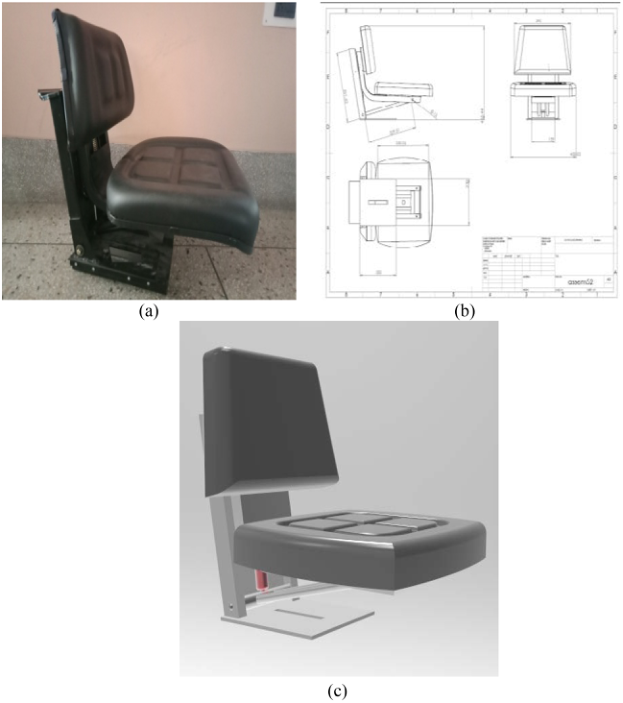
Figure 1: (a) Real Tractor seat (b) detailed drawing (c) 3-D model of Tractor seat.
arm in tractor seat has been given revolute type of join that help in attenua- ting vibrations. In addition to it, spring and damper has been connected via translational and visco-elastic joints. Whereas the roller act as a bearing betw- een frame and sub-frame using a revolute joint. On the other hand, cushion has been considered fixed that could lead to amplify or damp vibration tran- smission depending upon the type of cushion and its corresponding material properties.
Modeling of Tractor Seat All the components of real tractor seat (Figure 1(a)) were disassembled to get necessary measurement using various tools like vernier caliper, micrometer, dial-indicator etc. The entire information was used to create the detailed dra- wing (Figure 1 (b)) of tractor seat. Then a three-dimensional model of the tractor seat was created using reverse engineering technique in SolidWorks 2014.
Seat Suspension Systems In this study, three different types of seat suspension system (referred as SP1; SP2; and SP3) were considered to investigate individual impact on vibration transmissibility. Correspondingly, the spring stiffness values with respect to SP1; SP2; and SP3 was 0.3 kg/mm (K1); 0.55 (K2); and 0.7 kg/mm (K3), respectively. The spring stiffness of the existing (company fitted) used seat suspension system was 0.4 kg/mm. In addition, the damping coefficient (C1; C2; and C3) of the considered suspension systems was 1465.9 Ns/m.
Seat Cushion Polyurethane (PU) light foam cushion material with thickness of 54 mm; den- sity of 68 kg/m3; the backrest inclination (i.e. 12 degree) with thickness of 45 mm has been undertaken and set uniform throughout the analysis.
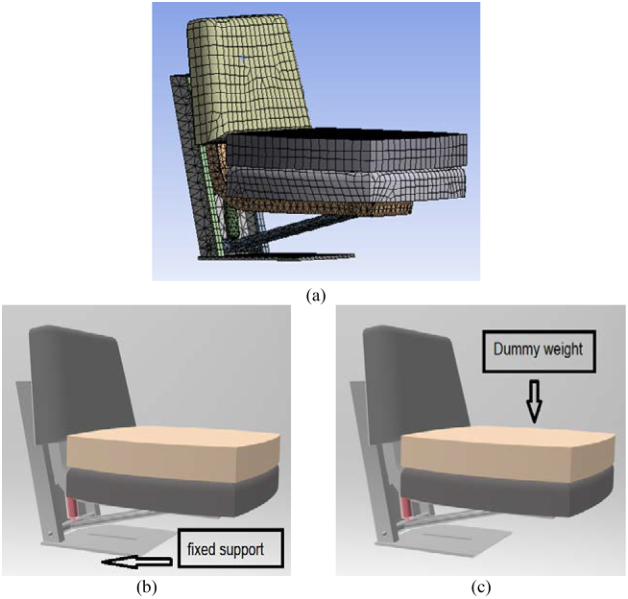
Meshing and Boundary Conditions The meshing of seat model has been done considering various element types and sizes depending upon the dimension, shape and the complexity of seat component sing Ansys 2016 (Figure 2 (a)). For example, the sections such as frame, sub-frame and swing arm with small thickness were meshed with tetrahedral element due to more stiffness and effective in complex geome- try (Gokhale et al. 2008). Total number of tetrahedral nodes and elements formed on frame, sub-frame and swing arm were 162483 and 54607 with respect to the element size of 10 mm. Seat pan and backrest cushions were relatively thicker than mild steel mechanism parts and had a less complex shape. Therefore, hexahedral element meshing was used due to less distortion at edges and less calculating time. The number of elements and nodes genera- ted on cushions and dummy weight are 117144 and 35009 respectively. The quality of mesh has been checked by comparing: Distortion, Jacobean and Volumetric Skewness values with the required ranges (Gokhale et al. 2008).
The main frame of tractor was considered fixed to the tractor chassis as shown in Figure 2 (b). Further, a dummy weight of 76 kg (360 mm x 390 mm x 60 mm); density of 7850 kg/m3 was placed on the seat pan to replicate human subject as shown in Figure 2 (b). The influence of damping due to the friction of moving components (20 Ns/m) and cushion material (150 Ns/m) was set similar throughout the transmissibility evaluation (Rakheja et al. 1994).
Excitation and Frequency Range The seat model has been given excitation amplitude of 0.5 m/s2 along the vertical direction. Excitation amplitude was considered on the basis of recom- mended exposure action value limit given by Directive 2002/44/EC. The transmissibility response was investigated between low frequency ranges 0 to 20 Hz throughout the investigation.
Measurement and Analysis of Vibration Transmissibility Through Tractor Seat 381
Figure 2: (a) Meshing of the tractor seat; (b) Fixed support of the tractor seat; (c) Dummy weight to replicate human subject sitting.Table 2. Natural frequency and deformation of tractor seat.
Table available in the original PDF paper.
Component Frequency [Hz] Deformation [mm] Seat pan base 3.4 7.3 Seat pan cushion 24.6 4.6 Seat pan cushion 25.7 3.7 Seat sub-frame 27.2 3.1 Back rest cushion 48.1 3.3 Back rest 49.6 3.0
RESULT AND DISCUSSION
Modal Analysis In the initial phase of the investigation, a modal analysis has been carried out to get the natural frequency of various seat model components. This analysis was performed considering the company fitted seat suspension system with spring stiffness value 0.4 kg/mm and damping coefficient value 1465.9 Ns/m. The natural frequency and corresponding deformation outcomes with respect to different seat components can be visualized in Table 2.
It can be observed that the seat pan showed maximum deformation at its natural frequency (3.4 Hz) i.e. 7.3 mm. It means that the lower frequencies
tend to cause maximum deformation compared to the higher frequencies. Thoung and Griffin (2011) reported low frequencies (up to 10 Hz) as the main cause of discomfort among the tractor drivers. This may be due to the existing natural frequencies of various human body parts in this range. If an external frequency coincide with the existing natural frquency then it could lead to cause maximum deflection (i.e. high exchange of energies) at that location. This might be risky for the exposed body depending upon the phase angle. Overall, it can be said that existing seat suspension with 0.4 kg/mm spring stiffness exhibited dominant natural frequency of 3.4 Hz at the seat pan.
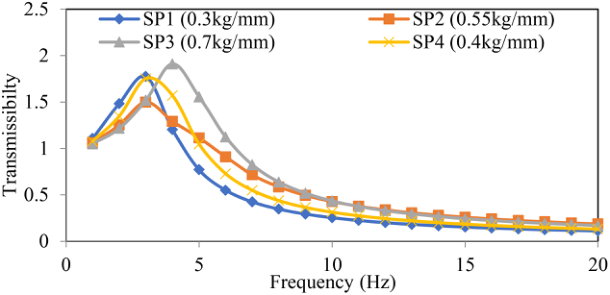
Transmissibility Response Two location i.e. seat base and seat pan were chosen to evaluate the vibration transmissibility response from the seat base towards seat pan at particular excitation of 0.5 m/s2 along the vertical axis. As discussed earlier, the present study has undertaken three additional seat suspension systems with different spring stiffness values (0.3 kg/mm, 0.55 kg/mm and 0.7 kg/mm) for the tran- smissibility evaluation. In nutshell, total of four (1 existing company fitted and 3 additional) suspension systems were analyzed. The acceleration (or excitation) of 0.5 m/s2 has been applied to the seat base and its response was obtained at the seat pan surface to get transmissibility. In case of suspension system with 0.3 kg/mm spring stiffness, the maximum transmissibility (1.77) was found at a frequency of 3 Hz as shown in Figure 3. It has been noted that the transmissibility get decreased with the increase in frequency up to 20 Hz. In addition, the maximum transmissibility (1.75) was noted at frequ- ency of 3.4 Hz with respect to suspension system having spring stiffness of 0.4 kg/mm. It can be said that the transmissibility response was 1.5% more in case of 0.44 kg/mm spring stiffness compared to suspension system of 0.3 kg/mm spring stiffness. Again the transmissibility gets decreased gradu- ally with the increase in frequency range. The spring stiffness of 0.55 kg/mm showed maximum transmissibility as 1.49 at 3 Hz and then gets down with the increase in frequency. Whereas the transmissibility response was found maximum (1.91) at 4 Hz and then get deceased, gradually. It can be obse- rved that the spring stiffness plays important role in impacting the vibration transmissibility. With the increase in spring stiffness from 0.3 to 0.55, the transmissibility responses get lower from 1.77 to 1.49. However, there has been found a sudden increase in transmissibility when the spring stiffness value changed to 0.7 kg/mm.
Validation of Study Outcomes Transmissibility response of the current study has been compared and vali- dated with the results exhibited by Nupur et al. (2013) and Adam et al. (2017). Nupur et al. (2013) carried out a study to obtain transmissibility response among tractors commonly used in India. Three different spring stiffness values i.e. 0.3 kg/mm, 0.55 kg/mm and 0.7 kg/mm were conside- red. On the other hand, Adam et al. (2017) attempted a study to evaluate
Measurement and Analysis of Vibration Transmissibility Through Tractor Seat 383
Figure 3: Transmissibility response with respect to different spring stiffness’s.
the transmissibility response in the real field conditions. Similar to the cur- rent investigation, Adam et al. (2017) found transmissibility of 1.49 between 1.25 Hz to 3.5 Hz. Nupur et al. (2013) evaluated transmissibility as 1.38 at 3.2 Hz which has been found near to current investigation. It has been also found that the transmissibility values get gradually decreased with the incre- ase in frequencies above 6 Hz in both the studies. Overall, it can be said that tractor seat exhibit maximum transmissibility at the low frequencies and the spring stiffness has considerable impact on the transmissibility.
CONCLUSION
This study investigated four different seat suspension systems with varying spring stiffness values and constant damping coefficient to obtain transmis- sibility response at seat pan along the vertical axis. It has been found that the transmissibility response tends to decrease (1.77 to 1.49) with increasing the spring stiffness (0.3 to 0.55 kg/mm). And a sudden increase in the transmis- sibility was found while investigating the suspension system with 0.7 kg/mm spring stiffness. If compared the investigated suspension systems, the system with spring stiffness of 0.55 kg/mm can be said most effective to get reduced vibration transmissibility. Overall, the transmissibility response was found to decrease with the increase in frequencies above 6 Hz. The obtained results were then compared and validated with published studies.
ACKNOWLEDGMENT
The authors would like to acknowledge The Institution of Engineers (IEI), India for providing the financial support to carry out the present study [Grant Code: RDDR2016067].
REFERENCES
Adams, B.T., Reid, J.F., Hummel, J.W., Zhang, Q. and Hoeft, R.G., 2004. Effects of central tire inflation systems on ride quality of agricultural vehicles. Journal of terramechanics, 41(4), pp. 199–207.
Ciloglu, H., Alziadeh, M., Mohany, A. and Kishawy, H., 2015. Assessment of the whole body vibration exposure and the dynamic seat comfort in passenger aircraft. International Journal of Industrial Ergonomics, 45, pp. 116–123. Deprez, K., Moshou, D. and Ramon, H., 2005. Comfort improvement of a nonlinear
suspension using global optimization and in situ measurements. Journal of sound and vibration, 284(3-5), pp. 1003–1014. Dewangan, K.N., Rakheja, S., Marcotte, P. and Shahmir, A., 2015. Effects of elastic seats on seated body apparent mass responses to vertical whole body vibration. Ergonomics, 58(7), pp. 1175–1190. Directive EU, Provisions GE. Directive 2002/44/EC of the European Parliament and
the Council of 25 June 2002 on the minimum health and safety requirements regar- ding the exposure of workers to the risks arising from physical agents (vibration) (sixteenth individual Directive within the meaning of Article 16 (1) of Directive 89/391/EEC). Official Journal of the European Communities, L. 2002; 117(13), pp. 6–7. Duke, M. and Goss, G., 2007. Investigation of tractor driver seat performance with non-linear stiffness and on–off damper. Biosystems Engineering, 96(4), pp. 477–486. Fairley, T.E. and Griffin, M.J., 1986. A test method for the prediction of seat
transmissibility (No. 860046). SAE Technical Paper. Gokhale, N.S., 2008. Practical finite element analysis. Finite to infinite. Griffin, M.J., 2007. Discomfort from feeling vehicle vibration. Vehicle System Dynamics, 45(7-8), pp. 679–698. Harsha, S.P., Desta, M., Prashanth, A.S. and Saran, V.H., 2014. Measurement and
bio-dynamic model development of seated human subjects exposed to low freque- ncy vibration environment. International Journal of Vehicle Noise and Vibration, 10(1-2), pp. 1–24. Jain, K.K., 2008. Analysis of selected tractor seats for seating dimensions in laboratory. Agricultural Engineering International: CIGR Journal, 10, pp. 1–10. Lehtonen, T.J. and Juhala, M., 2005. Predicting the ride behaviour of a suspen-
ded agricultural tractor. International Journal of Vehicle Systems Modelling and Testing, 1(1-3), pp. 131–142. Loutridis, S., Gialamas, T., Gravalos, I., Moshou, D., Kateris, D., Xyradakis, P. and Tsiropoulos, Z., 2011. A study on the effect of electronic engine speed regulator on agricultural tractor ride vibration behavior. Journal of Terramechanics, 48(2), pp. 139–147. Nawayseh, N. and Griffin, M.J., 2004. Tri-axial forces at the seat and backrest
during whole-body vertical vibration. Journal of Sound and Vibration, 277(1-2), pp. 309–326. Nupur, Y., Tewari, V.K., Thangamalar, R., Kumari, S. and Kumar, A., 2013.
Translational vibration evaluation of tractor seats for ride comfort. Agricultural Engineering International: CIGR Journal, 15(4), pp. 102–112. Ohmiya, K., 1985. Seat suspension system for improving ride comfort. Journal of the Faculty of Agriculture, Hokkaido University, 62(3), pp. 302–311. Rakheja, S., Afework, Y. and Sankar, S., 1994. An analytical and experimental inve-
stigation of the driver-seat-suspension system. Vehicle System Dynamics, 23(1), pp. 501–524. Rakheja, S., Dong, R.G., Patra, S., Boileau, P.É., Marcotte, P. and Warren, C.,
2010. Biodynamics of the human body under whole-body vibration: Synthe- sis of the reported data. International Journal of Industrial Ergonomics, 40(6), pp. 710–732.
Measurement and Analysis of Vibration Transmissibility Through Tractor Seat 385
Scarlett, A.J., Price, J.S. and Stayner, R.M., 2007. Whole-body vibration: Evaluation of emission and exposure levels arising from agricultural tractors. Journal of terramechanics, 44(1), pp. 65–73. Singh, A., Samuel, S., Singh, H., Kumar, Y. and Prakash, C., 2021. Evaluation and
Analysis of Whole-Body Vibration Exposure during Soil Tillage Operation. Safety, 7(3), pp. 1–11. Singh, A., Samuel, S., Singh, H., Singh, J., Prakash, C. and Dhabi, Y.K., 2022.
Whole Body Vibration Exposure among the Tractor Operator during Soil Til- lage Operation: An Evaluation using ISO 2631-5 Standard. Shock and Vibration, 2022. Singh, A., Singh, L.P., Singh, S., Singh, H. and Prakash, C., 2018. Investigation of occupational whole-body vibration exposure among Indian tractor drivers. International Journal of Human Factors and Ergonomics, 5(2), pp. 151–165. Singh, A., Singh, L.P., Singh, S., Singh, H., Chhuneja, N.K. and Singh, M., 2019. Eva-
luation and analysis of occupational ride comfort in rotary soil tillage operation. Measurement, 131, pp. 19–27. Thuong, O. and Griffin, M.J., 2011. The vibration discomfort of standing persons: 0.5–16-Hz fore-and-aft, lateral, and vertical vibration. Journal of sound and vibration, 330(4), pp. 816–826. Toward, M.G. and Griffin, M.J., 2011. The transmission of vertical vibration
through seats: Influence of the characteristics of the human body. Journal of Sound and Vibration, 330(26), pp. 6526–6543. Velmurugan, P., Kumaraswamidhas, L.A. and Sankaranarayanasamy, K., 2012.
Influence of road surfaces on whole body vibration for suspended cabin tractor semitrailer drivers. Journal of low frequency noise, vibration and active control, 31(2), pp. 75–84. Yan, Z., Zhu, B., Li, X. and Wang, G., 2015. Modeling and analysis of static and dynamic characteristics of nonlinear seat suspension for off-road vehicles. Shock and Vibration, pp. 1–13.
LISTED IN THE AHFE DIGITAL BOOKSTORE CATALOGUE
Explore the complete digital volume
Human Factors in Transportation
Read this individual research paper free through the original publisher, or explore the full digital proceedings book.
ISBN 978-1-958651-36-0
Explore this ISBN in the AHFE Bookstore ↗Listed in the July 2026 bookstore catalogue; search by ISBN to confirm current availability · Digital book purchase optional