Miriam Schäffer, Philipp Pomiersky, Wolfram Remlinger (2023). “Hand-Over, Move-Over, Take-Over” – HoMoTo as a Holistic Method to Analyze Take-Over Scenarios. In: Human Factors in Transportation. AHFE Open Access, vol. 95, pp. 248–260. https://doi.org/10.54941/ahfe1003810
Automated driving in Level 3 (SAE) allows the driver to temporarily devote his or her time to other activities (non-driving related activities, NDRA). If the system reaches its limits, take-overs back to Level 2 are mandatory. During the take-over phase, both the driver and the vehicle interior are in a state transition in order to regain a drivable condition. In Level 4, a complete and continuous devotion of the driver is possible and take-overs are not necessary by definition. Due to initial limited application areas, the use of Level 4 systems will initially also include take-overs. Then, the state transitions of driver and interior increase in complexity since a higher number and more variations of NDRAs are permitted. For the development and design of safe take-overs in automated vehicles, the prediction and assessment of the time required for these state transitions under different conditions, like NDRA and the associated body postures and interior adaption, is necessary. Currently, a procedure for describing and documenting the states and tasks of vehicle occupants and vehicle interior, and for the evaluation of positions and attitudes during the take-over does not exist. To close this gap, Schäffer et al. (2021) developed the method “Hand-Over, Move-Over, Take-Over” (HoMoTo). HoMoTo provides a description format of the driver's postures, movements, and cognitive states by dividing the take-over phase into subphases and subtasks. In this work, HoMoTo will be explained in detail with focus on the individual phases, steps, and influencing factors. Nevertheless, to obtain valid results further investigation of the procedure based on this work is necessary.
Automated driving means the independent driving through the vehicle system and is divided into six levels (Level 0 to 5) (SAE J3016, 2021). During automated driving in Level 3, the driver of the vehicle can temporarily devote his or her time to non-driving related activities (NDRA). If the system reaches its limits, a take-over from the vehicle back to the driver is mandatory. Level 4 allows the driver a complete and continuous devotion, as take-overs are not mandatory. Due to restricted areas of application during the introductory phase, the use of Level 4 systems will also include take-overs initially.
The take-over is a particularly sensitive state transition. For the development and design of safe take-overs in automated vehicles, the prediction and assessment of the time required for this state transition under different conditions is necessary. In the future, OEMs will have to deal with this safety-critical process in the design of every interior variant and in the further development of every driving function.
Current research analyzes mainly take-overs in Level 3 vehicles (i.a., Vogelpohl et al. 2016; Yoon et al. 2021; Jarosch and Bengler, 2019), or does not differentiate between the Levels (i.a., Zhang et al. 2019). Furthermore, it is widely assumed that the driver as well as the vehicle interior are in a drivable state in terms of their physical condition at the time of a request to take over (take-over request, TOR) (i.a., Jarosch and Bengler, 2019; Naujoks et al. 2018; Radlmayr et al. 2019). However, transition and adaption of both the driver and interior as well as take-overs in Level 4 vehicles need to be investigated in detail. Therefore, like the automated driving functions themselves, the analysis, development, and validation of these transition processes and conditions in the vehicle interior involving the driver must be able to be precisely described, simulated and digitally documented. Currently, there is no known procedure for describing and documenting the states, postures, and activities of vehicle occupants in interaction with automated driving functions. In particular, a description format for the use in computer software and in simulation procedures does not exist. Furthermore, there are no known or established procedures for the evaluation of positions, attitudes, and activities based on criteria such as time requirement, risk, interruptibility, importance, attentiveness, and cognitive, psychological or emotional stress.
Although approaches describing these transitions for all Automation Levels already exist (Marberger et al. 2017), depth of detail is currently insufficient to describe take-overs in a standardized format. Schäffer et al. (2021) expanded this approach to the method “Hand-Over, Move-Over, Take-Over”(HoMoTo). In addition to passive safety, a safe transition process from the respective NDRA is necessary for the approval of an NDRA. The required take-over time and the interior design to support a safe take-over play a decisive role in this context. Currently, a holistic approach does not exist to this demand. The method of HoMoTo presented in detail in the following aims to close this gap. HoMoTo provides a description format for the driver’s postures, movements, and cognitive states by breaking down the whole process into individual steps and tasks. On this basis, it is possible to predict the time required for the driver to take over from different occupant situations. In the long term, the principle of HoMoTo provides a basis for a standard description format for take-over scenarios.
THEORETICAL BACKGROUND Automated Driving and Current Limitations
According to SAE J3016, automated driving is divided into Levels 0 to 5. Level 0 does not provide any assistance. Level 1 and 2 are referred to driver assistance systems, since the driver is only supported in driving
the vehicle. In Level 3, the vehicle drives highly automated. During the ride, the driver has the option to devote himself or herself to NDRAs in phases. However, he or she must remain in the driving position and enable continuous readiness to take over. Complex adjustments of the interior are therefore not possible. If the system reaches its limits, the vehicle requests the driver to stop the current activity and take over within a defined time window.
In Level 4, by definition, no take-over is required unless the driver requests it. The system always guarantees a safe state. The driver can devote himself or herself completely and persistently to other activities throughout the trip, including leaving the driver’s seat unoccupied. Complete automation is achieved in Level 5. The driver becomes a passenger and can no longer intervene in the driving action.
Despite ensuring a permanently safe condition, the use of Level 4 systems will probably remain restricted to routes with manageable complexity (e.g., highways) for a longer introductory phase. When leaving the highway for a route of lower category but higher complexity, a driver take-over back to Level 2 is required. Leaving a route that is suitable for Level 4 and, consequently, continue driving in the manual mode may seem opportune for time reasons (e.g., a route change due to traffic jam avoidance to save time). Then, a take-over comparable to the procedure in Level 3 occurs. Due to the higher number and more variations of NDRAs, body postures, and interior adaptions permitted, take-overs in Level 4 will be more complex and extensive. Nevertheless, longer lead times for these take-overs are expected in Level 4 than in Level 3.
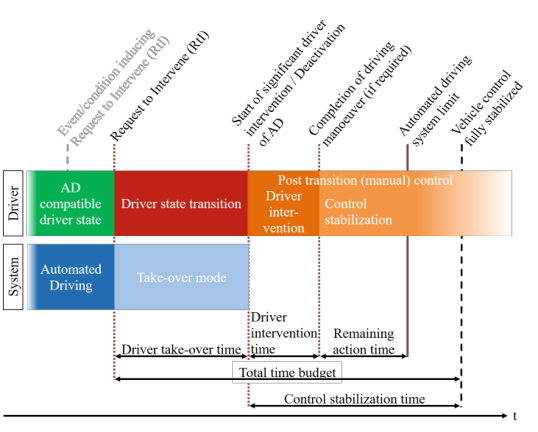
Take-Over Process Model Currently, approaches to describe and predict these take-over procedures already exist (Marberger et al. 2017; Damböck, 2013; Gold, 2016), whereas the process model of Marberger et al. (2017) is used as a basis for the development of the HoMoTo method. The authors serve a comprehensive conceptual framework that describes the take-over phase through the transition processes of the driver and the vehicle system running in parallel, each consisting of individual steps running sequentially (see Fig. 1). The aim of the model is to define time windows and to specify the corresponding start/end conditions.
In the initial situation, driver and system are in state of automated driving. When the systems requests to take over the driving task, both system and human merge into a state of transition in order to reach a drivable constitution. The driver state during automated driving mainly depends on the activated Automation Level, and therefore, on the performance limits of the system. Accordingly, the state of the system in the take-over mode depends on the performance of the system. However, in general the system remains in the automated driving mode until the driver takes over. The duration of the state transition represents the time budget available for the driver until intervening into the system is mandatory. Then, the driver deactivates the automated driving, gains control stabilization, and takes over.
“Hand-Over, Move-Over, Take-Over” 251
Figure 1: System-initiated transition model from automated to manual driving (Marberger et al. 2017).
According to Marberger et al. (2017), the type of current NDRA influences the sensory, motoric, and cognitive state of the driver resulting into the current driver state. During the transition process, the driver adapts his or her current state to the target state to be able to take over. According to his or her arousal levels and motivational conditions, different take-over paths are possible. The state transition process of the driver can be divided by relevant points in time. These include interrupting and finishing the NDRA, beginning of reorientation, gazing on the road, and putting hands on the steering wheel and feet on the pedals, respectively. Derived external factors influencing the transition process are the NDRA, driver characteristics, and the TOR.
Factors Influencing the Take-Over Since the variability and complexity of possible NDRAs in Level 4 will increase, the complexity of the associated take-overs will increase as well. In order to apply the presented model to a wide variety of scenarios, further development as well as implementation of influencing factors are required.
Currently, research investigates the variety of take-over scenarios and their influencing parameters. Different research methods and testing environments complicate the comparability of the results. Nevertheless, existing meta studies summarize e.g., determinants of the take-over time (TOT) (Zhang et al. 2019) or give an overview about the general TOT as well as about the duration until the motor and cognitive control over the vehicle in different scenarios is fully restored (Vogelpohl et al. 2016). Study results show strong influences e.g., of the NDRA on the TOT (Yoon et al. 2021). Jarosch and Bengler (2019) summarize the impact of NDRAs on the motoric, sensory, and cognitive transition during take-over and conclude the need for standardized
methods to assess the influence of NDRAs. The NDRA influences the take- over especially through the sense addressed during NDRA and through the TOR modality used. Complex body positions and the use of hand held devices extend the TOT (Jarosch and Bengler, 2019; Zhang et al. 2019). In general, the readiness of motor movements can be carried out reflexively, while the cognitive processing is impaired by e.g., the NDRA, or other factors influencing the cognitive capacities (Zeeb et al. 2015).
Additionally, the available time-budget and the criticality of the situation affects the drivers’ take-over performance (Jarosch and Bengler, 2019; Gold, 2016). The current lane, surrounding traffic density, age, and driver’s mental load influence his or her performance as it is during manual driving (Gold, 2016). Other situational conditions affect the take-over performance, like drowsiness, changes of the center of pressure in the seat and backrest, as well as the TOR (Radlmayr, 2020). The urgency of the situation (e.g., regarding the time to collision) influence the necessary TOT (Zhang et al. 2019). According to the authors, visual-only TOR showed longer TOT than vibrotactile or auditory TOR. To predict the best possible outcome of a take-over scenario and to calculate the associated TOT a holistic model considering all crucial factors is required.
The aim of the HoMoTo approach presented in the following is to develop a standardized procedure and certifiable standard to describe various possible take-over scenarios. The standard should ease OEMs to predict the TOT required and to derive design recommendations for the interior of Level 3 and 4 vehicles. Therefore, not only the take-over time but also the space needed for movements of body parts as well as for single and whole extremities is required.
Based on the research results so far, dividing the take-over phase into subphase, substeps, and individual tasks on a more granular level seems useful. The overall TOT can then calculated through summing up the time values for individual steps, whereas the subphases and tasks are running sequentially or in parallel. In order to imply all relevant factors influencing the quality and time of a take-over the “worst case” of a take-over scenario is assumed.
Current studies focus on the preparation of the driver and the actual start of the manual driving task (Take-Over phase). Some studies do not consider the phase between TOR and take-over in relation to the NDRA performed previously. It is widely assumed that the driver and the vehicle interior are already in a condition ready for take over. However, for user- oriented interior design and for safe driver take-overs the driver’s passive role must be explicitly defined and investigated since this has a decisive influence on the overall TOT (Marberger et al. 2017). The driver and the vehicle need to transform their NDRA compatible state into a state for executing the primary driving task in physical and psychological way. During this transition phase, the driver and the vehicle interior interact through e.g., interfaces,
“Hand-Over, Move-Over, Take-Over” 253
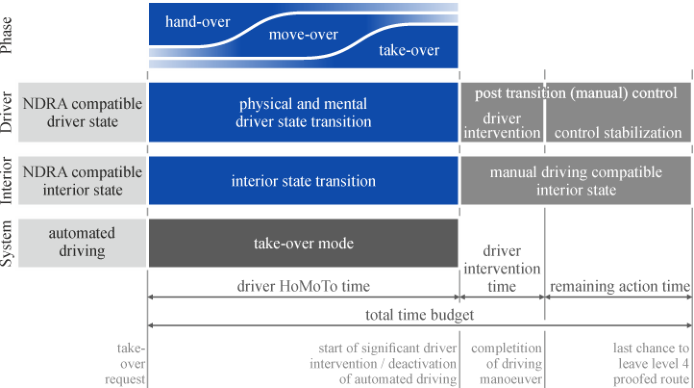
control elements, and interior components. To assess these interdependencies, HoMoTo pays special attention to handling objects (represented through Hand-Over), to the movement of extremities as well as to transforming the interior into a drivable state (Move-Over) (see Fig. 2).
Hand-Over Past research assumes that the use of hand held devices increase the TOT required as the devices need to be handed over first (Zhang et al. 2019). To allow the use of mobile devices during the driver’s passive phase, it must be possible to hand over the device to a storage position that is safe in terms of driving dynamics and safety. Therefore, the Hand-Over phase implies the termination of the NDRA including handing over items used during passive driving to the vehicle (stowing). Then, the driver picks up objects he or she needs for driving. Additionally, all items can be divided according to their belonging. Personal items are those that the driver himself or herself brings into the vehicle. E.g., in case of a TOR the driver is obliged to stow his or her book, his or her reading glasses, and to insert contact lenses, put on sunglasses, and take on shoes (see Fig. 3). Vehicle items are provided by the manufacturer and belong to the vehicle. E.g., in the future manufacturers may provide VR glasses, pillows, and blankets. After more complex NDRAs (like sleeping), the driver is obligated to store the utensils in the designated compartments. Both personal items and vehicle elements are transferred from the driver to the vehicle and vice versa during the Hand-Over procedure.
Move-Over During Move-Over the driver is obliged to establish readiness for take-over of himself or herself and of the vehicle interior. Marberger et al. (2019) divide the driver state into his or her sensory, motoric and cognitive state. According to this, the adjustment of all three states within the transition phase is required. While the motoric re-configuration relates to the human body and movements of extremities, the sensory and cognitive state relate to cognitive functions like information reception and processing, memory, awareness, and mental activities. Transferred to HoMoTo, Move-Over implies the cognitive and emotional processing or termination of the NDRA, and the physical and psychological adaptation of the driver for taking over the driving task.
Figure 2: Basis structure of HoMoTo (Schäffer et al. 2021).
Figure available in the original PDF paper.
Figure 3: Take-over scenario from NDRA “Reading a book” (Schäffer et al. 2021).
This includes shifting focus from the NDRA, regaining the environmental awareness, and restoring the sensory perception.
The motoric state during NDRA is linked to a certain body posture. These postures function as starting points and therefore determine the take-over process in particular. Yang et al. (2018) investigated the variation of non- driving postures for different NDRAs. Furthermore, Fleischer and Chen (2020) evaluated the most common sitting postures related to NDRAs during the passive drive. Research indicates a higher number and more variations of sitting postures for Level 4 than for Level 3. The physical adaption includes e.g., adjusting the posture like straighten and align the body, preparing hands (e.g., cleaning) and preparing feet (e.g., move to the pedals) (see Fig. 4). In this transition phase Hand-Over and Move-Over are coupled.
Besides the driver, the adaption and preparation of the driver’s workplace regarding geometric and informational aspects is also required. These include seat position and settings like raising the backrest, moving the seat forward, or turning the seat in driving direction (see Fig. 4). Moreover, the steering wheel, driving pedals, and further interior components are adapted regarding position and settings for driving condition (like armrests, reading light, or the information panel). Adjustment paths of interior components relating time and space are considered as well. Special situations appear when the driver’s workplace is not occupied, folded, or stored away and for dynamic interiors. Furthermore, complex NDRAs like sleeping or working require the modification and adaption of the entire interior (e.g., tilt seat backwards, prepare food with trays and holders). During Move-Over the driver is obliged to reconstruct the interior and disassemble the interior components accordingly.
Take-Over As part of the cognitive adaption, the driver regains awareness of the current traffic situation during Take-Over. Restoration of situational awareness is an important prerequisite for safely taking over and is not a singular step. Instead, the recovery of the situational awareness begins with the TOR and continues during driving manually with the largest increase during Take-Over (Pfeifer et al. 2022). According to Endsley (1995), situational awareness contains a) perception of the environment, b) comprehension, and c) prediction of the future state of the environment. Gaps in situational awareness or deviations from the real events in the traffic around the ego vehicle inevitably create a hazardous situation. Body postures that deviate from a drivable position decrease the situational awareness regarding
Figure 4: Take-over scenario from NDRA “using VR glasses” (Schäffer et al. 2021).
“Hand-Over, Move-Over, Take-Over” 255
two aspects. Both the deviation from the driver’s position in physical and psychological manner decreases situational distancing (Pfeifer et al. 2022).
Therefore, the psychological readiness is divided into two dimensions, emotional and cognitive. The emotional readiness does not affect the driving ability directly but e.g., the driving style. The conscious perception of the situation to assess and to evaluate the traffic situation prepares the driver for the cognitive readiness. Currently, Remlinger and Pomiersky (2021) are developing a Situation Awareness Management. The novel software function provides a method to determine the required situational awareness of the human driver and assists to verify, regain, and increase situation awareness. The tool aims to provide a context-adaptive, individual increase of the human’s situation awareness during a Take-Over process and an increase in functional system safety (Pfeifer et al. 2022).
HoMoTo as Expanded Take-Over Process As mentioned above not only the driver performs physical and mental state transition during take-over mode, but vehicle interior too. Since the process is characterized by interdependencies of driver and interior the approach of HoMoTo refers to the vehicle interior and to the interaction of both as well (e.g., interaction with interfaces, driving functions, or control elements) (see Fig. 5). Furthermore, Hand-Over, Move-Over, and Take-Over cannot be separated for both the driver and the interior state transition due to their fluent transition explained above.
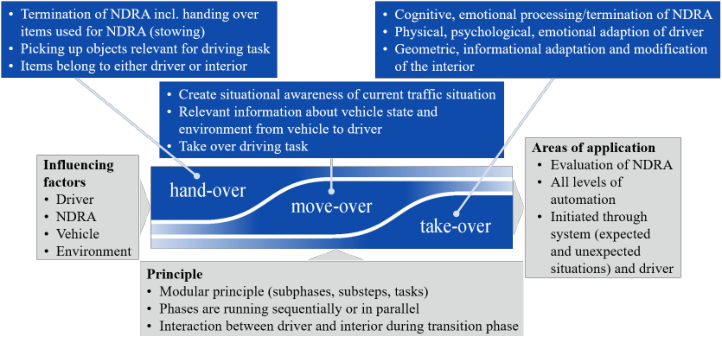
Factors Influencing HoMoTo The HoMoTo process is significantly influenced through the determinants a) driver, b) NDRA, c) vehicle, and d) environment (see Fig. 6, left). These factors affect the number, chronology, and time required of the individual
Figure 5: System-initiated expanded transition model from automated to manual driving (Schäffer et al. 2021, based on Marberger et al. 2017).Figure 6: Overview of the HoMoTo method (based on Schäffer et al. 2021).
steps. Influences of driver’s characteristics and current state have already been proven (Marberger et al. 2017). The HoMoTo approach considers driver’s traits (e.g., experience, age, personality, and anthropometry) as well as his or her condition (e.g., physical, mental, emotional, motivation, and stress). E.g., higher trust in automated systems leads to higher TOT since the driver over-trusts the system and its limits.
Since the NDRA performed affects the whole take-over process in particular, the HoMoTo approach bases on the evaluation of NDRA-specific transition scenarios. The method aims to evaluate the NDRAs concerning physical and mental stress and strain, and the quality, admissibility, and willingness to take over (e.g., interruptibility). Furthermore, for the release of NDRAs the interior design must guarantee a safe take-over. The transition of the interior as well as of the driver is influenced through e.g., vehicle geometry, the dimensional concept, storage options, and degrees of freedom. Appropriately placed storage facilities, stowage spaces, and holders can reduce the TOT. Moreover, the respective driving dynamics (accelerations) and the routing (curves, decelerations) through the automated system must allow a Hand-Over and Move-Over.
According to literature, the current traffic and environment situation (traffic density, criticality, and complexity) highly impacts the take-over quality and TOT. Therefore, HoMoTo considers e.g., traffic situation, weather, light, and sound volume.
Potential Application Areas Generally, HoMoTo applies to all Automation Levels in which the driver functions as fallback level, and intervening into the automated system is part of the use case. However, HoMoTo was developed mainly for automation Level 3 and 4.
The application of HoMoTo aims to evaluate NDRAs with regard to risk, time required, ability to interrupt, frequency and importance, mental stress, attention, and emotional stress to determine optimization potentials of the
“Hand-Over, Move-Over, Take-Over” 257
vehicle interior. HoMoTo supports deciding which activities the driver may perform during driving passively from a legal point of view and how to secure these NDRAs including their misuse. For this purpose, the OEM can use the format of HoMoTo for the description and specification of the setting variations of seats, tables, steering wheel positions, and other adjustment possibilities in the interior.
Areas of application are divided into scenarios according to system- initiated and driver-initiated TORs. System-initiated TORs occur if the system prefers to leave a route released for automated driving systems and to continue driving in the manual mode. Differences appear for the cause of leaving a route. Take-overs can be anticipated by the navigation system long before the situation arises e.g., depending on the destination set. Crucial scenarios occur in unexpected situations mentioned above e.g., to avoid a traffic jam, or when the automated system excludes certain route options or refuses to drive in sudden weather or traffic situations. The vehicle’s safety response to stop the vehicle at the next opportunity would make the trip problematic for both the passengers and other road users. This case is dependent on system settings e.g., when preferring a TOR instead of bringing the vehicle into a safe condition in cases of certain traffic scenarios. Furthermore, HoMoTo considers TOR which are initiated through the driver.
Currently, the approach does not imply situations when a critical scenario appears and the system predicts that an accident cannot be avoided. In this case, the interior supports the driver with passive safety systems to minimize the damage, as it is known in manual driven vehicles. However, as the variants of possible behavior of the occupants in case of crash arises, the OEM can use the description format of HoMoTo for the definition and documentation of the occupants for crash variants of vehicle safety.
Fig. 6 summarizes the HoMoTo method presented above including the influencing factors and areas of application.
DISCUSSION AND FURTHER DEVELOPMENT HoMoTo offers potentials for a holistic method to analyze, develop, and validate take-over processes and conditions in the vehicle interior. Since take-over scenarios represent an elementary part of the use of automated driving functions and the development speed of these functions is increasing exponentially, the establishment of a standard for interior design based on take-over scenarios is required. Therefore, the method aims to generate a standardized process and description format to describe NDRAs regarding position, posture, and state, to describe the whole take-over procedure, as well as to assess NDRAs regarding quality, admissibility, and readiness to take over. As stated above, in the field of vehicle safety the description format of HoMoTo represents a benefit as well.
For important and typical take-over scenarios a catalog should be built up that allows systematic testing and thus an objectified evaluation of the driver’s station and the interior. Existing research results regarding e.g., body postures and description formats (Yang et al. 2018; Fleischer and Chen,
2020) can be used. To determine the time required for Hand-Over, Move- Over, and Take-Over precisely, a subdivision of the phases into standardized partial actions and the determination of the time required for each sub-action is necessary. Schäffer et al. (2021) presented potentials using Methods Time Measurement (MTM) for describing physical movements on a granular level during the transition phase. In order to ensure a rapid transferability into practical application, an applicability in form of a computer-aided analysis, design, and simulation tool is aimed. Therefore, the HoMoTo approach strives for a standardized description and exchange format for a maximum compatibility with established and partly standardized methods in the field of vehicle ergonomics and scenario-based development tools of automated driving functions (e.g., RAMSIS, ASAM OpenX standards). In particular, the alignment of the method with OpenSCENARIO and OSI Open Simulation Interface within ASAM OpenX standards seems promising.
For the market launch of an automated system, sufficient safety must be demonstrated and guaranteed to users regarding NDRAs permitted and the associated take-over processes. Due to the variety of variables and influencing factors, it is not feasible to validate every take-over variant in real-life tests for reasons of time and cost. The digital validation of take-overs explained above allows many innovative vehicle concepts to be tested in the early development phase as well. Thereby, the multitude and diversity of interior situations, due to the geometric and functional variants as well as the body postures of the vehicle occupants can be described systematically, unambiguously, and reproducibly. Currently, a standardized process to prove safety for the wide variety of take-over scenarios including deviations from the desired, intended process does not exist. ISO 21448 SOTIF (2022) aims to ensure Safety of the Intended Functionality (SOTIF) through the absence of unreasonable risk due to a hazard caused by functional insufficiencies. SOTIF addresses the specification and design phase, the verification and validation phase, as well as the operation phase in order to eliminate hazards or reduce risks. Specific conditions of a scenario including reasonably foreseeable misuse can trigger hazards SOTIF aims to eliminate. The scope of application includes all Levels of Driving Automation. The transfer or expansion of SOTIF to HoMoTo or the development of a standardized process similar to the principle of SOTIF is required and needs to be investigated in order to ensure safety during NDRAs and during take-over processes. In particular, the freedom provided for performing NDRAs can be subject to misuse during automated driving. Furthermore, the guarantee of a sufficient safety for possible but reasonable variants of take-over scenarios during development is necessary.
Integrating Situation Awareness Management (Pfeifer et al. 2022) into the assessment process of HoMoTo may be suitable, but needs further investigation.
However, the current HoMoTo approach contains some limitations. Although cognitive processes influence the TOT and quality decisively, the assessment of cognitive steps and associated tasks is insufficient so far. Integrating existing cognitive or mental models into HoMoTo and adjusting these models to the driving task must be examined. HoMoTo already considers environmental factors regarding the driving task like the traffic
“Hand-Over, Move-Over, Take-Over” 259
situation. Nevertheless, interdependencies of traffic scenario and vehicle dynamics is not regarded although these may influence driver’s motion and transition. This gap may be closed by linking the approach virtually to driving simulations of the whole vehicle.
SUMMARY AND OUTLOOK The method of HoMoTo based on the transition model of Marberger et al. (2017) has already been introduced (Schäffer et al. 2021). In this work, the method and its components are explained in-depth. HoMoTo describes the state transition of both driver and vehicle interior as well as their interdependencies, and consists of phases, subphases and tasks running sequentially or in parallel. The method offers potentials for a holistic, standardizable procedure for the harmonized description, evaluation, and prediction of the large variability of possible take-over scenarios and their influencing factors. Based on these results, findings for the design of the interior can be derived. For further development of the method existing findings from research can be used in order to detail and design the individual subphases and tasks (e.g., body postures during NDRA and description formats) (Fleischer and Chen, 2020). The modular structure of the process method offers potentials for the connection with existing tools of automated driving functions, like ASAM OpenX and RAMSIS. Therefore, the transfer into digital visualization is required. The implementation of MTM into the HoMoTo method has already been shown (Schäffer et al. 2021). The challenge is to implement every crucial factor into one model and to consider interrelationships and mutual influences sufficiently. This allows to reliably and accurately predict the TOT required and to assess the take- over quality for different NDRAs and take-over scenarios. Nevertheless, further investigation is necessary in order to obtain valid results, namely the expansion of the model to secure take-overs (e.g., according to ISO 21448 SOTIF), and the integration of Situation Awareness Management (Pfeifer et al. 2022; Remlinger and Pomiersky, 2021) and existing cognitive models.
REFERENCES
Damböck, D. (2013). Automationseffekte im Fahrzeug – von der Reaktion zur Übernahme, Ph. D. dissertation, Chair of Ergonomics, Technical University of Munich, Munich. Endsley, M. R. (1995). Toward a Theory of Situation Awareness in Dynamic Systems,
Human Factors, vol. 37, pp. 32–64. Fleischer, M., Chen, S. (2020). How Do We Sit When Our Car Drives for Us?, in: Digital Human Modeling and Applications in Health, Safety, Ergonomics and Risk Management. Posture, Motion and Health, Duffy, V. G. (Ed.). Cham: Springer International Publishing, pp. 33–49. Gold, C. (2016). Modeling of Take-Over Performance in Highly Automated Vehicle
Guidance, Ph. D. dissertation, Chair of Ergonomics, Technical University of Munich, Munich. ISO 21448 SOTIF 06–2022 (2022). Road vehicles – Safety of the Intended Functionality.
Jarosch, O., Bengler, K. (2019). Is It the Duration of the Ride or the Non-driving Related Task? What Affects Take-Over Performance in Conditional Automated Driving?, in: Proceedings of the 20th Congress of the International Ergonomics Association (IEA 2018), Bagnara, S., Tartaglia, R., Albolino, S., Alexander, T., Fujita, Y. (Eds.). Cham: Springer International Publishing, pp. 512–523. Marberger, C., Mielenz, H., Naujoks, F., Radlmayr, J., Bengler, K., Wandtner, B.
(2017). Understanding and Applying the Concept of “Driver Availability” in Automated Driving, 8th Conference on Applied Human Factors and Ergonomics, pp. 595–605. Naujoks, F., Befelein, D., Wiedemann, K., Neukum, A. (2018). A Review of Nondriving-related Tasks Used in Studies on Automated Driving, in: Advances in Human Aspects of Transportation, Stanton, Neville A. (Ed.). Cham: Springer International Publishing, pp. 525–537. Pfeifer, C., Pomiersky, P., Remlinger, W. (2022). Situation Awareness Management
for Driver Take Over from Level 4, in: 22. Internationales Stuttgarter Symposium. Proceedings, Bargende, M., Reuss, HC., Wagner A. (Eds.). Wiesbaden: Springer Vieweg, pp. 101–111. Radlmayr, J. (2020). Take-over Performance in Conditionally Automated Driving: Effects of the Driver State and the Human-Machine-Interface, Ph. D. dissertation, Chair of Ergonomics, Technical University of Munich, Munich. Radlmayr, J., Fischer, F. M., Bengler, K. (2019). The Influence of Non-driving Related
Tasks on Driver Availability in the Context of Conditionally Automated Driving, in: Proceedings of the 20th Congress of the International Ergonomics Association (IEA 2018), Bagnara, S., Tartaglia, R., Albolino, S., Alexander, T., Fujita, Y. (Eds.). Cham: Springer International Publishing, pp. 295–304. Remlinger, W., Pomiersky, P. (2021). Fahrassistenzsystem für ein automatisiert fahrbares Fahrzeug und computerimplementiertes Verfahren zum Assistieren eines Fahrers eines automatisiert fahrbaren Fahrzeugs, Germany DE 10 2021 209 251, still unpublished patent. SAE J3016 (2021). Taxonomy and Definitions for Terms Related to Driving
Automation Systems for On-Road Motor Vehicles. Warrendale, PA, United States. Schäffer, M., Pomiersky, P., Remlinger, W. (2021). Hand Over, Move Over, Take Over – What Automotive Developers Have to Consider Furthermore for Driver’s Take-Over, in: Automatisiertes Fahren 2021, Bertram, T. (Ed.). Wiesbaden: Springer Vieweg, pp. 127–142. Vogelpohl, T., Vollrath, M., Kühn, M., Hummel, T., Gehlert, T. (2016). Übergabe
von hochautomatisiertem Fahren zu manueller Steuerung. Berlin: GDV. Yang, Y., Klinkner, J. N., Bengler, K. (2018). How Will the Driver Sit in an Automated Vehicle? – The Qualitative and Quantitative Descriptions of Non-Driving Postures (NDPs) When Non-Driving-Related-Tasks (NDRTs) Are Conducted, Proceedings of the 20th Congress of the International Ergonomics Association (IEA 2018), pp. 409–420. Yoon, S. H., Lee, S. C., Ji, Y. G. (2021). Modeling Takeover Time Based on
Non-Driving-Related Task Attributes in Highly Automated Driving, Applied Ergonomics, vol. 92. Zeeb, K., Buchner, A., Schrauf, M. (2015). What determines the take-over time? An integrated model approach of driver take-over after automated driving, Accident Analysis and Prevention, vol. 78, pp. 212–221. Zhang, B., de Winter, J., Varotto, S. F., Happee, R., Martens, M. (2019).
Determinants of take-over time from automated driving: A meta-analysis of 129 studies, Transportation Research Part F: Traffic Psychology and Behaviour, vol. 64, pp. 285–307.
LISTED IN THE AHFE DIGITAL BOOKSTORE CATALOGUE
Explore the complete digital volume
Human Factors in Transportation
Read this individual research paper free through the original publisher, or explore the full digital proceedings book.
ISBN 978-1-958651-71-1
Explore this ISBN in the AHFE Bookstore ↗Listed in the July 2026 bookstore catalogue; search by ISBN to confirm current availability · Digital book purchase optional