Catarina Carreto, Rui Carreto (2022). Design as an enhancer of the circular economy in fashion. In: Human Factors for Apparel and Textile Engineering. AHFE Open Access, vol. 32, pp. 106–112. https://doi.org/10.54941/ahfe1001544
1 CIAUD, Centro de Investigação em Arquitetura, Urbanismo e Design Faculdade de Arquitetura, Universidade de Lisboa Rua Sá Nogueira, Polo Universitário, Alto da Ajuda, 1349-063, Lisboa, Portugal ↗
2 Escola Superior de Tecnologia e Gestão de Viseu, Instituto Politécnico de Viseu, Campus Politécnico, 3504-510 Viseu, Portugal ↗
This article aims to address new territories of influence, whose theme of circular economy inspired the territory of design. Circular economy is a concept based on the operationalization of the reduction, reuse, recovery and recycling of products, materials and energy. The linear process that defined fashion's end of life gave way to new models and circular flows of reuse, where design has an important role to play. The emerging theories of circular design are based on the same principles, promoting a sustainable future and whose project methodology already addressed.We can see that these principles are portrayed in an initiatory way in the project methodologies disseminated in school manuals. Perhaps the little depth of the phases that make up the methodology make these “new” innovative approaches appear. In our view, circular design is a reinterpretation of the project method-ology. The design thinking is verified as a fundamental mental process of the methodology, whose lack of knowledge about the specific knowledge of this theme leads to the emergence of parallel lines or new approaches that divide and highlight certain moments of the methodology to the detriment of others.With this investigation it is our intention to clarify concepts and ways of acting. Demonstrate graphic models that show that circular design is already applied in the analysis of the project methodology, both in the macro structure and in the micro structure.We can say that design is verified by the usability of the products but assuming that there is a new applicability, the strategic. Thus, design must be more globally involved in the creation of new products, overcoming the death of objects in their functionality. We are considering a new sustainability territory that reinterprets planned obsolescence in fashion.
Despite the diversity of paths and players in the construction of Modern Design, all ended up competing for the same purpose and setting a new course. Design associates art and technique, based on a particular articula- tion of art with industry, a process that has gone through several stages until today. As a discipline, it developed from a new social thinking, supported
Design as an Enhancer of the Circular Economy in Fashion 107
by problem solving, for the design and mass production, with a view to expanding access to products and services. This massification of products was created according to a linear economy based on a short life cycle and waste of objects (take, make, use and dispose).
In 1929, the Great Depression accelerated the industrialization process and, in an attempt to stimulate the economy, designers began to design new products based on programmed obsolescence, which today still occurs in many products, especially electronics. Since then, the consequent concerns about the sustainability of the planet, in terms of resources, waste, conta- mination of land and water, lack of reuse, recycling and reuse threaten the viability of human beings. In an attempt to respond to this problem, in the 1980s, new processes based on the life cycle of products began to develop and the first circular economy models were introduced, with the main concerns of recycling and the extinction of waste or pollutants (Egenhoefer, 2018). Seve- ral models have been discussed and developed, integrating the design right at the beginning of the chain’s circularity. This is one of the most important requirements for the development of the circular economy.
DESIGN AND CIRCULAR ECONOMY The term circular economy appears with greater visibility in a publication by the Ellen MacArthur Foundation, when the sailor Ellen MacArthur deci- des to dedicate herself to environmental causes and the investigation of this theme (Ellen Macarthur Foundation, 2013). Based on hers main concerns are the preservation and increase of natural capital, the optimization of resource production and the promotion of the system’s efficiency (Ellen Macarthur Foundation, 2013). Supported on these ideals, they created a butterfly diagram for a new circular economy.
As the environmental consequences became clearer, academics and pro- fessionals began to explore alternatives to the way in which design works, new terms such as eco-design and sustainable design emerging, driven in part by Victor Papanek. Since the 1970s, Papanek has advocated that design and ecology have a very close but also complex relationship (Papanek, 1995). Papanek put design as part of the solution for a better world. “The design response must be positive and unifying; it must be the bridge be-tween human needs, culture and ecology” (Papanek, 1995, p. 31).
Lavoisier’s famous principle (1743–1794) “In Nature nothing is created, nothing is lost, everything is transformed” can be used as the basic concept of circular design. Today’s designers cannot just be concerned with the aesth- etic and functional characteristics of products. It is essential that they also think, at an ecological level, what is their destination after being used. By directing the circular economy towards product design and development, circular design has become a new method for the application of this pro- cess, having as main concerns the selection of materials, the standardization and modularization of components in product design.
Between 2012 and 2016, the RSA (Royal Society for the encourage- ment of Arts, Manufactures and Commerce) in partnership with Innovative UK, developed a project entitled “The Great Recovery Project”, where they
108 Carreto and Carreto
investigated challenges and opportunities in the design of products / services for the circular economy. This project gave rise to a report that identifies the role of design in the circular economy and provides a circular design model consisting of four distinct but complementary approaches, which will serve as the basis for our study (RSA, 2013).
In 2017, The Ellen MacArthur Foundation, in partnership with Tim Brown’s design thinking company IDEO, created the “Circular Design Guide”, covering twenty-four different design intervention methods in the circular economy, organized in four stages: understand, define, make and release. This guide combines principles of circular design with principles of design thinking, inspiring solutions for designers for a circular economy (IDEO, 2017).
DESIGN METHODOLOGY FOR A CIRCULAR ECONOMY In creating solutions, the designer is based on a project methodology that can solve the most varied types of problems. The knowledge of this methodology will allow the designer to work more effectively in the various domains of the area, with a view to exploring new disciplinary fields. In this way, design is concerned with solving the questions that are proposed. Thus, according to designer Bruce Archer (1922–2005), “The design problem results from a need” (Archer apud Munari, 2004, p. 39). The designer needs to provide a solution and use the most appropriate methodology to solve the propo- sed problem, dividing it into its components. “Dismantling a problem in its components means discovering many sub-problems”, emphasizes the desi- gner Bruno Munari (1907–1998) (Munari, 2004). “A unique design problem is a set of many sub-problems. Each of them can be solved in order to obtain a field of acceptable solutions”, said Archer (Archer apud Munari, 2004, p. 48).
In this sense, according to the interpretation of Gui Bonsiepe (b.1934): “(…) It is up to the designer to intervene in reality with design acts, overco- ming difficulties and not being content with just a critical attitude towards reality and persisting in that position. After all, designing, introducing the necessary changes, means having the predisposition to change reality without distancing it” (Bonsiepe, 2011, p. 37).
Daciano da Costa (1930–2005) points out that design acts as a “(…) hinge discipline between art and technique (…)” (Daciano apud Souto, 2009, p. 81). “All Design is geared towards an objective. Only our questions change. We no longer ask: ≪How is it?≫or ≪How does it work?≫. We are now more interested in the answer to: ≪How is it related?≫” (Papanek, 1995, p. 9).
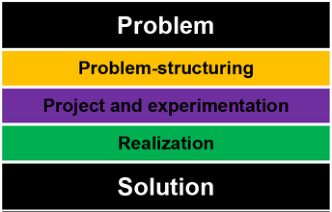
In an attempt to answer Victor Papanek’s question - “how does Design relate” - we propose a theoretical reflection, considering the circular design model proposed by RSA in partnership with Innovative UK and a design methodology created by Alexandra Lage and Suzana Dias (2002), built on the methodologies of Bruno Munari and Gui Bonsiepe. This methodology is composed of three phases in their macrostructure: problem-structuring, project and experimentation and realization.
Design as an Enhancer of the Circular Economy in Fashion 109
Figure 1: Macrostructure phases of the project methodology (Adapted from: Lage & Dias, 2002:4).
The phases of circular design are transversal to various design domains, where processes and methods are the essence of the exploration of its conce- ption. In a sequential method, the end and the beginning of circular design are ouroboros of the same equation, considered a means of renovation.
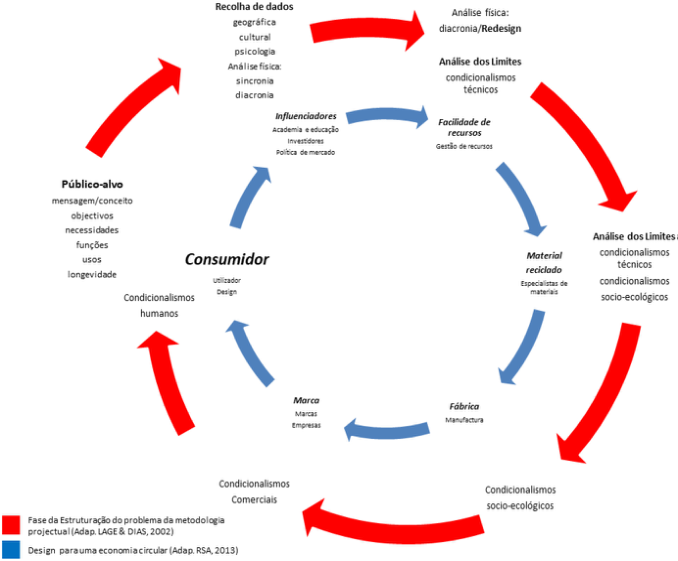
The first methodological moment of exploring and structuring the problem incorporates several similarities with circular design. If we analyze the profile of the consumer in both methodologies, their relationship is direct, since this field coexists in both. The target audience conditions and guides the tenacity and durability of the project, and it is pertinent to define the objective and the message of the project, since, in a circular orientation, the product closes the circle in the last instance if it responds to these premises initials. The functions that the product must have, in an initial phase, allow incorporating the precepts of a circular economy.
In the project, all aspects to be avoided must be listed, taking into account that handling or use problems must be considered. The lack of product understanding by the user, can lead the design to a failure. In this process, the poka-yoke system minimizes the error of use, evidently increasing the product’s longevity.
In the data collection phase, there is a parallel with the circular design process in the influencer component, which is broken down into academia and education, investors and market policies. In the project methodology, this phase is related to psychological and physical analyzes. Psychological analyzes reflect culture, history and geographical context, since culture is closely linked to academia and education. The emotional relationship betw- een design and user is based on the five senses. Factors such as noise (hearing), smell (nose), color (vision), texture (touch) and taste (taste) are essential in differentiating products on the market.
In physical analysis, synchrony and diachrony direct us towards the uni- verse of market policies and investment trends. In synchrony, the various objects with similar functions are analyzed, giving us the perception of mar- ket trends and the development of technique and economics within the same period in which it is inserted. Diachrony is a formal analysis that exempli- fies the evolution of the product from the past to the present, indicating the future and allowing us to redesign products for contemporary times. This redesign process can fit into the resource ease phase, where new techniques
110 Carreto and Carreto
Figure 2: Hybrid methodological model of circular design (Adapted from: Lage & Dias, 2002:4).
and new materials are considered in the design and rethinking of the existing product.
In another stage of project methodology, the definition and analysis of limits that can be paralleled with recycled material and production meth- ods in the circular design process are also analyzed. This fact is verified in the technical constraints, where science, with its development, will allow the adaptation of new materials and new production techniques as a project requirement. These conditions can be broken down into the profitability of materials, durability, resistance, ease of maintenance, among others. In socio- ecological constraints, there is a direct relationship with material recycling, as the policy of the 3R (recycle, reduce and reuse) and the 5R (recycle, reduce, recover, renew, reuse), such as the theories of Vitor Papanek and eco-design, gave visibility and practical application in sustainable design and social design. We can also place in this context, product life cycle that can be fully controlled with the obsolescence programmed in certain products. The time of use is pre-defined, causing the object to die at a functional level, not taking into account, many times, its reuse to preserve the environment.
Design intervenes in the circular economy through reuse and sustainable and ecological manufacturing, resulting in reduced energy and use of raw materials, avoiding waste. The commercial constraints phase is linked to the circular design in the brand phase, as services, means of distribution and com- munication campaigns are represented by the brand image as a visual unit.
Design as an Enhancer of the Circular Economy in Fashion 111
The brand can be leveraged by distribution principles that minimize economic impacts related to distribution and storage through packaging design.
A new parallelism between human constraints and consumer closes the circle of longevity and product validation. Relationships with the ergonomics of use, safety, understanding of the object and its cultural/aesthetic contex- tualization, are validated by the target audience as a true segmentation of symbolic, functional and formal value (Löbach, 2001). Economic constraints reflect the entire decision-making process, based on knowledge established on supply and demand.
The relationship between the model of circular design and the project design method-ology leads us to the analysis of the problem-structuring phase, before the project/experimentation stages (creation, project, verifica- tion) and realization. The next figure represents all phases of the problem structuring process based on the principles of design for a circular economy.
CONCLUSION
Circular design is a relatively recent theme, the result of the economic and environmental concerns of the 21st century, where design has not yet taken center stage. This article allowed us to verify that there are some pioneering studies on this theme, placing the role of design in the circular economy, still within the scope of reports and theoretical framework. For this rea- son, the relationship with the projectual methodology must be made at the problem-structuring level and the theoretical framework. As Bruno Munari said, “Removing a problem in its components means discovering many sub- problems”. Based on this analysis, we can conclude that the foundation of the project in design is much more a process of strategic management of the creative method due to the fact of its holistic character. The structuring phase of the problem already includes the premises of circular design in theoretical research. The design methodology is a more comprehensive process than the circular design process. Due to its multi, inter and transdisciplinary character, design can, due to its project methodology, be agglutinating and capable of the most varied redesigns.
ACKNOWLEDGMENT
The authors would like to acknowledge to FCT- Fundação para a Ciência e a Tecnologia, I.P. under the Strategic Project with the references UIDB/04008/2020 and UIDP/04008/2020 for founding this project.
REFERENCES
Archer apud Munari, B. (2004). Das Coisas Nascem Coisas. Lisboa: Edições 70. Bonsiepe, G. (2011) Design, Cultura e Sociedade. São Paulo: Blucher (2011) Daciano apud Souto, M. H. (2009). História do Design em Portugal I: Reflexões.
Lisboa: IADE Edições. Egenhoefer, R. (2018). Handbook of Sustainable Design. London: Routledge. Ellen Macarthur Foundation (2013). Rumo à Economia Circular: O racional de negócio para acelerar a transição. [em linha]. [Consult. 1 Junho 2017]. Disponível
112 Carreto and Carreto
em WWW: https://www.ellenmacarthurfoundation.org/assets/downloads/Rumo- a%CC%80-economia-circular_Updated_08-12-15.pdf IDEO (2017). The Design Guide. [em linha] [Consult. 1 Junho 2017]. Disponível em WWW: https://www.circulardesignguide.com/ Löbach, B. (2001). Design industrial: Bases para a configuração dos produtos
industriais. São Paulo: Editora Blucher. Munari, B. (2004). Das Coisas Nascem Coisas. Lisboa: Edições 70. Papanek, V. (1995). Arquitectura e Design: Ecologia e Ética. Lisboa: Edições 70. RSA (2013). Investigating the role of design in the circular economy. (Report 1) London: RSA.
LISTED IN THE AHFE DIGITAL BOOKSTORE CATALOGUE
Explore the complete digital volume
Human Factors for Apparel and Textile Engineering
Read this individual research paper free through the original publisher, or explore the full digital proceedings book.
ISBN 978-1-958651-08-7
Explore this ISBN in the AHFE Bookstore ↗Listed in the July 2026 bookstore catalogue; search by ISBN to confirm current availability · Digital book purchase optional