Kunal Gide, Sabrina Islam, Tilak Dutta, Shaghayegh Bagheri (2022). Design of tread patterns for use with novel composite outsole materials for slip-resistant footwear. In: Human Factors for Apparel and Textile Engineering. AHFE Open Access, vol. 32, pp. 89–93. https://doi.org/10.54941/ahfe1001542
1 Department of Mechanical Engineering George Mason University, VA 22030, USA ↗↗
2 KITE Institute, Toronto Rehabilitation Institute, University Health Network Toronto, Ontario M5S 3G9, Canada ↗
3 Department of Mechanical Engineering George Mason University, VA 22030, USA; KITE Institute, Toronto Rehabilitation Institute, University Health Network Toronto, Ontario M5S 3G9, Canada ↗
The ultimate goal of this research is to prevent fall-related injuries for workers exposed to outdoor winter conditions through the development of slip-resistant footwear based on novel composite materials and optimization of tread pattern design to retain its properties over extended use. This research will answer the following research question: how do tread pattern design features (tread depth, shape, orientation, and surface area) effect the slip-resistance of footwear with outsoles made up of a combination of novel composite and conventional materials? The objective of this project is to identify the relationship between tread pattern and slip-resistance on icy surfaces for footwear based on novel composite materials.
Fall-related injuries are five times more common in workers exposed to out- door conditions and one of the leading causes of fatalities in many industries (World health organization, 2021). In particular, in the fishing industry, falls overboard fatalities are the second leading cause of death among comme- rcial fishermen nationwide (The National Institute for Occupational Safety and Health (NIOSH), 2020). In nonfatal injuries, slips and falls account for 16% of all worker’s claims and result in more than 31 days of lost time per claim yearly (National Floor Safety Institute, 2015). The total financial burden associated with fall-related injuries has been estimated at approxi- mately $13-14 million per year in the U.S., which requires about $70 billion annually to cover compensation and medical costs associated with emplo- yee slip/fall accidents (National Floor Safety Institute, 2015). Since most falls that cause no/minor injury go unreported, these statistics are likely to underestimate the effects of falls in icy conditions on public health, perh- aps by a large margin. Ice-covered surfaces increase the risk of falls for workers exposed to outdoor winter conditions and result in a higher rate of falls during winter because of the difficulty to maintain traction on ice
(Gevitz et al., 2017; Gyllencreutz et al., 2015). Poor footwear is often iden- tified as one of the risk factors for falls in icy conditions; in particular, the lack of slip-resistant outsoles has been identified as one of the most important characteristics related to the risk of slip-and-fall incidents (Dre- bit et al., 2010). While footwear is an important part of preventing slips and falls in outdoor winter conditions, most previous standards for testing its slip-resistant properties were restricted to indoor environments. (HSE, 2019; SATRA TM144, 2011). Anti-slip footwear designed for indoor surfa- ces is not effective in outdoor conditions since the properties of the outsoles materials that enable them to maintain a good grip on indoor contaminants such as oil or water tend to have poor performance on ice (Aschan et al., 2005). To address this gap, part of our team at Toronto Rehab Institute (TRI) (Ontario, Canada) has recently developed a method called maximum achie- vable angle (MAA) that measures the steepest ice-covered sloped surface that participants can walk without having a slip in a simulated winter environ- ment, created in WinterLab (Hsu et al., 2016). Nearly all of the footwear that passes the MAA test criteria have outsoles based on novel composite materi- als (Bagheri et al., 2019; Bagheri et al., 2019). In a recent study, we found that personal support workers wearing this novel footwear reported 68% fewer slips and 78% fewer falls compared to workers wearing their own footwear (Bagheri et al., 2021). However, the composite materials these boots are based on have two limitations: 1) they lose their slip-resistance properties over as lit- tle as 100,000 steps of use (for context, it would not be unusual for someone to walk 10,000 to 20,000 steps in a single day); 2) not all footwear with these advanced materials perform well on icy surfaces due to different tread pattern designs.
Rather than relying on traditional composite-based footwear that is sen- sitive to wear, we’ve developed and patented a novel textured composite material that has better wear resistance properties than existing materi- als. (Anwer et al., 2017; Bagheri et al., 2018; Bagheri et al., 2019). Our testing demonstrated that this material was better at maintaining slip resi- stance on ice after being exposed to simulated wear compared to existing composite outsoles. In addition to its better wear resistance, our initial lab-based tests have determined that its coefficient of friction (COF) on ice is higher than the best footwear currently available on the market. (Anwer et al., 2017).
In this research, we propose using our recently developed composite mate- rial to understand the effect of four tread design features on the slip-resistance performance of composite-based winter footwear. We hypothesize that small changes in the depth and layout of these different materials can have a large impact on overall slip resistance performance. Previous work on the impact of tread design have established key principles (Li et al., 2006; Liu et al., 2013), but these design principles have never been tested with foo- twear with composite material on icy surfaces. Therefore, we propose to investigate the interaction of four tread pattern features on slip resistance of footwear on ice made of a combination of composite and conventional materials.
Design of Tread Patterns for Use with Novel Composite Outsole Materials 91
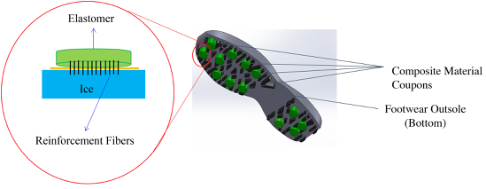
Figure 1: Schematic of outsole design incorporating composite and conventional materials.
RELATIONSHIP BETWEEN TREAD PATTERN DESIGN AND SLIP-RESISTANT PROPERTIES OF COMPOSITE-BASED FOOTWEAR We propose using our recently developed composite material to understand the effect of four tread design features on the slip-resistance performance of composite based winter footwear. We will use the Taguchi Design of Experi- ment approach to guide this research. We will develop a series of prototype footwear with outsoles made up of plugs of our composite material as well as conventional rubber. We will systematically vary the form and layout of the plugs to run our experiments. Four factors will be varied, each at three levels: plug depth, orientation, shape and surface area of the composite-based plugs in accordance with the Taguchi orthogonal array design. Plugs of com- posite materials are manufactured for each experimental run, while plugs of conventional rubber material are taken from existing footwear. Winter boots, are purchased and their existing outsoles are removed to expose the midsole. Then, plugs of our composite and conventional rubber materials are glued to the bottom of the boots to create the set of prototypes to be tested in this project (Figure 1).
Assessment of the slip-resistant properties of the prototypes and reduction in fall risk will take place at TRI in the WinterLab. Each prototype outsole will be tested with human participants in WinterLab at TRI to measure their MAA score. The MAA scores gathered through Taguchi experiments will be used to optimize each of the four control factors in our design to maximize the slip-resistance performance of the outsole. The MAA scores will be tran- sformed into signal-to-noise ratio as logarithmic transformation of the loss function using the “larger-is-better”. An Analysis of Variance (ANOVA) will be used to determine the tread design factors that have the greatest impact on the slip-resistance performance of composite-based outsoles. With the results of S/N ratio and ANOVA, the optimal combination of tread design parame- ters will be determined. The proposed approach is a general methodology to design and develop slip-resistant footwear based on our novel compo- site material. Future research should be performed to develop appropriate methodology to satisfy specific objectives and end users needs.
CONCLUSION
This research aims to prevent fall-related injuries for workers exposed to outdoor winter condition by providing guidelines to optimize tread patterns
used with footwear based on slip-resistant composite materials. The results of this project will help footwear manufacturers to develop durable slip-resistant footwear that can retain its traction on ice over an extended use.
ACKNOWLEDGMENT
The authors would like to acknowledge the funding support from National Institute of Occupational Health and Safety (NIOSH Grant# U54OH007542) and Natural Sciences and Engineering Research Council of Canada (RGPIN-2017-06655).
REFERENCES
Anwer, A., Bagheri, Z.S., Fernie, G., Dutta, T., Naguib, H.E., (2017). Evolution of the Coefficient of Friction with Surface Wear for Advanced Surface Textu- red Composites. Adv. Mater. Interfaces 4, 1600983. https://doi.org/10.1002/ad mi.201600983 Aschan, C., Hirvonen, M., Rajamäki, E., Mannelin, T., (2005). Slip resistance of
oil resistant and non-oil resistant footwear outsoles in winter conditions. Safety Science 43, 373–389. https://doi.org/10.1016/j.ssci.2005.08.001 Bagheri, ZS, Anwer, AO, Rizvi, R, Naguib, N, Dutta, T, Fernie, GR. Methods of manufacturing a high friction composite material for footwear. US Patent: 16378933. Bagheri, Z.S., Beltran, J.D., Holyoke, P., Dutta, T., (2021). Reducing fall risk for
home care workers with slip resistant winter footwear. Applied Ergonomics 90, 103230. https://doi.org/10.1016/j.apergo.2020.103230 Bagheri, Z. Shaghayegh, Patel, N., Li, Y., Morrone, K., Fernie, G., Dutta, T., (2019).
Slip resistance and wearability of safety footwear used on icy surfaces for outdoor municipal workers. WOR 62, 37–47. https://doi.org/10.3233/WOR-182840 Bagheri, Zahra Shaghayegh, Patel, N., Li, Y., Rizzi, K., Lui, K.Y.G., Holyoke, P., Fernie, G., Dutta, T., (2019). Selecting slip resistant winter footwear for personal support workers. WOR 64, 135–151. https://doi.org/10.3233/WOR-192947 Drebit, S., Shajari, S., Alamgir, H., Yu, S., Keen, D., (2010). Occupational and
environmental risk factors for falls among workers in the healthcare sector. Ergonomics 53, 525–36. https://doi.org/10.1080/00140130903528178 Gevitz, K., Madera, R., Newbern, C., Lojo, J., Johnson, C.C., 2(017.) Risk of Fall-Related Injury due to Adverse Weather Events, Philadelphia, Pennsy- lvania, 2006–2011. Public Health Rep 132, 53s–58s. https://doi.org/10.1177/ 0033354917706968 Gyllencreutz, L., Bjornstig, J., Rolfsman, E., Saveman, B.I., (2015). Outdoor pede-
strian fall-related injuries among Swedish senior citizens--injuries and preventive strategies. Scand J Caring Sci 29, 225–33. https://doi.org/10.1111/scs.12153 Health and Safety Laboratory (HSE), Grip Ratings. https://www.hsimagazine.com/ article/get-a-grip/, (2019). Hsu, J., Shaw, R., Novak, A., Li, Y., Ormerod, M., Newton, R., Dutta, T., Fernie,
G., 2016. Slip resistance of winter footwear on snow and ice measured using maximum achievable incline. Ergonomics 59, 717–728. https://doi.org/10.1080/ 00140139.2015.1084051 Li, K.W., Wu, H.H., Lin, Y.-C., (2006). The effect of shoe sole tread groove depth on the friction coefficient with different tread groove widths, floors and contaminants. Applied Ergonomics 37, 743–748. https://doi.org/10.1016/j.aper go.2005.11.007
Design of Tread Patterns for Use with Novel Composite Outsole Materials 93
Liu, L.-W., Lee, Y.H., Lin, C.J., Li, K.W., Chen, C.Y., (2013). Shoe Sole Tread Designs and Outcomes of Slipping and Falling on Slippery Floor Surfaces. PLoS ONE 8, e68989. https://doi.org/10.1371/journal.pone.0068989 National Floor Safety Institute, and Slip & Fall Quick Facts. URL https://nfsi.org/n
fsi-research/quick-facts/ SATRA TM144, (2011). Friction {Slip Resistance} of Footwear and Floorings. Bagheri, Z. S., Anwer, A.O., Fernie, G., Naguib, H.E., Dutta, T., 2019. Effects of multi-functional surface-texturing on the ice friction and abrasion characteristics of hybrid composite materials for footwear. Wear 418–419, 253–264. https://doi. org/10.1016/j.wear.2018.11.030 The National Institute for Occupational Safety and Health (NIOSH), (2020). Com-
mercial Fishing Safety - Fall Overboard. URL https://www.cdc.gov/niosh/topics/f ishing/fallsoverboard.html World health organization, (2021). Falls. URL https://www.who.int/news-room/fact -sheets/detail/falls
LISTED IN THE AHFE DIGITAL BOOKSTORE CATALOGUE
Explore the complete digital volume
Human Factors for Apparel and Textile Engineering
Read this individual research paper free through the original publisher, or explore the full digital proceedings book.
ISBN 978-1-958651-08-7
Explore this ISBN in the AHFE Bookstore ↗Listed in the July 2026 bookstore catalogue; search by ISBN to confirm current availability · Digital book purchase optional