Kwang Tae Jung, Sung Min Kim, Keyoung Jin Chun, Jae Soo Hong (2021). Design of Wearable Product for Protecting Pelvis from Falls. In: Advances in Human Aspects of Healthcare. AHFE Open Access, vol. 13. https://doi.org/10.54941/ahfe100541
The aim of this study is to design a wearable product for protecting pelvis from falls. In this product, an airbag cushion system was applied to absorb falling impact energy from falls. Korea became an ‘ageing society’ (defined as a society of more than 7% of elderly population) in 2000 and is expected to be going into an 'aged society' (more than 14% of elderly population) in 2018 and a 'super aged' (more than 20% of elderly population) in 2026. Falls can be occurred in all life-cycle. In particular old people over 65 years have more experiences of falls. The elderly have various forms of physical and mental degeneration and so they can easily meet a fall by tripping over a stone, slipping, etc. In fact, fall and slip account for 55.3 percent of all accidents in case of the elderly in Korea. Therefore, it is necessary to develop a product to prevent the elderly's injury from falls. Wearable airbag cushion system will be developed in this study and firstly its design was developed. The characteristics of elderly falls were identified from some previous studies and design requirements considering the characteristics were proposed. Finally, the design of pelvic airbag cushion system for absorbing falling impact energy was developed.
Korea became an ‘ageing society’ in 2000 and is expected to be going into an 'aged society' in 2018 and a 'super aged' in 2026. The increase in the elderly has aroused international and corporate interests and has enabled the study and development of senior-friendly products. In particular, the degradation of senior citizens' physical and cognitive abilities has underscored the necessity of ergonomic design in the development of senior-friendly products (Jung et al., 2010). The elderly stay at home most of the time because they have declined in health, but there are many risk factors in everyday life. The elderly are often exposed to the danger of accidents. In particular, fall and slip account for 55.3 percent of all accidents in case of the elderly (Korea Consumer Agency 2007). It means that the possibility of falls is very high for the elderly. In fact, because 30 to 50 percent of the elderly over 65 have experiences of fall, five percent of the fallen have trauma such as bone fracture requiring hospitalization and three quarter of people who die as fall are over 65 year old, fall is important health problem of them (Kim, 1998). A fall is often defined as “inadvertently coming to rest on the ground, floor or other lower level, excluding intentional change in position to rest in furniture, wall or other objects” (Stalenhoef et al., 2002). Falls are a common and important health issue for the elderly. Falls are not only related with physical injuries, but must be very importantly considered for the elderly's independent life. Therefore it is necessary to develop a product to prevent injuries from falls for the elderly's independent life.
ANALYSIS OF ELDERLY FALLS The characteristics of elderly falls were identified from previous studies and the results were applied in the design of a wearable product for preventing injuries from falls.
Frequency of Falls Campbell, Borrie & Spears(1989) stated that more than one-thirds of the elderly had falls in the past year. Tabbitts (1996) stated that 30 percent of the elderly had experience of fall every year. Cho(1996) stated it was 25.3% and Yoo and Lee(2009) stated 31.8%. Many researchers have studied for frequency of falls in Korea. Table 1 presents a summary of studies for falls frequency in Korea. Findings show that 30-50 percent among the elderly over 65 has experience of fall, each year. The frequency of falls increases with age and frailty level (Kim and Suh, 2010). The elderly who are living in nursing homes fall more often than those who are living in the community. Approximately 30-50% of people living in long term care institutions fall each year, and 40% of them experienced recurrent falls. About 10 per cent of falls result in serious injury (eg fractures). Falls are a leading cause of injury-related hospital admissions and deaths for the elderly. Falls can also lead to the need for residential care (Tinetti, 1987).
Table 1: Percentage of falls in Korea
Distribution By gender, elderly female had more experiences for falls than elder male (Park, 2004, Jang 2002, Cho, 1996, Yoo and Lee, 2009). For the place of the fall, Kim(2004), Mun(2005), Choi & Lee(2010), Kim & Suh (2010) stated that the elderly had more falls in the outdoor, in particular in a street. On the other hand, Eom(2006) stated that the elderly had more falls in the indoor from her analysis. This means that the elderly can meet a fall in any place. For the causes of falls, Mun(2005) stated that slip was 54.8 percent of the whole and Eom(2006) stated trip was 59.9 percent and slip was 22.5 percent. Kim and Suh(2010) stated that the elderly met most frequently a fall while walking and its percentage was 38.4. The elderly who lives alone had more experiences (51.7%) for falls than the elderly who lives with the other (26.0%) (Yoo and Lee, 2009). For season that the elderly had a fall, Jang (2002) stated that the fall occurred in summer most frequently and next spring. Yoo and Lee(2009) stated that the fall occurred in spring most frequently and next summer. Eom(2006) stated spring(29.6%), summer(26.1%), and Kim and Suh(2010) stated spring(42.3%), winter(27.9%). For the time of the fall, Eom(2006) stated the elderly had most of falls in daytime. The areas of the fracture from falls included foot, leg, and pelvis (53.5 percent of the whole) (Kim and Suh, 2010).
Characteristics of Elderly Falls From the analysis of elderly falls, some characteristics were identified. (1) Elder female have more experiences for falls than male. (2) The elderly who lives alone has higher possibility for falls. (3) Falls can be occurred in any place including the outdoor and the indoor. (4) Old people have falls more frequently in spring and summer. (5) Falls is frequently occurred in everyday life. (6) Falls is most frequently occurred while walking.
DESIGN Wearable Airbag Cushion System
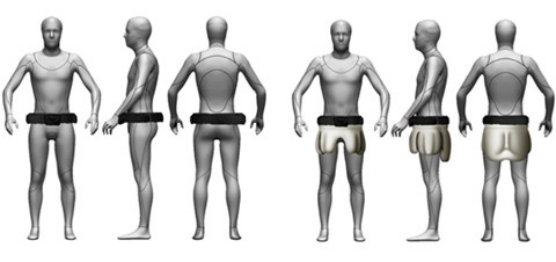
Although there are many types of pelvic cushion system for protecting pelvis, it was not sufficient to protect human pelvis. To ensure its protection effect, airbag system will be introduced for the development of the product in this study. This product can disperse the impact of a fall using wearable airbag cushion system and so can substantially reduce the risk of pelvis fractures in the elderly. This product will be developed as wearable type. This wearable product consists of sensor module, airbag module, and control unit. Sensor module consists of acceleration sensor, angle/angular velocity sensor, and terrestrial magnetism sensor. Airbag module consists of inflator, cushion, and cover. Control unit consists of switches to control the product. Figure 1 is the concept diagram.
Figure 1. Concept diagram of a wearable product for absorbing falling impact energy (left: before inflation, right: after inflation)
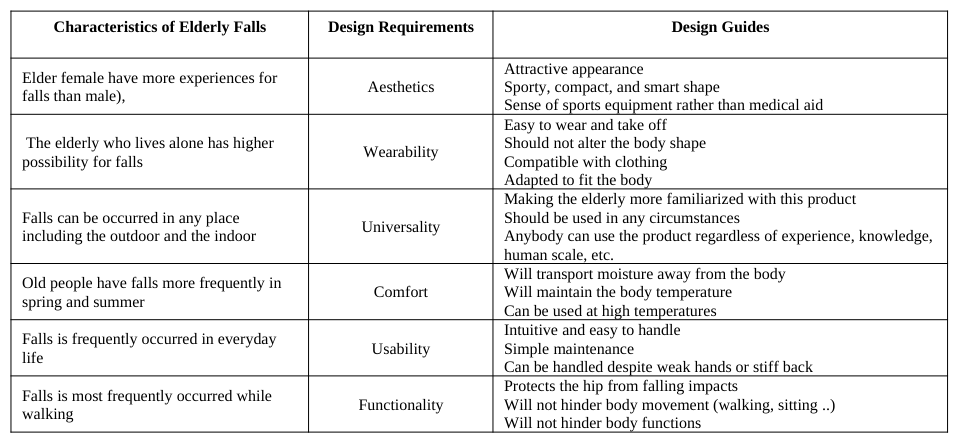
Design Requirements Design requirements were drawn considering characteristics identified from the analysis of elderly falls. The design requirements are aesthetics, wearability, universality, comfort, usability, and functionality. Then, design guides were proposed considering the design requirements and the elderly’s needs for the design of the product. The elderly’s needs for the design were investigated through interviewing 5 persons and surveying literatures. Table 2 represents the results.
Table 2: Design principles and requirements for pelvic airbag cushion system Characteristics of Elderly Falls Design Requirements Design Guides
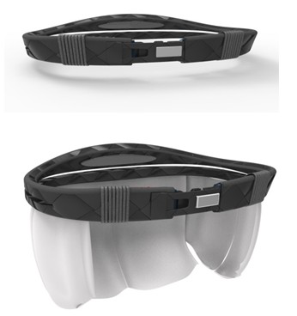
Concept Design A good impression of the product is crucial and so it is important to consider design requirements and design guides. The belt was designed to round shape to give wearability and aesthetics. The front part of the belt has a buckle to fasten the belt and was designed considering aesthetics. The back part of the belt was widely and thickly designed because it has airbag in the inside. Figure 2 is the concept design. The elderly usually wear this product as a belt round his or her waist. When the elderly fall down, the airbag of the product will inflate.
Figure 2. Concept design of a wearable product for absorbing falling impact
CONCLUSIONS
In this study, characteristics of elderly falls in Korea were identified from previous studies and a wearable product for protecting pelvis from falls was designed considering the characteristics. For the success of product development, user requirements including ergonomic and emotional characteristics as well as its functional characteristics must be considered. The elderly’s requirements for the design of the product were not sufficiently surveyed in this study. In the future, the survey will be carried out for many elderly persons. Some prototypes of the product will be also developed and then its usability will be evaluated.
REFERENCES
Andreoni, G. (2002), “Method for the analysis of posture and interface pressure of car drivers”, Applied Ergonomics, 33, 511-522. Brazier, J.E., Harper R., Jones, N.M.B., O'Cathain, A., Thomas, Usherwood, T., and Westlake, L.(1992), “Validating the SF-36 health survey questionnaire: new outcome measure for primary care”, BMJ, 305, 160-164. Brennan, F. H. Jr.(2002), “Exercise prescriptions for activity seniors; a team approach for maximizing adherence”, Phys Sports Med,
30, 19-29, 2002. Campbell, A.J., Borrie, M.J., and Spears, G.F.(1989), “Risk factor for falls in a community-based prospective study of people 70 & older”, Journal of Gerontology, 41, 112-117.
Choi, K.W. and Lee, I.S.(2010), “Fall Risk in Low-Income Elderly People in One Urban Area”, J Korean Acad Nurs, 40(4), 589-598. Eom, J.Y.(2006), “A study on the elderly patients hospitalized due to fall injuries”, Woman Health, 7(2), 47-68. Jung, K., Chun, K., Won, B., and Hong, J. (2010), "A study on the usability evaluation of senior friendly products", ISOES. Kang, K.H., Jeong, H.C., and Jeon, M.Y.(1999), “A survey study on fall-related fracture in hospitalized elderly patient”, Journal of Keukdong College, 251-264. Kim, J.M and Lee, M.S.(2007), “Risk Factors for Falls in the Elderly Population in Korea: An Analysis of the Third Korea
National Health and Nutrition Examination Survey data”, Journal of Korean Society for Health Education and Promotion, 24(4), 22-39. Kim J.M. and Suh H.K.(2010), “Risk factors for falls in the elderly by life-cycle, Korean Journal of Health Education and Promotion”, 27, 21-34. Kim, W.O.(1998), “The literature review for fall in the elderly”, The Korean Journal of Rehabilitation Nursing, 1, 43-50. Korea Consumer Agency (2007), Old People’s Safety. Mun, Y.H.(2005), “The Prevalence and Associated Factors of the in-home Falls of the Elderly”, Journal of Korean Academy of Public
Health Nursing, 19(2), 249-260. Ryan, J. J., McCloy, C,, Rundquist, P., Srinivasan, V., and Laird, R.(2011), “Fall risk assessment among older adults with mild Alzheimer disease”, J Geriatr Phys Ther, 34(1), 19-27. Sadigh, S., et al.(2004), “Falls and fall-related injuries among the elderly: a survey of residential-care facilities in a Swedish
municipality”, Journal of Community Health, 29(2).. Song, K., Moon, J., Kang, S., and Choi, J. (2001), “The survey of activities and fear of falling in the community dwelling elderly”, J Korea community health nursing academic society, 15(2), 324-333. Stalenhoef, P.A, Diederik, J.P.M. and Knottnerus, J.A. (2002), "A rist model for the prediction of recurrent falls in community-
dwelling elderly", J. Clin. epidemiol., 55, 1088-1094. Tabbits, G.M. (1996), “Patients who fall: how to predict and prevent injuries”, Geriatrics, 51(9), 24-31. Tinetti, M.E. (1987), “Factors associated with serious injury during falls by ambulatory nursing home residents”, J Am Geriatr Soc, 35(7), 644-648. Yoo, I.Y. and Lee, J.A.(2009), “Characteristics and Factors Associated with Falls of the Community-dwelling Elderly in Small
Cities”, J of Korean Society of Living Environment System, 16(4), 428-435.
LISTED IN THE AHFE DIGITAL BOOKSTORE CATALOGUE
Explore the complete digital volume
Advances in Human Aspects of Healthcare
Read this individual research paper free through the original publisher, or explore the full digital proceedings book.
ISBN 978-1-4951-2093-0
Explore this ISBN in the AHFE Bookstore ↗Listed in the July 2026 bookstore catalogue; search by ISBN to confirm current availability · Digital book purchase optional