Maria Madalena Pereira, João Nuno Oliveira, João Oliveira, Rui Miguel, José Morgado, Manuel Pereira, Manuel Gonçalves, João Barata (2022). STVgoDigital Project: The contribution of industry and scientific and technological system for fashion ecosystem digitalization. In: Human Factors for Apparel and Textile Engineering. AHFE Open Access, vol. 32, pp. 82–88. https://doi.org/10.54941/ahfe1001541
Digitalization is the act of deploying digital technologies to transform available business models and generate new revenue and value-producing opportunities (Gartner 2018). Digitalization is also called Industry 4.0. Several projects have emerged to respond to the challenges of Industry 4.0 and that, in some way, can respond to questions and problems found in an era of sustainability in the TCI (textile and clothing industry) supply chain, namely new business models for value creation. The STVgoDigital project, with the leadership of the “Têxtil Manuel Gonçalves” company, developed in partnership between the Portuguese textile and clothing industry and organizations of the scientific and technological system, allowing the development of advanced technology and market solutions applied to the fashion ecosystem. Thus, the objective of this project is to develop a digital platform (B2B and B2C) that contributes to the digitalization of processes from design to production and consumer with a horizontal and vertical integration system and allows responding to the problems of the new generations of fashion designers. For its development, a multidisciplinary team was formed (engineers, designers, informatics, managers, among others) to formulate the digital platform and interconnection with micro-factories production for a specific business model in the textile and clothing industry. It is concluded that the STVgoDigital project can contribute to a global level in this new digital and sustainable era: create value in the Portuguese textile and clothing industry and include more significant participation of designers and artists in the sector’s value chains, both nationally and internationally.Keywords: Industry 4.0, Fashion Ecosystem, Portuguese Textile, and Clothing Industry
STVgoDigital Project: The Contribution of Industry, Scientific and Technological System 83
INTRODUCTION
Digitalization is the act of deploying digital technologies to transform availa- ble business models and generate new revenue and value-producing opportu- nities (Gartner 2018). Industry4.0 is a term applied to a rapid transformation in the design, manufacture, operation, and service of manufacturing systems and products.
Buhr (2015) says about industry4.0 or smart factory is a virtual copy of the physical world and decentralized decision making can be developed, and physical systems can cooperate and communicate with each other and with humans in real-time, all enabled by the IoT and related services (cyber- physical). Commonly considered the fourth industrial revolution. Born in Germany, Markel defines Industry 4.0 as “the comprehensive transformation of the whole sphere of industrial production through the merging of digital technology and the internet with conventional industry.” Smart Factories, the Industrial Internet of Things, the Smart Industry, and others are also called Industry4.0 (Hounshell,2018; Taifa & Vhora, 2019;da Silva Bartolo, 2020). Industry4.0 depends on several new and innovative technological and capabi- lities developments in sensor technology; interconnectivity and data analysis allow mass customization, integration of value chains and greater efficiency (Davis, 2015).
Industry4.0 promotes industrial agility, flexibility, adaptability, and effi- ciency; in this sense, Europe, the USA, Asia and others create policies and strategies for implementing that in Industry and develop next generation of manufacturing. Several projects have emerged to respond to the policies and strategies of Industry4.0 and digitalization. And that, in some way, can respond to questions and problems found in the TCI supply chain (Hermann, 2016; Kagermann et al., 2013) . The State of Fashion 2019 (Business of Fash- ion and McKinsey & Company, 2019) indicates that companies in the fashion area, regardless of their market segment and size, will have to be more agile, get to market faster, think digitally, assume an active stance on social issues and satisfy consumer demands in terms of complete transparency and sustai- nability. PWC (2016) and Textile ETP (2016) also write about the importance of this strategy for the textile and clothing industry.
The Portuguese Fashion Ecosystem The textile and clothing industry (TCI) is an important industrial sector in Portugal. It represents (data 2021 of ATP) 10% of total Portuguese exports, 20% of manufacturing industry employment, 9% of manufacturing industry turnover, and 9% of manufacturing industry production.
Portuguese TCI is an industry: eclectic in terms of TCI subsectors; strongly clustered by need and tradition; which represents a complete and integra- ted Cluster (Industry, R&D+I Entities, Schools and Universities, Specialized Sectorial Associations); with a strong textile business culture in the regions with the highest concentration of the industry. The Portuguese TCI has been a highly clustered sector in its physical industrial activities for a long time. In Portugal, it is a sector comprising multiple subsectors, interdependent, inte- grated, and complete. The more or less individualized movement has become
apparent during the last few years. Collective dynamics of seeking foreign markets and participating in R&D projects were generated. This is how the Textile Cluster of Portugal was created, with the vision of becoming glo- bally competitive in the research, design, development, manufacture, and commercialization of textile and clothing products intended for the fashion segments and other sectors such as home textiles, technical and functional textiles of added value; jointly involving multidisciplinary teams from the scientific and technological system and companies. One of the objectives is to enhance complementarities and boost R&D opportunities in the direction of Industry4.0 (CITEVE, 2019; Hermann, 2016). In this way, a team with the different system actors begins to create the STVgoDigital project in 2019 and its execution from 2020 to 2023.
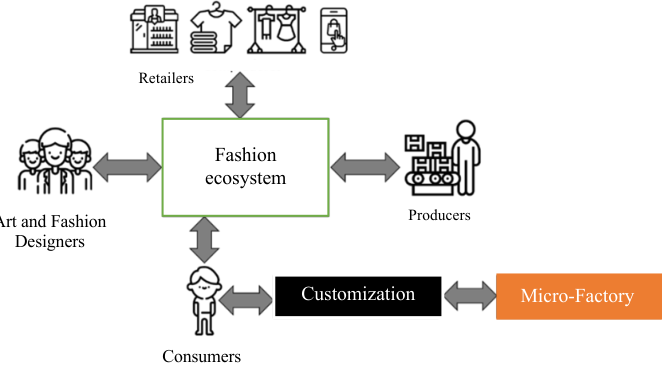
STVgoDIGITAL: THE PROJECT The main objective of this project (STVgoDigital - PPS3) is to develop a digi- tal ecosystem that brings together the main actors that make up the textile and clothing sector, to promote an environment that offers more signifi- cant interaction and openness between these same actors, and to promote new business models and of production. With this ecosystem, we will seek to support more local, more granular fashion business models, models that will allow graphic and fashion designers to be able to materialize their cre- ativity in an economically sustainable way, digital integrating them into the value chain by uniting creatives with producers, retailers, and consu- mers. It also intends to be able to provide an industrial response, namely to small, or even unitary, series, by exploring the concept of micro-factory with electronic documents, drawings and simulation models. Figure 1 pre- sents the digital illustration underlying this ecosystem, representing the main actors and blocks. The ecosystem should involve four user profiles: creati- ves, buyers (retailers), producers, and consumers. A creative can be a fashion designer or artist, is someone who develops their arts and these are rele- vant as a creative element. Notoriously, the designer is an essential factor, as the fruit of his work is the base element of the entire ecosystem, in this case, the garment. Two profiles can be found: the “art designer,” someone who expresses their creativity in form, for example, drawings and graph- ics, and the “fashion designer,” a creative capable of developing fashion proposals.
On the buyer’s side, digital integrated, the focus is on the retailer who selects the pieces he wants to place in the sales channels he operates in the ecosystem. In the field of producers, the profile will be diversified. However, the focus here is on companies that produce finished products, usually com- panies focused on cutting and confection, companies capable of accepting digital orders and ensuring their production. Finally, the consumer appe- ars here framed in the theme of personalization and the connection to the micro-factory. The micro-factory is an infrastructure part of the universe of producers in the cyber-physical fashion ecosystem; it is only for design purpo- ses that it has this highlight in the model. This also extends to the consumer, as he becomes a designer when personalizing his garment. Once again, this
STVgoDigital Project: The Contribution of Industry, Scientific and Technological System 85
explicit focus is carried out because the personalization element is intended to be more prominent in the project.
This ecosystem should support digital communication and interaction between actors to facilitate the composition of a supply chain capable of ope- rationalizing a part of the product’s life cycle, from design to sale. In this way, the conditions will be created to make a new business model based on small series viable, a business model that presents characteristics of open innova- tion by opening and promoting a community of creatives in the design of clothing or graphic elements, and a business model that seeks to aggregate the production offer and bring production closer to the other actors in a cyber-physical ecosystem.
Business Model The business model for the fashion ecosystem was described using the Sustai- nable Business Model Canvas. This model allows the systematization of the main elements involved in the business idea intended to be developed and implemented in a viable business model. The objective is to identify the main surroundings and the relationships inside and outside the business. In addi- tion to the economic criteria, the ecological and social consequences of the activity are also evaluated. It is intended to maximize the positive and avoid negative impacts on society and the environment. In this way, sustainability is integrated into the business.
Art and Fashion Designer The art designer is someone who expresses his creativity in the form of draw- ings and patterns and who, in the specific case of this project, does not know pattern-making or fashion design. The result of your creative effort is images. It will also be someone who has a relevant digital presence and dynamics so that you can take advantage of what the ecosystem can provide. A fashion
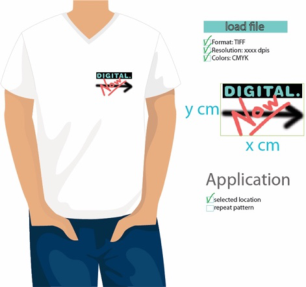
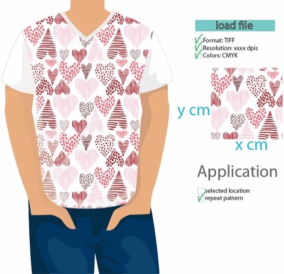
Figure 2: Artwork located and applied to T-Shirt developed by Fashion Designer João Barata. It is used for Apparel Design on the platform provided and developed by the Fashion Designer or pre-existing in the product bookstore. (Source: STVgoDigital Project).Figure 3: Art and Fashion Design with customization (Source: João Barata to STVgo- Digital Project).
designer is a professional who expresses himself creatively and technically in the design of clothing, footwear, or accessories, considering market trends. He has the knowledge, experience, and digital skills suitable for imagining, designing, and specifying illustrations (communication of ideas) and deve- loping technical solutions (specification of ideas) in clothing, footwear, or accessory projects. The fashion designer can be an art designer also. But art designer does not have technical skills in clothing and patternmaking. The commercialization of the work of the art and fashion designer’s work is car- ried out through royalties and the dissemination through their followers and admirers. We have a different model of digital platforms in the market to create this (digital art and fashion design product), but with all integration in an ecosystem including production (micro-factory) and sales online.
On the other hand, and to differentiate what the market offers, the art desi- gner can propose a customized approach to personalized Art (for example, an adapted and transformed children’s drawing for them to offer on Father’s Day to reflect the love between father and children and be suggestive for
STVgoDigital Project: The Contribution of Industry, Scientific and Technological System 87
your purchase and offer on “Father’s Day”) in addition to customization of the name’s initials or another type of customization (figure 3).
CONCLUSION
It is concluded that the STVgoDigital project in the future can contribute to a global strategy for Industry 4.0, as initially defined: ”fundamental impro- vements to the industrial process involved in manufacturing, engineering, material usage and supply chain and life cycle management” (Kagermann et al., 2013); promotes industrial agility, flexibility, adaptability and effici- ency; and also create competitiveness in the Portuguese textile and clothing industry. The inclusion of a more significant participation of fashion desi- gners, art designers, industry, and scientific and technological systems in the sector’s value chains, both nationally and internationally, can contribute to a better fashion ecosystem for the future strategy for industry 4.0. After defi- ning the concept of the model and the actors presented here at this stage, suggest common understanding and discuss with project members of the various players in the ecosystem for contribute to the creation and execu- tion of applied and market-oriented research allowing the creation of value and the resolution of current problems. One of the problems that this project intends to solve is the creation of a fashion ecosystem that involves scienti- fic, technologic, artists, fashion designers, and industry; to contribute to a more economically sustainable fashion ecosystem, digitally integrated with all players, with production solutions for small or even unitary quantities, customization, and even order-to-make in micro-factory or smart factory (Kagermann et al. 2013); with new business models in which everyone invo- lved can earn their income with a creation a cyber-physical system. We suggest the need to continue to develop the project based on the recommendations of Kagermann et al. (2013) and Herman et al. (2016), where the participa- tion and communication between theorists and practitioners is an essential contribution to the definition of the project STVgoDigital. A better and more transparency definition and discussion of the different actors’ profiles from the point of view of academics and practitioners is fundamental in future. In future the profile of Art Designer and Fashion designers it is crucial the analysis intellectual property context.
ACKNOWLEDGEMENT
This research is also supported by the mobilizador project n° 46086- STVgoDigital-PPS3, co-supported by Programa Portugal 2020 (PT 2020), in the Programa Operacional Competitividade e Internacionalização (POCI) and European Union by Fundos Europeus Estruturais e de Investimento (FEEI). The authors are very grateful for the support given by the research unit UNIDCOM-IADE and the research unit Fiber Materials and Environ- mental Technologies (FibEnTech-UBI), on the extent of the project reference UIDB/00195/2020, funded by the Fundação para a Ciência e a Tecnologia (FCT).
REFERENCES
ATP (2017) https://atp.pt/wp-content/uploads/2020/04/A-fileira-t%C3%AAxtil-e -vestu%C3%A1rio-no-horizonte-2025-1.pdf BOF and McKinsey (2019) The State of Fashion; https://www.mckinsey.com/indus
tries/retail/our-insights/the-state-of-fashion-2019-a-year-of-awakening Buhr, D. (2015). Social innovation policy for Industry 4.0 (pp. 1–24). Berlin, Germany: Friedrich-Ebert-Stiftung. da Silva Bartolo, P. J., da Silva, F. M., Jaradat, S., & Bartolo, H. (Eds.). (2020). Indu-
stry 4.0–Shaping The Future of The Digital World: Proceedings of the 2nd International Conference on Sustainable Smart Manufacturing (S2M 2019), 9–11 April 2019, Manchester, UK. CRC Press. Davies, R., (2015). Industry 4.0: Digitalisation for productivity and growth, EPRS: European Parliamentary Research Service. Retrieved from https://policy commons.net/artifacts/1335939/industry-40/1942749/ on 23 May 2022. CID: 20.500.12592/6mqvs1. Gartner. (2018). Digitalization. Gartner. Available at: http:// www.gartner.com/it-
glossary/business- Gartner. 2018. Digitalization. Gartner. Available at: http:// www.gartner.com/it-glossary/business-intelligence-bi/ Gerbert, P., Lorenz, M., Rüßmann, M., Waldner, M., Justus, J., Engel, P. & Harnisch, M. (2015). Industry 4.0: The future of productivity and growth in manufacturing industries. The Boston Consulting Group. Hermann, M., Pentek, T., & Otto, B. (2016, January). Design principles for industrie
4.0 scenarios. In 2016 49th Hawaii international conference on system sciences (HICSS) (pp. 3928–3937). IEEE. Hounshell, L. (2018). The industrial internet of things, digitalization and the future of business. Forbes Technology Council. Available at: https://www.forbes.com/s ites/forbestechcouncil/2018/07/30/the-industrial-internet-ofthings-digitalization- and-the-future-of-business/ Kagermann, H., W. Wahlster, and J. Helbig, eds.(2013) Recommendations for imple-
menting the strategic initiative Industrie 4.0: Final report of the Industrie 4.0 Working Group, Frankfurt. PWC (2016) Industry 4.0: How digitization makes the supply chain more efficient, agile and customer-focused Taifa, I.W.R. & Vhora, T.N. (2019). Cycle time reduction for productivity impro-
vement in the manufacturing industry. Journal of Industrial Engineering and Management Studies 6(2): 147–164. Textile ETP (2016) Towards a 4th Industrial Revolution of Textiles and Clothing A Strategic Innovation and Re-search Agenda for the European Textile and Clothing Industry.
LISTED IN THE AHFE DIGITAL BOOKSTORE CATALOGUE
Explore the complete digital volume
Human Factors for Apparel and Textile Engineering
Read this individual research paper free through the original publisher, or explore the full digital proceedings book.
ISBN 978-1-958651-08-7
Explore this ISBN in the AHFE Bookstore ↗Listed in the July 2026 bookstore catalogue; search by ISBN to confirm current availability · Digital book purchase optional