Marta Bicho, Maria Madalena Pereira, Rui Miguel, Nuno Belino (2022). Fashion Design and Fashion Technology Courses: Practical Skills in Patterns Making, Garment Manufacturing Techniques, Technologies, and Applications for Fashion Industry. In: Human Factors for Apparel and Textile Engineering. AHFE Open Access, vol. 32, pp. 73–81. https://doi.org/10.54941/ahfe1001540
Publisher statistics will load when you open Metrics.
AHFE OPEN ACCESS OPEN ACCESS CONFERENCE PROCEEDINGS PAPER
Fashion Design and Fashion Technology Courses: Practical Skills in Patterns Making, Garment Manufacturing Techniques, Technologies, and Applications for Fashion Industry
In higher education of national and international courses, there appear the designation Fashion Design, Fashion Technology, and the techniques of pattern making and garment manufacturing which are not always associated in the same curricular unit. The practical skills associated with these two techniques are complementary in fashion product development; but the separation or the failure of interaction between them in the past, contributed to the deficiencies in the validation of the fashion product in the learning phase and in many cases, they present deficiencies in the transfer of knowledge to the labor market. The type of textile and clothing industry differs from country to country, in Portugal it is still essentially based on exporting companies, accounting for 10% of the national exports, where the profile of the professional required is mainly for product development, with skills in techniques, materials and market. In other countries, the profile is adapted for departments, from the creation and development of collections for fashion brands, product development, market, global and local sourcing, among others, result of the evolution that the sector had in the last 20 years, after the multifiber agreement and with the relocation of production to countries with cheaper labor. However, the textile and clothing sector, although belonging to the same chain differ from each other, capital intensive versus labor intensive. The objective of this investigation is to answer a main question: What competences, from a practical point of view, are necessary for the Portuguese garment exporting industry in graduate students specialized in fashion design and fashion technology? The objective is to know what practical skills the Portuguese clothing exporting industry needs, as well as the necessary relationship between the various techniques in the learning phase that contribute to the development of a value-added fashion product. To answer this question, a program of visits/ classes in companies was developed with students in the fashion design specialization, to sensitive them of the needs of the industry and was developed a program of collaboration between two curricular units: pattern making and garment manufacturing. A practical lesson plan for two curricular units was developed for two groups of 25 students. Were also interviewed 10 entrepreneurs from the sector, about their needs and deficiencies in terms of qualified staff in the area. It is concluded that, after contact with companies in the sector and in a classroom model in the company, students show changes in behavior regarding the commitment and acquisition of technical skills. The interconnection between the two curricular units also allowed students to validate the results of their practical work, in the image of industrial model. It is also concluded that the contribution of teachers with recent experience in the clothing industry is essential in the contribution of student’s acquisition of skills to the labor market of the Portuguese clothing industry.
Last decades research’s debate on University-Industry collaboration is highly used from 80’s. One of the functions of collaboration University-industry has an essential role for development programs and finding solutions for the problems (Magazinik et al. 2019). Rossi (2010) confirms from your study, the choice of university-industry knowledge transfer governance forms on the part of organizations involved in knowledge production and dissemina- tion projects. But it also depends on the type of industry to which we refer. In Portugal, Textile and Clothing production industry are very strong with 5,3 thousand millions of exportations in 2021. (Jornal T, 2022) compare with another countries of EU. One of the needs mentioned by clothing manufactu- rers is human resources for product development, including pattern making and knowledge of production processes. On the other hand, a 4th Industrial Revolution has third prime goal the productivity. But the productivity goal is different from the ones in the previous era. According to Jin and Shin (2021) the prime goals of the 4th Industrial Revolution include environmen- tal sustainability, hyper-personalization, and productivity. The pandemic in 2019 compromised practical components, such as pattern making and gar- ment manufacturing, where know-how is very important, for the acquisition of skills that were underlying the level of a specialization.
University education is undergoing transformation, and institutions must be more flexible and resilient in the long term to prepare for future challen- ges (McKinsey, 2021). Kozar e Hiller Connell (2015), also concluded that the internship experience is a powerful tool for their practical learning. The academy needs to find new ways to contribute to productivity, in the transfer of knowledge. One way is to link teaching to the real industry environment, understand their needs and transfer knowledge to students to solve problems under pressure. The example discussed in this article, of the need for a close connection between pattern making and garment manufacturing, as well as the need to adapt the skills of future professionals in Fashion Design and Fashion Technology and Product Development, is one of the objectives of this investigation. By bringing the teaching methodology closer to the exi- sting model in Industry, students acquire skills that are more suited to the job market and develop product design and development learning based on best working practices, in the relationship of two fundamental areas men- tioned by Portuguese industry: pattern making and garment manufacturing (including garment making processes and techniques), “develop a fashionable product with the best quality at the best price, in short time, and with custo- mer satisfaction”. (In Interview of Twintex 2021). The literature highlights the importance of developing new ways of teaching, adding new learning in the interaction between teachers and school-industry cooperation. The academic-industry link can be established in several ways, and its evolution is constantly debated by various research. There is a need for a paradigm shift in the attitude and approach of both entities to achieve mutually bene- ficial goals. (Magazinik et al. 2019; Nangia, 2011). The big bet on creativity in fashion design courses resulted in a failure from the business point of view and market knowledge. Renowned schools such as Pearsons School
Fashion Design and Fashion Technology Courses 75
and Polimoda are redefining their training trying to find a better alignment between creativity, technical knowledge, business, and the market. One of the ways is the connection to companies, either through internships or other identified ways. (Lam e al. 2020). The curricular units of clothing pattern and atelier of making-up, in higher education courses, are generally autonomous curricular units in terms of their functioning, but with a high practical com- ponent. The contribution of professors with experience in the industry made it possible to bring these two curricular units closer together and transpose the methodology developed in the context of industry into teaching, instil- ling the spirit of multidisciplinary work, with a view to a practical result of the industry-university relationship in achieving the objectives and acquisi- tion of skills, for the design and product development and in the acquisition of technical knowledge content for the validation of prototypes, which is a fundamental aspect for the acquisition of orders in the Portuguese fashion industry. After analyzing the objectives, skills and learning syllabus of the two curricular units at the level of specialization (clothing pattern and atelier of making-up), a plan of practical classes resulting from this symbiosis was developed. At the same time, a program of visits/classes was designed in clo- thing companies with experience in export with fashion design students. This study aims to know which technical skills are needed and currently valued in the Portuguese industry for students specializing in fashion design and technology and product development. As a methodology, interviews were carried out with 10 professionals from the garment production sector in Portugal, accompanied by a planning of visits and classes in a factory con- text with students of clothing pattern and atelier of making-up curricular units.
THE LINK BETWEEN PATTERN MAKING AND GARMENT MANUFACTURING FROM THE INDUSTRY’S POINT OF VIEW Fashion brands look for products capable of offering quality, innovation, durability, design, and comfort. From this perspective, product design and development plays a key role in sales success, and this is a differentiating aspect if supported by highly technically competent human capital. In Por- tugal, the clothing industry is essentially exporter, without its own brand collection, where the profile of the required professional is mainly for pro- duct development, with skills in techniques, knowledge of materials and markets; while in the industry, or fashion brands, with their own collection, the intended profile is directed towards creative offices, trend research, model development and material selection. In the case of the Portuguese industry, where the custom is not to have a collection with its own brand, the model is previously selected by the customer and the company receives a physical sample of the product and/or a technical sheet of the desired product. The company is responsible for developing pattern, cutting, and making a pro- totype for customer validation. In the process that goes from the receipt of the technical sheet, or physical sample, to the making of the prototype for validation and delivery to the customer, there are several important and fun- damental steps for the making of the prototype to be successful. The first
stage results from the analysis carried out by the pattern making team and the product development technical office, on the viability of the product from a productive point of view, considering any limitations that may exist from a technical and/or equipment point of view. There is strong competitive pres- sure for the efficiency of the production processes and their consistency, in the product development phase, with the final objectives in terms of costs and profits, which contribute to the success of the collection. (Simona D’Amico, 2013). Once this step is completed, we move on to the patter making phase, fulfilling all the procedures inherent to the elaboration of the pattern. Curren- tly, CAD software is used in the industry to increase quality and productivity and also reduce the manual and time-consuming process of garment design. (Sarita Chaudhary, 2020). Once the pattern is completed, the prototype is cut and made, and in the production phase there is interaction between the pattern maker in monitoring the prototype, either in clarifying any technical details, or in collecting notes on rectifications/ improvements to be carried out in the pattern, with the main objective of improving the process and the final product. Once the prototype is completed, it is analyzed by the techni- cal team in terms of quality, regarding compliance with the requirements of the technical sheet and the functional quality of the product and comfort to use, for which it is necessary to wear the garment (fit sample). Once these steps are completed, adjustments are often made to the pattern, to obtain improvements in the final product, with the main objective of customer sati- sfaction and order acquisition. After sending the prototype to the client, there are often comments about this prototype, sometimes requiring changes to the pattern and/or production, which must be carried out in the development of a pre-production sample, produced with all the final materials, before making the entire order.
In this often-complex process, the communication and involvement of pattern teams and the clothing technical team play a fundamental role in obtaining successful products from a commercial point of view. There are several tasks performed by multidisciplinary and multifunctional teams, in which people involved in different functions and with different know-how collaborate in the different stages of the development process. (Romeo Ban- dinelli, 2013). Usually in the industry the development process is quite collaborative. In recent years, value-added services have been created in the Portuguese industry, allowing them to stand out in terms of flexibility, ability to adapt to new situations, productivity with small series and working with premium and luxury brands.
METHODOLOGY USED IN THE COLLABORATION BETWEEN THE TWO CURRICULAR UNITS The objective of the collaboration between the two curricular units was to transfer to teaching, the methodology developed in an industry context, regarding the interaction between the area of pattern and clothing manufa- cturing in the development of prototypes, corrections, and pre-production samples. The integrated efforts of professionals in areas of different specia- lization, allow us to show the advantage of an interdisciplinary approach to
Fashion Design and Fashion Technology Courses 77
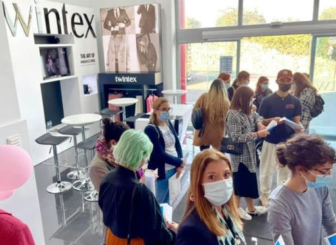
Figure 1: Classes in a company context.
problem solving, innovation, training next-generation leaders and advancing research and development. (Jacob, 2015). Based on the learning objectives of the two curricular units, a practical lesson plan was developed for two groups of 12 students and, at the same time, a program of four visits/clas- ses was designed in companies with students specializing in fashion design, throughout the 15 weeks of classes of the academic semester. In the practical classes of clothing pattern, students developed the pattern needed for the ate- lier of making-up curricular unit. The cutting and making of the prototype, before making the final product, was performed in the atelier making-up cur- ricular unit. The group of students evaluated each of the prototypes made, which allowed them to adopt active methodologies that encourage reflection and the ability to solve problems. Subsequently, the students made at least one correction/ improvement of patterns, in the curricular unit of clothing pattern and in some cases a second prototype was produced, before produ- cing the final garment, in the curricular unit of atelier of making-up. At the same time, a program of visits/classes was developed in companies, to sen- sitize students to the needs of the industry, which allowed them to see, in a real environment, the interdepartmental interaction of the two areas in a work context and the importance of linking these areas in the development of product (Figure1). The visits/classes worked as a way of consolidating kno- wledge and complementing the learning process in real work contexts. Based on this experience, the students showed changes in behavior commitment and acquisition of technical skills, as well as greater learning motivation, for the areas of clothing pattern and garment manufacturing, than is usually usual.
Table 1. Activities/Number of specialists.
Table available in the original PDF paper.
Activity Number of specialists (%)
2 (4%)
Senior pattern maker in industry (IV) 1 (2%) Pattern maker in industry (junior and others) (IV) 7 (14%) Product development in textile and clothing industry 8 (16%) Activity in the creative process of collection development (service company) 2 (4%) Creative process of development collections for brand (industry)
6 (12%)
Professional free-lancers 2 (4%) Atelier of Design 2 (4%) Fashion apparel commercial 2 (4%) Continuity of training in 3rd cycle 9 (18%) Teaching 6 (12%) Technological centers and research centers 3 (6%) Activity in professionals’ companies (outside Portugal) Total 50
NECESSARY SKILLS FOR THE PORTUGUESE EXPORT INDUSTRY IN POSTGRADUATE STUDENTS SPECIALIZING IN FASHION DESIGN AND FASHION TECHNOLOGY, FROM THE EMPLOYERS’ POINT OF VIEW To complement the study, 60 specialists trained in the 2nd cycle of Fash- ion Design at UBI were surveyed, and 10 professionals from the clothing sector were interviewed, in which the sample is composed of entrepreneurs and area managers at the management level, responsible for the depar- tments of product development, responsible for the pattern departments and responsible for the clothing manufacturing departments. Regarding the speci- alists, the functions/activities they performed or perform in the training area were questioned; considering the professional opportunities presented in the characterization of the study cycle1. The results are shown in table 1:
Thus, in view of possible professional opportunities, we asked a group of 60 specialists in Fashion Design (UBI) and their respective activity who have been integrated, from which we obtained 50 responses: After analyzing the results, it was verified the need to include in the pro- fessional opportunities the continuity of training for the 3rd cycle; teaching, and technological centers and research centers. Responses from activities outside the area of specialization were not considered. Thus, the reality of the market in terms of employability is fundamentally the industry of the results obtained with around 36%, followed by continuing training in the 3rd cycle and teaching. This justifies the need to improve pedagogical pra- ctices in the Clothing Pattern and Product Development Curricular Units; associated with Curricular Units of Atelier of Making-UP; Atelier of Clo- thing and Fashion Design Project II. In the next phase, employers/industry
1https://www.ubi.pt/curso/832
Fashion Design and Fashion Technology Courses 79
(36%) were interviewed to understand the needs and offers of the market. Most of these companies produce for other fashion brands. Most respon- dents mentioned technical skills (pattern and clothing manufacturing) as a way of boosting the business and contributing to increased productivity in the company. One of them says “our industry has great competitive advan- tages today in terms of flexibility, adaptation to small series and with highly demanding customers in the market, but we must have human resources with these skills, or we must train them in a company context. We have our own academy within the company. The academy is not always in tune with our needs”. Autonomy, responsibility, and English language was one of the aspects considered in the competences of the specialists. Finally, a good pre- sentation can reflect the quality and good taste, as well as the passion for the area.
This is how the competences most mentioned by the interviewees are presented:
1. Knowledge about the industrialization of the product
Most of the interviewees mentioned that it is important for future pro- fessionals to have technical knowledge of the product construction phases, considering the creations and limitations of the industry in the execution, as well as the operations necessary for the execution of the product.
2. Pattern knowledge
Most of the interviewees highlighted the knowledge of pattern in different families of products and the connection with the production of the product, for the success in the product development.
3. Knowledge of the different stages of product development
Respondents mentioned that “knowing the stages of product development is essential”, for students to know the different tasks to perform in each of the stages.
4. Seriousness and integrity
One of the interviewees highlighted the form of relationship both in the internal work environment and in the interaction with suppliers and customers, as an important tool for professional growth.
5. Ability to communicate
Most of the interviewees pointed out that knowing how to communicate internally and with external partners, clearly and correctly, is a tool that allows them to facilitate processes and create the necessary empathy to pro- mote good relationships and establish a portfolio of contacts throughout the supply chain
6. Organization of the work in the various tasks to be performed
Two interviewees mentioned that executing work plans autonomously, with established objectives and deadlines, contributes to the achievement of the company’s overall objectives.
7. Soft Skills
Some interviewees mentioned behavioral skills as attributes that allow stu- dents to stand out in the work environment and the mastery of different languages to contact customers directly to clarify doubts, thus reducing the chain of information transmission and, at the same time, the inherent errors associated.
FINAL CONSIDERATIONS The articulation between the different syllabus contents and interdisciplina- rity works as an important methodology, not only for students to achieve the learning objectives, but also to have the correct perception of the practi- cal reality existing in a company context and the way in which the contents of the curricular units interact in the work environment. The contribution of professors with recent experience in the clothing industry is essential in contributing to the acquisition of skills by students for the job market in the Portuguese clothing industry, since by having a knowledge of the practical and real functioning of the industry, they can establish the relationship betw- een the syllabus and the technical skills that students must develop. Also the programmed and interim inclusion over the 15 weeks of 4 classes in a company context and not just the well-known study visit, allowed a better understanding of the objectives, competences and contents of the two cur- ricular units, as well as a greater motivation of students in the success of learning, and consequently a contribution to the improvement of producti- vity in the context of academia and in the future in the context of industry. As for the results of the interviews carried out with professionals in the clothing sector, with positions at the administration and management level, it allows assessing the employer’s perspective on the skills necessary for the successful employability of students and helps to reflect on how the academic syllabus to bring them closer to the real needs of companies.
These conclusions are in line with what defines the role of fashion buying and merchandising, when looking for your productive partner is about “ getting the right product at the right price, at the right time, to the right place” and additionally that it needs to be delivered in the “right quantity” and the “right customer”. however, currently, it adds the 7R, the product range is delivered “in the right way”. (Shaw, 2006; p.139; Stone, 2012, p7; quoted in Boardman et al. 2020).
ACKNOWLEDGMENT
The authors are very grateful for the support of the research unit Fiber Mate- rials and Environmental Technologies (FibEnTech-UBI) on the extent of the project reference UIDB/00195/2020, funded by the Fundação para a Ciência e a Tecnologia (FCT). The authors are very grateful for the support given by
Fashion Design and Fashion Technology Courses 81
the research unit UNIDCOM/ IADE - Europeia ID Unidade de Investigação em Design e Comunicação, Lisboa, Portugal, funded by the Fundação para a Ciência e a Tecnologia (FCT).
REFERENCES
Boardman, R., Parker-Strak, R., & Henninger, C. E. (2020). Fashion Buying and Merchandising: The Fashion Buyer in a Digital Society. Routledge. http://www3.weforum.org/docs/WEF_Global_Lighthouse_Network.Pdf Business Management Jacob, W.J., 2015. Interdisciplinary trends in higher education. Palgrave Communi-
cations, Volume1 Jin, B. E., & Shin, D. C. (2021). The power of 4th industrial revolution in the fashion industry: what, why, and how has the industry changed. Fashion and Textiles, 8(1), 1–25. Lam, M. M. L., Li, E. P. H., Liu, W. S., & Yee-Nee Lam, E. (2020). Introducing
participatory action research to vocational fashion education: theories, practices, and implications. Journal of Vocational Education & Training, 1–19. Magazinik, S. J. Mäkinen, N. C. Lasheras, J. S. Bedolla and U. Saari, 2019 “Research- Industry Collaboration: A Review of the Literature on Evaluation Methods and Motivations,” 2019 Portland International Conference on Management of Engineering and Technology (PICMET) Romeo Bandinelli, R. R. M. R. a. S. T., 2013. New Product Development in the Fash-
ion Industry: An Empirical Investigation of Italian Firms. International Journal of Engineering Business Management, Volume 5 Rossi, F., 2010. “The governance of university-industry knowledge transfer”, European Journal of Innovation Management, Vol. 13 No. 2, pp. 155–171 Sarita Chaudhary, P.K. a P.J., 2020. Maximizing performance of apparel manufa-
cturing industry through CAD adoption. International Journal of Engineering, Volume 12 Simona D’Amico, L.G.M.E.N. a L.P., 2013. Product Lifecycle Management as a Tool to Create Value in the Fashion System. International Journal of Engineering Business Management. Volume 5 Vinay K. Nangia, C.P., 2011. Towards An Integrated Model for Academia-Industry
Interface in India. International Journal of Social, Behavioral, Educational, Economic, Business and Industrial Engineering, Volume 5 Vinay K. Nangia, C. P., 2011. Towards An Integrated Model for Academia- Industry Interface in India. International Journal of Social, Behavioral, Educational, Economic, Business and Industrial Engineering , Volume 5. Kozar, J. M., & Hiller Connell, K. Y. (2015). The fashion internship experience: Iden-
tifying learning outcomes in preparing students for the ‘real world’. International Journal of Fashion Design, Technology and Education, 8(1), 3–11. World Economic Forum. (2020). Global lighthouse network: Insights from the forefront of the fourth industrial revolution.
LISTED IN THE AHFE DIGITAL BOOKSTORE CATALOGUE
Explore the complete digital volume
Human Factors for Apparel and Textile Engineering
Read this individual research paper free through the original publisher, or explore the full digital proceedings book.
ISBN 978-1-958651-08-7
Explore this ISBN in the AHFE Bookstore ↗Listed in the July 2026 bookstore catalogue; search by ISBN to confirm current availability · Digital book purchase optional