Sandra Ferreira, Madalena Pereira, Teresa Raquel Barata, Nuno Belino, Ana Santiago, Marta Bicho Fernandes, Rui Miguel (2026). Circularity research using fashion industry waste as new fibers for eco-designed knitwear. In: Human Systems Engineering and Design (IHSED2026): Future Trends and Applications. AHFE Open Access, vol. 237, pp. 511–522. https://doi.org/10.54941/ahfe1008191
Recycling is minimal in the approximately 7 million tons of waste generated each year in the European Union's fashion value chain, which is burned or disposed of in landfills. Therefore, it is very important to develop recycling processes for textile waste and introduce them into clothing, promoting the circular economy. Relevance is based on compliance with EU regulations and directives regarding sustainability and circular fashion and the principles of eco-design. It demands stringent minimum requirements for durability and recyclability. Products must be designed with long service life cycles in mind. Mechanically recycled fibers are shorter, posing a challenge for eco-engineering in fiber blend design and the production of fine and regular yarns. To demonstrate that knitwear eco-design enables the production of sustainable clothing without compromising wear performance yarns and knit samples were developed, whose quality parameters were laboratory evaluated and compared with market references. It is technically possible to produce relatively fine (25 Nm) and regular (USTER international statistics) yarns with 50% wool/viscose waste and 50% virgin cotton. Within the scope of the be@t project, that the primary focus is the bio-economy of the textile industry, laboratory work was carried out at the Department of Textile Science and Technology. Through eco-design, the structure of the knits placed the yarns with recycled fibers in the inner layer and the yarns with virgin fibers in the outer layer, thus maintaining the durability, appearance, and touch of the garment similar to those of the control garment made with 100% virgin fiber yarns. Fashion eco-design practices enable the production of commercial clothing incorporating recycled fibers, with an acceptable level of quality, contributing to circularity and the reduction of textile waste.
Although pre- and post-consumer recycled textiles made from non-bottled raw materials accounted for less than 1% of the global fiber industry in 2023, the use of recycled textile fibers is becoming more significant as it
Received July 10, 2026 Revised August 4, 2026 Accepted August 22, 2026 Available online September 25, 2026
helps to reduce textile waste and the demand for virgin resources (Materials Market Report, 2024).
Through the European Parliament (Commission Delegated Regulation (EU) 2023/2486, 2023) and the EU Textile Strategy (European Commission, 2022), the EU is spearheading efforts to address the growing environmental and societal concerns and the environmental initiatives are to improve the circular economy concept, the use of sustainable recycled materials, supply chain transparency, and advanced production methods. The EU Eco-design for Sustainable Products Regulation specifies minimum environmental requirements, including durability, recyclability, and decreased environmental effect, with a specific goal of using recycled fibers in manufacturing. (European Parliament, 2024) Additionally, the EU Corporate Sustainability Reporting Directive (CSRD) (EU Corporate Sustainability Reporting Directive (CSRD, 2022) addresses companies’ disclosure of the environmental and social impacts of its activities, which promotes greater transparency, while the EU Waste Framework Directive focuses on reducing textile waste. The textile industry is becoming more resource-efficient and ecologically friendly because of these changes in legislation, especially the encouragement of recycled materials, which represents a worldwide trend towards more ethical and circular production and consumption practices (Directive (EU) 2025/1892 of the European Parliament and of the Council of 10 September 2025 Amending Directive 2008/98/EC on Waste -Text with EEA Relevance, 2025).
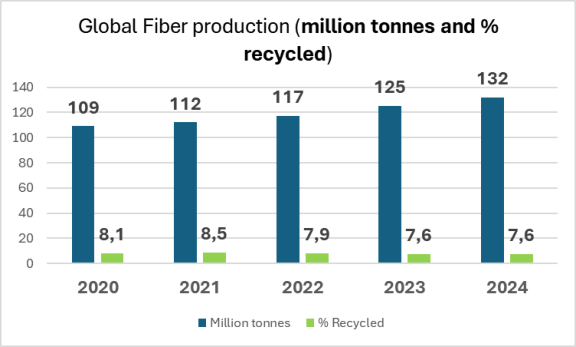
Importance of Recycled Fiber Production In part due to the increased manufacturing of polyester made from fossil fuels, which was less costly than recycled polyester, the overall proportion of recycled fibers decreased slightly from 7.9% in 2022 to 7.6% in 2024 and remained the same in relation to 2023 (Figure 1).
Figure 1: Graphs of global fiber production and % recycled (adapted from textile exchange, 2025).
Circularity Research Using Fashion Industry Waste as New Fibers 513 In 2024, 81 million tons of synthetics made from fossil fuels were produced up from 75 million tons in 2023. On the other hand, less than 1% of the global fiber market was made up of recycled textiles from pre- and post-consumer sources. It may be possible to decrease the manufacturing of virgin textile fibers and stay clear of more invasive operations throughout the life cycle of textile goods by increasing the reuse and recycling of textiles, which could reduce the impact on the environment (Textile Exchange, 2025). Recycled wool from a range of pre- and post-consumer sources is frequently blended with virgin wool or synthetic fibers to compensate for any deficiencies in the fibers’ physical qualities caused by recycling techniques and to meet the rigorous performance requirements of novel textiles (Glasper et al., 2024).
European Union´s Contributions to Sustainability and Circularity in the Fashion Sector Numerous problems still exist despite ten years of attempts to improve sustainability and working conditions in the textile industry. As the biggest importer of clothing worldwide, the EU has the power to drastically change the textile sector. As a result, in March 2022, it announced the EU Strategy for Sustainable and Circular Textiles. (Committee and the Committee of the regions EU Strategy for Sustainable and Circular Textiles, 2022).
An extensive plan to improve supply chain working conditions and increase the sustainability of the sector. The European Union’s expansive policy strategy focuses on two key issues: climate change and sustainability. The primary goal of this ambitious plan, which includes 35 measures intended to begin an important change of the economy and society, is to make Europe carbon neutral by 2050 (delivering the EU Green Deal Progress towards Targets, 2025).
The EU is leading the way in sustainable goods and production policies, even as the industry works to achieve circularity. This generation created a plan that rethinks global textile value chains, identifies problems, and offers novel solutions for success in a circular economy through a comprehensive bottom-up survey. Developing and implementing eco-design and new circular business models, as well as encouraging research and innovation to strengthen the EU recycling value chain, are some of the guiding principles that EURATEX works on (Euratex, 2023).
Mechanical Recycling of Textile Waste Textile waste recovery and recycling can be facilitated and encouraged by a variety of technologies. These technologies might provide an acceptable way to reduce landfill waste and the harm it causes to the environment. Mechanical recycling is frequently seen as the simplest and most effective technique for recycling textiles. Different procedures are typically used in the recycling process, depending on the type of material and the intended use of the recovered material. The fibers resulting from the shredding operation of the mechanical recycling process are shorter than the initial virgin fibers, giving rise to yarns that potentially have a lower spindle strength, are less resistant and less regular, that is, of inferior quality. It is possible
to convert these recycled fibers into yarn, which can then be used to make knitted or woven fabrics. Alternatively, they can be used directly to make non-woven materials. Open-loop recycling can stimulate the economy by creating new businesses and jobs. The closed-loop recycling approach is a very efficient method for recovering and reprocessing the raw material used to manufacture a product, sometimes allowing for the creation of products that are just as high-quality as those made from virgin material. This strategy helps to promote sustainability by reducing pollution and the need for natural resources (Abrishami et al., 2024).
Objective Evaluation of Knit Abrasion Resistance Analyzing the effects of abrasion on a fabric’s surface and the resulting degradation is one of the most crucial studies in fabric characterization. In this regard, the British Standard technique (1979) employs the Martindale equipment to evaluate woven and knits. The Martindale pilling test evaluates a fabric’s resistance to the creation of pilling, which is the emergence of small twisted fibers on the material’s surface because of friction caused by the abrasion of the open ends of the yarn fibers used to manufacture knits and fabrics. The ASTM D 3512:2022 standard is used to evaluate the pilling test sample results and compare them with photographic standards. There are five different levels of pilling: grade 1 – Very Severe Pilling; grade 2 – Severe Pilling; grade 3 – Moderate Pilling; grade 4 – Slight Pilling; grade 5 – No Pilling (Standard Test Method for Abrasion Resistance of Textile Fabrics, Martindale Abrasion Tester Method, 2012).
Objective Evaluation of Knits Touch and Drape The subjective sensations of clothing and textiles that encounter human skin during wear have long been recognized as one of the most significant factors of fabric quality (Zhezhova et al., 2019). The idea of drape and “hand fabric” which is a property that is assessed according to the material’s feel, is the source of this concept in the textile industry. Therefore, fabric hand characterizes the perception of stiffness, softness, roughness, and smoothness. This perspective is challenging to assess, yet it has a significant impact on consumers’ levels of pleasure with different items. In this sense, objective and quantified assessments of these parameters can be obtained through physical tests of fabrics (Bakar & Brook, 2004).
Kawabata (1975) proposed that a fabric’s physical characteristics may successfully express its hand, ignoring the essential part that humans play in creating a work’s aesthetic appeal. The mechanical properties of the materials can be used to objectively evaluate their drape and touch behavior using the Kawabata System techniques. Each parameter can be analyzed with the aid of its four modules, resulting in an honest and impartial understanding of a fabric’s performance when subjected to small loads, such as those it undergoes during industrial processing and use. Roughness, surface friction coefficient, shear rigidity and bending rigidity can all be evaluated. To evaluate a fabric’s drape and touch, the most important characteristics are shear
Circularity Research Using Fashion Industry Waste as New Fibers 515 rigidity modulus (G), bending rigidity (B), geometric roughness (SMD) and coefficient of friction (MIU) (Kawabata Evaluation System - an Overview | ScienceDirect Topics, n.d.).
MATERIALS AND METHODS
In alignment with the framework outlined in the introduction, specific yarn references were created for the integrated project be@t - Textile Bio-economy, some of which include mechanically recycled fibers, to incorporate the concepts and challenges presented in the previously discussed theoretical framework and to serve as a sign of industry research that needs more work (CITEVE, 2022). Promoting eco-engineering and eco-design research for the development of clothing and textile products that employ a proportion of mechanically recycled fibers according to the application for appropriate quality is one of the objectives of the be@t project. The design methodology included problem analysis; experiments with fiber blends and yarn counts; knit structures and garment design; evaluation of wear performance. The research includes fashion eco-design and EU’s emphasis on sustainability and circularity in the fashion industry. Both virgin and mechanically recycled fibers from pre-consumer textile waste were employed in this study. Recycled wool (RWo) and recycled viscose (RVis) were the recycled fibers. Cotton was the virgin fiber (Co). Pre-consumer textile waste fibers were mechanically recycled as part of the technology, which was then carded to blend and parallelize the fibers and produce slivers. In order to improve fiber mixture, parallelism, and thin the output slivers for feeding the open-end spinning process, the recycled fibers were then mixed with virgin cotton fibers in a hat carding machine. Through open-end (O-E) and woolen systems spinning techniques, these fibers were utilized to create yarns with a variety of compositions, linear mass (yarn count), twists, and plies.
The testing laboratories follow ISO 139, which specifies that standard atmospheres must have a temperature of 20.0 ºC +/− 2.0 ºC and a relative humidity of 65.0% with a tolerance of +/− 4%. The recycled fibers were Recycled Wool (RWo) and Recycled Viscose (RVis), the virgin fiber was Cotton (Co). The laboratory test employed a projection microscope, and average measurements of a set of fibers to estimate the approximate average diameter and fineness of the fibers using ASTM D2130-22. The diameter of Recycled Wool is 25.33 microns and of Recycled Viscose is 20.00 microns. The weighted average lengths, height (H) and beard (B), and the proportion of fibers with lengths less than 15mm and 25mm were determined using the Almeeter equipment method in the laboratory test to determine some of the fibers’ structural characteristics that most influence the spinning process (see Table 1). The standard followed for the preparation of the tests is ISO 2648:2020.
CVB (%) 43,20 24,50 Less than 15 mm (%) 37,20 31,20
Equation reproduced from the original PDF.
L = 1% (mm) 55,93 40,50 These fibers were used to produce yarns with different compositions, linear mass (yarn count), twists and plies, through open-end (O-E) and carded wool (woolen system) spinning systems. Table 2 shows some structural characteristics of yarns, which are important for both their production and application. Producing fine yarns with the highest degree of regularity is one of the study’s objectives since yarns produced from recycled fibers have been selected for use in a greater variety of products. Consequently, two yarn references with different characteristics were developed. Yarns Ref. 1 and Ref. 2 were spun from slivers that were left over after the carding process, which opened, parallelized, and mixed the fibers. They contain the same kind of material, but in different quantities. The front face of the knits is made from Yarn Ref. 3, which is blue in color and composed of virgin fibers that are of higher quality than the others. It is 90% viscose and 10% PBT.
Table 2: Technical characteristics of yarns.
Table available in the original PDF paper.
Yarn Ref. Yarn Type Composition (%) Linear Mass (Nm) Ref.1 O-E 70 Co/15 RWo/15 RVis Nm: 26.0
The rotor speed of Open-end (rotor) spinning at University of Beira Interior are 55000 rotations per minute and the diameter is 30 mm (30 G4S). Some of the structural characteristics of yarns that are crucial for their manufacture and use are given in Table 2. One goal of the research is to produce fine yarns with the potential highest degree of regularity possible since yarns made from recycled fibers are able to be used in more kinds of products. In this way, two yarn references with different characteristics were developed. The composition of the yarn Ref. 1 consists of 30% recycled fiber and 70% virgin fiber (cotton) and the composition of the yarn Ref. 2 consists of 50% recycled fiber and 50% virgin fiber (cotton). The recycled fiber component is a 50/50 blend of wool and viscose. The goal was to increase its regularity and apply it to a knit sample.
Circularity Research Using Fashion Industry Waste as New Fibers 517 The tenacity of the yarns was determined by normalizing the tensile strength with the linear mass in Tex. The precise calibration procedure for each equipment was followed in the laboratory. The dynamometer Adamel Lhomargy DY35 was used to assess tensile strength and elongation at break using the NP EN ISO 2062 standard test procedure. The samples are 500 mm long, and the crossbar travels at 500 m/min. A pneumatic system is used to secure the clamps during the hand sample assembling process. Ten samples were analyzed in accordance with the standards. Since the yarns contain both fibers, wool and cotton, in their composition, two types of analyses were considered to evaluate the quality of the yarns in comparison with the quality of similar yarns produced worldwide, through USTER Statistics from the Swiss company Uster Technologies AG. One for the application of the yarns in articles from the cotton sector (USTER Statistics CO) and another for application in products from the wool sector (USTER Statistics WO). Double-faced knitted samples were created using a Shima Seiki SVR123SP straight-line knitting machine in gauge 12 to illustrate the possible uses of these yarns. The knits were made using two distinct types of yarn: a virgin blue yarn (2/50 Nm yarn, 90% viscose/10% PBT) for the front face and recycled yarn for the back face. The four knits made are displayed in Table 3. All knits have yarn Ref. 3 (90% Vis/10% PBT) on the front face, while knit A and knit B have yarns Ref. 1 and Ref. 2 on the back face, respectively. Yarn Ref. 3, which is blue on the front face and gray on the back, is used on both faces of knit C. When comparing performance with different knits that use recycled fibers, Knit C serves as the quality reference. Table 3 displays the weights/m² of the knits.
Table 3: Technical characteristics of knits.
Table available in the original PDF paper.
Knit Ref. Front Face Yarn
Back Face Yarn
Linear Mass (Nm) Structure Weight/ m2 (g) Knit A Ref. 3 blue Ref. 1 Ref. 1 - 1/26Nm Interlock 2 faces 286.52
Knit B Ref. 3 blue Ref. 2 Ref. 2 - 1/25Nm Interlock 2 faces 249.11 Knit C Ref. 3 blue Ref. 2 Ref. 2 - 1/25Nm Double 235.25
Knit D Ref. 3 blue Ref. 3 Ref. 3 - 2/50Nm Interlock 2 faces 332.20 To objectively evaluate a knit fabric’s drape and touch, the four modules of the Kawabata System were used. The most important properties are shear rigidity modulus (G), bending rigidity (B), geometric roughness (SMD) and coefficient of friction (MIU).
To assess the propensity of the knit samples to form pilling the ASTM D 3512:2022 standard was used. The formation of pilling occurs after 1000 rotations on the Martindale Abrasion Tester, rubbing fabric against fabric. After the abrasive test, the amount and type of pilling formed were evaluated and compared with photographic standards. There are five different levels of pilling: grade 1 – Very Severe Pilling; grade 2 – Severe Pilling; grade 3 – Moderate Pilling; grade 4 – Slight Pilling; grade 5 – No Pilling (Standard Test Method for Abrasion Resistance of Textile Fabrics, Martindale Abrasion Tester Method, 2012).
RESULTS AND DISCUSSION
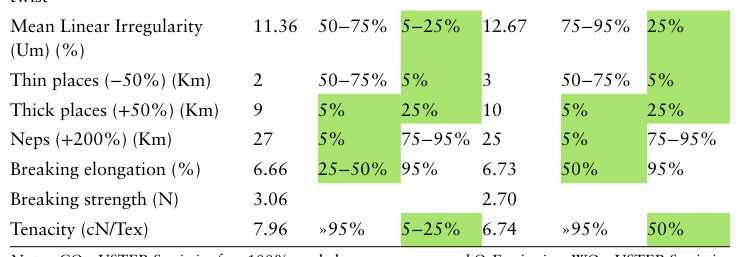
Laboratory Tests of Yarns The yarns Ref. 1 and Ref. 2, containing mechanically recycled fibers in their compositions, were analyzed through laboratory tests for their regularities (USTER regularimeter) and tenacities (dynamometer). The results shown in Table 4 indicate that the yarn’s quality is most appropriate for use in woolen products. For woolen products, the yarns’ quality ranks in the top 5 to 25% of yarns produced worldwide when regularity is considered, as indicated by the Mean Linear Irregularity (Um%). If the application in cotton products is considered, 50% or more of the yarns produced globally have superior quality to the yarns under study. If the application is woolen products, both yarns’ quality is in the top to 50% of yarns in terms of tenacity. The fact that these USTER Statistics were created for yarns made from virgin fibers should be noted. There are at present no statistics available for mechanically recycled yarns because their application is still not widespread. Thus, the comparison being made is with more demanding standards than would be expected. Table 4, which deals with some of the characteristics of the yarns under evaluation, shows that, on average, Ref. 2 yarn has slightly worse results than Ref. 1 yarn, which is to be expected, but both fall within the range of USTER Statistics.
Table 4: Defects, regularity and tenacity properties of yarns Ref. 1 and Ref. 2.
Yarn Ref. 1 Yarn Ref. 2
Property
USTER Statistics Reference
USTER Statistics Reference
CO WO CO WO 25 Nm/1
Linear mass (Yarn count) (Nm/number of cables)
26 Nm/1
Linear mass (Yarn count) (Tex) Twist direction Z Z
Twist (t/m) 653 825
K (Coefficient of Koechlin) - twist
Circularity Research Using Fashion Industry Waste as New Fibers 519 Laboratory Tests of Knits – Kawabata System
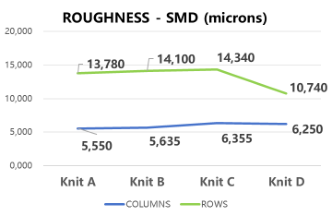
The knits produced with the yarns under study were then evaluated with laboratory tests, and the results of the parameters measured by the Kawabata System, presented in the graphs of Figure 2, allow for comparison, analysis, and discussion of the performance of the various knit samples.
Figure 2: Graphs of Kawabata system modules.
Considering the shear rigidity of the four knit samples, it can be observed that samples Knit B and Knit C have higher values, which means, for these knits, less yarn mobility in the plane of the knit structure. This situation is probably due to the fact that these knit samples have yarns with a higher percentage of recycled fibers (50%) on the back face, resulting in greater hairiness and, consequently, greater friction between the yarns of the structure.
Regarding bending rigidity, sample Knit C exhibits the highest value. This sample has a double knit structure, unlike the interlock structure of the other three samples. This behavior may be related to the fact that double knit consists of two jersey layers joined by binding stitches, which have a locking effect on the bending of the knit sample.
The coefficient of friction (MIU) was determined on the front face, the main face of the knit fabric, although it shows some similarity in values among the four knit samples, a slight decrease in surface friction is noted in the Knit C sample, probably because the double knit structure places jersey knit on the right side of the sample, a smooth structure, with yarn Ref. 3 consisting of 100% virgin fibers, thus offering less friction.
Roughness (SMD) was also determined on the front face of the knit samples, as this face is the main side of the fabric. The main conclusion that can be drawn from the results is the difference in values between the
measurements in the column and in the row directions. Measurements in this latter direction are sensitive to the bumps in the vertical columns of the knit structure, causing these values to be higher. In the case of sample Knit D, the difference between the values in the two directions is noticeably more attenuated, possibly because it is made of 100% virgin fibers.
Laboratory Tests of Knits – Pilling Martindale The results of the tests, performed on the Martindale abrasimeter, to evaluate the propensity of the knit samples to form pilling are shown in Table 5. The results show that the faces of the knitted samples that exhibit the greatest propensity for pilling formation are those made by yarns with recycled fibers. This is because these yarns have more hairiness on their surface since the recycled fibers are shorter.
Table 5: Results of pilling martindale.
Table available in the original PDF paper.
Knit Ref. Front Face Yarn Back Face Yarn Pilling Grade Front to Front
Pilling Grade Back to Back Knit A 90%Vis, 10%PBT Ref. 1 Grade 4 – Slight Pilling Grade 2 – Severe Pilling
The textile and fashion industry is one of the most polluting and, in terms of circularity, recycles a very low percentage of the waste it generates, pre- and pos- consumer. The European Union is producing directives aimed at moving towards a more sustainable and circular fashion supply chain. The consumer market and the relationship between companies (B2B) are moving in the same direction. Research shows that eco-engineering makes it possible to produce relatively fine yarns incorporating up to 50% mechanically recycled fibers, exhibiting acceptable values for regularity and strength when compared to global statistics developed by USTER. However, to maintain quality levels in clothing similar to those consumers are accustomed to with virgin fiber products, the relationship between eco-design and eco-engineering is very important. In the research work developed, the eco-design strategy was to design knit samples incorporating yarns with recycled fibers on the back face and yarns of virgin fibers on the front face. In this way, it is possible to design knitwear with the same appearance and performance that consumers are accustomed to, but incorporating 25% recycled fibers from textile waste.
ACKNOWLEDGMENT
The authors acknowledge the financial support from integrated project be@t – Textile Bio-economy (TC-C12-i01, Sustainable Bio-economy No. 02/C12i01.01/2022), promoted by the Recovery and Resilience Plan (RRP), Next Generation EU, for the period 2021 – 2026.
Circularity Research Using Fashion Industry Waste as New Fibers 521 The authors are very grateful for the support granted by the Research Unit of Fiber Materials and Environmental Technologies (FibEnTech- UBI), through the Projects references UID/00195/2025, DOI:10.54499/ UID/00195/2025 (https://doi.org/10.54499/UID/00195/2025), and UID/ PRR/195/2025, funded by FCT - Fundação para a Ciência e a Tecnologia, IP/MECI.
The authors would like to thank the company J. Gomes for the facilities provided.
REFERENCES
Abrishami, S., Shirali, A., Sharples, N., Kartal, G. E., Macintyre, L., & Doustdar, O. (2024). Textile Recycling and Recovery: An Eco-friendly Perspective on Textile and Garment Industries Challenges. In Textile Research Journal. SAGE Publications Ltd. https://doi.org/10.1177/00405175241247806 Bakar, B. A., & Brook, M. D. B. (2004). Subjective and objective evaluation of fabric
(EU) 2020/852 of the European Parliament and of the Council by establishing the technical screening criteria for determining the conditions under which an economic activity qualifies as contributing substantially to the sustainable use and protection of water and marine resources, to the transition to a circular economy. Official Journal of the European Union. Committee and the Committee of the regions EU Strategy for Sustainable and Circular Textiles. (2022). https://ec.europa.eu/eurostat Delivering the EU Green Deal Progress towards targets. (2025). https://doi.
org/10.2760/8188748 Directive (EU) 2025/1892 of the European Parliament and of the Council of 10 September 2025 amending Directive 2008/98/EC on waste (Text with EEA relevance). (2025). Official Journal of the European Union, 1892. EU Corporate Sustainability Reporting Directive (CSRD. (2022). amending
Regulation (EU) No 537/2014, Directive 2004/109/EC, Directive 2006/43/EC and Directive 2013/34/EU, as regards corporate sustainability reporting. Official Journal of the European Union. European Commission. (2022, March 30). Communication from the Commission to the European Parliament, the Council, the European Economic and Social Committee and the committee of the regions EU Strategy for Sustainable and Circular Textiles. EU Strategy for Sustainable and Circular Textiles. European Parliament. (2024, April 24). Ecodesign rules to ensure sustainable
products on EU market. Eurotex, T. E. A. and T. C. (2023). Circular Economy. EUROTEX. https://euratex.
eu/sustainable-businesses/circular-economy Glasper, M. J., Picerno, G., Tausif, M., & Russell, S. J. (2024). Closed loop mechanical recyclability of post-consumer waste wool fabrics based on fibre length retention. Cleaner Engineering and Technology, 22. https://doi.org/10.1016/j. clet.2024.100796 Honour, Eric C. (2006) “A Practical Program of Research to Measure Systems
Engineering Return on Investment (SE-ROI)”, proceedings of the Sixteenth Annual Symposium of the International Council on Systems Engineering, Orlando, FL.
Kawabata Evaluation System - an overview ScienceDirect Topics (n.d.).
Retrieved March 4, 2026, https://www.sciencedirect.com/topics/engineering/ kawabata-evaluationsystem. Meilich, Abe. (2008) INCOSE MBSE Initiative Status of HSI/MBSE Activity (Presentation). Standard Test Method for Abrasion Resistance of Textile Fabrics (Martindale
Abrasion Tester Method). (2012). In Designation: D4966. Taubman, Philip. (June 25, 2008) Top Engineers Shun Military; Concern Grow. The New York Times Website: http://www.nytimes.com/2008/06/25/us/25engineer. html. Zhezhova, S., Jordeva, S., Golomeova-Longurova, S., Dimitrijeva-Kuzmanoska, V.,
& Dimova, T. (2019). Tactile properties of fabrics. Tekstilna Industrija, 67(2), 4–10. https://doi.org/10.5937/tekstind1902004z
FIND THE COMPLETE VOLUME IN THE AHFE DIGITAL BOOKSTORE
Explore the complete digital volume
Human Systems Engineering and Design (IHSED2026): Future Trends and Applications
Read this individual research paper free through the original publisher, or explore the full digital proceedings book.