Marta Bicho Fernandes, Teresa Raquel Barata, Sandra Ferreira, Rui Miguel, Joaquim Trindade, Constança Almeida, Madalena Pereira (2026). Development digital skills for sustainable fashion design projects: a case study of Portuguese brand. In: Human Systems Engineering and Design (IHSED2026): Future Trends and Applications. AHFE Open Access, vol. 237, pp. 927–936. https://doi.org/10.54941/ahfe1008231
1 University of Beira Interior, Department of Textile Science and Technology, Covilhã Portugal; FibEnTech – Fiber Materials and Environmental Technologies, University of Beira Interior Covilhã, Portugal ↗
2 University of Beira Interior, Department of Textile Science and Technology, Covilhã, Portugal ↗
3 University of Beira Interior, Department of Textile Science and Technology, Covilhã Portugal ↗
4 University of Beira Interior, Department of Textile Science and Technology, Covilhã Portugal; FibEnTech – Fiber Materials and Environmental Technologies, University of Beira Interior Covilhã, Portugal; UNIDCOM/IADE-UE, University Europeia, Lisbon, Portugal ↗
Digital transformation is reshaping the textile and clothing sector, requiring greater competitiveness and the implementation of sustainable practices (Pereira et al., 2025). Ongoing technological and organizational change demands professionals with specific skills, as digital solutions increasingly influence the value chain and reshape traditional processes (Nafz et al., 2022). Digitalization also supports sustainability and circularity (Wiegand & Wynn, 2024; 2025), requiring professionals able to interpret complex information, adapt to change, collaborate in multidisciplinary teams, and generate innovative solutions. In this context, Problem-Based Learning (PBL) emerges as an effective strategy for developing these skills in the textile and apparel industry, focusing learning on students and on solving real problems. Collaborating with industry helps students understand production complexity and respond to concrete sector problems.This research analyses the use of PBL in developing digital and sustainability skills through a challenge conducted with a Portuguese brand, discussing its contribution as a pedagogical tool for solving complex problems and integrating digital technologies and sustainability criteria into production. PBL develops knowledge, skills, and attitudes through practical, real-world experiences (Guo et al., 2020). Results show that student involvement in real challenges increases commitment to the work. The challenge proved decisive in fostering active participation and deepening digital and sustainability skills. The experience highlighted the value of academia-industry collaboration, aligning learning with sector requirements. Facing a real challenge gave students direct contact with the sector and clearer understanding of future skills needs. Interaction with the company required confronting technical constraints, reinforcing practical application of knowledge and skill consolidation.
The textile and clothing industry is currently facing a period of profound transformation. Increasing digitalization has driven significant changes, particularly regarding product development. At the same time, the need to
Received July 14, 2026 Revised August 2, 2026 Accepted August 13, 2026 Available online September 25, 2026
address the challenges of sustainability and circularity requires specific skills. The European Commission’s Pact for Skills was launched to foster upskilling and reskilling in adaptation to the green and digital transitions. The digital transformation of the textile value chain is driving the integration of advanced technologies—such as smart production systems, data analytics, automation, artificial intelligence, and digital platforms thereby requiring new skills from professionals in the sector (Nafz et al., 2022). Digitalization also emerges as an enabler of sustainability, allowing for greater traceability, resource efficiency, and the implementation of circular models (Wiegand & Wynn, 2024). In this context, acquiring these skills is becoming increasingly relevant and necessary. Beyond technological proficiency, professionals need to develop capabilities in complex problem-solving, critical thinking, collaboration, creativity, and adaptability to change. These competencies are frequently referred to as 21st century skills and are considered essential for professional success in environments characterized by high levels of complexity and innovation. At the same time, developing sustainability related competencies is crucial specifically, understanding circular economy principles, making responsible material selections, ensuring the eco-efficiency of production processes, and assessing environmental impacts throughout the product life cycle (Gam & Banning, 2011). These skills often referred to as “green skills” are considered essential for professional success in environments characterized by high levels of complexity and innovation, as well as the growing need for the textile and clothing industry to transition toward digitalization and sustainability.
Higher education institutions therefore face the challenge of developing pedagogical methodologies capable of aligning learning with real-world work contexts. Among these methodologies, PBL stands out as a student centered approach that fosters the active construction of knowledge through the resolution of authentic problems. The literature indicates that the PBL methodology fosters the development of specific competencies for solving complex problems, making its use relevant in transformation and innovation processes (Bertel et al., 2021).
DIGITAL AND GREEN TRANSFORMATION IN THE TEXTILE AND APPAREL INDUSTRY Currently clothing production involves smaller quantities and a wide variety of styles, making the entire value chain process more complex and demanding. A much larger volume of prototypes must be developed due to the existence of multiple collections throughout the year, rather than just the traditional autumn/winter and spring/summer collections. Given these circumstances, the textile and apparel industry must embrace digital transformation. By integrating digital technology, companies become more efficient, achieving more sustainable processes and reduced waste. Digitalization offers significant benefits across the various stages of production and throughout the entire value chain (Nafz et al., 2022).
The transformation of the apparel industry requires professionals to possess digital skills. Digitalization plays a pivotal role in the implementation of circular and sustainable business models. Digital technologies can
Development Digital Skills for Sustainable Fashion Design Projects 929 contribute across the entire fashion business value chain, making it easier to achieve desired sustainability and circularity goals (Wiegand & Wynn, 2024; Vuorikari et al., 2022).
This market realignment requires the development of not only technical skills but also digital and green competencies. Reports from consulting firms, based on market studies, highlight the need to continue strengthening the development of digital skills—particularly in areas such as artificial intelligence and digital product development, and by integrating them into production processes—to ensure companies remain competitive (McKinsey & Company, 2025).
On the other hand, regulations guide the sector toward the integration of sustainable and circular models, meaning that “green skills” cannot be overlooked. It will therefore be necessary for future professionals to possess these two sets of competencies. The literature also indicates growing market interest in green skills (Cabral & Dhar, 2021). There are various regulations encouraging the integration of circularity and sustainability criteria, as well as incentives for the use of low-environmental-impact processes and materials in industrial management (Niinimäki et al., 2020; Vandeplas et al., 2022; Orisadare et al., 2025). Sustainability is not a new topic and therefore cannot be ignored; higher education must contribute to accelerating the development of these competencies. The United Nations has recognized Education for Sustainable Development (ESD) as a fundamental strategy for achieving the Sustainable Development Goals (SDGs). Education plays a crucial role in developing the competencies needed for critical awareness and active commitment to the Sustainable Development Goals (SDGs) (Wals, 2015; UNESCO, 2017; Agbedahin, 2019). This transformation entails a redefinition of the skills required by the labor market, making green skills essential for addressing the challenges of the twin digital and sustainable transition.
PBL AND SKILL DEVELOPMENT PBL emerges to foster meaningful learning (Efstratia, 2014). This methodology is characterized by presenting students with complex problems that mirror professional reality, with students taking an active role in seeking solutions. The teacher acts as a supervisor and guide in the learning process, directing students’ investigation and reflection. The PBL methodology promotes essential skills for highly technological work environments, namely critical thinking, teamwork, autonomy, and the capacity for innovation (Carpenter & Fairhurst, 2005; Yuan et al., 2008; Bradley-Levine & Mosier, 2014; Salvador et al., 2022). The literature indicates that PBL allows the articulation of theoretical learning with practical application, enabling students to simultaneously develop the knowledge, skills, and attitudes necessary for professional practice shaped by new trends (Brzovic & Matz, 2009; Guo et al., 2020). Furthermore, empirical evidence demonstrates that the use of PBL (Problem-Based Learning) methodologies presents higher levels of student motivation, promoting greater engagement, autonomy in learning, and active
participation throughout the learning process—factors that contribute to more consolidated learning and the development of transferable skills for the professional context (Hmelo-Silver, 2004; Cao et al., 2006; Larmer et al., 2015; Shin, 2018; Wijnia & Servant-Miklos, 2019; Evenddy et al., 2023). The literature also highlights that collaboration between educational institutions and companies is a key factor in increasing the relevance of learning experiences, bringing students closer to the real challenges faced in the job market (Nygaard et al., 2008; Ankrah & Omar, 2015).
METHODOLOGY
This study adopted a qualitative, exploratory approach, utilizing the case study method. In qualitative research, the case study is a particularly suitable approach for analysing complex phenomena in real world contexts, enabling the collection of relevant, detailed, and contextualized data that are essential for an in depth understanding of the phenomenon under study (Coombs, 2022).
This study was conducted over a fifteen-week semester involving a class of eleven students in the second-cycle Fashion Design program at the University of Beira Interior in the curricular unit of 3D digital pattern and clothing atelier. The pedagogical experience was based on the PBL methodology and structured around a real world challenge proposed by a Portuguese company in the clothing sector which markets a leading Portuguese brand to enable students to understand real-world problems. The challenge presented to the students required analysing the requirements identified by the company and developing proposed solutions supported by digital tools used throughout the work process.
The partner company presented students with a challenge focused on developing a Valentine’s Day capsule collection, with sustainability serving as the guiding principle throughout the product design and development process. By exposing students to real world business challenges, PBL fosters the acquisition of sustainability competencies including systems thinking, collaborative problem-solving, responsible decision making, and the integration of circular economy and ecodesign principles into product development (Gam & Banning, 2011; Bicho et al., 2024).
For this challenge students were tasked with compiling a technical dossier covering product trends, concept, and slogan of the collection while incorporating detailed technical specification sheets and descriptions for the proposed products. Additionally, they were required to create a Bill of Materials (BOM) listing the specifications for all materials and trims needed to develop each proposed product. To complement the product development process, students also designed and virtually presented the collection using CLO3D software, enabling 3D visualization of the proposals and validation of the technical characteristics and fit of the developed models.
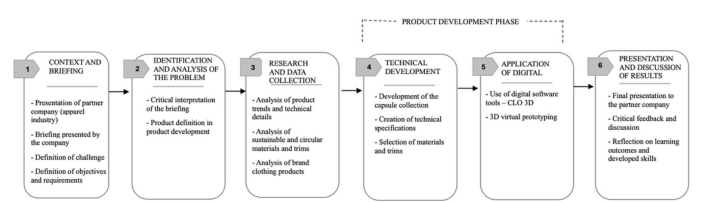
PROJECT STAGES The project proceeded in different phases (see Figure 1).
Figure 1: Phases of the PBL methodology.
In the first phase, the partner company presented the challenge to the students in a meeting, contextualizing the project and defining the objectives, technical requirements, and development criteria for the intended capsule collection at the end of the project. This phase allowed for the evaluation and structuring of the problem in an authentic professional context. In the second phase of the project, a critical analysis was conducted from the students’ perspective, allowing them to reflect on the constraints, both in terms of production and materials, opportunities, and requirements associated with product development. This phase also included a reflection on the digital component. This stage promoted an analytical approach and stimulated problem-solving skills, and was essential for the subsequent stages of the project.
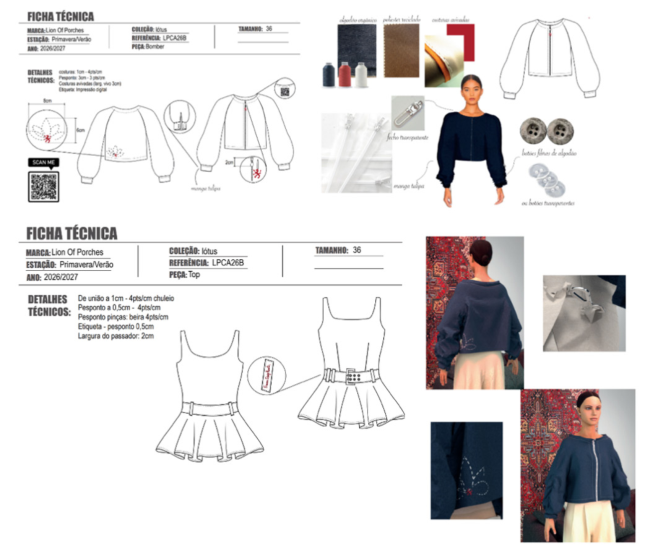
Figure 2: Example of a section of a student, Constança Almeida project. Source: Own.
In the third stage of the project, research was conducted to gather information, including an analysis of fashion product trends and a study of the partner brand’s identity and positioning. This phase also involved researching existing collections regarding the selection of materials and trims based on sustainability criteria. This phase allowed the proposals to be based on market evidence and principles of sustainable development. In the fourth and fifth stages of the project, the technical and digital development of the pieces to be presented was carried out. The students prepared technical dossiers for the proposals, incorporating technical specifications and descriptions. In the case of 3D modeling, the pieces were presented using CLO3D software, with technical and aesthetic validation of the proposed solutions before any physical prototyping. Finally, in the sixth stage, the projects were presented to the partner company before a multidisciplinary team comprising specialists from product development, marketing, sales, and quality departments. During the presentation, the technical, functional, and aesthetic aspects of the various proposals were discussed, and expert feedback was provided to foster critical reflection among the students, the substantiation of design decisions, and the consolidation of the skills developed throughout the process.
Throughout the project and the working semester, students had the opportunity to clarify questions with the company, gaining a better understanding of project requirements and enabling them to carry out the work more effectively. This interaction fostered a closer relationship between the company and the academic institution, promoting the application of knowledge to real-world situations.
At the project’s conclusion, individual pitches were held, giving each student the opportunity to detail product specifications, justify material choices based on sustainability criteria, and showcase the products in 3D. These presentations took place at the company’s headquarters and were attended by representatives from various departments.
RESULTS
The analysis of the results was conducted by having students present their projects to a multidisciplinary team from the company, followed by an evaluation of the work and a reflection on the learning process. Interaction with an authentic business context contributed to the development of relevant competencies aligned with the Pact for Skills (Pact for Skills, 2020; Bianchi, 2020). Students demonstrated greater readiness to apply and develop technical knowledge in real- world situations, justify design decisions, use digital tools, incorporate sustainability criteria into material selection, and communicate well-founded technical solutions to the partner company.
As summarized in Table 1, the implementation of the PBL methodology fostered the mobilization of technical, digital, and green competencies, as evidenced by the activities carried out during the project’s various phases.
Table 1: Development of skills demonstrated by students.
Table available in the original PDF paper.
Observed Evidence
Skills to Develop Mobilization of Competencies Across the Different Phases of PBL
Virtual prototype development
Digital skills Use of CLO3D in design and prototyping Technical skills Preparation of technical documentation
Preparation of technical sheets with product technical descriptions
Green skills Application of ecodesign principles and selection of sustainable materials
Integration of circular economy principles
Professional skills Technical communication of the proposals to the company
Presentation and defense of the developed proposal
Analytical skills Critical analysis at the different stages of the product development process
Justification of product, material, and process choices
CONCLUSION
This study demonstrates that implementing the PBL methodology in collaboration with a company in the fashion sector proved to be an effective strategy for the integrated development of technical, digital and green skills (Bianchi et al., 2022). Solving a real world business challenge fostered active contextualized learning enhancing the application of knowledge in authentic situations and promoting the connection between higher education and industry in line with literature (Savery, 2015).
The integration of digital tools and ecodesign principles has simultaneously enabled the development of competencies aligned with the demands of digital transformation and the transition to more sustainable production models. These results corroborate literature identifying the combination of digital, green, and transversal competencies as a critical factor for employability and innovation in industrial contexts characterized by high complexity and rapid technological evolution (European Commission, 2022; World Economic Forum, 2025; Vuorikari et al., 2022).
Although limited by the number of participants and the specific implementation context, this study reinforces the potential of PBL as a methodology for fostering meaningful learning and developing competencies aligned with the current challenges of the fashion industry, thereby making a significant contribution to the evolution of pedagogical models in higher education. However, given the limitations of the number of projects developed, to use only one brand, a longitudinal analysis and quantification of the choices made in each case in terms of sustainability are recommended, and the results cannot be generalized.
ACKNOWLEDGMENT
The authors acknowledge the financial support from integrated project Be@T – Textile Bioeconomy (TC-C12-i01, Sustainable Bioeconomy No. 02/ C12- i01.01/2022), promoted by the Recovery and Resilience Plan (RRP),
Next Generation EU, for the period 2021 – 2026. The authors are also very grateful for the support granted by the Research Unit of Fiber Materials and Environmental Technologies (FibEnTech-UBI), through the Project references UID/00195/2025 (https://doi.org/10.54499/UID/00195/2025), UID/PRR/00 195/2025 (https://doi.org/10.54499/UID/PRR/00195/2025) and UID/PRR2/ 00195/2025 (https://doi.org/10.54499/UID/PRR2/00195/2025), funded by FCT - Foundation for Science and Technology, IP/MECI.
REFERENCES
Agbedahin, A. V. (2019). Sustainable development, Education for Sustainable Development, and the 2030 Agenda for Sustainable Development: Emergence, efficacy, eminence, and future. Sustainable Development, 27(4), 669–680. Ankrah, S., & Omar, A. T. (2015). Universities–industry collaboration: A systematic
review. Scandinavian journal of management, 31(3), 387–408. Bertel, L., Kolmos, A., & Boelt, A. (2021). Emerging PBL Futures: Exploring Normative Scenario Development as an Approach to Support Transformation in Problem-Based Learning and Higher Education. Journal of Problem Based Learning in Higher Education, 9(1). Bianchi, G. (2020). Sustainability competences. Publications Office of the European
Union, 1(1), 1–73. Bianchi, G., Pisiotis, U., & Cabrera Giraldez, M. (2022). GreenComp: The European sustainability competence framework (M. Bacigalupo & Y. Punie, Eds.; EUR 30955 EN). Publications Office of the European Union. https://doi. org/10.2760/13286 Bicho, M., Pereira, M., Barata, T. R., Santiago, A., Ferreira, S., & Miguel, R. (2024,
October). Development Skills in Sustainable Fashion Design Projects. In Global Fashion Conference (pp. 90–102). Cham: Springer Nature Switzerland. Bradley-Levine, J., & Mosier, G. (2014). Literature review on project-based learning.
University of Indianapolis Center of Excellence in Leadership of Learning. Brzovic, K., & Matz, S. I. (2009). Students advise Fortune 500 company: Designing a problem-based learning community. Business Communication Quarterly, 72(1), 21–34. Cabral, C., & Dhar, R. L. (2021). Green competencies: Insights and recommendations
from a systematic literature review. Benchmarking: An International Journal, 28(1), 66–105. Cao, H., Frey, L. V., Farr, C. A., & Gam, H. (2006). An environmental sustainability course for design and merchandising students. Journal of family and consumer sciences, 98(2), 75. Carpenter, J. M., & Fairhurst, A. E. (2005). Delivering quality and value in the
classroom: The use of problem-based learning in retail merchandising courses. Clothing and Textiles Research Journal, 23(4), 257–265. Coombs, H. (2022). Case study research: Single or multiple [White paper]. Southern Utah University. https://doi.org/10.5281/zenodo.7604301 Efstratia, D. (2014). Experiential education through project based learning. Procedia-
social and behavioral sciences, 152, 1256–1260. European Commission. (2020, November 10). The Pact for Skills: Mobilising all partners to invest in skills [Press release]. https://ec.europa.eu/commission/ presscorner/detail/en/ip_20_2059
Development Digital Skills for Sustainable Fashion Design Projects 935 European Commission. (2022, May 27). Digital and green skills upgrading
programmes by the Public Employment Service. https://digital-skills-jobs. europa.eu/en/initiatives/european-initiatives/digital-and-green-skills-upgrading- programmes-public-employment Evenddy, S. S., Gailea, N., & Syafrizal, S. (2023). Exploring the benefits and challenges of project-based learning in higher education. PPSDP International Journal of Education, 2(2), 458–469. Gam, H. J., & Banning, J. (2011). Addressing sustainable apparel design challenges
with problem-based learning. Clothing and Textiles Research Journal, 29(3), 202–215. Guo, P., Saab, N., Post, L. S., & Admiraal, W. (2020). A review of project-based learning in higher education: Student outcomes and measures. International Journal of Educational Research, 102, 101586. https://doi.org/10.1016/j. ijer.2020.101586 Hmelo-Silver, C. E. (2004). Problem-based learning: What and how do students
learn?. Educational psychology review, 16(3), 235–266. Larmer, J., Mergendoller, J., & Boss, S. (2015). Setting the standard for project based learning. ASCD. McKinsey & Company, & The Business of Fashion. (2025). The state of fashion
2026: When the rules change. https://www.mckinsey.com/industries/retail/our- insights/state-of-fashion Nafz, R., Schinle, C., Kaiser, C., & Kyosev, Y. (2022). Digital Transformation of the Textile Process Chain – State-of-the-Art. Communications in Development and Assembling of Textile Products. Niinimäki, K., Peters, G., Dahlbo, H., Perry, P., Rissanen, T., & Gwilt, A. (2020). The
environmental price of fast fashion. Nature Reviews Earth & Environment, 1(4), 189–200. Nygaard, C., Højlt, T., & Hermansen, M. (2008). Learning-based curriculum development. Higher education, 55(1), 33–50. Orisadare, E. A., Achukwu, O. E., Ogunyemi, A. A., Adedeji, D. O., Diyaolu, I. J.,
Ugwu, E. I., ... & Awoyelu, I. O. (2025). Digitalisation and green strategies: A systematic review of the textile, apparel and fashion industries. Circular Economy and Sustainability, 5(4), 2775–2827. Pereira, M., Barata, T. R., Bicho, M., Mesquita, A., Vilaça, H., Silva, C. J., Belino, N., Santiago, A., Ferreira, S. & Miguel, R. (2025). Portugal. In: Wynn, M., Wiegand, T. (eds) Sustainability, the Circular Economy and Digitalisation in the European Textile and Clothing Industry. SDGs and Textiles. Springer, Singapore. https://doi. org/10.1007/978-981-97-9116-3_8 Salvador, R., Barros, M. V., Barreto, B., Pontes, J., Yoshino, R. T., Piekarski, C. M., &
Francisco, A. C. (2022). Challenges and Opportunities for Problem-Based Learning in Higher Education: Lessons from a Cross-Program Industry 4.0 Case. Active Learning in Higher Education. Savery, J. R. (2015). Overview of problem-based learning: Definitions and distinctions. Essential readings in problem-based learning: Exploring and extending the legacy of Howard S. Barrows, 9(2), 5–15. Shin, M. H. (2018). Effects of Project-Based Learning on Students’ Motivation and
Self-Efficacy. English teaching, 73(1), 95–114. UNESCO Division for Inclusion, Peace, and sustainable development, education sector. Education for Sustainable Development Goals: Learning Objectives. United Nations Educational Scientific and Cultural Organization (2017).
Vandeplas, A., Vanyolos, I., Vigani, M., & Vogel, L. (2022). The possible implications of the green transition for the EU labour market. Luxembourg: Publications Office of the European Union. Vuorikari, R., Kluzer, S., & Punie, Y. (2022). DigComp 2.2: The Digital Competence
Framework for Citizens (EUR 31006 EN). Publications Office of the European Union. https://doi.org/10.2760/115376 Wals, A. E. (2015). Beyond unreasonable doubt. Education and learning for socioecological sustainability in the Anthropocene. Wageningen University. Wijnia, L., & Servant-Miklos, V. F. (2019). Behind the times: A brief history of
motivation discourse in problem-based learning. Advances in Health Sciences Education, 24(5), 915–929. Wiegand, T., & Wynn, M. (2024). Circularity and Digitalisation in German Textile Manufacturing: Towards a Blueprint for Strategy Development and Implementation. Processes, 12(12): 2697. Wiegand, T. & Wynn, M. (2025). Introduction. In: Wynn, M., Wiegand, T. (eds)
Sustainability, the Circular Economy and Digitalisation in the European Textile and Clothing Industry. SDGs and Textiles. Springer, Singapore. https://doi. org/10.1007/978-981-97-9116-3_1 World Economic Forum. (2025). The Future of Jobs Report 2025. https://www.
weforum.org/publications/the-future-of-jobs-report-2025/ Yuan, H., Williams, B. A., & Fan, L. (2008). A systematic review of selected evidence on developing nursing students’ critical thinking through problem-based learning. Nurse education today, 28(6), 657–663.
FIND THE COMPLETE VOLUME IN THE AHFE DIGITAL BOOKSTORE
Explore the complete digital volume
Human Systems Engineering and Design (IHSED2026): Future Trends and Applications
Read this individual research paper free through the original publisher, or explore the full digital proceedings book.