Sandra Ferreira, Rui Miguel, Teresa Raquel Barata, Marta Bicho, Joaquim Trindade, Madalena Pereira (2026). The contribution of artificial intelligence for optimization pattern cutting plan to reducing textile industry waste in fashion design solutions. In: Human Interaction and Emerging Technologies (IHIET-FS 2026): Future Systems and Design Applications. AHFE Open Access, vol. 235, pp. 314–323. https://doi.org/10.54941/ahfe1007285
By increasing knowledge about the problem and calling for sustainable and circular solutions, governments, institutions, and organizations encourage companies, fashion brands, and industries to address the main sources of pollution in the textile sector by reducing waste. Scaling sustainable solutions is quite challenging because these solutions require a lot of study to develop eco-friendly production methods. This study explores how artificial intelligence (AI) using digital solutions for pattern cutting plan reduced waste from cutting the manufacturing of garments. The digital solutions for development pattern cutting plan, such as optimization plan software, is a program that enables the creation of pattern plans for cutting and production of clothing pieces. On the other hand, the software of making plans, supports the use of artificial intelligence to optimize an expansion strategy by conducting nesting simulations to achieve the most efficient and least wasteful plan. These studies, which used these digital solutions, were conducted in the CAD laboratories of the textile department at the University of Beira Interior and aim to develop a study for different fashion design pieces, different sizes, and combinations of sizes in the marker plan. With the study conducted on the various marker-making, it is concluded that the use of AI in digital tools given more efficiency and productivity, and there is a limit of number of combinations of sizes to reduce waste. It was cut and a prototype was produced to demonstrate the potential of the threads made with visual textile yarn orientation material. For this, a twill fabric produced within the scope of be@t was used, with a yarn in the weft 50% recycled produced in the DCTT laboratories at University of Beira Interior. It was concluded that these digital tools allow companies in the textile industry to save time, resources and improve their ability to make quick decisions and study different options with less time for reduce waste, compared with solutions without artificial intelligence.
Digital transformation (DT) has become a crucial strategic requirement for companies looking for success in a highly dynamic, competitive, and uncertain business environment in the current era of unprecedented technology innovation. To significantly alter an organization’s operations, value-creation processes, and stakeholder involvement, DT refers to the integration of digital technologies into every department of the company (MaryAnne M. Gobble, 2018). Artificial intelligence, simulation, cloud computing, additive manufacturing, augmented reality, cybersecurity, industrial of internet of things, 3D printing and robotics, vertical and horizontal integration, and big data analytics are examples of digital technologies that have enabled companies to increase productivity, flexibility, and creativity (Zaki, 2019; Pereira, 2022; Pereira, et al., 2025). Recent research emphasizes the importance of aligning digital transformation with sustainability principles, a strategic integration referred to as sustainable of the companies (Kunkel & Matthess, 2020; Wiegand and Wynn, 2025; Pereira et al., 2025). Based on the results of these studies, this research aims to relate the use of Digital transformation and the reduction of waste, contributing to a more sustainable industry.
SUPPLY CHAIN DIGITALIZATION Over the past few decades, digitalization has grown significantly. These days, supply chains and other company operations are interconnected due to the fourth industrial revolution, often known as Industry 4.0 (Seyedghorban et al., 2019). Information availability and transparency, supply chain process optimization, real-time data collection, process waste reduction, and improved inventory management are some advantages of digitalization in supply chains (Kache & Seuring, 2017) . Businesses must rethink their organizational strategies to obtain a competitive advantage as they transition to digitalized, fully connected, and transparent business processes (Li et al., 2018). But not every company is ready to go digital. Adopting digitalization might be particularly difficult for small and medium-sized businesses (SMEs). Financial and human resources, notably workforce technical competencies, are factors that limit SMEs’ adoption of digitalization (Bokša et al., 2020). To be competitive and future-proof, businesses must assess their digital abilities, for example, by conducting a maturity scan (Zondervan et al., 2022). According to Gupta et al. (2020), a company’s level of digital maturity depends on the technology and tools it uses in comparison to the most recent trends in the sector, as well as the extent to which it uses technology to achieve supply chain and company goals.
THE INTEGRATION OF DESIGN At Textile and Clothing Industry (TC&I) , the digitalization of design integration with production is already a reality with used CAD/CAM systems, but it should advance quickly to the extensive usage of virtual models and tests using simulators that can include all stages of production.
According to research conducted in 2014 by the European Skills Council Textile Clothing Leather Footwear (TCLF), digitalizing design is crucial to achieve the following goals: develop a more customized, high-value proposal, strengthen the relationship between manufacturers and consumers, increase flexibility, rigor, and productivity, simplify procedures and improve profits for companies (European Union, 2025). The CAD-3D will make it possible to develop virtual prototypes of products that are exact to client preferences while additionally creating a database with consumer measures to encourage innovation in accordance with those preferences, with that we can reduce the number of of prototype samples. Perhaps the technology that advances fashion the most is the digitization of design (TC&I) for its contributions to process, product, and marketing innovation. Cloud computing enables access to a vast set of data that is not physically stored on the computer. The data is available through the Internet. The benefits of computing in the cloud are related to the access of information through a device that allows collecting, analyzing, and sharing with clients, suppliers, and company personnel, which facilitates the creation of an image of every step of the value chain, from suppliers to the final consumer (Associação Têxtil e Vestuário de Portugal, 2018).
DIGITALIZATION TECHNOLOGIES AND WASTE REDUCTION An important advancement in sustainable practices, the incorporation of digitization and artificial intelligence into waste management creates both opportunities and challenges. The digital transformation of supply chain management highlights the necessity for a comprehensive approach to sustainability(Schilling & Seuring, 2023). For makers of clothing, furniture, automobiles, and technical textiles, different software, offers, a professional marker-making and automatic nesting solution. It converts cut orders and graded patterns into extremely effective markers that maximize fabric yield while cutting labor, waste, and cycle time. For example, the Diamino software arranges pieces based on size runs, fabric widths, grain and nap, matching rules for stripes and plaids, buffer allowances, and exclusion zones using complex algorithms. To balance speed, quality, and material consumption, it offers roll and piece management, single-ply and multi-ply cutting, and interactive or totally automatic nesting modes. It can simulate hypothetical situations to maximize material distribution and efficiency, and it offers detailed consumption analysis and costing reports to support planning and pricing negotiations. Sector requirements, including specialty materials to complex structure limitations, are addressed by industry-specific arrangements. Faster marker generation, increased fabric consumption, less placement errors, and a more efficient, economical cutting procedure are the results. With Diamino V5R4 the manufacturers looking for simplicity of use, speed, and efficiency in marker-making and material consumption optimization activities during the phases of costing, prototyping, and manufacturing. It also optimizes material consumption at the development and production stages. Another benefit that companies gain from this software is the ability to simulate fabric
The Contribution of Artificial Intelligence For Optimization Pattern Cutting Plan 317 consumption for a specific order and forecast it, creating synergies with the company’s sales and accounting departments (LECTRA, n.d.).
ZERO-WASTE When translated literally, “zero-waste” means “zero garbage.” This method has been applied to the production of fashion items because it minimizes environmental consequences by reducing the amount of textile waste that is thrown away during the manufacturing process (Srivastava & Chanana, 2024). Accordingly, zero-waste refers to the process of fully utilizing raw materials and producing cuts that maximize the material and produce the least amount of waste. The zero-waste technique is attributed to eco-design, which anticipates the reduction of waste and reuse, integrated into a structural technique Zero-waste elevates the designer’s creative capacity, encouraging them to rethink solutions that respect the sustainability principles (Almansour & Akrami, 2024).
However, even while the zero-waste approach aims to prevent and reduce waste before and during the production process. Using this method necessitates examining the pattern and encasing procedure for the pattern making in different sizes. In addition, in large-scale industrial production, the fitting may show inconsistencies with the initial tests and signal changes in the initial material consumption, which could be a weakness of the mold’s grading system (Keating, 2025).
METHODOLOGY
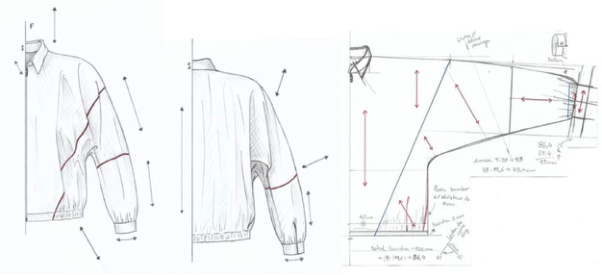
This research proposes the analysis a case study of clothing piece use of fabric in twill with diagonal orientation with wool recycling fibers from be@t project and the development of a prototype with zero-waste patternmaking techniques in the development of clothing products aimed at reducing textile waste in all phases of pattern cutting process. It is proposed to adapt and study the patternmaking of a bomber jacket to reduce waste. The basic bomber jacket patterns represented technical drawing in Figure 1.
Figure 1: Study of technical drawing for reduce waste. Source: own.
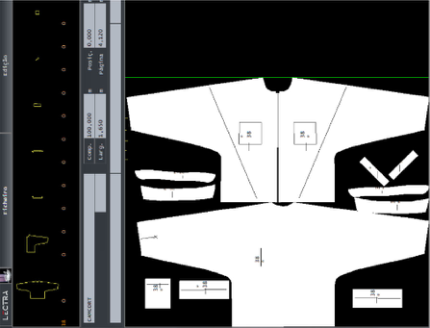
The basic analysis of consumer, we used the diamino expert with IA. The firth analysis of consumers has a base of 1.35 with only 67.02 % of efficiency, and the fabric width needed for the pattern is 1.65 m (Figure 2).
Figure 2: Patternmaking base of the bomber jacket (DCTT CAD).
This study began with the development of patternmaking based on digital software: Previous tests and the use of these patternmaking bases incentivized the choice for the development of the products of this research.
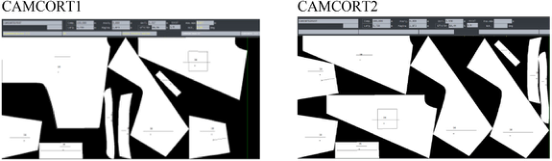
Based on the patternmaking base, tests were conducted using the Diamino software with artificial intelligence (AI), and the use of this base motivated the development of products, allowing for a reduction in consumption and consequently a reduction in waste. They were developed from the base bomber jacket, with other variants applying cuts to pieces and zero-waste techniques. The cutting plan was developed digitally in the software using the diamino with AI, which allowed for the best cutting plan for the configured width of 1.50m (the usable width of the fabric used). The cutting pan respected the restrictions that were applied to the automation, such as adhering to the grainline and forcing in the same piece of garment not to rotate, meaning the pieces had to respect an orientation. The specification of the quantity of products to be fitted was the outcome of earlier experiments that showed that the combination made the most use of the fabric. Additionally, considering large-scale production, cutting plan additional pieces offers satisfactory waste reduction. The base bomber jacket with batwing sleeves in size 38 does not fit within the usable width of the 1.50 m fabric. For this, it was necessary to make a crosscut on the sleeves and create the shaping effect: CAMCORT (see Figure 1). Another variant was created with a bias cut in the front to create a diagonal effect on the final piece: CAMCORT1. To create another hypothesis was to include the same cut from the front in the back part: CAMCORT2. Tests were conducted on the 2 variants, and it was concluded that the variant with the front cut (CAMCORT1) was the most viable for better utilization and better results (see Figure 3).
Figure 3: Comparison of a folded plan with the variant with a cut in the front (CAMCORT1) and with a cut also in the back (CAMCORT2) - own source in DCTT CAD.
When fitting the bomber jacket with a back cut to add to the front, there was no better profitability, which increased consumption due to the necessary sewing values for the making, and it is one more operation in the shirt’s development. So, based on this variant (CAMCORT1), several tests were developed, changing the stretching conditions and the number of pieces to fit in the same plane (see Table 1).
Table 1: Tests conducted on the optimization plan of software in the CAD laboratories of the DCTT (own source).
The software with AI allows analysing the efficiency percentage of each plan. Thus, it is possible to see the percentage of textile waste after the pieces are cut. Taking an example of a fabric that costs 8 euros per meter, we can check the cost of a piece and the cost of the waste after the cut is made. (see Table 2). Furthermore, this cutting plan can be used in large-scale production, and for example the optimization of 1000 products/day, we have 1980 euros of waste by day from 2 sizes, and for 4 sizes 1670 euros.
Table 2: Tests conducted on optimization plan of software in the CAD laboratories of the DCTT (own source).
Table available in the original PDF paper.
Number of Sizes of the Spreading Plan
Unit Consumption (m)
Efficiency (%)
Waste (%)
Bomber Cost (EUR)
Cost of Waste (EUR) CAMCORTE1FEST 1.525 66.56 33.44 12.20 4.07
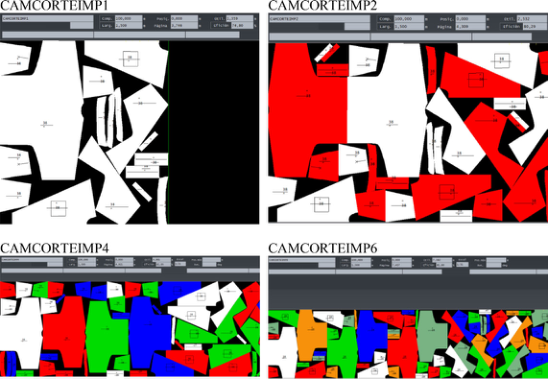
The following images represent the plans of the various size combinations: 1, 2, 4, or 6. All cutting plans are shown in a simple open cutting stretch (see Figure 4).
Figure 4: Plans for various size combinations with variant (CAMCORT1) - own source in DCTT CAD.
We can analyze that 1 bomber jacket cut in a folded has more waste than a bomber cut in a single ply. With the cutting of the simple sheet, shows that mixing more pieces in the same plane results in better efficiency. By analyzing the data, it is observed that increasing the number from 1 bomber to 2 results in a 5.69% increase in efficiency, and for 4 bombers, an 8.15% increase. There is a limit to the cutting plan efficiency; this is confirmed by the fact that mixing 6 bomber jackets in the same plane decreases efficiency compared to the 4-bomber plan. Therefore, for this type of product, the number of patternmaking composition sizes in the same cutting plan with the highest efficiency is 4 (CAMCORTEIMP4).
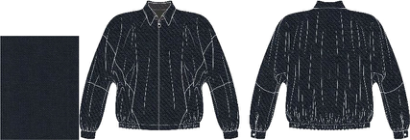
With the chosen variant, the plan was cut to make a prototype that serves as a demonstrator of yarns produced with recycled material. A fabric produced at was used, which belongs to the consortium of the be@t project, in which the weft used yarn produced in the laboratories of the Department of Textile Science and Technologies of the University of Beira Interior. The production of the fabric used the yarn with 25 Nm open-end with 50% recycled fibers wool/viscose and 50% virgin cotton in the weft and in the warp used the yarn with 55% PES, 45 % wool RWS with the title 2/50Nm.´The result of the composition was: 28%PES, 25 %Cotton, 22% Wool RWS, 12.5% Recycled Wool and 12,5 % Recycled Viscose. The fabric structure used was granite with 25.5 yarns per cm and with the fabric was produced the prototype demonstrator (see Figure 5).
Figure 5: Fabric sample and the prototype demonstrator, Source: own.
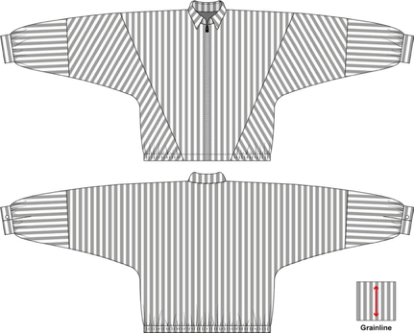
The Contribution of Artificial Intelligence For Optimization Pattern Cutting Plan 321 The effect of a wider stripe was also simulated to understand the aesthetic effect that simultaneously allows for reduced fuel consumption (Figura 6).
Figure 6: Fabric with large stripe, Source: own.
CONCLUSION
This study aimed to analyze the patern making and cutting plan process of a fashion product – bomber jacket, with a focus on reducing textile waste derived from the garment industry, using industrial upcycling as a technique with digital technology included IA used.
It is confirmed that giving sustainability values to the product was possible add sustainability values to the product. It is highlighted that using automated techniques for studying the optimal fit of the clothing products may boost fabric consumption and, as a result, reduce the use of material. In this specific case, the results of the bomber cutting plan demonstrate the need for an in-depth study on it; that is, the introduction of cuts in parts of the garments, namely, in the sleeves and fronts. Even though it takes a lot of time to analyze and cutting plan through studies, the approach is interesting because it can result in significant benefits that are crucial for industry and, by extension, the environment. With the study conducted on the various marker-making, it is observed that the more times it is placed in the same marker, the more efficiency is gained and consequently less waste. But there is a limit to the number of times, because due to the pattern making of the model, we don’t gain much more by adding more pieces.
ACKNOWLEDGMENT
The authors acknowledge the financial support from integrated project be@t – Textile Bioeconomy (TC-C12-i01, Sustainable Bioeconomy No. 02/C12- i01.01/2022), promoted by the Recovery and Resilience Plan (RRP), Next Generation EU, for the period 2021 – 2026.
The authors are very grateful for the support granted by the Research Unit of Fiber Materials and Environmental Technologies (FibEnTech-UBI), through the Projects references UID/00195/2025 (https://doi.org/10.54499/ UID/00195/2025), UID/PRR/00195/2025 (https://doi.org/10.54499/UID/ PRR/00195/2025) and UID/PRR2/00195/2025(https://doi.org/10.54499/ UID/PRR2/00195/2025), funded by FCT - Fundação para a Ciência e a Tecnologia, IP/MECI.
The authors would like to acknowledge.
REFERENCES
Almansour, M., & Akrami, M. (2024). Towards Zero Waste: An In-Depth Analysis of National Policies, Strategies, and Case Studies in Waste Minimisation. In Sustainability (Switzerland) (Vol. 16, Number 22). Multidisciplinary Digital Publishing Institute (MDPI). https://doi.org/10.3390/su162210105 Associação Têxtil e Vestuário de Portugal. (2018). Diretório para a tranformação
digital da ITV. In Projeto n.o POCI-O2-0853-FEDER-036189 - ITV Novos desafios de Competitividade. Pamésa Consultores, Lda. Bokša, M., Šaroch, S., & Bokšová, J. (2020). Digitalization of SMEs. International Advances in Economic Research, 26, 157–177. European Union. (2025, October 9). The EU TCLF Skills Strategy: a practical
roadmap for a greener, more digital and more inclusive industry. Gupta, H., Kumar, S., Kusi-Sarpong, S., & Agyemang, M. (2020). Enablers to supply chain performance on the basis of digitization technologies. Industrial Management & Data Systems, 9, 1915–1938. Kache, F., & Seuring, S. (2017). Challenges and opportunities of digital information
at the intersection of Big Data Analytics and supply chain management. International Journal of Operations & Production Management, 37(1), 10–36. Keating, L. (2025). Zero-Waste Pattern Making: A Lean Approach to Sustainable Fashion Design. Kunkel, S., & Matthess, M. (2020). Digital transformation and environmental
sustainability in industry: Putting expectations in Asian and African policies into perspective. Environmental Science & Policy, 112(1), 318–329. https://doi. org/10.1016/j.envsci.2020.06.022 LECTRA. (n.d.). We are at the forefront of Industry 4.0. Li, L., Su, F., & Zhang, W. (2018). Digital transformation by SME entrepreneurs: A capability perspective. Combined Special Issues on Social Inclusion and Digital Entrepreneurship, 28(6), 1129–1157. MaryAnne M. Gobble. (2018). Digital Strategy and Digital Transformation.
Research-Technology Managemen, 61:5, 66–71. Pereira, F., Carvalho, V., Vasconcelos, R., & Soares, F. (2022). A review in the use of artificial intelligence in textile industry. In J. Machado, F. Soares, J. Trojanowska, & S. Yildirim (Eds.), Innovations in mechatronics engineering. ICIENG 2021. Lecture notes in mechanical engineering. Springer. Pereira, M. et al. (2025). Portugal. In: Wynn, M., Wiegand, T. (eds) Sustainability,
the Circular Economy and Digitalisation in the European Textile and Clothing Industry. SDGs and Textiles. Springer, Singapore. Schilling, L., & Seuring, S. (2023). Linking the digital and sustainable transformation with supply chain practices. International Journal of Production Research, 949–973.
The Contribution of Artificial Intelligence For Optimization Pattern Cutting Plan 323 Seyedghorban, Z., Tahernejad, H., Meriton, R., & Graham, G. (2019). Supply chain
digitalization: past, present and future. 31:2-3, 94–114. Srivastava, P., & Chanana, B. (2024). Review of Zero Waste Pattern Making Techniques in Building Sustainable Fashion. In Journal of the Textile Association (Vol. 85, Number 3). Zaki, M. (2019). Digital Transformation: Harnessing Digital Technologies for the
Next Generation of Services. Journal of Services Marketing, 33, 429–435, 33, 429–435. Zondervan, N., Tolentino-Zondervan, F., & Moeke, D. (2022). Logistics Trends and Innovations in Response to COVID-19 Pandemic: An Analysis Using Text Mining. Processes, 10, 2667. Wynn, M., & Wiegand, T. (2025). Sustainability, the circular economy and
digitalisation in the European textile and clothing industry. SDGs Textiles. Springer, Singapore
LISTED IN THE AHFE DIGITAL BOOKSTORE CATALOGUE
Explore the complete digital volume
Human Interaction and Emerging Technologies (IHIET-FS 2026): Future Systems and Design Applications
Read this individual research paper free through the original publisher, or explore the full digital proceedings book.
ISBN 979-8-950676-11-6
Explore this ISBN in the AHFE Bookstore ↗Listed in the July 2026 bookstore catalogue; search by ISBN to confirm current availability · Digital book purchase optional