Philipp Brauner, Luisa Bremen, Linus Atorf, Malte Rast, Martina Ziefle, Jürgen Rossmann (2020). Evaluation of Different Feedback Conditions on Worker’s Performance in an Augmented Reality-based Support System for Carbon Fiber Reinforced Plastic Manufacturing. In: Advances in The Ergonomics in Manufacturing: Managing the Enterprise of the Future. AHFE Open Access, vol. 12. https://doi.org/10.54941/ahfe100465
Publisher statistics will load when you open Metrics.
AHFE OPEN ACCESS OPEN ACCESS CONFERENCE PROCEEDINGS PAPER
Evaluation of Different Feedback Conditions on Worker’s Performance in an Augmented Reality-based Support System for Carbon Fiber Reinforced Plastic Manufacturing
Carbon fiber reinforced polymers (CFRP) are materials with excellent mechanical properties. However, slight variations in the manufacturing process lead to substantially decreasing mechanical stability and additional production costs for assuring the product’s quality. For large lot sizes a high process quality can be achieved through automation. However, for small lot sizes manual processes are required, which introduce variances in process quality. To support workers in the manual production however, there is little support to guide them and to reduce the variance in product quality. Augmented Reality (AR) applications are successfully used to offer guidance in other manufacturing processes. Yet, no empirical studies of the applicability of AR to support CFRP processing have been carried out. Therefore we present an AR based prototypic worker support system for CFRP manufacturing. Empirically, the impact of different feedback modalities (none, auditory, visual, auditory+visual) as well as individual factors on effectivity, efficiency and user satisfaction was investigated. Key findings show that combined feedback worked best for accuracy, however no feedback was fastest. Regarding user preferences, auditory followed by auditory+visual feedback was rated best. Taking user preferences and performance into account will provide useful guidelines for the development of a support system.
Carbon fiber reinforced polymers (CFRP) are materials that combine very good mechanical stability and very low weight. Components made of CFRP weigh only half as much as comparable steel components and weigh 30% less than components made of aluminum. The combination of high mechanical stability and little weight makes CFRP increasingly used in domains where weight and stability are key design criterions and energy efficiency, mobility or small CO2 emissions are important. Thus, CFRP increasingly gains currency for manufacturing lightweight parts, such as bicycle frames, tennis rackets, boat hulls, car parts. Consequently, industries that heavily invest in the manufacturing of CFRP parts include the aerospace industry and the automobile industry. Due to the outstanding mechanical properties of CFRP, the market is expected to double from approx. 50,000 tons in 2010 to over 110,000 tons in 2018 (Acmite Market Intelligence, 2010). CFRP are composite materials, that is, carbon fibers are combined with polymer. Carbon fibers provide the strength and rigidity of the components, however the rigidity is only available in the direction of the carbon fiber. This is comparable to corrugated fiberboard: A force parallel to the flutes is easily absorbed, while forces orthogonal can easily crush the fiberboard.
Various methods for manufacturing CFRP components exist. We focus on the molding process, in which layers of carbon fiber cloths are placed into a mold, which is then filled with a polymer. As the strength and rigidity of carbon fibers is unidirectional, each layer of carbon fiber cloth has to be placed in a specific orientation. Depending on the component to be build, all carbon fibers on the different cloth layers must lie in parallel to achieve maximum stability in one specific direction (e.g. for manufacturing fishing rods), or the layers need to be placed in a quasi- isotropic layout, e.g. the cloths must be rotated by -45°, 0°, 45°, 90° to achieve a uniform rigidity (e.g. for manufacturing engine covers and car bodies). Strikingly, small variances in orientation can lead to a dramatic decrease in mechanical stability: Even a small misorientation of one layer of carbon fiber cloth by 5° can decrease the overall mechanical stability of the produced component by 50% (Menges, Haberstroh, Michaeli, & Schmachtenberg, 2005). Currently, there are limited options for automatically assessing the correct placement of the carbon fiber cloths during the manual process (Schmitt et al. 2010). Therefore, the quality of a manufactured component can only be tested after the molding process in a closure check. Hence, the component passes through several stages of production until potential errors can be detected. Also, a defective part cannot easily be fixed and usually has to be replaced completely. Consequently, the pivotal element to reduce costs in CFRP manufacturing is the reduction of misalignments of the carbon fiber cloth by supporting workers to place the cloths exactly into the mold.
RELATED WORK
Overview on Worker Support Systems The desire to support laborers during their work is as old as work itself. Since thousands of years plows support workers in telling the land by increasing the performance in comparison to manual work. Also, the basement of pyramids was leveled with water ditches, which helped the workers to increase the accuracy of maintaining a horizontal position. With the advent of modern information and telecommunication technology (ICT) and the early experiments of Ivan Sutherland (Sutherland, 1968), new forms of worker support systems in form of virtual reality (VR) or augmented reality (AR) arose.
Azuma (Azuma, 1997) defines AR as a variation of Virtual Reality (VR). According to Azuma, in VR users are totally immersed into a virtual environment, whereas in AR the user can see the real world, "with virtual objects superimposed upon or composited with the real world". Azuma further argues that AR is an extension to rather than a replacement of reality. As possible applications for AR he explicitly mentions manufacturing and repair tasks. For example, Azuma presents prototypes that support workers during the wiring of cables for airplanes.
Regenbrecht et al. (Regenbrecht, Baratoff, & Wilke, 2005) present systems that support workers in assembly and maintenance in the automotive and aerospace industries. For example, an AR system is used for engine maintain tasks to guide users to defective components and to highlight relevant parts. Assembly tasks, such as wiring cables in an airplane, can be supported by overlaying planned cable route on top of the real working environments. In (Henderson & Feiner, 2011) a worker support system is presented, which assists workers during several maintenance and repair tasks of military vehicles. In a controlled experiment three different display types (AR, head mounted display, and fixed monitor) were evaluated and the study revealed no effect task completion times, but on time for localizing specific parts during the repair task. The AR system worked best, while the head mounted display performed worst. Additionally, the error rate was lowest for the AR system.
A comprehensive overview of AR applications in manufacturing, current technologies for building AR applications and design considerations can be found in (Nee, Ong, Chryssolouris, & Mourtzis, 2012). Moreover, a brief overview of human factors studies in AR applications is given, however the authors suggest, that the understanding of human factors in AR is currently rather incomplete, which may certainly limit the widespread application of AR. Tang et al. (Tang, Owen, Biocca, & Mou, 2003) evaluated the usage of AR in object assembly and showed that AR support increases assembly performance at the cost of increased fatigue and orientation problems. (Odenthal, Mayer, Kabuß, & Schlick, 2012) evaluated an augmented vision system for identifying errors in the assembly of an object comparing it with a virtual counterpart. A static presentation mode and presentation of the virtual object, that dynamically adjusts to the users movements were evaluated with regard to error rate and error detection rate. The study showed that the dynamic presentation of the model worked best in regard to completion time and accuracy. An intelligent mobile welding gun that support welding and riveting in the manufacturing of cars is presented in (Echtler et al., 2003). The gun increased performance and orientation within the chassis, however users criticized the weight of the welding gun and the reduced sight as the display of the gun was between the users eyes and the target.
Although many AR worker support systems exist and many studies suggest that they can increase performance and accuracy of manufacturing processes, no system is specifically targeted at supporting workers in carbon fiber manufacturing.
Impact of Feedback The effect of different feedback variants in mouse pointing tasks was investigated by (Akamatsu, MacKenzie, & Hasbroucq, 1995). Users had to move the mouse cursor to a region of the screen and signal task completion with a mouse click. Upon entering the region, feedback was given to the users either as an auditory signal (constant 2 kHz tone), as a tactile signal (given to the user’s index finger through a modified mouse button), as a visual signal (highlighted target region) or as a combination of all three modalities. Additionally, no feedback was given, i.e. the user could only see that the cursor entered the target region. The study showed that positioning times were best for tactile feedback and worst for no feedback. The overall ranking regarding positioning times was: tactile (fastest), combined, auditory, visual and no feedback (slowest). A recent study (Li et al., 2013) investigated different types of target acquisition assistances and compared the impact of no feedback and two different visualization techniques on efficiency and effectivity. As found, users were significantly faster with visual support compared to no feedback.
A PROTOTYPIC CFRP MANUFACTURING SUPPORT SYSTEM In this section we present the requirements and the design of a prototypic CFRP manufacturing support system followed by implementation details. Requirements’ definition was achieved by carrying out an empirical pre-study.
Requirements definition A pre-study was conducted to identify problems in CFRP manufacturing out of a workers‘ perspective as well as to define requirements for the worker support system. This study was relevant to gain deeper insights into the every- day working processes besides the sparely existing literature in this context. Qualitative data was collected and analyzed descriptively. Process description as well as individually statements of the interviewed experts portrayed that an assistant system might be an excellent support especially in the cloths alignment process. Furthermore, we observed that the work takes place under unsteady conditions and the factory buildings were usually not well illuminated and the machinery caused loud and random noises.
Based on the pre-study the basic requirements for the worker support system in CFRP manufacturing were defined as follows:
The worker support system should be designed for stationary usage. Although the workers frequently changed positions and were standing at different locations around the mold, the main work area was around a single mold.
Feedback for the worker must be encoded with multiple modalities to support both, a diverse user population of which a portion may suffer from visual or hearing impairments, as well as unsteady working environments, in which visual feedback can be used if the noise of a nearby machine drowns out the auditory feedback (Van Krevelen & Poelman, 2010). Suggested feedback mechanisms are visual, auditory, or tactile.1
Furthermore, we use dynamic feedback that visualizes two aspects: First, the fixed target orientation and second, the current orientation, that convergences to the target orientation, as the user rotates the cloth. A contrasting option would have been static feedback, which solely represents the target orientation of the 1 Tactile feedback is currently disregarded, as the support system is not attached to the body and designed for stationary usage.
cloth. The latter option was discarded as previous studies attest the benefits of dynamic feedback (Odenthal et al., 2012).
System Implementation In a prototypic experimental setup, users are asked to create a stack of plates with CFRP-like textures, where the plate orientations must follow a given pattern relative to the ground orientation. This prototype of the planned support system was created rapidly, to answer fundamental design issues early. In the ongoing design process, components and sub processes that have been identified as important were modeled down to the desired level of detail (Rossmann, Kaigom, Atorf, Rast, & Schlette, 2013). Further, the concept of Virtual Testbeds provides an ideal basis for collaborative design and development approaches in interdisciplinary teams (Rossmann & Schluse, 2011). As there was no sophisticated computer vision system for orientation detection of CFRP textures available, a substitute was developed and used as stand-in for future sensors. Currently, we use Microsoft’s Kinect sensor to track the users’ hand movements. Since its launch in 2010, Microsoft's Kinect sensor has become an invaluable contribution to many applications in the fields of computer vision and robotics (El-iaithy, Huang, & Yeh, 2012). The integrated skeletal tracking engine recognizes the user's body poses and returns up to 20 Cartesian joint positions of a human body (Zhang, 2012).
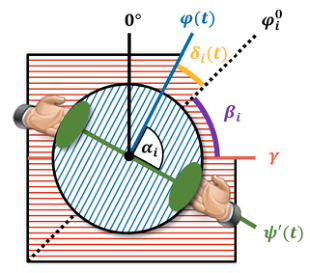
The input variables of the system prototype are 3D positions of the users’ hands, provided by the Kinect sensor at a frame rate of 30 Hz. These sensor data are subject to noise and jitter. Hence, we apply a moving average low pass filter with 6 frames to smoothen the input. The joining vector of the smoothed hand positions is then projected into a plane parallel to the ground in order to calculate the yaw-angle ψ(t) of the horizontal hand positions, according to the following convention. ψ=0° corresponds with the initial position, both hands are parallel in front of the users’ body. If the users’ current plate was a car’s steering wheel, the car would be going straight. Values for ψ>0° are used for clockwise movements (car analogy: steering right), and ψ<0° for counter-clockwise movements, respectively. User guidelines ensure that this hand orientation satisfies −180°<ψ(t)≤180° at all times. However, due to increasing inaccuracies of the Kinect sensor’s skeletal data output, as well as too challenging user tasks, we further constrain valid hand orientations to a range of −45°<ψ(t )≤45° via operator instructions. For further calculations we consider a coordinate system where 0° is pointing straight away from the user, so that we have to transform ψ (t) to ψ
' (t )=ψ (t )+90°. See Figure 1 for an example configuration.
0=45°. With ψ'(t)=120°, it
Figure 1: Illustration of different variables and orientations. It is α i=±90°, γ=±90°, and βi =-45°, so φi follows that φ(t)=30° and hence δ i(t)=-15°. Values for α i and γ are ambiguous due to symmetry.
Due to the experimental setup, the true texture orientation of each plate is not ψ ' (t), but φ (t )=ψ ' (t )+αi, i.e.
0. An assistant system’s objective is then to help the user
shifted about an offset α i with respect to the user’s hand positions. This offset is individual to each plate and is known to the system. As long as the users are using the plates in their intended order and as long as their hand positions stay in the intended areas (both conditions are ensured by the operator), the current plate’s orientation φ (t ) is known to the system at all times. The users are given tasks to place each plate with a certain angle offset βi relative to the ground γ, resulting in target orientation φi
0 and to increase the speed at which small values for δ i(t ) are reached.
minimize the error δ i(t )=φ (t)−φi Design of visual and auditory feedback
The visual assistant system is displayed on a 2D screen, easily visible to the users. In empirical tests we found that the absolute target orientation φi
0 is crucial information to the users, while its calculation is confusing at the same time. Therefore a huge virtual plate with texture orientation is displayed, correctly aligned to the users. The current state φ (t ) is overlaid as transparent texture with a different color, so users can constantly verify their progress.
As auditory feedback, we provide a signal similar to common parking assistance systems from the automotive sector. The pulse frequency of tones with constant pitch varies according to the current situation. When the goal has been reached, i.e. when the absolute angle error ϵ=|(δi (t))| is below a certain threshold δ 0, the signal changes to a constant tone. During normal operation, i.e. for ϵ >δ 0, the tone signal is active for a time t on and pauses for a duration of t off=c ·ϵ. We found δ 0=7°, t on=0.2s, and c=6 to work well in practice.
EVALUATION To evaluate our prototype we conducted a controlled experiment with the following research questions:
(1) What kind of feedback (no feedback, auditory, visual and the combination feedback of visual and auditory) is the most accepted by (a) the users? Which performance regarding (b) completion time and (c) accuracy is best? (2) Do individual performance measurements and user experience deviate from each other? (3) Which user factors have an impact on performance?
Independent Variables As independent variables the within-factor “feedback-type” with the parameter values no feedback, visual, auditory and the combination visual and auditory were evaluated.
Dependent Variables As dependent variables we assessed two different groups that reflect the objective performance and subjective user experience of the participants.
For Performance Measures, two different measured were taken: (1) Efficiency. Measured by completion time in seconds in order to assess the reaction time users needed to fulfill the task. (2) Effectiveness. Measured by the average degree of misalignment (δ i at the end of each task) of the carbon fiber cloth stand-in plates, which had to be positioned accurately according to the task.
In order to measure User Experience, participants rated the perceived Ease of Use after each condition (6-point Likert-scale), on the following dimensions: easiness of usage, usefulness, velocity, accuracy, trust, support, guidance, distraction, fun and own control. Additionally the preferred feedback type was ranked.
Procedure First, a short tutorial was given by explaining the participants the different possible feedback support by turning their attention to the visual presentation in front of them on the wall and to the sound system. At the beginning of Ergonomics in Manufacturing (2020) each trial, participants had to hold the plate horizontal in front of them above a fixed positioned ground plate with a specific fiber orientation γ (either -45°, 0°, 45°, see Figure 2 left). The users’ task was to build a pile of four plates with different orientations, to simulate the layering of carbon fiber cloth (see Figure 2 right). The tasks were
Figure 2: Starting position of a task (base orientation γ=-45°) (left). Two additional carbon fiber cloths plates have been placed during a task (β1=90° and β2=45° relative to base orientation) (right).
Figure available in the original PDF paper.
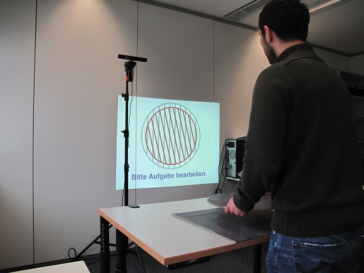
verbally instructed by the experimental (e.g. “Position your board 45° according to the ground fiber orientation”). Participants had to complete the trials as fast and accurately as possible. Prior to starting the experimental trials, each participant was asked to finish a training trial (piling four plates with different fiber cloth orientations) to allow them to get familiar with the feedback types and tasks. The training trial was excluded from the data analysis. Each condition consisted of two different ground plates with four trials each. The feedback type was randomized. Time and accuracy of the tasks was transparently measured within the application. After each trial user experience was assessed through a questionnaire. In the end an overall questionnaire including items about demographic data (age, gender, education, vision and hearing ability), technology acceptance, handling the plates, user characteristics followed as well as the paper-folding test. The overall duration of each experiment was about 45 minutes. Figure 3 (left and right) shows a participant during the experiment.
Participants A total of 23 participants, 4 women and 19 men, in an age rage between 21 and 53 (M=27.55; SD=8.09) took part in the study. Participants were mostly students of different field of studies (design, communication science, production engineering) and fulfilled a course requirement as well as researchers in production engineering. Four participants stated to have theoretical as well as practical knowledge about CFRP manufacture. Overall, a technology- experienced sample was under study (frequent usage of ICT). 90% of the sample was right-handed.
Statistical analysis Results were analyzed using ANOVAs with repeated measurements and t-tests for related samples. The level of significance was set at p < 0.05. Regarding user ratings, non-parametric Friedman analyses were run. The level of significance was set at α=0.05.
Figure 3: A user interacting with the prototype (visual feedback) (left). User placing a carbon fiber cloth layer on bass (right)
RESULTS
Completion time: A significant main effect was found (F(3,66)=6.87; p > 0.001). Tasks with no feedback were solved with M=5.35 s (SD=0.46) significantly faster than tasks with the auditory feedback (M=7.25 s; SD=3.18 s) as well as visual feedback (M=7.92 s; SD=3.66 s). Between the first rank no feedback (M=5.35 s; SD=0.46 s) and the second rank auditory and visual feedback (M=6.42 s; SD=2.67 s) no significant difference was found. In Figure 4
(left) descriptive outcomes of all feedback types are visualized.
Accuracy: Regarding the accurate piling of plates, a different picture emerges. A significant main effect of the different feedback types was revealed (F(2.06,45.34)=24.62; p<0.001). The most accurate performance (smallest misalignment) was found with the auditory and visual feedback (M=7.08°; SD=5.52°) that differs significantly from the no feedback type (M=21.03°; SD=8.74°). Visual feedback (M=8.39°; SD=7.37°) and auditory feedback (M=11.18°; SD=7.68°) show no significant effect. The ranking and its outcomes are portrayed in Figure 4 (right). Subjective ranking: Participants were asked to rank the different feedback types. Results portray that the best-rated feedback type is the auditory, followed by the combination feedback (auditory+visual), visual feedback and finally no feedback. The Friedman rank analysis revealed that feedback types differ significantly from each other (χ2=20.67 (df=3); p<0.001). User experience: To gain a deeper insight into users’ experience, the usefulness of the assistance systems was evaluated according to different dimensions (Figure 5 and 6). Overall, there was a superiority of the feedback systems that combined visual and auditory assistance (blue line), followed by the visual guidance. The merely auditory feedback system was evaluated last.
Figure 4: Mean completion time [s] of feedback types (left). Mean accuracy [°] of different feedback types (right) fast
Figure available in the original PDF paper.
6
fun
accurate
5
4
3
2
trustful
1
easy
visual and audi- tory visual auditory
controlled
supportive guided
Figure 5: User experience ratings of the three feedback modes (1 completely disagree, 6 = completely agree).
Figure available in the original PDF paper.
Also, participants were asked to rate if the feedback modes were “adequate”, “reliable”, and also, if the given feedback might have been distractive during task completion (Figure 6).
feedback did not distra...
feedback was adequate
feedback was reliable
1 2 3 4 5 6
auditory visual visual+auditory
Figure 6: User experience ratings of the three feedback modes (1 completely disagree, 6 = completely agree).
Figure available in the original PDF paper.
Furthermore it was analyzed in how far user experience and performance outcomes show the same result pattern across the different feedback types (see Figure 7). As can be seen in Figure 7 (left), user experience mirrors the speed of execution (completion time): the two lines (blue portraying the completion time and black portraying the user rating) show that both measures are – overall – in parallel2. When focusing on accuracy, again both measures are in line except the condition no feedback. Apparently, users are not aware that accuracy decreases in the condition in which no feedback was given.
Figure 7: Mean completion time [s] and mean User experience score of feedback types (left). Mean accuracy [in °] and mean
Figure available in the original PDF paper.
User experience score of feedback types of different feedback types (right).
Impact of user factors on performance: The final research question, in how far we can find an impact of user factors as e.g. the spatial ability on performance, delivered no significant results.
2 The different absolute levels should not be over interpreted as both scales – time on the left and user experience on the rate- cannot be compared. Ergonomics in Manufacturing (2020)
DISCUSSION
The study suggests that feedback is an important supplement for worker support in CFPR manufacturing. Especially the combination of visual and auditory feedback led to a decreased misalignment of the carbon fiber cloth, while no feedback led to the largest average misalignment within the manufactured CFRP component. Surprisingly, feedback had a negative effect on the participants’ performance (time) and the trials completed without feedback were actually performed fastest. We suspect that this counter-intuitive effect is caused by the novelty and partially unanticipated appearance of the feedback during the experiment. Although the participants successfully made use of the presented feedback (i.e. drastically increased accuracy), they first had to familiarize themselves with the presented feedback to the disadvantage of performance. The instructors frequently observed participants who intentionally misaligned the plates in order to explore how the feedback system will react within or outside of the acceptable limits. Also, this could also be an expertise reversal effect (Kalyuga, 2007), according to which users’ performance decreases despite the assistance as the assistance might counteract to the already established mental model (Ziefle et al., 2003). In further studies it will have to be explored in how far domain knowledge interacts with the worker assistance.
Regrettably the experimental setup did not take this curiosity of the participants into account. Hence, the current study cannot predict how the worker’s performance will evolve under the different feedback conditions over a longer period of time. A follow up study should therefore be carried out, in which a significantly larger number of trials has to be performed under each feedback condition. Nonetheless, the drastically increased accuracy is a promising indicator that a well-designed worker support system will increase the productivity of CFPR manufacturers.
Aspects of user diversity, e.g. different age groups, gender, differences in technical aptitude, as well as subjective technical competency had no measurable impact on neither the subjective rating, nor performance, or accuracy of the worker support system. This may either be caused by the admittedly small sample, or by the fact, that the current design respects different working styles and preferences for feedback modes. Our experimental setup allowed us to investigate the effect of different feedback variants on the worker’s performance, accuracy and user satisfaction. Still, we need to admit, that the accuracy of our prototypic system is currently far from acceptable. Even for the most accurate feedback modes (visual+auditory) the average misorientation is approx. 8.5° and therefore above the accepted error margin. Hence, follow-up studies need to invest in better mechanism to detect the users hand position (for studies investigating prototypes) or mechanisms that reliably measure the actual misalignment of the fibers (for actual support systems).
SUMMARY AND FUTURE WORK This work is focused on the manufacturing of carbon fiber reinforced polymers (CFRP). Similar systems to support workers are also desired for manufacturing similar materials, such as glass fiber reinforced polymers, that share similar mechanical properties and also share similar difficulties in the manual manufacturing process. In addition to pure feedback giving AR based worker support systems, we furthermore imagine to integrate the concept of gamification into the CFRP manufacturing process, as gamification has shown to increase efficiency, effectivity and compliance in various domains (e.g. (Brauner et al. 2013; Deterding et al. 2011; McGonigal, 2011)), we anticipate an additional increased productivity of the CFRP worker.
ACKNOWLEDGMENTS
Thanks to Julian Hildebrandt, Nedim Süzen, Camile Delhaes and Christopher Schröder as well as Tobias Fürtjes, Philipp Kosse and Daniela Brehme for valuable research input and support. The Excellence Initiative of the German Research Foundation DFG funded this work.
REFERENCES
Acmite Market Intelligence. (2010). World Carbon Fiber Composite Market.
Akamatsu, M., MacKenzie, I. S., & Hasbroucq, T. (1995). A comparison of tactile, auditory, and visual feedback in a pointing task using a mouse-type device. Ergonomics, 38, 816–827. doi:10.1080/00140139508925152 Azuma, R. (1997). A survey of augmented reality. Presence: Teleoperators and Virtual Environments, 6(4), 355–385.
doi:10.1.1.30.4999 Brauner, P., Calero Valdez, A., Schroeder, U., & Ziefle, M. (2013). Increase Physical Fitness and Create Health Awareness through Exergames and Gamification. The Role of Individual Factors, Motivation and Acceptance. In A. Holzinger, M. Ziefle, & V. Glavinić (Eds.), SouthCHI 2013, LNCS 7946 (pp. 349–362). Maribor, Slovenia: Springer: Berlin . Deterding, S., Dixon, D., Khaled, R., & Nacke, L. (2011). From game design elements to gamefulness: defining gamification. In
MindTrek ’11 Proceedings of the 15th International Academic MindTrek Conference: Envisioning Future Media Environments (pp. 9–15). doi:10.1145/2181037.2181040 Echtler, F., Sturm, F., Kindermann, K., Klinker, G., Stilla, J., Trilk, J., & Najafi, H. (2003). The intelligent welding gun: Augmented reality for Experimental Vehicle Construction. In Virtual and Augmented Reality Applications in Manufacturing. El-iaithy, R. A., Huang, J., & Yeh, M. (2012). Study on the Use of Microsoft Kinect for Robotics Applications. In Position
Location and Navigation Symposium (PLANS) (pp. 1280–1288). doi:10.1109/PLANS.2012.6236985 Henderson, S., & Feiner, S. (2011). Exploring the Benefits of Augmented Reality Documentation for Maintenance and Repair.
IEEE Transactions on Visualization and Computer Graphics, 17(10), 1355–1368. doi:10.1109/TVCG.2010.245 Kalyuga, S. (2007). Expertise reversal effect and its implications for learner-tailored instruction. Educational Psychology Review, 19(4), 509-539. Li, M., Arning, K., Bremen, L., Sack, O., Ziefle, M., & Kobbelt, L. (2013). ProFi: Design and Evaluation of a Product Finder in a
Supermarket Scenario. In Proceedings of the 2013 ACM Conference on Pervasive and Ubiquitous Computing Adjunct Publication (pp. 977–984). Zurich, Switzerland: ACM New York, NY, US. McGonigal, J. (2011). Reality Is Broken: Why Games Make Us Better and How They Can Change the World. Penguin Group Menges, G., Haberstroh, E., Michaeli, W., & Schmachtenberg, E. (2005). Menges Werkstoffkunde Kunststoffe (5th Editio.).
Munich: Carl Hanser Verlag,. Nee, A. Y. C. Y. C., Ong, S. K. K., Chryssolouris, G., & Mourtzis, D. (2012). Augmented reality applications in design and manufacturing. CIRP Annals - Manufacturing Technology, 61, 657–679. doi:10.1016/j.cirp.2012.05.010 Odenthal, B., Mayer, M. P., Kabuß, W., & Schlick, C. M. (2012). A comparative study of head-mounted and table-mounted
augmented vision systems for assembly error detection. Human Factors and Ergonomics in Manufacturing & Service Industries, n/a–n/a. doi:10.1002/hfm.20364 Regenbrecht, H., Baratoff, G., & Wilke, W. (2005). Augmented reality projects in the automotive and aerospace industries. IEEE Computer Graphics and Applications, 25(6). doi:10.1109/MCG.2005.124 Rossmann, J., Kaigom, E. G., Atorf, L., Rast, M., & Schlette, C. (2013). A Virtual Testbed for Human-Robot Interaction. In
Computer Modelling and Simulation (UKSim), 2013 UKSim 15th International Conference on (pp. 277–282). doi:10.1109/UKSim.2013.87 Rossmann, J., & Schluse, M. (2011). Virtual Robotic Testbeds: A Foundation for e-Robotics in Space, in Industry - And in the Woods. 2011 Developments in E-Systems Engineering, 496–501. doi:10.1109/DeSE.2011.101 Schmitt, R., Mersmann, C., & Schoenberg, A. (2009). Machine vision industrialising the textile-based FRP production. In 2009
Proceedings of 6th International Symposium on Image and Signal Processing and Analysis (ISPA 2009) (pp. 260–264). Sutherland, I. E. (1968). A head-mounted three dimensional display. In Proceedings of the AFIPS Fall Joint Computer Conference (pp. 757–764). Washington, DC, USA: ACM. doi:10.1145/1476589.1476686 Tang, A., Owen, C., Biocca, F., & Mou, W. (2003). Comparative effectiveness of augmented reality in object assembly. In
Proceedings of the Conference on Human Factors in Computing Systems - CHI ’03 (pp. 73–80). doi:10.1145/642625.642626 Van Krevelen, D. W. F., & Poelman, R. (2010). A survey of augmented reality technologies, applications and limitations.
International Journal of Virtual Reality, 9, 1–20. doi:10.1155/2011/721827 Zhang, Z. (2012). Microsoft Kinect Sensor and Its Effect. IEEE Multimedia, 19, 4–10. doi:10.1109/MMUL.2012.24 Ziefle, M., Künzer, A., & Bodendieck, A. (2004). The impact of user characteristics on the utility of adaptive help systems. In Proceedings of the 6th International Conference on Work With Computing Systems (pp. 71-76)
LISTED IN THE AHFE DIGITAL BOOKSTORE CATALOGUE
Explore the complete digital volume
Advances in The Ergonomics in Manufacturing: Managing the Enterprise of the Future
Read this individual research paper free through the original publisher, or explore the full digital proceedings book.
ISBN 978-1-4951-2103-6
Explore this ISBN in the AHFE Bookstore ↗Listed in the July 2026 bookstore catalogue; search by ISBN to confirm current availability · Digital book purchase optional