Valerio Cibrario, Manuela Vargas Gonzalez, Cesare Fantuzzi, Maria Pia Cavatorta, Enrica Bosani, Daniel Dengel, Meike Schaub, Niclas Delfs, Elin Fägerlind, Alessandro Bagalà, Domenico Spensieri (2023). Assessing Ergonomics on Cobot for an Optimized Integrated Solution in Early Phase of Product and Process Design. In: Digital Human Modeling and Applied Optimization. AHFE Open Access, vol. 76, pp. 63–69. https://doi.org/10.54941/ahfe1003355
The design goal for Human-Robot collaboration is combining the repeatability and productivity of automated systems with the flexibility of the operators [1]. One main interest is for cobots to take over complex and physically demanding assembly tasks, reducing the biomechanical workload on workers and increasing product quality. However, as reported by several authors [1-3], the introduction of cobots is not straightforward and should be thoroughly investigated and planned to avoid higher mental stress on workers and a decrease in efficiency. In this respect, Digital Human Modelling can support the integration of robots in design or evaluation of hybrid cells, anticipating process and interaction criticalities.One key aspect of hybrid cells is task allocation between worker and cobot. Recently, Authors in [4] proposed an optimization procedure that looks into productivity and ergonomics. However, the proposed approach is rather complex to apply and does not allow for evaluations of the what-if type, which are particularly useful in the development of new hybrid cells.The paper proposes a new methodology, which has the advantage of being simple and allowing for a visualization of shared operations through a simulator, and for a heuristic evaluation during the design phase of the hybrid workstation, and, finally, permitting a “what-if” analysis. The work is part of the research project D-HUMMER (Digital HUMan Model for ERgonomic workplace) funded by EIT Manufacturing (project number 22294).The simulation tools are the IPS IMMA and IPS Robotics that integrate in the same scenario the evaluation of the biomechanical load on different anthropometries of workers with the performance of the robot working cycle. The advantage of a full digital approach allows frontloading in Concept Phase the workstations’ layout and sequence, even considering different variants, before any production line is established.In the presented methodology, each working job scenario is represented by a state-machine (fig. 1), where each state defines a single atomic task (i.e. a single state) that may be fulfil by either the robot or the human operator, depending on the choice of the workplace designer. Each atomic task is characterized by several parameters (e.g. human strains, time of execution, etc.). In each of the simulator runs, a performance index I_k is computed:I_k = sum_(i=1, to n) alpha_i,k * t_i,k + beta_i,k * s_i,kwhere:k : is the index of each scenario, each represented by a state machine.i : is the index of each state in the state machine.t_i,k : is the time required for each atomic tasks_i,k : is the human strain required for each atomic taskalpha and beta are appropriate weights for each parameter.The paper presents the methodology through a real industrial use case of the Whirlpool microwave assembly. In the current workstation (fig.2) the operator assembles a heavy component (transformer), given by a robot that places it on a table. The worker has therefore the full weight of the component in hands. The optimized solution (fig.3) improves the robot usage, resetting the weight for the worker, and achieving better safety and ergonomics conditions.The methodology has been applied to an already-existing industrial solution. However, its application in early stage may mark a paradigm shift in the workstation design layout for manufacturing companies.
The design goal for Human-Robot collaboration is combining the repea- tability and productivity of automated systems with the flexibility of the operators (Knudsen and Kaivo-Oja, 2020). One main interest is for cobots to take over complex and physically demanding assembly tasks, reducing the biomechanical workload on workers and increasing product quality. How- ever, as reported by several authors (Bruno and Antonelli, 2018; Knudsen
and Kaivo-Oja, 2020; Faccio et al., 2023), the introduction of cobots is not straightforward and should be thoroughly investigated and planned to avoid higher mental stress on workers and a decrease in efficiency. In this respect, Digital Human Modelling can support the integration of robots in design or evaluation of hybrid cells, anticipating process and interaction criticalities.
One key aspect of hybrid cells is task allocation between worker and cobot. Recently, Authors in (Pearce et al., 2018) proposed an optimization proce- dure that investigates productivity and ergonomics. However, the proposed approach is rather complex to apply and does not allow for evaluations of the what-if type, which are particularly useful in the development of new hybrid cells.
The paper proposes a new methodology, which has the advantage of being simple and allowing for a visualization of shared operations through a simu- lator, and for a heuristic evaluation during the design phase of the hybrid workstation, and, finally, permitting a “what-if” analysis.
MATERIALS AND METHODS
The advantage of a fully virtual approach allows the layout and sequence of workstations to be designed in advance by considering different working job scenarios before the production line exists. The simulation tools used are the IPS IMMA (Intelligently Moving Manikin in Assembly) and IPS Robotics, that integrate in the same scenario the evaluation of the biomechanical load on different anthropometries of workers with the performance of the robot working cycle. An innovative feature of IPS IMMA is the possibility to build a customized family of manikins with different anthropometries and simulta- neously running the simulation for the entire family, thus taking into account the physical variety of human operators (Brolin et al., 2019).
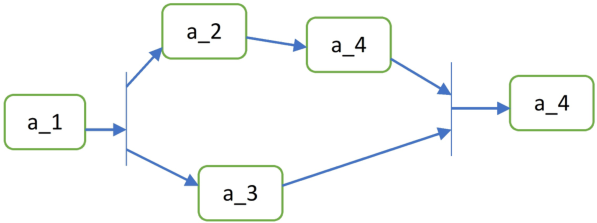
To design the simulation runs, each working scenario is represented by a state-machine (see Figure 1), where each state defines a single atomic task (i.e., a single task operation, such as “grab a device”, or “rotate the screwing tool”, for example) that may be fulfil by either the robot or the human ope- rator, depending on the choice of the workplace designer. Each atomic task is characterized by several parameters (e.g., human strains, time of execution, etc.), as defined in the following equation (1).
Figure 1: State machine representing the breakdown of the working scenario.
Assessing Ergonomics on Cobot for an Optimized Integrated Solution 65
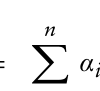
Then, in each of the simulator runs, the performance index Ik is computed as:
Equation reproduced from the original PDF.
where: k: is the index of each scenario represented by a state machine. i : is the index of each state in the state machine. ti,k : is the time required to execute each atomic task, either by the robot or the human operator.
si,k : is the human strain required for each atomic task. αi,k and βi,k are appropriate numeric parameters assigned by the workplace designer to assess the “weight”of the atomic task into the global working job.
Finally, for k = 1, .., n simulation runs the indices Ik is computed in order to assess the best job configuration that minimizes the equation (1).
The reason for running the simulation instead of limiting the study to the numerical calculation for minimizing the index (1) is that the simula- tion makes it possible to evaluate at the same time the functional correctness of the cell, verifying the kinematic parameters and physical dimensions of the various configurations working conditions of the robot and the human operator. The simulation also allows for “what-if”analysis, allowing the desi- gner to vary easily the task allocation and design choices and to evaluate the performance index (1) of the solution under analysis.
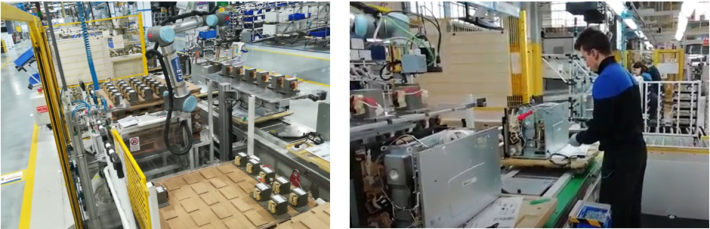
APPLICATION CASE STUDY The selected use case is the assembly of the transformer unit inside a microw- ave. The workstation is at Whirlpool’s factory in Cassinetta, Italy. Currently an UR robot picks the transformer (weight range 4 to 5kg) from the pallet through a magnet and places on a table in front of the worker. The operator then picks up the transformer and places it inside the microwave, fixing it with different tools (Figure 2).
Although the robot helps carrying the transformer, the operator still needs to grasp it and place it in the microwave. This handling activity may represent a risk for the operator and this was the main reason why the workstation was
Figure 2: Current workstation activities.
selected as use case. A digital model of the workstation was created based on the CAD geometries provided by Whirlpool and a family of manikins was built taking into account the anthropometric data of the current operators of the production line. Once the simulation with the family of manikins was completed, the ergonomic assessment was performed. Specifically, the EAWS standard was chosen (Schaub et al., 2013).
In order to improve the process of the production line, the proposed methodology was applied, identifying a further optimized solution for the workplace, based on cobot usage.
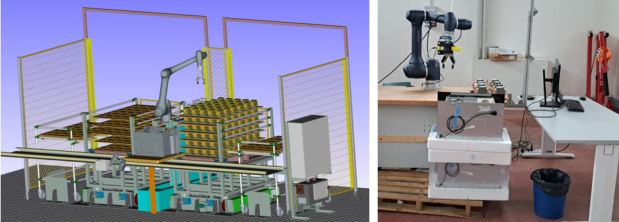
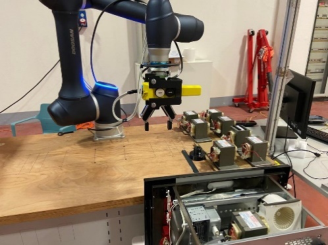
The focus has been a full digital and physical validation of an improved hybrid workstation (Figure 3) that eliminates the weightlifting task by imple- menting an operator-guided cobot. Moreover, the optimization consented to the use of another robot, DOOSAN A0912 (Doosan Robotics Inc., 2023) equipped with a UR RG6 gripper (OnRobot, 2023), a cobot that has force control capabilities that allow for direct manipulation by the worker. The new gripper ensures a more secure hold on the transformer, thus minimizing the chance of failure due to dropping or insecure grip. In this solution, the robot brings the transformer in front of the operator. While the robot is still holding the weight of the transformer, the operator can gently drag the robot tip and gripper to place the transformer inside the microwave. The rest of the work cycle is kept unchanged and was simulated using IPS IMMA. The improved solution eliminates the necessity for the operator to support the weight of the transformer thus improving the overall ergonomic risk. The cobot behaviour was simulated inside IPS Robotics. The time history of the robot joints was then exported, and the results validated with a physical demonstrator.
We recreated in the laboratory the workplace mock-up of the transformer assembly by the design and the development of a workplace that integrates the human operator and the robot. We developed a real work cell with all the components required to fulfil all the operational goals, such as the integration of a handle to the robot arm to permit a true interaction between the robot and the human operator and the insertion of a vision system to allow the identification of the transformers for automatic picking (Figure 4).
Figure 3: Digital and physical optimized workstation.
Assessing Ergonomics on Cobot for an Optimized Integrated Solution 67
Figure 4: Experimental set up.
RESULTS AND DISCUSSION
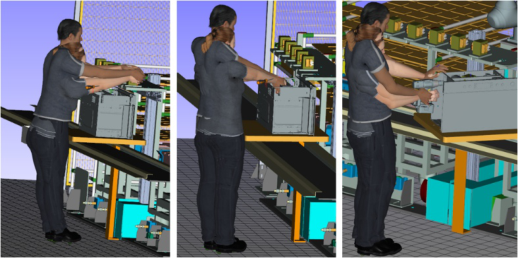
The full work cycle of the microwave workstation was simulated combining IPS Robotics and IPS IMMA (Figure 5).
Currently the task requires manual material handling activities (EAWS, Section 3) when the worker picks and places the microwave transformer and implies working postures and movements with low additional physical efforts (EAWS, Section 1). No significant applied forces are required (EAWS, Section 2).
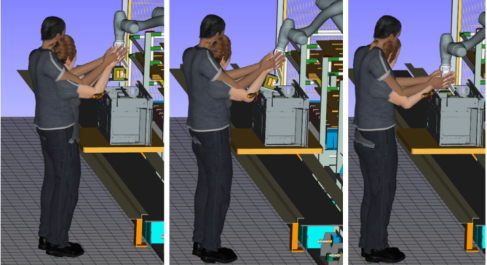
Based on the application of the proposed methodology, a further optimi- zed solution has been identify for the workstation in object. This solution eliminates the necessity for the operator to support the weight of the transfor- mer, thus removing the manual material handling activities and improving the ergonomic score of the task. The analysis of the manikin family allowed simulating the posture adopted by operators’ of different stature and avoiding anthropometric mismatches (Figure 6). The comparison between the current workstation and the new solution highlighted a significant reduction in the operator’s workload.
The last step of the project was the verification on the demonstrator of the results obtained in the virtual environment. These experimental results fully confirm the evaluations carried out using the digital model.
Figure 5: Simulation of the current workstation activities with the family of manikins (4 females and 1 male).Figure 6: Simulation of the cobot functionality of the optimized workstation.
CONCLUSION
A case study of the application of a simulator for the design of industrial work cells where there are collaborative robots and human operators has been presented. The innovative contribution that the article proposes is a methodology that guides the cell designer to develop the shared task betw- een man and robot considering the individual characteristics of the human operator (task precision) and of the robot (strength), through the definition of a performance index on which to base the evaluation of the designed and simulated work cell. The efficacy of the method is based on the characteri- stics of the IPS simulator, which allows combining the functional simulation of a robotic cell (IPS Robotics) with the simulation of the ergonomic load of the human operator (IPS IMMA).
The methodology has been applied to an already-existing industrial solu- tion. However, its application at early design stage may mark a paradigm shift in the workstation design layout for manufacturing companies.
ACKOWLEDGMENT This work has been carried out within the D-HUMMER (Digital Human Model for Ergonomic Workplace Layout and Optimized Production Process) project, funded by EIT Manufacturing, Project number 22294. The support is gratefully acknowledged.
REFERENCES
Brolin, E., Högberg, D., Hanson, L., & Örtengren, R. (2019). Development and evalu-ation of an anthropometric module for digital human modelling systems. Inter-national Journal of Human Factors Modelling and Simulation, 7(1), 47. https://doi.org/10.1504/ijhfms.2019.102178 Bruno, G. and Antonelli, D. (2018) Dynamic task classification and assignment for
the management of human-robot collaborative teams in workcells. Doosan Robotics Inc. (2023) A-SERIES A0912, Doosan Robotics. Available at: https://www.doosanrobotics.com/en/products/series/a0912 (Accessed: 16 January 2023).
Assessing Ergonomics on Cobot for an Optimized Integrated Solution 69
Faccio, M. et al. (2023) ‘Human factors in cobot era: a review of modern production systems features’, Journal of Intelligent Manufacturing. doi: 10.1007/s10845- 022-01953-w. Knudsen, M. and Kaivo-Oja, J. (2020) ‘Collaborative Robots: Frontiers of Cur-
rent Literature’, Journal of Intelligent Systems: Theory and Applications, 3(2), pp. 13–20. OnRobot (2023) RG6 - FLEXIBLE 2 FINGER ROBOT GRIPPER WITH WIDE STROKE, RH6 Gripper. Available at: https://onrobot.com/en/products/rg6-grip per (Accessed: 16 January 2023). Pearce, M. et al. (2018) ‘Optimizing Makespan and Ergonomics in Inte- grating Collaborative Robots into Manufacturing Processes’, IEEE Tran- sactions on Automation Science and Engineering, 15(4), pp. 1772–1784. doi: 10.1109/TASE.2018.2789820. Schaub, K. et al. (2013) ‘The European Assembly Worksheet’, Theoretical Issues in
Ergonomics Science, 14(6), pp. 616–639. doi: 10.1080/1463922X.2012.678283.
LISTED IN THE AHFE DIGITAL BOOKSTORE CATALOGUE
Explore the complete digital volume
Digital Human Modeling and Applied Optimization
Read this individual research paper free through the original publisher, or explore the full digital proceedings book.
ISBN 978-1-958651-52-0
Explore this ISBN in the AHFE Bookstore ↗Listed in the July 2026 bookstore catalogue; search by ISBN to confirm current availability · Digital book purchase optional