Cheng Ma, Huajie Wang (2025). The influence of Chinese calligraphy on cultural and creative product design: A perspective of emotional preferences. In: Human Interaction and Emerging Technologies (IHIET 2025). AHFE Open Access, vol. 197, pp. 149–159. https://doi.org/10.54941/ahfe1006708
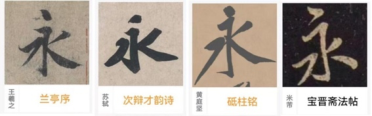
Chinese calligraphy, inscribed in the UNESCO Intangible Cultural Heritage list, is one of China’s most significant contributions to world civilization. It is possible to uncover the emotional expressions embedded in the creator’s writing process by capturing the visual perception of calligraphy. This provides a valuable approach for understanding consumer preferences in the design of cultural and creative products. Based on these insights, designing products can not only enhance their cultural attributes but also position them as new mediums for promoting Chinese calligraphy.This research, grounded in the theories of visual perception and emotional expression, focuses on the character "永" as the central theme. It uses four visual styles from prominent Chinese calligraphers—Wang Xizhi, Su Shi, Huang Tingjian, and Mi Fu—known for their distinctive xingshu (semi-cursive script). These styles serve as prototype samples for analysis. By employing affective engineering measurement methods, the study quantifies consumer preferences and emotional responses to these calligraphic styles, providing an empirical analysis of how different calligraphic forms influence consumers’ emotional preferences.The results of this study will offer valuable insights for cultural and creative product designers, helping them understand individualised consumer preferences from the perspective of calligraphic style. This understanding will enable designers to use new technological approaches to create culturally relevant and aesthetically appealing products. By integrating these insights into product design, the study aims to advance the precise design of cultural products and promote Chinese calligraphy, thereby enhancing its cultural significance through modern design practices.
Chinese calligraphy, rich in diverse cultural connotations, is inscribed on the UNESCO Representative List of the Intangible Cultural Heritage of Humanity in 2009. Safeguarding and transmitting this heritage, while advancing its innovative dissemination globally, has emerged as a globally significant challenge. However, the abstract and symbolic nature of Chinese calligraphy makes its styles, aesthetics, and emotional expressions difficult to comprehend for audiences unfamiliar with Chinese culture or lacking professional training in calligraphy. This poses a significant challenge to its global communication and appreciation. In recent decades, with cultural transitions and creative industry growth, Chinese calligraphy has increasingly been incorporated into product design, giving rise to new cultural meanings and channels of dissemination.
Long before the emergence of Kansei Engineering, emotional expression had been a central criterion in evaluating the most celebrated masterworks in the history of Chinese calligraphy. Notably, three masterpieces—Wang Xizhi (王羲之, Eastern Jin Dynasty)’s The Preface to the Orchid Pavilion (兰亭集序), Yan Zhenqing (颜真卿, Tang Dynasty)’s The Memorial for His Nephew (祭侄文稿), and Su Shi (苏轼, Song Dynasty)’s The Cold Food Post from Huangzhou (黄州寒食帖)—have been historically revered for the emotions embedded within their brushstrokes. Ancient Chinese calligraphy theory placed great emphasis on the philosophical interpretation of emotional expression. During the Tang dynasty, theorist Sun Guoting (孙过庭) proposed visual aesthetic principles based on strokes, structure, and composition, regarding them as vehicles for conveying temperament. He particularly praised Wang Xizhi for the unity of expressive emotion and technical mastery, defining his flowing brushwork and effortless composition as the embodiment of emotional freedom (Sun, 687).
With the rise of the imperial examination system in the Song dynasty, Confucian orthodoxy began to dominate the aesthetic core of calligraphy, reinforcing the idea that “one’s handwriting reveals one’s character” (字如其人, Ni, 2018). Scholars such as Su Shi and Huang Tingjian later developed the theory of “yiqu” (意趣, artistic charm), emphasizing that calligraphy was not merely a technical performance, but a manifestation of the artist’s inner emotions (Dong, Rongtai Ji, 2012). However, these theories were also deeply rooted in Confucian ideology, and over the following centuries, the evaluation of calligraphy increasingly reflected moral character and political allegiance (Ni, 2018).
Since China’s Reform and Opening Up, calligraphy theories on emotional expression have been influenced by Western aesthetics, leading to the emergence of modern interpretations. Calligrapher and theorist Qiu Zhenzhong proposed the theory of “form-language” (书法形式语言), asserting that emotions in calligraphy are conveyed through material traces and that they result from the self-discipline of form (Qiu, 1986; Qiu, 2010). In contrast, Chen Zhenlian introduced the “subjective consciousness” (主体意识) theory, drawing from emotional semiotics, cultural discourse fields, and anti-habitual writing. He emphasized that emotional expression in calligraphy relies on the artist’s subjective agency (Chen, 1993; Chen, 2001). From the perspective of Kansei Engineering, these two theoretical directions—objectivist and subjectivist—offer complementary foundations for the scientific exploration of emotional expression in calligraphy.
At the same time, Kansei Engineering, as a methodology that transforms users’ emotional needs into product design parameters, has been widely adopted in design research and practice. Nagamachi (1995) laid the theoretical groundwork by introducing a framework that maps subjective feelings to physical attributes using SD analysis and factor analysis. However, most early applications focused on industrial products such as automobile interiors, with limited attention to traditional cultural symbols. The SD method by Osgood et al. (1957) provided a standard tool for evaluating emotional polarity across cultural aesthetics.
The Influence of Chinese Calligraphy on Cultural and Creative Product Design 151
Regarding the emotional translation of traditional cultural elements, Correct to “Hsiao and Chen (2015) developed a 12-category evaluation system for Taiwanese teaware design, demonstrating that regional cultural symbols could be quantified through design parameters such as pattern density (120–180 lines/cm2) and curvature radius (0.5–2.0 mm). Lee et al. (2018) found that users’ perception of auspicious symbols like “Fu”(富) and “Shou” (寿) in Chinese iconography correlated positively with color contrast (1E ≥18, r = 0.72, p < 0.01), offering empirical guidance for color configurations in calligraphy-based cultural products.
With the rise of the cultural and creative industries in mainland China, calligraphy has been increasingly used in branding, packaging, and digital media design since the 1980s. Fonts imitating the styles of famous calligraphers such as Wang Xizhi and Su Shi have been widely adopted. In the past decade, calligraphy has played an even more prominent role in cultural product design. However, a trend known as “Jianghu-style” (江湖体, a non-traditional, unregulated calligraphy style characterized by personal spontaneity and commercial appeal, often used in branding and advertising)—which distorts traditional Chinese characters for visual impact—has gradually diverged from the artistic value of authentic calligraphy. To counter this, Huang and Wang (2024) explored the application of Han dynasty clerical script, as seen in the “Shen Wu Fu” (神乌赋) bamboo slips, in packaging design to enhance cultural appeal and aesthetic value. However, this study remained limited to formal analysis and did not propose a generalized design method or pathway.
A few researchers have applied Kansei Engineering and eye-tracking methods to explore cross-cultural aesthetic perceptions of Chinese calligraphy. For instance, Chang and Chiang (2023) selected Kansei words based on the structural characteristics of regular and cursive scripts, using expert questionnaires to analyze their emotional impressions. Their findings suggest that regular script is better suited for structured and hierarchical design, while cursive script is more appropriate for contemporary fashion- oriented products.
In summary, although the application of Kansei Engineering to the study of Chinese calligraphy aesthetics is gaining traction, existing research remains focused on visual perception and broad design implications. It lacks targeted design methods and procedural guidance, limiting its practical application in product development. Therefore, this study aims to construct a novel design research process based on Kansei Engineering and explore new pathways for enhancing the cultural dissemination of Chinese calligraphy through the development of cultural and creative products.
METHODS
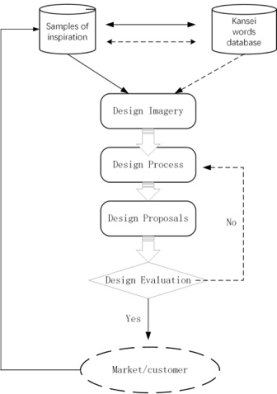
Building upon the established theories of Kansei Engineering and design practices, this study proposes an innovative measurement path for emotional expression in Chinese calligraphy. A three-stage research process — Image Mapping – Design Development – Effect Evaluation — was constructed to
152 Ma and Wang
explore novel pathways for integrating calligraphic emotion into cultural and creative product design (see Fig. 1)
Figure 1: Measurement path for emotional expression in Chinese calligraphy.
Case Study: In-Vehicle Cultural and Creative Pendant Design Following the proposed framework, this project adopted the design of an in-vehicle cultural pendant as a practical case. The study began with a quantitative emotional assessment of classical Chinese calligraphers’ works to derive style-specific imagery maps, which were then translated into design features for product development.
Construction of Kansei Vocabulary Utilizing the Semantic Differential (SD) method — a key tool in Kansei Engineering — an aesthetic lexicon related to the “Qi Yun” (气韵, spiritual rhythm) dimension of Chinese calligraphy was developed. The vocabulary was derived from canonical Chinese calligraphy and aesthetics literature, including Shupu by Sun Guoting (孙过庭) of Tang, Shu Duan (书断)by Zhang Huai-Guan (张怀瓘) of Tang, Guang Yi Zhou Shuang Ji (广艺舟双楫) by Kang Youwei (康有为) of Qing, and Aesthetic Wanderings (美学散步) by Zong Baihua (宗白华) of Modern China.
A focus group of 10 design professionals and University Students with formal training in both calligraphy and product design refined the vocabulary through expert review. Three bipolar aesthetic scales were selected as core dimensions:
Elegance ←→Vulgarity
Tranquility ←→Agitation
Harmony ←→Extremity
The Influence of Chinese Calligraphy on Cultural and Creative Product Design 153
A 9-point Likert scale (−4 to +4) was developed to evaluate these dimensions quantitatively, with 0 as the neutral midpoint.
Table 1: Semantic polarities for calligraphic aesthetic dimensions.
Table available in the original PDF paper.
Comparative Dimension Definition (−4: Left Pole) Definition (+4: Right Pole) Vernacular appeal/Overt and Elegance ←Vulgarity Aristocratic refinement/
Subtle and restrained aesthetics
flamboyant visual expression Serenity ←Agitation Composed and harmonious Dynamic tension/Visually
rhythm/Visual stability
conflicting and restless forms Balance ←Extremity Rigorous compositional Rule-breaking
rules/Harmonious layout
experimentation/Visually disruptive formats Selection of Representative Calligraphers The focus group identified Xingshu (行书, semi-cursive script) as the most emotionally expressive script among the five traditional types. Four historically significant masters were chosen as representatives based on three criteria:
Innovation in visual and tactile aesthetics.
Lasting historical influence and legacy.
Potential for cross-cultural design adaptation.
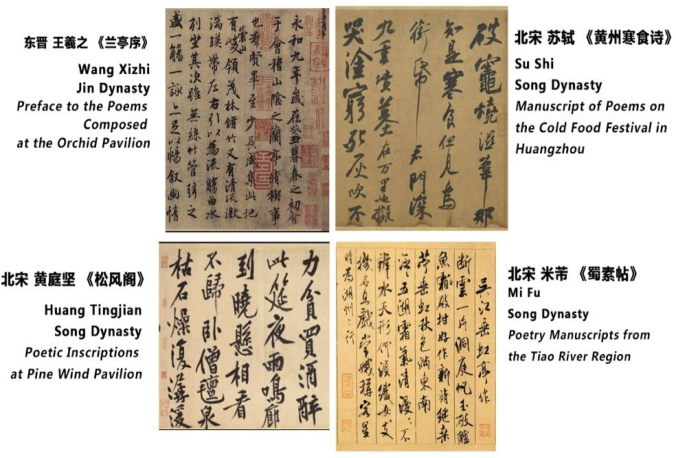
Selected calligraphers and their benchmark masterworks included Wang Xizhi (Eastern Jin), Su Shi, Huang Tingjian, and Mi Fu (Northern Song) (Fig. 3)
Figure 2: Representative works of the four calligraphy masters.
154 Ma and Wang
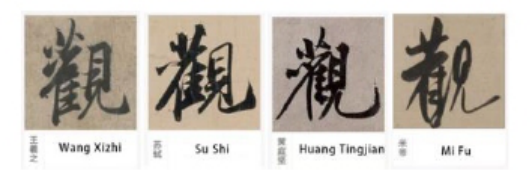
Character Set for Comparative Evaluation Three categories of Chinese characters were selected for the evaluation, each designed to test different aspects of calligraphic emotion:
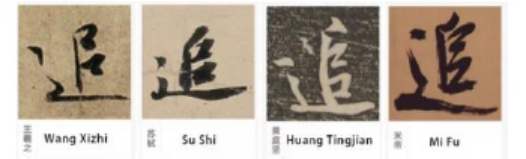
Figure 4: The Character “Guan” in masterworks of the four calligraphy masters.Figure 5: The Character “Zhui” in masterworks of the four calligraphy masters.
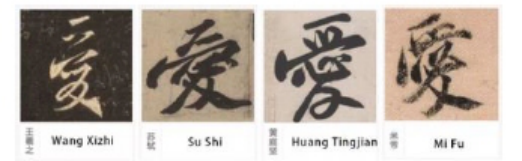
Figure 6: The Character “Ai” in masterworks of the four calligraphy masters.
The Influence of Chinese Calligraphy on Cultural and Creative Product Design 155
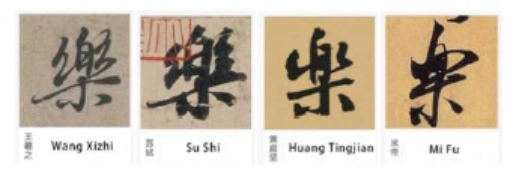
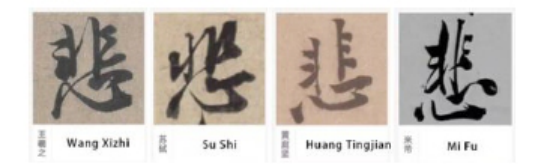
Figure 7: The Character “Le” in masterworks of the four calligraphy masters.Figure 8: The Character “Bei” in masterworks of the four calligraphy masters.
Each character was analyzed using the Likert scale across the three aesthetic dimensions. Evaluation was guided by Qiu Zhenzhong’s framework (Qiu, 2023), emphasizing stroke technique, composition, and structure.
Derivation of Stylistic Labels Through group discussions, integrated style labels were derived for each master:
Table 2: Emotional dimension ratings of calligraphic styles (Scale: −4 to +4).
Table available in the original PDF paper.
Calligrapher Elegance ←→ Tranquility ←→
Harmony ←→ Style Label
Vulgarity Agitation
Extremity
Wang Xizhi +3 +2 +4 Harmonious Ideal Su Shi 0 –2 +1 Intellectual Paradox Huang Tingjian +1 0 -1 Zen Dynamic
Balance Mi Fu –3 –4 –3 Technical Extremism
Based on the style labels, four Kansei Maps were developed to guide visual and emotional translation into practice:
Wang Xizhi →Harmonious Ideal: Elegance, scholarly grace, antiquity (Fig. 9).
Figure 9: Kansei image board aligned with Wang Xizhi’s style.
Figure available in the original PDF paper.
156 Ma and Wang
Su Shi →Intellectual Paradox: Melancholy, simplicity, spontaneity (Fig. 10).
Figure 10: Kansei image board aligned with Su Shi’s style.
Figure available in the original PDF paper.
Huang Tingjian →Zen Peak: Zen spirit, wildness, grandeur (Fig. 11).
Figure 11: Kansei image board aligned with Huang Tinjian’s style.
Figure available in the original PDF paper.
Mi Fu →Technical Revolution: Extremity, modernity, intensity (Fig. 12).
Figure 12: Kansei image board aligned with Mifu’s style.
Figure available in the original PDF paper.
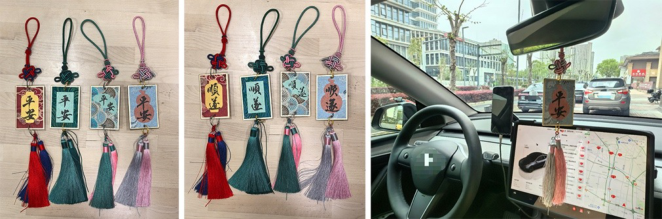
Cultural and Creative Pendant Design: Calligraphic in-Vehicle Pendants In Chinese culture, in-vehicle pendants often symbolize protection and good fortune. The creative design centered on the phrase “Ping An Shun Sui” (平安顺遂, Peace and Smooth Travels), rendered in calligraphic styles matching the emotional characteristics of the four masters. Four symbolic icons were selected for the pendant design, each with culturally embedded meanings:
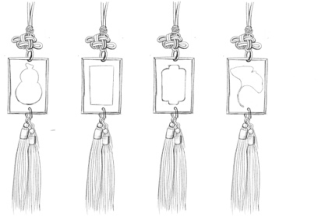
Design adaptation utilized Song brocade aesthetics, aligning with the popular appreciation for Song Dynasty visual culture in contemporary China. Fig. 13 presents a conceptual design sketch developed with reference to pendant products currently available on e-commerce platforms.
Each calligraphic master was matched to a specific symbol based on emotional and aesthetic compatibility:
The Influence of Chinese Calligraphy on Cultural and Creative Product Design 157
Figure 13: Conceptual design sketch for In-Vehicle Pendants.Table 3: Symbolic matching of calligraphic styles and pendant forms.
Table available in the original PDF paper.
Symbol Calligrapher Rationale Lantern Mi Fu High visual tension and symbolic movement Gourd Huang Tingjian Spiritual containment and Zen sensibility Ginkgo Leaf Wang Xizhi Balanced structure and refined elegance Square Frame Su Shi Intellectual experimentation with form
Final culture-based In-Vehicle Pendants shown in Fig. 14, and the final real-world installation of the calligraphy-inspired in-vehicle hanging ornament, illustrating its integration within the automobile interior setting.
Figure 14: Final calligraphy-inspired in-vehicle pendant and interior display.
Design Effect Evaluation A post-design user evaluation was conducted using a questionnaire based on a 9-point Likert scale (1 = not achieved, 9 = fully achieved) covering:
Visual congruency
Cultural resonance
Functional perception.
Fifty participants observed the products and rated their impressions. The measurement results indicate that the participants demonstrated a positive attitude toward the implementation of this new method.
158 Ma and Wang
Table 4: Post-design user evaluation results (9-point likert scale).
Table available in the original PDF paper.
Evaluation Mean (M) SD Distribution [1–3–5–7–9] Positive Dimension
Achievement Rate
Visual
7.2 1.1 (8/25/17) 84% Congruency Cultural 6.8 1.3 (10/22/18) 76%
CONCLUSION AND DISCUSSIONS This study presents a novel emotional expression pathway for cultural and creative product design based on the stylistic characteristics of Chinese calligraphy. By integrating the principles of Kansei Engineering with traditional calligraphic aesthetics, the research successfully explores a design approach that aligns emotional semantics with tangible product forms, particularly in the design of in-vehicle hanging ornaments. The evaluation of the creative outcomes through a post-design survey demonstrated that the design outputs were well-received by the participants, achieving high ratings in visual matching, cultural appropriateness, and perceived functionality. These results validate the applicability and effectiveness of the proposed framework, confirming its potential as a valuable tool in the development of culturally infused products.
Despite the positive reception, the study does have limitations that must be addressed in future research. One key limitation is the reliance on subjective feedback gathered from questionnaires, which lacks the objective support provided by more advanced physiological research methods such as eye- tracking and electroencephalography (EEG). These methods could offer deeper insights into the users’ emotional and cognitive responses to the calligraphic designs. Additionally, the participant pool consisted entirely of individuals from design-related disciplines, which may introduce bias and limit the generalizability of the findings. To enhance the robustness of future studies, it is crucial to incorporate a more diverse range of participants from various demographic and professional backgrounds.
Moreover, the study’s focus on a single design category—automotive cultural-creative pendants—limits the scope of its applicability. Future research should explore how the framework can be extended to other product categories, such as home decor or digital media, to further test its versatility in cultural product design. Furthermore, additional quantitative evaluation methods, such as biometric feedback, would provide more precise and reliable data to support the findings.
In conclusion, this study contributes to the field of cultural-creative product design by providing a systematic approach to integrating the emotional expressions of Chinese calligraphy into product development.
The Influence of Chinese Calligraphy on Cultural and Creative Product Design 159
It offers a pathway for enhancing the global communicability of Chinese cultural heritage while also fostering innovation in product design. As research continues to expand in this area, the inclusion of more sophisticated evaluation methods and broader participant demographics will ensure that the findings become even more meaningful and applicable across diverse cultural contexts.
REFERENCES
Chang, C. S. & Chiang, H. J., 2023. Analysis of the Chinese calligraphy using Kansei Engineering. Unpublished manuscript. Chen, Z., 1993. Calligraphy aesthetics [书法美学]. Zhejiang People’s Fine Arts
Publishing House. (In Chinese) Dong, Q., 2012. Rongtai ji [容台集]. Xiling Yin She Press. (In Chinese) Hsiao, S. W. & Chen, C. H., 1997. A semantic and shape grammar based approach for product design. Design Studies, 18(3), pp. 275–296. Huang, J. & Wang, D., 2024. Research on the design strategy of cultural and creative
packaging for bamboo slips in Shen Wu Fu (神乌赋). Shanghai Packaging, 12, p. 32. https://doi.org/10.19446/j.cnki.1005–9423.2024.12.011 Nagamachi, M., 1995. Kansei engineering: A new ergonomic consumer- oriented technology for product development. International Journal of Industrial Ergonomics, 15(1), pp. 3–11. Ni, Y., 2018. Yan Zhenqing’s calligraphy and Song literati politics [中正之笔: 颜真 卿书法与宋代文人政治]. Jiangsu People’s Publishing House. (In Chinese) Osgood, C. E., Suci, G. J. & Tannenbaum, P. H., 1957. The measurement of meaning.
University of Illinois Press. Qiu, Z., 1986. The form and interpretation of calligraphy [书法的形态与阐释].
Chongqing Publishing House. (In Chinese) Qiu, Z., 2010. Writing and contemplation: On calligraphy creation, statement and criticism [书写与观照——关于书法的创作、陈述与批评]. China Renmin University Press. (In Chinese) Qiu, Z., 2023. Brushwork, composition, and structure: A study of the forms
of calligraphy [笔法·章法·字结构: 书法形态研究]. Shanghai Calligraphy and Painting Publishing House. (ISBN: 978-7547931431) (In Chinese) Yeh, C. T. & Chen, M. C., 2018. Applying Kansei Engineering and data mining to design door-to-door delivery service. Computers & Industrial Engineering, 115, pp. 512–527.
LISTED IN THE AHFE DIGITAL BOOKSTORE CATALOGUE
Explore the complete digital volume
Human Interaction and Emerging Technologies (IHIET 2025)
Read this individual research paper free through the original publisher, or explore the full digital proceedings book.
ISBN 978-1-964867-73-1
Explore this ISBN in the AHFE Bookstore ↗Listed in the July 2026 bookstore catalogue; search by ISBN to confirm current availability · Digital book purchase optional