Jinwu Xiang, Miao Zhang, Rong Chen, Huajie Wang (2022). Sustainable Development Index System: New design method about cultural and creative product. In: Human Factors in Communication of Design. AHFE Open Access, vol. 49, pp. 101–107. https://doi.org/10.54941/ahfe1002042
Cultural and creative products has provided important support for the cultural and creative industry. Based on the three basic principles of Sustainable Development Theory - fairness, continuity and commonality, this article uses focus groups and analytic hierarchy process to construct the product design basic element, cultural element and value element. The indicators of these elements include 15 design indicators. Using these indicators can guide the design of cultural and creative products to achieve common, coordinated, fair, efficient, and multi-dimensional development, Focusing on relevant design indicators, we finished some projects about Chinese Jiangnan cultural series products and waste glass products etc., which verified the effectiveness of the corresponding indicators.
With the progress of society and the improvement of people’s living stan- dards, the cultural and creative industry has begun to develop rapidly, and cultural and creative products (CCPs) are important part of cultural and creative industry which have ushered in various more favorable policies (Lin, 2011).
How to design wonderful CCPs is becoming more and more important in the cultural and creative industry. The paper tries to find a sustainable development method to improve the CCPs’ design.
Definition of Sustainable Development Sustainable development is defined as: “meeting the needs of the present without meeting the needs of future generations.
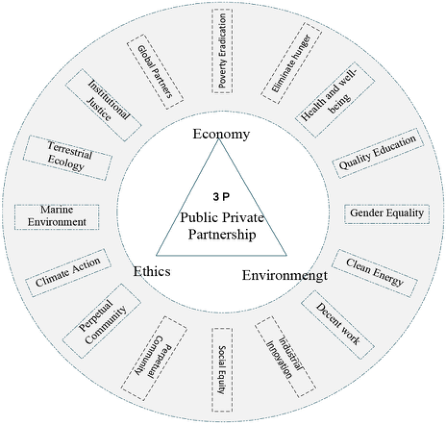
On September, 2015, the United Nations Sustainable Development Sum- mit was held at the headquarters in New York. The 193 member states of the United Nations made 17 sustainable development goals at the summit (Webteam, 2003), these members would solve development problems in the three dimensions of society, economy and environment, and turn to the path of sustainable development (see Figure 1).
Figure 1: Schematic diagram of the united nations sustainable development goals.
Cultural and creative products originate from culture, and the develo- pment of CCP also needs to follow the concept of sustainable development.
Overview of CCPs The cultural industry takes culture as its core content and conducts acti- vities to directly meet people’s spiritual needs. CCPs include goods and services; CCP refer to consumer goods with creativity, symbols and lifesty- les, and cultural services are an activity that responds to culture or needs (Xiang, 2021).
CCPs are “products with market value that originate from cultural the- mes and are transformed through creativity”.CCP includes “cultural end”, “creative end”, “product end”, “channel end” and “consumption end”, that is, the entire process of “design-production-sales-consumption-disposal and recycling” of products needs to be taken into account.
METHOD
Focus Group Method Focus group method is one of the most commonly used usability evalua- tion methods. In the 1980s, the results of focus group research began to appear in the literature, which made it more widely accepted and applied as a qualitative research method. The focus group method relies primarily on the moderator to initiate discussion and facilitate the interview, while the moderator’s personal views cannot influence the results. Because it mainly relies on discussions and interviews, it is flexible and open to use, and it can explore the ideas in people’s consciousness, which makes it one of the important qualitative research methods in usability evaluation.
Sustainable Development Index System 103
Through the focus group method, this paper finds some important ele- ments in the design factors of CCPs can be determined comprehensively and scientifically, so as to provide reasonable theoretical support for the design of CCPs.
Analytical Hierarchy Process Analytical Hierarchy Process is an analysis method for multi-objective decision-making and an important concept in operations research (Saaty, 2004). It is a quantitative calculation method that obtains the decision of complicated problem. The basic idea is hierarchical analysis. According to the overall goal, problems are decomposed into several levels: Target level, criteria level and index level. Analytic Hierarchy Process is suitable for the study of “CCP design factors”, which is an unstructured and multi-objective systematic evaluation. After selection, the categories of CCP product design factors can be clarified, so as to design the sustainable development of CCP products.
CONSTRUCTING THE SUSTAINABLE DEVELOPMENT CCP INDEX SYSTEM CCPs’ Sustainable Development Index System
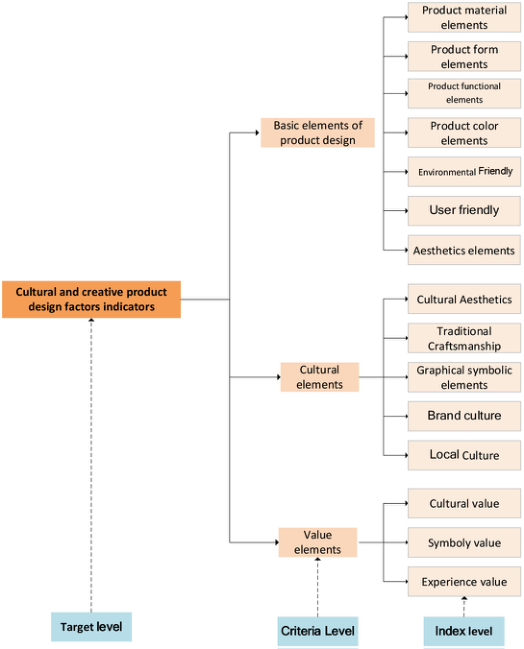
As shown in Figure 2, CCP product design factors take culture as the content and product as the carrier, and fully reflect the product value of CCP products through product design elements, cultural elements and value elements. We build 15 indicators in index level.
If the concept of sustainable development is adhered to in its connotation, and the concept of sustainable development is placed in the cultural content, product essence, and design creativity, then the entire CCP can be integra- ted from creative design, product production, marketing, recycling, etc. The product cycle reflects the concept of sustainable development and spreads along with the cultural heritage. Combining the indicators of sustainable development and the design theory of CCPs, the indicator system for the design of CCPs based on the concept of sustainable development is completed (Wang, 2021).
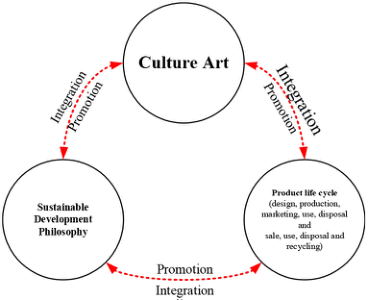
Theoretical Model for Integrating the Concept of Sustainable Development into Design Practice The design of CCPs is a process of integrating culture into products with culture as the source. How to reasonably use the modern context to better express the connotation of traditional Chinese culture is an important pro- blem that we urgently need to solve. To this end, we try to build a platform that takes the concept of sustainable development as the foundation, integra- tes the content of culture and art into products, and runs through the entire life cycle of CCPs through green design(see Figure 3). On this platform, there are our regular product green material library, advanced product production technology experience accumulation, product green design methods, product recycling methods, redesign and utilization methods and so on.
Figure 2: The sustainable development index of CCP design.Figure 3: Theoretical model (platform) of industrial design practice of CCPs.
In our product life cycle, we need to plan our product concept and carry out the green design path of the product at the source. The traditional pro- duct design only takes people as the center. while the green design with the concept of sustainable development as the core is to plan products from
Sustainable Development Index System 105
the source, it requires designers to apply the idea of concurrent design in the designer, rationalize the utilization of resources, improve the efficiency of energy utilization, assemble, disassemble, and recycle resources and pro- tect the ecological environment, and ensure the function, quality, and use of products. Various requirements such as life and cost are listed as equally important design goals and are guaranteed to be smoothly implemented in production.
EMPIRICAL STUDY Application Cases of Materials Sustainability in CCPs
Reusing waste is also an option for our creative product development under the concept of sustainable development. An organization called “Plastic Reduction” in Thailand launched a project called “Classifying Plastic Bot- tles to Help Medical Staff” during the epidemic, aiming to recycle plastic bottles and put them back together. Plastic bottles and polyester clothing are the same base material, and the recycled plastic bottles are redissolved, spun and woven to make polyester protective clothing used in hospitals. This pro- tective clothing can be reused for many times after being properly sterilized up to 20 times; this not only reduces the environmental pollution of pla- stic waste, but also solves the need for insufficient protective equipment for medical personnel under the epidemic.
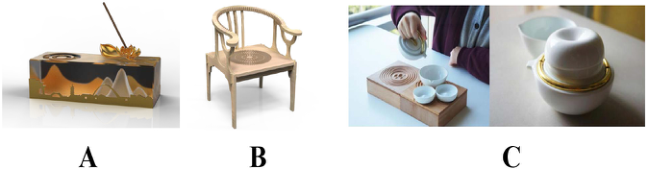
As shown in Figure 4-A, a gift design designed by the author’s team, we used the discarded optical glass manufactured by one company to make its own company-specific gifts. The combination of low-cost metal kits featuring silhouette features of architectural elements forms paperweights and pen hol- der supplies for the study, which not only reflect humanistic aesthetics, but also have practical value.
Cases of Technological Sustainability of New Functionalities of CCPs Under the trend of the concept of sustainable development, the application of new materials and technologies has laid a strong foundation for the concept of sustainable development. The application of 3D printing technology in the design and development of CCPs will inevitably be widely used with the development of printing materials. 3D printing materials include not only plastic materials such as photosensitive resins. It is widely used in furniture and decoration industries, and it can reflect the concept of low carbon and sustainable development in terms of utilization rate and transportation, and the CCP furniture made of it. It is also a reflection of the concept of sustai- nable development; at the same time, the products made of laminates can be recycled and reused, which reflects the efficiency of their material application to the greatest extent.
As shown in Figure 4-B, the cultural product design completed by the author’s team based on the combination of the shape of the armchair in the Ming Dynasty and the laminate technology reflects the cultural nature of the design and the sustainability of technology.
Figure 4: Three projects of CCPs with sustainable indicators.
Cultural and Artistic Sustainability of CCP Design When people accept the product, it is the recognition of the cultural and artistic connotation endowed by the product. At the same time, the artistic and creative transformation is also the embodiment of its culture and art.
As shown in Figure 4-C, “Jiangnan teapot and teaware CCPs” are desi- gned with Chinese tea culture as the creative background, Chinese porcelain as the carrier, and Jiangnan architectural culture as the element; and the esse- nce of its ceramics is sustainability Environmentally friendly materials, even if they are discarded and recycled, come from the soil and return to the soil without causing pollution. The materials of the metal handles and wooden boxes can be easily separated from other materials, making recycling simple and convenient. The wooden box itself is the outer packaging of the teapot, and it is also a natural tea tray when used, which not only saves the waste in the packaging process, but also is convenient to use. “Jiangnan teapot and tea set CCPs”, from the design concept, we consider the environmental prote- ction, use and packaging sustainability of materials; and under its sustainable development concept, Chinese tea culture connotation, Chinese ceramic cul- ture carrier, Jiangnan artistry of architectural and garden elements is fully reflected.
DISCUSSION
CCP Design Sustainable Development Platform is Valuable Taking sustainable development as the concept, when meeting the basic requi- rements of product design such as appearance and function, it aims at deeper product planning, management, allocation and management of various cul- tural and artistic resources, and integrates the culture of CCPs into products. CCP design, development, marketing, consumption, recycling and other links are integrated to break the gap between them, and create a CCP platform under the concept of sustainable development as a whole. And if we can uphold our sustainable development concept at the cultural level, then we can better coordinate the design and development of CCPs.
The Concept of Sustainable Development has Guiding Significance for the Development of CCPs The direction of sustainable development is promoted by social development. Human beings cannot think about the recyclable state of the environment
Sustainable Development Index System 107
when their basic life is not guaranteed. They can only respect sustainable development on the premise of not affecting their way of life and social needs.
In modern society, the concept of sustainable development of culture, economy and environment has become a trend, and the concept of green consumption with the purpose of “green, natural, harmonious and healthy” has been developed. In the process of high-quality development of the cultu- ral and creative industries, the inheritance and innovation of culture is not only reflected in the design of CCPs, but also in the promotion of innova- tion in product materials and processes, and the designation of sustainable development strategies for production enterprises.
CONCLUSION
From a macro perspective, China’s CCP industries include popular and popu- larized physical industries related to culture and tourism, as well as new forms of high-tech integration with digital technology, big data, and the Internet of Things. Regardless of the traditional or new form of the cultural and cre- ative industry, the existence and development of its CCPs is inevitable. A better view of the design, manufacture, sales, use, disposal and recycling of CCPs with the concept of sustainable development can better maintain the sustainable development of the cultural and creative industry, and also better maintain the social development of our human beings.
Subsequent research will further combine cases to improve relevant theo- ries and improve the level of CCP design.
ACKNOWLEDGMENT
This paper is supported by Shanghai Philosophy and Social Science Planning Project (No. 2021ZWY006).
REFERENCES
Huajie Wang, Jianxin Cheng. (2021). Sustainable Design Method for E-cigarette Products from the International Perspective. Tobacco Regulatory Science, 7(5): 1329–134. Lin R, Lin C L (2011). From digital archives to E-business: A case study on turning
“art” into “business”. International Conference on E-business. Saaty T L. (2004). Decision making — the Analytic Hierarchy and Network Processes (AHP/ANP). Systems Science and Systems Engineering. Webteam T M. (2003). Sustainable Design and Construction Guide. Xiang J, Huajie Wang. (2021). Design of Children’s Creative Toys Based on Cultural
Experience. Human Interaction, Emerging Technologies and Future Applications IV. IHIET-AI 2021. Advances in Intelligent Systems and Computing, vol 1378.
LISTED IN THE AHFE DIGITAL BOOKSTORE CATALOGUE
Explore the complete digital volume
Human Factors in Communication of Design
Read this individual research paper free through the original publisher, or explore the full digital proceedings book.
ISBN 978-1-958651-25-4
Explore this ISBN in the AHFE Bookstore ↗Listed in the July 2026 bookstore catalogue; search by ISBN to confirm current availability · Digital book purchase optional