Jessica Mack (2025). Challenges and obstacles in assembly work in sheltered workshops. In: Design for Inclusion. AHFE Open Access, vol. 169, pp. 1–8. https://doi.org/10.54941/ahfe1006148
Assembly work in sheltered workshops faces a variety of challenges and obstacles. In this context, these challenges have been identified in this paper and can be divided into structural and technological challenges, which will be discussed in detail. Additionally, an outlook is provided on the role digital assembly assistance systems can play in addressing these challenges. Digital assembly assistance systems offer promising solutions to meet these demands by increasing efficiency and accuracy, enabling customization, and serving as training tools.- Cost and access to technology: Purchasing and maintaining advanced digital assistance systems can be costly, which is a particular hurdle for smaller workshops.The paper discusses the identified challenges in detail and gives an outlook on the role digital assembly assistance systems can play in the context of these challenges. Digital assembly assistance systems offer promising solutions to address these demands by increasing efficiency and accuracy, enabling customization and serving as training tools.
According to the World Health Organization (WHO), participation means “involvement in a life situation” (ICF-CY, 2019). The inclusion of people with intellectual disabilities received a significant boost through the United Nations’ “Convention on the Rights of Persons with Disabilities,” adopted in 2006 and enacted in Germany in 2009 (Burtscher et al., 2013). Participation in working life has both social and economic aspects. Work provides individuals with intellectual disabilities with structure, security, and recognition. However, sheltered workshops (WfbM) face challenges such as non-transparent wage systems and low transition rates to the general labor market (Engels et al., 2023).
Economically, WfbM are a significant factor, employing around 300,000 people in Germany (Palleit, 2016). The marketing of their work results influences the remuneration of employees (Pansky, 2002). Digital assistance systems offer potential for humanizing the working world by relieving employees, improving work quality, and enhancing participation opportunities (Apt, Schubert and Wischmann, 2018). These systems support work processes and decision-making situations in production (Klapper et al., 2019), but they are often complex and require technical expertise that is frequently lacking in WfbM.
Particularly in assembly work, challenges arise because the cognitive limitations of employees place special demands on the clarity and safety of processes. There is a lack of methodology for selecting suitable digital assistance systems that align with the abilities of users with intellectual
disabilities. This paper addresses this gap by analyzing the challenges and obstacles in assembly work within sheltered workshops.
THEORETICAL BACKGROUND (Mental) Disability
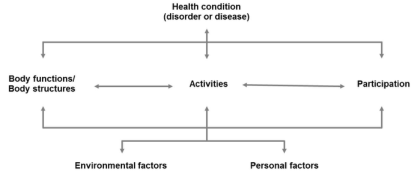
For the definition of the term “people with disabilities” the WHO issued a three-dimensional classification in 1980 called the “International Classification of Impairments, Disabilities, and Handicaps” (International classification of impairments, disabilities, and handicaps, 1980). However, this was revised and replaced by the “International Classification of Functioning, Disability, and Health” (ICF-CY, 2019), which was already mentioned in the introduction. From the perspective of the body, the individual, and society, the ICF is divided into two parts, each of which consists of two subcomponents: Part 1: Functioning and Disability (a) Body functions and structures (b) Activities and participation
Part 2: Contextual factors (c) Environmental factors (d) Personal factors
Figure 1: ICF modell (adaped from (ICF-CY, 2019)).
Quality Assurance in Manual Assembly “As part of quality management, quality assurance comprises all organizational and technical measures that serve to prepare, accompany and test the creation and maintenance of a defined concept and execution quality of a product or service” (DIN EN ISO 9000:2015-11, P. 31).
Quality assurance (QA) thus has the task of guaranteeing the implementation of the measures defined by quality management in order to ensure compliance with a certain quality standard (Klanitz, 2024). Companies are then obliged to place quality assurance personnel directly under the control of quality management or management so that they are not bound by instructions from the specialist management level. This is common, for example, in sensitive or high-risk production areas; typically these include
Challenges and Obstacles in Assembly Work in Sheltered Workshops 3
the pharmaceutical and chemical industries, food production and aerospace companies; workshops for the disabled (WfbM) are also bound by these standards as soon as they produce for these industries (Klanitz, 2024). In addition, service sectors such as medical care and nursing care must also comply with strict requirements (see, for example, section 8.2.2 of DIN EN ISO 9001:2015 as well as § 135 a SGB V and § 113 SGB XI).
Quality assurance can be carried out both internally, via the existing staff, and externally, via specialist agencies and service providers (Klanitz, 2024). Internal QA aims to fulfill the quality standards set by the company itself or agreed with partners (Klanitz, 2024).
The DIN standard defines the meaning of the term “quality assurance” and was quoted at the beginning of this section. The standard also describes various QA procedures and measures. This results in a “standardized quality assurance”, so to speak. Nevertheless, there is room for maneuver in the interpretation and implementation of quality assurance in many areas of the economy (Klanitz, 2024). Types of QA can be derived from this. A distinction is made, for example, between static and dynamic quality assurance. Dynamic QA plays a role above all in companies and industries with rapidly changing product portfolios and is therefore not considered further when applied to the WfbM sector. In static quality assurance, several contractual partners - e.g. manufacturers and customers as members of the supply chain or links in the value chain - jointly define key values for processes and products as quality parameters in assembly. Deviations from these target values are permitted within a certain range (Klanitz, 2024).
CHALLENGES AND OBSTACLES Sheltered workshops for disabled persons face several structural and technological challenges that impact their efficiency and inclusivity. These challenges were first identified in focus interviews with representatives of sheltered workshops and then validated in a second step through a literature review.
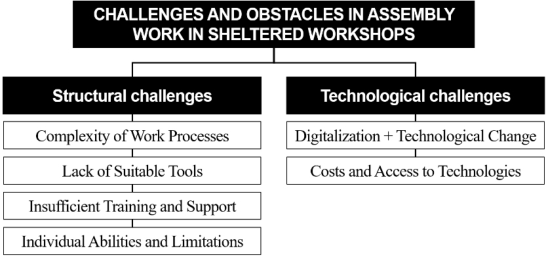
Figure 2: Overview of challenges and obstacles (own illustration).
Structural challenges can be categorized into four main areas, complexity of work processes, lack of suitable tools, insufficient training and support,
4 Mack
and individual abilities and limitations see Figure 2. The four main categories are described in more detail in the following text.
Complexity of Work Processes The complexity of work processes in sheltered workshops often poses significant challenges. These processes are typically weakly structured, leading to frequent task interruptions and changes based on the preferences and needs of the workers (Herrmann et al., 2024). Additionally, the setup of commercially available assembly systems, which includes hardware, software, and application, is often too complex for the capabilities of both workers and supervisors in these environments (Jost et al., 2022). This complexity can hinder the smooth operation and productivity of the workshops.
Lack of Suitable Tools Another major challenge is the lack of appropriate tools and assistance systems tailored to the needs of disabled workers. Many existing assembly systems do not address the specific requirements of people with disabilities, making it difficult for them to perform tasks efficiently (Jost et al., 2022).
Insufficient Training and Support Training and support are crucial for the successful inclusion of disabled individuals in assembly work. However, there is often a lack of structured training programs and support systems in place. Studies have shown that the implementation of standard operating procedures (SOPs) and hierarchical task analysis can significantly improve the training and performance of mentally disabled workers (Chi et al., 2018). Additionally, digital assistance systems and advanced work instructions can help bridge the skill gaps and increase the independence of mentally disabled workers (Heinz-Jakobs, Grose-Coosmann and Rocker, 2022; Peltokorpi et al., 2023).
Individual Abilities and Limitations The individual abilities and limitations of disabled workers must be carefully considered in the planning and execution of assembly tasks. The variation in skills and impairments among workers requires a flexible and adaptive approach to task assignment and support (Herrmann et al., 2024; Mordaschew et al., 2024). Multi-skill resource-constrained project scheduling problems is an example that can help in mapping the skills of disabled workers and optimizing task assignments accordingly (Herrmann et al., 2024; Mordaschew et al., 2024).
In addition to the structural challenges just presented, there are technological challenges that can be divided into the two categories of digitalization and technological change and costs and access to technologies.
Digitalization and Technological Change Sheltered workshops face significant challenges in adapting to the rapid pace of digitalization and technological change. The implementation of
Challenges and Obstacles in Assembly Work in Sheltered Workshops 5
digital assistance systems, which can reduce cognitive stress and improve efficiency, is often hindered by high investment costs (Reisinger et al., 2018). Additionally, the complexity of integrating these systems into existing IT infrastructures and ensuring they provide adaptable and specific information further complicates their adoption (Reisinger et al., 2018).
Moreover, the unique needs of disabled workers require specialized digital solutions. However, the creation and implementation of such advanced models demand significant technological expertise and resources (Mordaschew et al., 2024).
Costs and Access to Technologies The high costs associated with advanced technologies pose a major barrier for sheltered workshops. Many commercially available assembly systems are not designed with the needs of disabled workers in mind, leading to additional expenses for customization and accessibility features (Jost et al., 2022). This financial burden is often beyond the available resources of these workshops, limiting their ability to implement necessary technological solutions.
Furthermore, the affordability and availability of assistive technologies remain critical issues. Despite advancements in assistant systems, there is a persistent gap between the legislative mandates for access and the actual implementation in practice (Chen, 2024).
In low-resource settings, the situation is even more challenging. The lack of awareness and inappropriate design of technologies further restrict access for disabled individuals (Barbareschi et al., 2021). Efforts to design cost-efficient and accessible technologies, such as the use of simple hardware like RGB cameras and projectors, show promise but require more widespread adoption and support (Jost et al., 2022).
DIGITAL ASSEMBLY ASSISTANCE SYSTEMS As already mentioned in the previous section, digital assistance systems for manual assembly in workshops for the disabled have great potential but may also be associated with high acquisition and implementation costs, as well as adaptations to the mentally disabled workers.
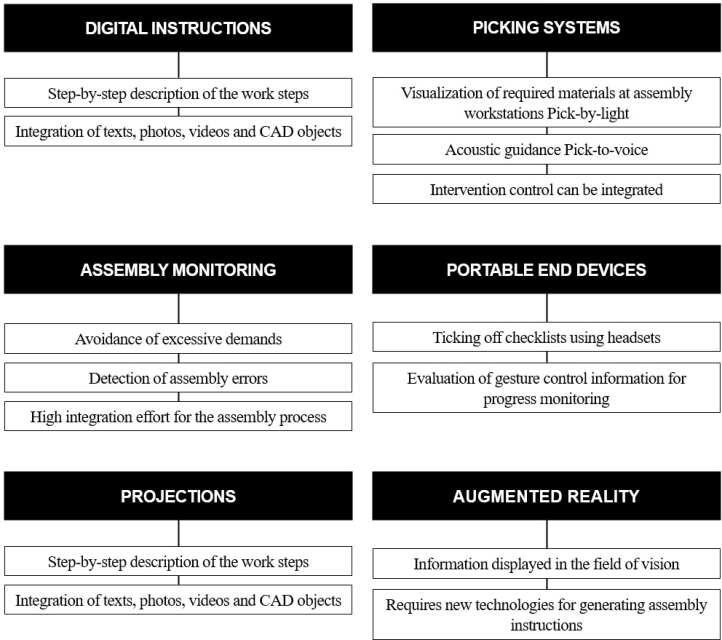
What is needed here is a well-founded method that brings together both worlds, assistance systems and mentally disabled workers. As a basis for this method development, which is not part of this paper, it is necessary to cluster digital assistance systems first. The following diagram provides a brief overview: The potentials of digital assistance systems are above all the increase in efficiency and accuracy, the ability to adapt to the needs of mentally disabled workers and the possibility of person-independent training and support in the work process. If these potentials of digital assistance systems are recognized efficiently and correctly, they represent a profitable opportunity to make work in WfbM more attractive, more efficient and easier.
6 Mack
Figure 3: Overview of digital assistance systems (own illustration).
CONCLUSION
The analysis of assembly work in sheltered workshops highlights significant structural and technological challenges that impact both efficiency and inclusivity. Structural challenges, such as the complexity of work processes, lack of suitable tools, insufficient training, and the diverse abilities of workers, underscore the need for tailored solutions. Technological challenges, including high costs, and limited access to adaptive technologies, further complicate the implementation of effective support systems.
Digital assembly assistance systems emerge as a promising avenue to address these challenges. However, the successful integration of these systems requires careful consideration of user-specific needs and the development of methodologies to align technological solutions with the capabilities of workers in sheltered workshops.
Future research focuses on bridging the gap between technological potential and practical application, so sheltered workshops can create more inclusive, efficient, and sustainable work environments.
This paper lays the groundwork for further exploration into how digital assistance can humanize and optimize assembly work for individuals with disabilities.
Challenges and Obstacles in Assembly Work in Sheltered Workshops 7
REFERENCES
Apt, W., Schubert, M. and Wischmann, S. (2018) Digitale Assistenzsysteme: Perspektiven und Herausforderungen für den Einsatz in Industrie und Dienstleistungen. Berlin. Available at: https://www.iit-berlin.de/iit-docs/ fd2aa38ad4474e6cb53720e7878ffd4a_2018_02_01_digitale_assistenzsysteme _perspektiven_und_herausforderungen.pdf. Barbareschi, G. et al. (2021) ‘Disability Design and Innovation in Low Resource
Settings: Addressing Inequality Through HCI’, Extended Abstracts of the 2021 CHI Conference on Human Factors in Computing Systems, CHI ‘21: CHI Conference on Human Factors in Computing Systems, Yokohama Japan, 08 05 2021 13 05 2021. New York, NY, USA: ACM, pp. 1–5. doi: 10.1145/ 3411763.3441340. Burtscher, R. et al. (eds.) (2013) Zugänge zu Inklusion: Erwachsenenbildung, Behindertenpädagogik und Soziologie im Dialog. Bielefeld: W. Bertelsmann Verlag (Forschung). Available at: https://elibrary.utb.de/doi/book/10.3278/ 9783763951086. Chen, W. (2024) ‘Disability, Inclusion, Service Provision, Policy and Legislation’, in
Miesenberger, K., Peˇnáz, P. and Kobayashi, M. (eds.) Computers Helping People with Special Needs. (Lecture Notes in Computer Science). Cham: Springer Nature Switzerland, pp. 433–439. Chi, C.-F. et al. (2018) ‘Workplace accommodation for workers with intellectual or psychiatric disabilities’, International Journal of Industrial Ergonomics, 68, pp. 1–7. doi: 10.1016/j.ergon.2018.06.001. Engels, D. et al. (2023) ‘Studie zu einem transparenten, nachhaltigen und zukunftsfähigen Entgeltsystem für Menschen mit Behinderungen in Werkstätten für behinderte Menschen und deren Perspektiven auf dem allgemeinen Arbeitsmarkt: Abschlussbericht’, 0174-4992, FB626. Heinz-Jakobs, M., Grose-Coosmann, A. and Rocker, C. (2022) ‘Promoting Inclusive Work with Digital Assistance Systems: Experiences of Cognitively Disabled Workers with In-Situ Assembly Support’, 2022 IEEE Global Humanitarian Technology Conference, GHTC 2022 (377 – 384). doi: 10.1109/ GHTC55712.2022.9910994. Herrmann, J.-P. et al. (2024) ‘A multi-skill RCPSP variant for persons with disabilities
in sheltered workshops’, Procedia Computer Science, 232 (1329 – 1338). doi: 10.1016/j.procs.2024.01.131. ICF-CY: Internationale Klassifikation der Funktionsfähigkeit, Behinderung und Gesundheit bei Kindern und Jugendlichen (2019) 2nd edn. Bern: Hogrefe. Jost, M. et al. (2022) ‘PARTAS: A Personalizable Augmented Reality Based Task
Adaption System for Workers with Cognitive Disabilities’, ACM International Conference Proceeding Series (159 – 168). doi: 10.1145/3529190.3529208. Klanitz, T. (2024) Qualitätssicherung. Available at: https://refa.de/service/refalexikon/qualitaetssicherung (Accessed: 24 March 2025). Klapper, J. et al. (2019) Potenziale digitaler Assistenzsysteme: Aktueller und
zukünftiger Einsatz digitaler Assistenzsysteme in produzierenden Unternehmen. Stuttgart. Available at: http://publica.fraunhofer.de/documents/N-555079.html (Accessed: 24 February 2022). Mordaschew, V. et al. (2024) ‘A Human Digital Twin of Disabled Workers for Production Planning’, Procedia Computer Science, 232 (745 – 751). doi: 10.1016/ j.procs.2024.01.074.
8 Mack
Palleit, L. (2016) Inklusiver Arbeitsmarkt statt Sonderstrukturen: warum wir über die Zukunft der Werkstätten sprechen müssen. (Position / Deutsches Institut für Menschenrechte, Bd. 2). Berlin. Pansky, B. (2002) Integration geistig Behinderter in den Arbeitsmarkt. Available at:
https://www.grin.com/document/105603. Peltokorpi, J. et al. (2023) ‘Manual assembly learning, disability, and instructions: An industrial experiment’, International Journal of Production Research, 61(22), pp. 7903–7921. doi: 10.1080/00207543.2023.2195957. Reisinger, G. et al. (2018) ‘A Concept towards Automated Data-Driven Reconfiguration of Digital Assistance Systems’, Procedia Manufacturing, 23 (99 – 104). doi: 10.1016/j.promfg.2018.03.168.
LISTED IN THE AHFE DIGITAL BOOKSTORE CATALOGUE
Explore the complete digital volume
Design for Inclusion
Read this individual research paper free through the original publisher, or explore the full digital proceedings book.
ISBN 978-1-964867-45-8
Explore this ISBN in the AHFE Bookstore ↗Listed in the July 2026 bookstore catalogue; search by ISBN to confirm current availability · Digital book purchase optional