Kin Wai Michael Siu, Qian Jiang (2025). Participatory Ergonomics in Designing Working Environments for Persons with Cognitive Disabilities: A Pilot Study on Sheltered Workshops in Hong Kong. In: Ergonomics In Design and Kansai Engineering. AHFE Open Access, vol. 170, pp. 44–54. https://doi.org/10.54941/ahfe1006166
Studies have shown that the working environment is closely related to the employment opportunities for persons with disabilities. Currently, the employment rate of persons with disabilities in many areas is not high. The theory of participatory ergonomics, which emphasises collaboration and user-centred design, has been widely applied in industrial and environmental design. This paper uses literature analysis to examine the factors affecting the employment rate of persons with disabilities in the working environment from three dimensions: physical, cognitive, and social aspects. Using sheltered workshops—a major employment venue for people with disabilities in Hong Kong—as a pilot site, the paper analyses the issues faced by trainees working there through qualitative research methods such as participatory observation and interviews. Ultimately, it proposes a participatory design framework suitable for the development of sheltered workshops in Hong Kong.
The concept of sheltered workshops originated approximately 400 years ago to provide meaningful employment opportunities for people with disabilities and to promote their active integration into society (Visier, 1998). Spanning nearly four centuries, the sheltered workshop has transformed from a 17th-century facility established by religious or charitable institutions in France as a residential facility to help protect the poor or inmates from persecution (Nelson, 1971; Nunley, 1972), to the present-day site of employment training and support for people with disabilities. The term “sheltered workshop” gained recognition during World War I (WWI) to denote a protected space offering a variety of rehabilitative services (Sullivan, 1926), and the number of sheltered workshops peaked during World War II (WWII) to address the serious problem of employment for the disabled (Dorado, 2020).
However, as the United Nations (UN) Disability Act continued to be refined, the sheltered workshop format came into question. Since the workers
Participatory Ergonomics in Designing Working Environments 45
are basically physically or mentally disabled, what the workshops offer them are simple, boring and repetitive jobs, which do not meet the needs of the open labour market. As a result, only a small number of people have been able to make the transition from sheltered workshops to the open labour market (Ma and Mak, 2016; tenBroek, 1962). In addition, because of the low wages, many trainees’ families prefer to keep them at home (Yip, 1998). While many countries in Europe and the Americas have now closed their sheltered workshops and transitioned to supported employment, sheltered workshops remain the main form of employment for persons with disabilities in Asia. This paper discusses the role of participatory ergonomics in designing public work environments, using sheltered workshops in the Hong Kong region as a pilot study. Through literature and case studies, this paper explores the interaction mechanism between people with cognitive disabilities and the work environment from three aspects: physical, cognitive and social. Finally, a participatory ergonomics-compliant design model is summarized, which is applicable to the Asian context and can be useful for the design of work environments in other high-density cities.
SHELTERED WORKSHOPS AND TRAINEES Development of Sheltered Workshops
Since the 17th century, places for the disabled have been established in United Kingdom and the United States. In 1837, the Perkins Institution in the United States was established to provide simple work opportunities for the blind, such as vocational training like weaving, knitting, and chair caning, as well as in music and similar arts. The establishment of asylums in England during the Victorian period was primarily for the mentally ill, a practice that was also common in Germany and the Oceania region (Hubbard, 1907). In the 18th and 19th centuries, persons with disabilities, especially those who were mentally handicapped, would have been mainly housed somewhere, almost isolated from the outside world. “Asylum” was the common format to place person who were suffering from the cognitive disabilities during that period.
After the 20th century, the concept of sheltered workshops was gradually recognised worldwide, and sheltered workshops developed rapidly in various countries. In Europe and the United States at this time, the service targets of sheltered workshops were mainly set for people with mental disorders, and employment training services were provided for them. Sheltered workshops developed rapidly in Asia during this period under the influence of globalisation, serving both physically disabled and cognitively impaired people, and in Australia around 1970, the Work Readiness Centre was set up to provide intensive work skills and social skills training for school leavers with mild intellectual disabilities. However, services in sheltered workshops have not been able to escape the single-occupation, low-wage nature of the work (Reppermund and Trollor, 2016).
In the 21st century, due to the enactment of the United Nations Disability Act, there is a growing call for the defence of the rights and interests of people with disabilities (United Nations, 2007). Sheltered workshops have been criticised for their low wages and inability to meet the needs of persons with
46 Siu and Jiang
disabilities. Due to the lack of social and community support, workers who remain in sheltered workshops for a long period of time gradually become disengaged from the outside world, and the repetitive and simple tasks do not meet the market demand and do not help them to successfully transition to the open labour market.
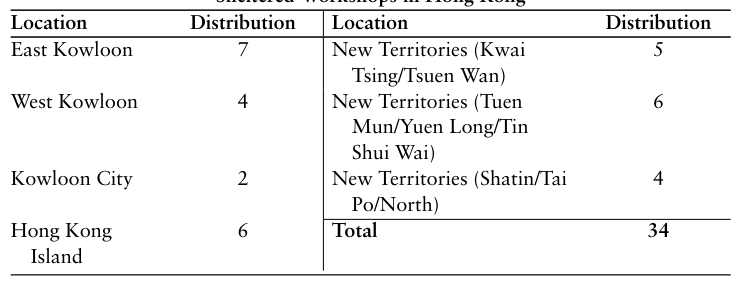
Sheltered Workshops in Hong Kong The service targets of sheltered workshops in Hong Kong are mainly persons with disabilities aged 15 and above who are capable of basic self- care and work (Siu, 2025). Most of them suffer from mild or moderate mental illness, and one-third of the clients are physically disabled. As at September 2024, there were 34 sheltered workshops in Hong Kong, based mainly on the records of the Social Welfare Department (Social Welfare Department, 2024a). Table 1 shows the distribution of the locations of these sheltered workshops, with about 44% of them located in the New Territories. According to the statistics, about 52% of the disabled persons in Hong Kong are located in the New Territories, which explains why the number of sheltered workshops in the New Territories is the highest. The major services provided by sheltered workshops in Hong Kong include vocational rehabilitation and training services. In addition, the Work Extension Programme (WEP) is a support programme of sheltered workshops in Hong Kong that aims to provide services to support the physical and health needs of elderly trainees aged 40 or above or those with reduced work capacity (Social Welfare Department, 2024b).
Table 1: The location of sheltered workshops in Hong Kong (source: Social Welfare Department of Hong Kong with presentation modification by the authors).
Mental health services in Hong Kong can be traced back to 1841 with slow development. Until the 1980s, working in sheltered workshops was defined as a ‘pathway to work’, however, the career progression of workers there was very inefficient, and in the 1990s, only 5 per cent of those who left the sheltered workshops were able to find work. In addition, due to the low wages, many rehabilitated persons prefer to stay at home unemployed, and the unemployment benefits they receive from the Comprehensive Social
Participatory Ergonomics in Designing Working Environments 47
Security Assistance (C.S.S.A.) are much higher than the wages in the sheltered workshops.
In addition, the influence of family members has a significant impact on the willingness of persons with disabilities to re-enter the workforce. Many caregivers do not want their family members to be subjected to public discrimination and prejudice, believing that working in a sheltered workshop can easily lead to public labelling, which is unfair to persons with disabilities. Moreover, many family members actually have high expectations of them, and the single nature of the work does not meet the diverse needs of people with disabilities. Health issues are also a consideration for family members, and it is clear that crowded work environments are not conducive to recovery. As of 2021, the percentage of people of all ages with disabilities living at home is much higher than those placed in institutions. In contrast, those living in institutions are mostly older disabled people over the age of 70 (Census and Statistics Department, 2021).
RELATIONSHIP BETWEEN WORKING ENVIRONMENT AND THE COGNITIVE DISABLED Environmental psychology argues that there is no natural environment divorced from the social and cultural context of the time, and that every change in the environment is not only culturally significant, but also has an impact on all segments of society (Bell, 2001). As a hub connecting people and the environment, the study of environmental behaviour cannot avoid the social dimension of the environment. People and all aspects of their living environments are interdependent. Thus, any substantive environment contains both physical and social elements, and human behaviour is a response to both the substantive environment and the cultural and social environment (Yu et al., 2000).
Physical and Cognitive Aspects The concept of the behavioural setting emphasises that the pattern of activities in a place is fixed, regulated and does not change over time, so that people enter a place as if they were entering a place where there is a pre- determined programme of activities, and the activities are simply repeated according to the schedule. The key concept in determining the legitimacy of a working space is the level of participation (Barker and Brayfield, 1965; Wicker, 2012). Workplace accommodation is a crucial strategy to guarantee equal job opportunities for persons with disabilities (Gates, 2000). However, based on the statistics, the employment rate of persons with disabilities is generally low in various countries. Therefore, it is necessary to analyse the disabled and the barriers to their employment environment.
The term “cognitive disabilities” refers to a pathological process in which the brain’s higher intellectual processing associated with learning, memory, thinking, and judgment is abnormal. This leads to learning and memory disorders, along with aphasia, dysarthria, and other changes (Liang and Zhang, 2024). Intelligence Disability, mental illness and Alzheimer’s disease, etc. all fall into this category (Radnitz, 2000). Basically, a simple, highly
48 Siu and Jiang
accessible work environment would be better for them. The safety of workspaces and rest areas promotes the basic conditions for the employment of persons with disabilities (Dyck and Jongbloed, 2000), including furniture, accessible parking facilities, accessible routes, railings, ramps, door handles, door opening and locking systems, accessible toilets, separate offices, and adapted or special equipment and tools (Lock et al., 2005; Nevala et al., 2015; Solstad Vedeler & Schreuer, 2011). Simply to say, it should be in line with their cognitive habits.
Cognitive and Social Aspects Social acceptance is helpful in promoting employment for people with cognitive impairment. Studies have shown that negative attitudes of employers and co-workers towards the target clients are one of the main factors hindering the employment of people with disabilities if they are in the workplace (Yelin et al., 2000), while on the contrary, appropriate knowledge and first-hand experience of the disability or illness of the people around them is seen as a facilitating factor (Lock et al., 2005). In the case of sheltered workshops, for example, the understanding of the trainees’ idiosyncrasies by managers and staff determines whether the content of the work is appropriate to the nature and level of the trainees, and the level of engagement in the work indirectly influences the success of their transition to the open labour market (Chiu, 2000). In addition, family and carer support for the disabled person’s return to work process is also considered as one of the facilitating factors (Yip and Ng, 1999).
Trainees’ self-assertion interacts with the attitudes of the people around them, i.e. the ability to communicate effectively between employers and employees (Nevala et al., 2015). Employees need to want to express their needs and interests to their employers, and this process is difficult for people with intellectual disabilities, so caregivers are needed to clarify the requirement for them. And the employer’s initiative in granting benefits also affects the efficiency of the process. Westmorland et al. (2005) in their study showed that co-operation, trust and mutual understanding between the employee, employer and others all contribute to the process of provision in the workplace. Therefore, we can conclude that participation and initiative of persons with disabilities in the employment environment and collaboration between employees and other staff are the key issues for promoting employment of persons with disabilities.
Social and Physical Aspects In 2001, the World Health Organization proposed the International Classification of Functioning, Disability and Health (ICF) in relation to the relationship between disability and health, which emphasises the appropriate identification of disability in terms of four considerations: health status, body functions and structures, activity and participation (World Health Organization, 2001), which means that full consideration is given to the person with a disability’s own condition. The term “physical” in this context indicates understanding of the physical functions of people with disabilities.
Participatory Ergonomics in Designing Working Environments 49
Medin and other scholars have shown in their research that flexible design of working hours and work arrangements are favourable factors for employee retention, including part-time work, freedom to take time off, reduced working hours or telecommuting (Medin et al., 2006; Nevala et al., 2015). In addition, flexible work arrangements include job sharing, adjusting job roles and changing job requirements, i.e., employer-employee communication and the ability of the workplace to adjust work to the nature of the employee to improve efficiency (Newbury et al., 2020).
To summarise, sustaining the employment of workers with disabilities goes far beyond the local issue of supporting the functioning and work capacity of individual workers, which involves the wider issue of managing complex combinations of different aspects of the process and the network of key players in the process and the environment. Key aspects of this inclusive process include four dimensions: 1) individual; 2) interpersonal or social elements of family, colleagues, and employers; 3) organization accessibility, e.g., work environment, recovery; and 4) social promotion, such as regulations, rehabilitative systems, and policies, among others. To elaborate, the first two refer to understanding, mental functioning, treatment, assistance from others, the constructed setting, training, and aid from others, and the latter two generically refer to employees, employers, co-workers, family, and professionals.
PARTICIPATORY ERGONOMICS IN ENVIRONMENTAL DESIGN Theoretical Framework
Based on Nevala and other academics’ systematic review in 2015, conclusions identified that the primary factors that facilitated and prevented employment were self-advocacy, employer and community support, the amount of instructional and psychological support, and schedule and flexibility in the job. It means that enhancing the work environment for persons with disabilities requires multiple efforts. Participatory ergonomics (PE) has been defined as an effective approach for design research and practice, especially in the field of urban and environment planning (Broberg et al., 2011). According to the study conducted by Haines and other scholars in 2002, PE includes the following parts: ‘designing equipment or tasks’, “designing work, teams or work organisations” and “developing policies or strategies”, with the aim of solving problems in an existing workplace, or reschedule a new installation.
Sundin et al. (2004) formalize the term ‘participatory ergonomics’ by arguing that improving workplaces and production systems is not enough, and product design should be involved in the “early steps in influencing the production system”, i.e., product design, which has clarified that both of people and product would affect the spatial arrangement in an environment. Broberg et al. (2011) developed and tested a participatory design framework for the workplace in their study, with the aim of providing methods and tools for use by ergonomists and other workplace professionals to be directly involved in the design and planning of new facilities and production systems, encouraging the engagement of all stakeholders. They proposed that prototyping is an effective intervention, referring to the mutual learning
50 Siu and Jiang
process that occurs in a collaborative design environment. In this process, prototypes can be constructed and manipulated (Brodersen et al., 2008), arguing in favour of facilitating collaborative design processes for future work and workplaces. Special emphasis is placed on enabling workers to easily express their concerns and aspirations and to participate in design activities.
Practice in Sheltered Workshops of Hong Kong The participatory design framework proposed by Broberg et al. was applied in our research on sheltered workshops in Hong Kong. In December 2020, the researchers met with the New Life Psychiatric Rehabilitation Association. Through the meeting and presentation, the research team learnt more about the current situation of non-governmental organizations (NGOs) in Hong Kong. Afterwards, the researchers visited the Tin King Sheltered Workshop under the Association and met with the staff and trainees of the workshop. During the visit, the researchers used participatory observation to gain an in-depth understanding of the activities of the users and the set-up of the facilities. To understand the needs of the users, the team experienced the internal environment of the sheltered workshop and took notes for further analysis.
Among the 180 persons with disabilities in the sheltered workshops, there are three main types of disabilities: mild-moderate intellectual disability, autism and intellectual disability and autism. Four of these persons with disabilities and one staff member were selected for observation and interview. The symptoms of four of the disabled persons were mild-moderate intellectual disability, autism, combined intellectual disability and autism, and older persons with Down’s syndrome. In addition, one representative was selected from the elderly, since older people are the main group of trainees in sheltered workshops. The interviewees were aged 40, 50, 60 and 70 years old, with the research focus was on identifying their daily actions and behaviours in the sheltered workshops. Due to the special situation of these cognitively impaired people, they need to be accompanied by a staff member.
PARTICIPATORY DESIGN FRAMEWORK FOR SHELTERED WORKSHOPS IN HONG KONG After the initial research, the researchers have analysed the data and summarized the results from three aspects: physical, cognitive and social. Basically, trainees in sheltered workshops interacted with two main places: individual workstations and lounges with stable traces of repetitive work, which kept trainees isolated from the open labour market. Safety hazards were existed in the environment due to space constraints. For example, some of the handling equipment (e.g. trolleys) were placed at stairways or bathroom doors, which might cause inconvenience to the physically disabled. Another problem was the lack of assistive devices for the disabled, such as handrails to enable wheelchair users to stand on their own. Lack of adequate sanitary compartments was also a big challenge. Generally, sheltered workshops had two toilets (one for each sex) with only 5–6 cubicles
Participatory Ergonomics in Designing Working Environments 51
in each, and a disabled toilet which was very limited in space. As the trainees grow older, more trainees would need accessible toilets, so the actual accessibility of the toilets was a crucial issue.
Management was another key problem. Sheltered workshops were understaffed and could not manage hundreds of trainees. Each counsellor had to manage about 20 trainees on his/her own, which made it even more difficult to deal with emergencies. Currently, many sheltered workshops still rely on paper documents, with a large amount of information taking up storage space. Trainees and staff need to sign in and out every day using traditional card punching machines, and they also need to manually check each attendance sheet for salary calculation, which increases the workload of staff. On a social level, there is a disconnect between the community and the sheltered workshops, and the lack of community support makes it more difficult for trainees to enter the social work market.
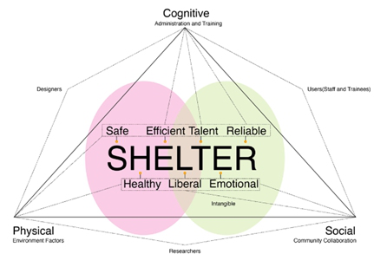
To achieve the goal of an inclusive society, designers or researchers should be aware of the importance of user-centered, not only to consider the needs of people with disabilities, i.e., users, but also to motivate them to actively participate in the design process (Siu, 2009). Based on above, a participatory design framework is proposed to solve these problems, including safe, healthy, efficient, liberal, talent, emotional, and reliable (Figure 1). The tangible factors concentrate on the physical accessibility, including the assistive facilitators and sufficient spaces, and the intangible factors focus on the collaborative service supported by communities and other social institutions to create a more flexible working environment for trainees there. For the physical aspects, the model advocates to provide a safe and healthy environment through observing the trace of trainees’ living traces. To enhance the cognitive awareness, talents of each employee there need to be considered for the purpose to create a flexible working schedule, which also facilitates the active improvement of their job skills and increases their freedom and opportunities for employment in the open labor market. Community collaboration is a key issue in the social aspect. Strengthening the emotional connection between society and them and providing reliable service protection are effective ways to increase the employment of people with disabilities.
Figure 1: Participatory design framework for sheltered workshop (created by the authors).
52 Siu and Jiang
In the future work, the researchers will evaluate the needs of stakeholders such as cognitively impaired employees and managers through a participatory design process. The feedback will be analyzed through Analytic Hierarchy Process (AHP), adjusting the framework’s hierarchy of needs and metrics to continually validate the framework’s effectiveness. Then a reusable participatory design collaboration template is formed and can be adapted to other cultural or institutional contexts.
CONCLUSION
As there are relatively few studies on sheltered workshops in Asia, in this study, the researchers adopted a pilot study approach using a participatory design methodology to study representative sheltered workshops in Hong Kong. Since sheltered workshops in Hong Kong mainly target at people with cognitive disabilities, the researchers have derived a design model from three aspects, namely physical, cognitive, and social, by applying qualitative research methods, including participatory observation and interviews. In the next step, the research team will further analyze the needs of trainees through the method of Analytic Hierarchy Process (AHP) to derive the design key points to test the validity of the model, and refine it through user feedback, with a view to arriving at a workplace design strategy suitable for promoting the employment of persons with disabilities in the Asian context.
ACKNOWLEDGMENT
We would like to acknowledge Eric C. Yim Endowed Professorship in Inclusive Design of PolyU (Ref.: 8.73.09.847K) and PolyU-HIT Joint- Research Centre for Inclusive Environment for supporting the research and preparing this paper. We also want to thank the Research Post graduate Studentship of the School of Design and the Department of Computing of PolyU to provide partial support. Thanks to researchers and research postgraduate students of the Public Design Lab, The Hong Kong Polytechnic University (PolyU), gave great support to carry out the study.
REFERENCES
Barker, R. G. and Brayfield, A. H. (1965) ‘Explorations in ecological psychology’, The American Psychologist, 20(1), pp. 1–14. Bell, P. A. (2001) Environmental psychology. 5th edn. Fort Worth, TX: Harcourt
College Publishers. Broberg, O., Karlsson, M., Hansen, I. S. and Söderberg, A. M. (2011) ‘Participatory ergonomics in design processes: The role of boundary objects’, Applied Ergonomics, 42(3), pp. 464–472. Brodersen, C., Dindler, C. and Iversen, O. S. (2008) ‘Staging imaginative places for
participatory prototyping’, CoDesign, 4, pp. 19–30. Census and Statistics Department (2021) Special Topics Report No. 63. The Government of the Hong Kong Special Administrative Region. Chiu, F. P. (2000) ‘The development of supported employment services for people with mental illness: Local experience in Hong Kong’, Work, 14(3), pp. 237–245.
Participatory Ergonomics in Designing Working Environments 53
Dorado, S., Martí, I. and Etzion, D. (2020) ‘Hybrid agency: Sheltered workshops (1941–2019)’, in Marya, L. B. and Bjoern, C. M. (eds.) Organizational Hybridity: Perspectives, Processes, Promises. Bingley: Emerald Publishing Limited, pp. 237–270. Dyck, I. and Jongbloed, L. (2000) ‘Women with multiple sclerosis and employment
issues: A focus on social and institutional environments’, Canadian Journal of Occupational Therapy (1939), 67(5), pp. 337–346. Gates, L. B. (2000) Workplace accommodation as a social process, Journal of Occupational Rehabilitation, 10(1), pp. 85–98. https://doi.org/10.1023/ A:1009445929841 Haines, H., Wilson, J. R., Vink, P. and Koningsveld, E. (2002) ‘Validating
a framework for participatory ergonomics (the PEF)’, Ergonomics, 45, pp. 309–327. Hubbard, S. F. (1907) ‘Association and commission for the blind’, Journal of Visual Impairment & Blindness, 1(1), pp. 4–6. https://doi.org/10.1177/0145482X 0700100103 Liang, K. and Zhang, X. (2024) ‘Association between Life’s Essential 8 and cognitive
function: Insights from NHANES 2011–2014’, Frontiers in Aging Neuroscience, 16, p. 1386498. doi: 10.3389/fnagi.2024.1386498. Lock, S. et al. (2005) ‘Work after stroke: Focusing on barriers and enablers’, Disability & Society, 20(1), pp. 33–47. Ma, G. Y. and Mak, W. W (2016) ‘Caregiving-specific worry, affiliate stigma, and
perceived social support on psychological distress of caregivers of children with physical disability in Hong Kong’, American Journal of Orthopsychiatry, 86(4), pp. 436–446. Medin, J., Barajas, J. and Ekberg, K. (2006) ‘Stroke patients’ experiences of return to work’, Disability and Rehabilitation, 28, pp. 1051–1060. Nelson, N. (1971) Workshops for the handicapped in the United States: An historical
and developmental perspective. Springfield, IL: Thomas. Nevala, N. et al. (2015) ‘Workplace accommodation among persons with disabilities: A systematic review of its effectiveness and barriers or facilitators’, Journal of Occupational Rehabilitation, 25(2), pp. 432–448. Newbury, J. et al. (2020) ‘Cognitive, noncognitive, and home environment correlates
of reading difficulties in primary-grade students with language impairment’, Journal of Speech, Language, and Hearing Research, 63(6), pp. 1933–1946. Nunley, R. L. (1972) ‘Workshops for the handicapped in the United States. An historical and developmental perspective’, Physical Therapy, 52(5), p. 601. Radnitz, C. L. (2000) Cognitive-behavioral therapy for persons with disabilities.
Northvale, NJ: Jason Aronson. Reppermund, S. and Trollor, J. N. (2016) ‘Successful ageing for people with an intellectual disability’, Current Opinion in Psychiatry, 29(2), pp. 149–154. https:// doi.org/10.1097/yco.0000000000000228 Siu, K. W. M. (2009) ‘Research for the disabled: Action, participatory and inclusive
approaches’, International Journal of the Humanities, 7(4), pp. 81–94. Siu, K. W. M. (2025) Walls or No Walls: Sheltered Workshops. Hong Kong: The Hong Kong Polytechnic University. Social Welfare Department. (2024a) Sheltered workshop. Available at: https://
www.swd.gov.hk/en/pubsvc/rehab/cat_vocatdaytrain/shelteredw/ (Accessed: 6 December 2024).
54 Siu and Jiang
Social Welfare Department. (2024b) Work Extension Programme (WEP). Available at: https://www.swd.gov.hk/en/index/site_pubsvc/page_rehab/sub_listofserv/ id_wep/ (Accessed: 6 December 2024). Solstad Vedeler, J. and Schreuer, N. (2011) ‘Policy in action: Stories on the workplace
accommodation process’, Journal of Disability Policy Studies, 22(2), pp. 95–105. Sullivan, H. (1926) ‘Erogenous maturation’, The Psychoanalytic Review (1963), 13(1), pp. 1–15. Sundin, A., Christmansson, M. and Larsson, M. (2004) ‘A different perspective in
participatory ergonomics in product development improves assembly work in the automotive industry’, International Journal of Industrial Ergonomics, 33, pp. 1–14. tenBroek, J. (May 16, 1962) The character and function of sheltered workshops’, The Blind American, II (5). https://nfb.org/images/nfb/publications/bm/bm62/ blindamerican-may1962.html#A6 (Accessed: 8 December 2024). United Nations. (2007) Convention on the rights of persons with disabilities. Sixty-
first session of the General Assembly by resolution A/RES/61/106. N.Y.: United Nations. Visier, L. (1998) ‘Sheltered employment for persons with disabilities’, International Labour Review, 137(3), pp. 347–366. Westmorland, M. G. et al. (2005) ‘Disability management practices in Ontario
workplaces: Employees’ perceptions’, Disability and Rehabilitation, 27(14), pp. 825–835. Wicker, A. W. (2012) ‘Perspectives on behavior settings: With illustrations from Allison’s ethnography of a Japanese hostess club’, Environment and Behavior, 44(4), pp. 474–492. World Health Organization. (2001) International Classification of Functioning,
Disability and Health (ICF). https://www.who.int/standards/classifications/ international-classification-of-functioning-disability-and-health (Accessed: [7 December 2024]). Yelin, E., Trupin, L. and Sebesta, D. (2000) ‘The prevalence and impact of accommodations on the employment of persons 51–61 years of age with musculoskeletal conditions’, Arthritis Care & Research, 13(3), pp. 168–176. Yip, K. S. (1998) ‘A historical review of mental health services in Hong Kong (1841
to 1995)’, International Journal of Social Psychiatry, 44(1), pp. 46–55. https://do i.org/10.1177/002076409804400105 Yip, K. S. and Ng, Y.-N. (1999) ‘The dilemma of productivity-oriented management versus treatment-oriented management in sheltered workshops in Hong Kong’, Psychiatric Rehabilitation Journal, 22(4), pp. 390–397. https://doi.org/10.1037/ h0095211 Yu, K. L., Wang, T.-L. and Yang, J. L. (2000) Environmental psychology [Huan jing
xin li xue]. 1st edn. Beijing: People’s Education Press.
LISTED IN THE AHFE DIGITAL BOOKSTORE CATALOGUE
Explore the complete digital volume
Ergonomics In Design and Kansai Engineering
Read this individual research paper free through the original publisher, or explore the full digital proceedings book.
ISBN 978-1-964867-46-5
Explore this ISBN in the AHFE Bookstore ↗Listed in the July 2026 bookstore catalogue; search by ISBN to confirm current availability · Digital book purchase optional