Qian Jiang, Kin Wai Michael Siu, Jiannong Cao (2024). How Multi-sensory Can Help the Visually Impaired Better Play the Instruments: An Inclusive Design Practice. In: Human Factors in Design, Engineering, and Computing. AHFE Open Access, vol. 159, pp. 750–760. https://doi.org/10.54941/ahfe1005642
For the visually impaired, it is harder to learn how to play an instrument. Taking playing the piano as the case, we conducted the research to explore how other senses work better to support this special group to learn how to play the piano. Using the methods of literature analysis and data collection by designed questionnaire, we tried to design a smart keyboard to solve the problems people with impaired sight may meet in three perspectives: 1) Finding the corresponding keys for notes. 2) Communication with instructors. 3) Variable changes in rhythm. We provide a new learning possibility for the visually impaired to play the piano. Based on the concept of inclusive design, we also considered the needs of the normal people with the expectation to achieve the inclusive goal of music communication between the abled and the disabled.
By 2020, 1.1 billion people suffered from visual impairment globally and China accounted for 19.1 percent of the total-an estimated 270 million people with vision loss. Depending on their location, degree of poverty, and access to support services, blind and visual-impaired people’s quality of life varies greatly across the globe. Due to the loss of the most important senses for acquiring information, daily lives of visually impaired people (VIPs) are much more difficult than normal. How to make their lives better through policies and research deserves extensive attention from all sectors of society (Siu, 2008b). In 1981, Kersten proposed that music could be used as a therapy for VIPs, which indicating the positive function for enhancing VIPs’ lives (Kersten, 1981). Ida Lam, chairperson of NGO Arts with the Disabled Association of Hong Kong (ADAHK) said that it is a vicious circle that the public believes that individuals with disabilities in the arts are not very important, which would lead to a lack of attention and support to discover their talent. Werbner conducted the research on new eating pattern for the purpose to promote basic capability of visually impaired children using tactile and tasting sense, which made a creative discovery between music and food (Bilyk et al, 2009). This indicated that the loss of sight might make them
How Multi-Sensory Can Help the Visually Impaired Better Play the Instruments 751
more reply on other senses, and music might could a more important role to them.
In recent years, much effort has been made to promote the lives of the visually impaired. Much evidence has proved that the visually impaired are skillful in music. In 2019, the activity ‘No Limits’ has featured over 60 performers with disabilities, whose musical talent like playing the piano has broken the stereotypes that many people have about them, rising the hot debate around the world. In 2021, Hong Kong Blind Union (HKBU)launched the one-stop support service for music development for the visually impaired, to help them learn music. (Hong Kong Blind Union, n.d.) Nowadays there are a lot of Piano Playing Training Course for VIPs around the world, which mainly because of their more sensitive hearing and touching. Various public welfare organizations, such as the Hong Kong Society for the Blind (HKSB)and Braille Library of China (CBL), often hold many classes to teach children with impaired vision to play the piano. As the king of musical instruments, playing the piano requires the co-operation of hands, feet, brain and hearing, but it is relatively easy to learn because each of the 88 keys has only one tone, compared with other instruments.
This design project is expected to solve the problem that VIPs may meet when they play the piano. Applied for the inclusive concept, we expect to explore a new possibility for the interaction between human and smart technology. The finding would create a new method for VIPs’ instrument learning and helpful to promote the inclusive communication between the abled and the disabled in the future.
THE CHALLENGES FOR THE VISUALLY IMPAIRED TO PLAY THE PIANO Finding the Corresponding Position
Besides the difficulty to read braille music, only tactile and hearing sense could work for the visually impaired when playing the piano. As the loss of sight, they have to rely on the sense of touch to acquire the information of musical notes is through the sense of touch, which means that what healthy people get by combining their eyes and hands, they can only get the same information by one perception. Because of the complex of the melody, it is impossible to know the corresponding positions of keys on the piano through smelling and taste. A device that used a haptic smartphone to transmit a conductor’s motions to a choir has been developed recently, which was effective in the team performance (Galea et al., 2018). To enhance synchronization among the visually impaired musicians, a research team led by Turchet has investigated the use of vibration-based devices to promote musical communication (Turchet et al., 2021). However, what should be noticed is that people have to pay full attention to hear the melody they play during the piano practice, it means that their hearing and touching cannot be disturbed. How to utilize the technologies like touching and non-verbal cues more effectively during the piano practice for VIPs is a key issue to be considered.
Communication There are also difficulties in teaching methods. Since VIPs have weak visual perception, some of the figurative metaphors that teachers are used to hardly come in handy. Instead, they have to use concepts related to sound or touch to explain. More importantly, many teachers do not know the braille either, and it generate a large gap on communication between teachers and learners (Pino, 2022). For the people with impaired vision, they are much more dependent on other senses, as well as the interdependence with families and teachers. A study showed that some participants who prioritized having a good teacher over having a teaching assistant tool. Even those other individuals who perceived the usefulness of tools with advanced techniques in music, they also envisaged employing them following their own solo and teacher-study music practice (Bennett et al., 2018; Lu et al., 2023). These results imply that technology cannot substitute the human support for VIPs’ music learning, and they need to be encouraged by others.
Changes in Rhythm Since the visually impaired need to feel the position of the keys all the time, their hands are usually close to the piano, which makes it difficult to produce rhythmic changes (Lu et al., 2023). In addition, the feet need to step on the pedals to match. For the visually impaired, it is quite difficult to find the appropriate position, and to ensure that the intonation is at the same time to keep up with the rhythmic changes of the piece. Moreover, when people play the piano, although it is the interaction of the five senses, due to the high degree of concentration, the fingers on the keys switch very quickly, the existing vibration technology is not able to keep up with the rhythm of the piece of music. If the vibration is constant, it will lead to distraction during practice. The utilization and improvement of technology is challenging.
To conclude, there are several problems for the visually impaired people to practice the piano, and they need to be solved: (1) Braille is hard to learn, and many piano instructors cannot even understand it. (2) Participants hope to be accompanied and encouraged by family members or teachers. (3) The notes are too complicated to be identified. Players, especially for VIPs, are quite difficult to find the corresponding keys and next notes.(4) There are 14 Majors Scales (Sharp and Flat) and 14 corresponding Minor Scales, a few of which have overlapping notes that are easily confused. (5) The speed and pages of sheets cannot be controlled even for the electronic one. (6) No additional area to place the music sheet. (7) The piano seat is too heavy to be moved. Height is adjustable, but there is no way to adjust the distance from front to back.
SOLUTION- AN INCLUSIVE CONCEPT Universal design, developed to the concept of inclusive design from 2000, refers to a design that can be used by everyone, e.g., wheelchair users, the elderly, the visually impaired, families with baby carriages, etc. The design itself can already cater for the needs of 80% to 90% of the population without the need to provide specially designed assistive facilities for specific
How Multi-Sensory Can Help the Visually Impaired Better Play the Instruments 753
groups (Eikhaug, 2010). The key feature of this design concept is accessible to the largest amount of people with possibility. Dr Joseph KWAN said that people with disabilities are not asking for priority treatment. They would rather have equal access and equal opportunities with everyone else. It means that if the solution is only designed to solve the problems of people with disabilities, such as a smart system designed only for them, the solution may be discriminatory, which may lead to negative feelings of special populations. The ideal solution is to integrate the two without having to separate this part which is for the exclusive use of the disabled; and that part which is for the use of the able-bodied.
When people play the piano, their hands are always in motion and their feet have to match the pedals. Visually impaired people have a keen sense of hearing but have to concentrate on the playing process. Therefore, the sense of hearing cannot be disturbed, and we gave up the intelligent voice prompting solution. As notes countless changes, it is hard to utilize the smelling and tasting senses to solve it. We finally decided to use the tactile method, the most accessible way for visually impaired people to reach out. Several research projects focusing on haptic technology have been conducted and proved that motivating tactile sense is an effective way for the visually impaired (Karpodini, 2022; Sabuncuoglu, 2020). Co-design is one of main methods to emphasize stimulate the senses of visually impaired people (Payne, 2022; Turchet et al., 2021). However, many of them did not consider the role of supporters like teachers or parents, and the solutions are mainly focusing on the disabled with the purpose of emphasizing the convenience the technology could bring to them but ignoring the equal access they want to have. Professor Siu and other researchers have proposed an inclusive design concept in daily-life game for the VIPs, and the abled was also the target audience. It was helpful to promote the inclusive communication between the group with impaired vision and the healthy ones. The concept was also applied to the research of playground facilities in Hong Kong since 2010s, emphasizing the interaction between children and their care givers and the role they play in new lifestyle lifestyle (Siu, 2008a; Siu et al., 2017, 2019). According to Henri Lefebvre, space is composed by human’s experience, which is created by interaction between the objects and human’s perception (Lefebvre et al., 1999; Guo, 1998). Thus, the functionality of the design is reflected in the interdependence with all possible users, which is the value of inclusion.
DESIGN DEVELOPMENT-JUMPING NOTE: A SMART TACTILE INTEGRATED KEYBOARD The Phenomenologist Merleau-Ponty also considered the essential factor to make up a space was human’s body because of the principle-‘everything is connected’ (Merleau-Ponty, 1978). Although modern technology can create a completely virtual environment, strictly it can be called an environment, but not a space, because it has not had contact with the human body. When people play the piano, their senses are focusing on the keys and rhythm. Due to their visual deficiencies, their eyes are unable to interact with the
piano during practice and the space is in a state of compression. According to Lefebrve’s theory of mirror, this is a community of self and real space immersed in the representation of notes (Lefebvre et al., 1999). If we regard the piano room as a macroscopic space, the interaction between the piano, the seat and human body is the relatively intimate space constructed by the practitioner. Thus, if there is a problem in this micro space, the most effective way to promote within this context. We decided to abandon methods of adding elements from the outside, such as implanting voice cues in the ears, which would also interfere with their understanding and judgement of the music.
The hardest part of the whole project was how to recognize the notes in a non-visual way and specify the position of the next note. We tried to use other senses to complete the design solution. When people play the piano, their hands are always in motion and their feet have to match the pedals. Some research has proved that smelling and touching could help VIPs to distinguish the direction (Bartolome et al., 2021; Feng et al., 2019). As notes countless changes, it is hard to utilize the smelling and tasting senses to solve it. We finally decided to use the tactile method, the most accessible way for visually impaired people to reach out. However, many VIPs feel that braille notes are hard to learn and remember, and there is lack of teachers who know both piano and Braille, which led to a stalemate in piano learning for the visually impaired. Many VIP players only rely on the records to memorize all melody. Based on the problems mentioned before, we have proposed the solution-Smart Tactile Keyboard-A thin and light touchpad with restored piano keyboard, like the principle of Dance Carpe, to address the above issues. We’ve turned feet into fingers.
To make the design applicable to a wider range of people, we conducted a questionnaire to collect information on the current difficulties encountered when learning to play the piano, and it was found that the speed of flipping through the sheet music was a major concern when practicing. The study was conducted from 1 to 3 February 2024. The probability sampling method was adopted to reduce bias. The electronic questionnaire was distributed on the website, and 62 were received. After analyzing the initial data, 8 invalid questionnaires with inappropriate answers were excluded, leaving 54 valid questionnaires. The effective rate reached 87%. Based on the analysis above, there are several points to solve the problems mentioned above.
Replacing Braille With Raised Simplified Staff According to the results of interviews conducted by Lu et al. (2023), participants with impaired vision indicated that reading braille music is hard, and they preferred to listen the music firstly, then practicing. Many visually impaired artists also agreed with that. Thus, tactile notation or staff are being researched because the staff is easier to understand the rhythm of music.Combing tactile sense and music notation has been prove to be an effective way for people to learn instruments (Rickey & James, 1990). Since 2010s, more computing technologies have been developed to generate tactile music notation for people with impaired sight, and it facilitates the
How Multi-Sensory Can Help the Visually Impaired Better Play the Instruments 755
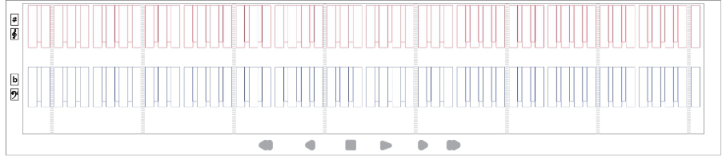
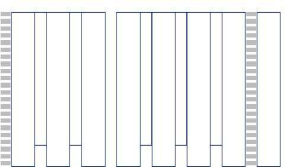
communication between teachers and students and enables blind students to learn music better and faster. However, all the inventions are focusing on the music sheet, and few of them are integrated with music instruments. Thus, we proposed an approach that combined the two (Fig. 1). To make the notes simply remembered, we simplified the shapes of some notes. For example, the curve of the original note is replaced by simple horizontal lines to make the tactile note more recognizable (Fig. 2).
Figure 1: A smart tactile integrated keyboard-outline (designed by the authors).
Figure available in the original PDF paper.
Figure 2: Simplified and tactile notes-sixteenth note and eighth note (designed by the authors).
Figure available in the original PDF paper.
Jumping and Tactile Notes and Two-Row Keys The size of the keyboard is the same as that of a piano, which makes it convenient for practitioners to find the corresponding position even on a real piano. In addition, the intelligent sheet music recognition system will make the corresponding keys tactile and display the corresponding tactile notes on them. Notes will jump up in order following the melody. For instance, when player hits the 1st note down, the 2nd one would jump up after the previous one is pitched end. This setup is also suitable for beginners to practice with one hand.
To learn playing the piano, it is the most basic homework to be familiar with different key signatures and scales. However, due to the complexity of scales, the same note will constitute different scales. Therefore, Two- row Key is set up according to the major key classification of the scales. Firstly, to facilitate the practitioner to distinguish between the treble and bass areas. Moreover, for those who are unfamiliar with the score, it is crucial and important to practice with both hands separately. Secondly, to help the learner to practice the Sharp and Flat Scales and the corresponding minor scales respectively, so as to avoid confusion due to the same notes, i.e., Sharp C Major Scale and Flat D Major Scale. The Octave Marker is also insert to help VIPs locate the position of Octave (Fig. 3–4).
Note Lines in Different Directions-Indicating the Positions of Keys In pentatonic music, the lines connecting the notes are directional, guiding the player to the next note. We protrude the connecting lines so that visually impaired people can specify the position of the next note by touch. Upward sloping lines mean that the notes are going to the right and are elevated. On
Figure 3: Two row keys (designed by the authors).Figure 4: Octave makers (designed by the authors).
the contrary, downward lines mean that the scale extends to the left. Parallel lines represent notes that need to be played together. For example, chords and sustained notes (Fig. 5). Simultaneous pressing of the pedal, the extension line represents the duration of the pedal. Since the pedals are below the piano, we indicate them with downward arrows. The shape is designed so that it does not overlap with other note shapes and mislead the practitioner.
Figure 5: Note lines on the keys-upward, downward and parallel lines (designed by the authors).
Figure available in the original PDF paper.
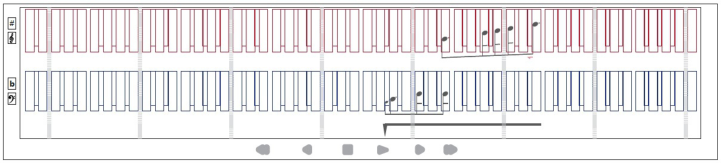
Multi-Functional Buttons and Height-Adjustable Holder With Smart Scanning System When a practitioner is first introduced to a new piece of music, it is good to practice with separate hands and deceleration. This is one of the issues that VIP wanted to be able to address, namely the ability to control the speed of the score. We have set up the corresponding raised smart buttons for turning pages and controlling the speed of practice. The length is as long as the length of keyboard, which is enough to place the paper or electronic sheet, or other tools like mobile phones. It is also attached an Intelligent Sheet Music Recognition that can scan the music sheet placed on it, then generating the tactile notes (Fig. 6). When the practitioner presses the PLAY button, the first note will jump up, and the following notes will jump up in sequence after the first note is played, making it easy for the visually impaired to familiarise themselves with the position of the notes. The notes jump up in rhythm with
How Multi-Sensory Can Help the Visually Impaired Better Play the Instruments 757
the melody of the piece (Fig. 7). We took the first bar of French Movie Waltz as an example to see what it would be on the keyboard. The full effect is shown on Fig. 8.
Figure 6: Height-adjustable holder with smart scanning system (designed by the authors).
Figure available in the original PDF paper.
Figure 7: The notes generated by the smart scanning system (designed by the authors).
Figure available in the original PDF paper.
Figure 8: The whole key board (designed by the authors).
Stimulating multi-sensory can enhance people’s perception, and effectively help the visually impaired feel the world better (Aksenova et al., 2022; Bartolome et al., 2021; Payne et al., 2022; Zand & Kyrarini, 2022). The transducers with soundbolts would be inserted in this smart system. It can create an immersive experience, automatically adjusting wind speed, tone and ambience according to the score (Fig. 9). The principle is like playing the Organ. As many VIPs prefer to listen the records first, then play the piano following the memory (Lu et al., 2023). This method can help them understand the music deeply according to the theory of flow, that immersion could enhance embodiment (Csikszentmihalyi, 2014). For example, if we intend to play the Classic Music, the transducer would generate the echo, as in an empty concert hall.
Figure 9: Transducers with sound bolts (designed by the authors).
Figure available in the original PDF paper.
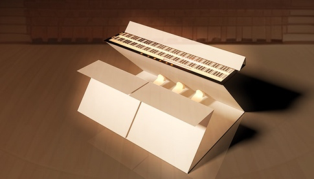
An Integrated Design With Double Seat For VIPs, the encouragement of those around them will boost their confidence, while the double-seat provides a more comfortable position for parents or teachers to help them complete their practice. For example, when they practice with one hand, the teacher can play the melody of the corresponding hand next to them to help them memorize it. Due to the impairments of the visually impaired people, they would love to have the encouragement of people around when they are practicing. When the notes jump up, the teacher needs to remind the learner which finger to play with. It is also suitable for four-handed practice. More importantly, the design provides a space for the visually impaired and the general public to play together. As the keyboard is an Origami Smart Keyboard. Paper-like thin body that can be folded as the plain flat when it is not in use, which can save the room if the space is limited. The piano benches currently on the market can only be adjusted in height, and in order to make them more stable, they are generally designed to be made of wood. Thus, the seats are too heavy to move flexibly. This design project applied for integrated principles, and seat height or fore/aft position can be adjusted according to different people’s body, suitable for adults or children (Fig. 10).
Figure 10: The whole model (designed by the authors).
CONCLUSION
For the visually impaired, we cannot deny the braille notation is suitable for their cognition, and a lot of people think that converting everything to braille is justified for them. but a question should be considered that how to make it easy to identify when VIPs face the complicated and variable rhythm. In the digital area, tactile pad with high technology seems to be normal, and can transfer images to the corresponding braille for VIPs to read. However, how can we guarantee that the VIPs could find the right position of the key after reading the electronic braille? Rieger et al questioned people’s biases about the abilities of people with disabilities (Rieger et al., 2020). Based on our inherent perception of VIPs, many organizations are devoted to promote the braille music sheet. The question is that how we can make sure that braille is the best way to learn an instrument for VIPs. Through this project, we try to propose a new method for VIPs to learn how to play an instrument. More importantly, it bridges a gap between the normal people and the disabled through music learning, trying to achieve the inclusive goal from a new perspective. The follow-on research will focus on promoting the
How Multi-Sensory Can Help the Visually Impaired Better Play the Instruments 759
output, trying to make it into practice. A comparative research about the effectiveness of the braille sheet and tactile staff is to be conducted. To avoid the bias of empiricism, we are going to design an experiment through the method of participatory design, trying to find if there is a new system of non-visualized notes that could be developed by the visually impaired.
ACKNOWLEDGMENT
The authors would like to acknowledge Eric C. Yim Endowed Professorship of PolyU (Ref.: 8.73.09.847K) and the Research Postgraduate Studentship of the School of Design and the Department of Computing of PolyU for supporting the research.
REFERENCES
Aksenova, D., Cai, W. J., & Gebbels, M. (2022). Multisensory prosumption: how cooking classes shape perceptions of destinations. International Journal of Contemporary Hospitality Management, 34(9), 3417–3439. https://doi.org/10. 1108/Ijchm-09-2021-1117 Bartolome, J. I., Cho, G., & Cho, J. D. (2021). Multi-Sensory Color Expression
with Sound and Temperature in Visual Arts Appreciation for People with Visual Impairment. ELECTRONICS, 10(11). https://doi.org/ARTN133610.3390/electr onics10111336 Bennett, C. L., Brady, E., & Branham, S. M. (2018). Interdependence as a Frame for Assistive Technology Research and Design. Proceedings of the 20th International ACM SIGACCESS Conference on Computers and Accessibility, Galway, Ireland. https://doi.org/10.1145/3234695.3236348 Bilyk, M. C., Sontrop, J. M., Chapman, G. E., Barr, S. I., & Mamer, L. (2009). Food
experiences and eating patterns of visually impaired and blind people. Canadian journal of dietetic practice and research : a publication of Dietitians of Canada = Revue canadienne de la pratique et de la recherche en dietetique : une publication des Dietetistes du Canada, 70(1), 13–18. https://doi.org/10.3148/70.1.2009.13 Csikszentmihalyi, M. (2014). Flow and the Foundations of Positive Psychology: The Collected Works of Mihaly Csikszentmihalyi (1 ed.). Springer Netherlands. https: //doi.org/10.1007/978-94-017-9088-8 Eikhaug, O. (2010). Innovating with people : the business of inclusive design.
Norwegian Design Council. Feng, A., Chen, Y. V., Li, R., & Ding, L. (2019). How smell can help visually impaired in health and well-being – a cognitive experiment. The Design Journal, 22(sup1), 371–386. https://doi.org/10.1080/14606925.2019.1595426 Galea, C., Porter, C., & Bcs, N. I. H. C. I. C. (2018). Accessible Choral Ensembles
for Visually Impaired Singers. Proceedings of the 32nd International BCS Human Computer Interaction Conference (HCI). Belfast, UK. Guo, Enci. (1998). The production of space in Hong Kong (1st ed.). Crabs Company Ltd. (Chinese edition) Hong Kong Blind Union. (n.d.) The one-stop support service for music development for the visually impaired. https://www.hkbu.org.hk/en/service/sport- art/sub-page?page_id=music Karpodini, C. (2022). Evaluating haptic technology in accessibility of digital audio
workstations for visual impaired creatives. Proceedings of the 24th International Acm Sigaccess Conference on Computers and Accessibility, Assets 2022. https: //doi.org/10.1145/3517428.3550414
Kersten, F. (1981). Music as Therapy for the Visually Impaired. Music Educators Journal, 67(7), 63–65. https://doi.org/10.2307/3400659 Lefebvre, H., Régulier, C., & Zayani, M. (1999). The Rhythmanalytical Project.
Rethinking Marxism, 11(1), 5–13. https://doi.org/10.1080/08935699908685562 Lu, L., Cochrane, K. A., Kang, J., & Girouard, A. (2023). “Why are there so many steps?”: Improving Access to Blind and Low Vision Music Learning through Personal Adaptations and Future Design Ideas. ACM transactions on accessible computing, 16(3), 1–20. https://doi.org/10.1145/3615663 Merleau-Ponty, M. (1978). Phenomenology of perception. Routledge & Kegan Paul. Payne, W. (2022). Sounds and (Braille) Cells: Co-Designing Music Technology
with Blind and Visually Impaired Musicians. 19th International Web for All Conference. https://doi.org/10.1145/3493612.3520464 Payne, W., Ahmed, F., Gardell, M., DuBois, R. L., & Hurst, A. (2022). Sound Cells: Designing a Browser-Based Music Technology for Braille and Print Notation. 19th International Web for All Conference. https://doi.org/10.1145/3493612.3520462 Pino, A. (2022). Facing the challenges of the inclusion of visually impaired students:
Music teacher’s perceptions. International Journal of Music Education, 40(2), 288–300. https://doi.org/10.1177/02557614211050987 Rickey, & James, C. (1990). Graphic/tactile musical keyboard and monographic music notation (United States Patent No. 4, 926, 734). Rieger, J., Herssens, J., & Strickfaden, M. (2020). Spatialising differently through
ability and techné. CoDesign, 16(2), 135–151. https://doi.org/10.1080/15710882. 2018.1531134 Sabuncuoglu, A. (2020). Tangible Music Programming Blocks for Visually Impaired Children. Tei’20: Proceedings of the Fourteenth International Conference on Tangible, Embedded, and Embodied Interaction, 423–429. https://doi.org/10. 1145/3374920.3374939 Siu, K. W. M. (2008a). Inclusive design : chess for those playing by heart. The Hong
Kong Polytechnic University, School of Design. Siu, K. W. M. (2008b). Quality in Design: User-oriented Design of Public Toilets for Visually Impaired People. In H. Pham (Ed.), Recent Advances in Reliability and Quality in Design (pp.441–464). Springer London. https://doi.org/10.1007/978- 1-84800-113-8_22 Siu, K. W. M., Wong, Y. L., & Lam, M. S. (2017). Inclusive Play in Urban Cities:
A Pilot Study of the Inclusive Playgrounds in Hong Kong. Procedia Engineering, 198, 169–175. https://doi.org/https://doi.org/10.1016/j.proeng.2017.07.080 Siu, K. W. M., Wong, Y. L., Lam, M. S. (2019). The Needs of Children and Their Caregivers in New Urban Lifestyles: A Case Study of Playground Facilities in Hong Kong. In: Charytonowicz, J., Falcão, C. (eds) Advances in Human Factors, Sustainable Urban Planning and Infrastructure. AHFE 2018. Advances in Intelligent Systems and Computing, vol 788. Springer, Cham. https://doi.org/ 10.1007/978-3-319-94199-8_25 Turchet, L., Baker, D., & Stockman, T. (2021). Musical Haptic Wearables
for Synchronisation of Visually-impaired Performers: a Co-design Approach. Proceedings of the 2021 ACM International Conference on Interactive Media Experiences, Virtual Event, USA. https://doi.org/10.1145/3452918.3458803 Zand, M., & Kyrarini, M. (2022). Sensing Visual Art by Relatable Music and Haptic Feedback for Individuals with Visual Impairments. Proceedings of the 15th International Conference on Pervasive Technologies Related to Assistive Environments, Petra 2022, 310–311. https://doi.org/10.1145/3529190.3534785
LISTED IN THE AHFE DIGITAL BOOKSTORE CATALOGUE
Explore the complete digital volume
Human Factors in Design, Engineering, and Computing
Read this individual research paper free through the original publisher, or explore the full digital proceedings book.
ISBN 978-1-964867-35-9
Explore this ISBN in the AHFE Bookstore ↗Listed in the July 2026 bookstore catalogue; search by ISBN to confirm current availability · Digital book purchase optional