Qiling Long, Kin Wai Michael Siu (2023). Public ICT access and use for people with disabilities (PWDs): a pilot study of public inclusive design. In: Design for Inclusion. AHFE Open Access, vol. 75, pp. 70–82. https://doi.org/10.54941/ahfe1003328
The access and use of the Internet in public spaces is becoming more extensive, and increasingly regarded as a transitional stage to achieving the ultimate goal of private internet access for all citizens (Viseu et al., 2006). Internet in public spaces does not only narrow the digital divide and promote digital inclusion, but is also a basic requirement for the realization of the information society. However, there may still be inequal access to information and communication technologies (ICT), especially for people with disabilities (PWDs), that has been widely overlooked. This ‘digital disability divide’ (Dobransky and Hargittai, 2006; Sachdeva et al., 2015) is widely acknowledged as affecting the equal participation of PWDs in society, hindering the construction of an inclusive society. The current academic literature related to digital inequality has focused on internet access and use of a diverse population segment, but there is deficient research on the ‘digital disability divide’, especially focusing on public ICT facilities. In order to bridge this gap and promote social inclusion, this paper takes the social model of disabilities as an objective group, exploring the public disabilities inequality theories and exclusive phenomenon through a deep literature review and onsite observation. This paper summarizes the four forms of public interactive behaviours of PWDs based on the four elements of ICT engaging with the public space from Abdel-Aziz et al. (2016). Also, a framework of public digital disability barriers that correspond with the ICT elements in public spaces has been proposed. By applying inclusive design thinking and principles, this paper identifies the deficiencies in design of existing ICT facilities. This paper also identifies and discusses key directions for improving digital disabilities inclusion in public spaces from a design policy and practical perspective. Suggestions for further study directions are also offered.
With the increasing diffusion of the Internet and ICT, the ‘digital divide’ is a critical factor impeding people’s equal access to informative and technologi- cal services. The term ‘digital divide’ is described as “the divide between those with access to new technologies and those without”, in a report researching internet diffusion among Americans (NTIA, 1999). People noticed the wide- spread inequalities in ICT access and believed this kind of maldistribution exacerbated social inequality, leading to a continuous information and kno- wledge gap between those ‘haves’ and ‘have-nots’ (Schweitzer, 2015). Digital
Public ICT Access and Use for People With Disabilities (PWDs) 71
inclusion provides people with broader choices and empowerment in major areas of life, including social, financial, and employment opportunities, lear- ning opportunities, and accessibility of services and information (Macdonald and Clayton, 2013).
Internet connections in public spaces improves the level of participation in the public sphere and the overall social participation (Hacker and van Dijk, 2000; Mattila and Nummi, 2022). Therefore, setting internet access and adopting ICT facilities in public spaces is one of the main policy tools adopted by governments to reduce the digital divide and eliminate digital inequality (Viseu et al., 2006; Abdel-Aziz et al., 2016). ‘Public space’ in this study is defined as the places that are “providing for all” “under the management of empire or state” (Siu, 2001; Hsia, 1994). However, due to poor design, planning and management, most existing public ICT facilities do not meet the requirement of “for all”, excluding vulnerable populations. For example, the proportion of PWDs being excluded from ICT facilities has increased over recent years across Europe (Macdonald and Clayton, 2013; Scholz et al., 2017). With growing public ICT access and use, if PWDs continue being una- ble to access and use them, their social exclusion will be exacerbated. This can lead to a worrying contradiction that those who should benefit the most from internet access end up being most at risk of exclusion (Watling, 2011). This paper conducts a literature review concerning the public digital disability divide and investigates the issue of public ICT facilities in digitally developed cities through a case study of Hong Kong, building a public digital disability inclusion framework from the perspective of design strategy and practices. This paper also pinpoints the concerns of inclusive public ICT design and management that lack consideration in previous research and discusses how to promote them through design policies and practices.
DIGITAL DIVIDE AND INCLUSION Digital Divide
The design of technology and the pace of technological change contributes to the exclusion of PWDs (Dobransky and Hargittai, 2016). The concept of ‘digital divide’ is nuanced and not confined to the binary view of ‘have’ and ‘have not’, which may hinder digital inclusion (DiMaggio and Hargittai, 2001; Bezuidenhout et al., 2017). The concept of ‘digital divide’ has been expanded into three levels: the initial gap between those with and without Internet access; the difference in Internet skill acquisition (Hargittai, 2001); and the tangible inequality of outcomes, such as learning and productivity through Internet technologies (Scheerder et al., 2017; Wei et al., 2011). Technologies involved in increasing participation in everyday life can also be considered a new form of digital divide, such as algorithmic awareness (Lythreatis et al., 2021; Gran et al., 2021).
A common misconception is that once internet connection rates reach satu- ration, the digital divide is bridged (Van Deursen and Van Dijk, 2019). A main public policy strategy has therefore expanded the provision of public access points, like public libraries, community computers, public Wi-Fi zones, etc.
72 Long and Siu
(Viseu, 2006). While public Internet and ICT facilities may improve access, there are a variety of questions that warrant further discussion: Can this kind of ‘access’ really be considered to satisfy ‘accessibility’ and ‘usability’ for PWDs? What barriers do they come across during the access process? How can the design and use of ICT facilities be improved to achieve equal access of public ICT?
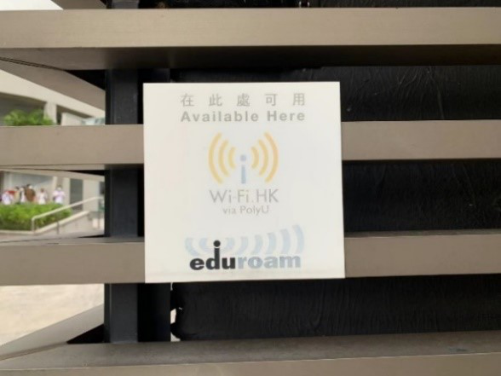
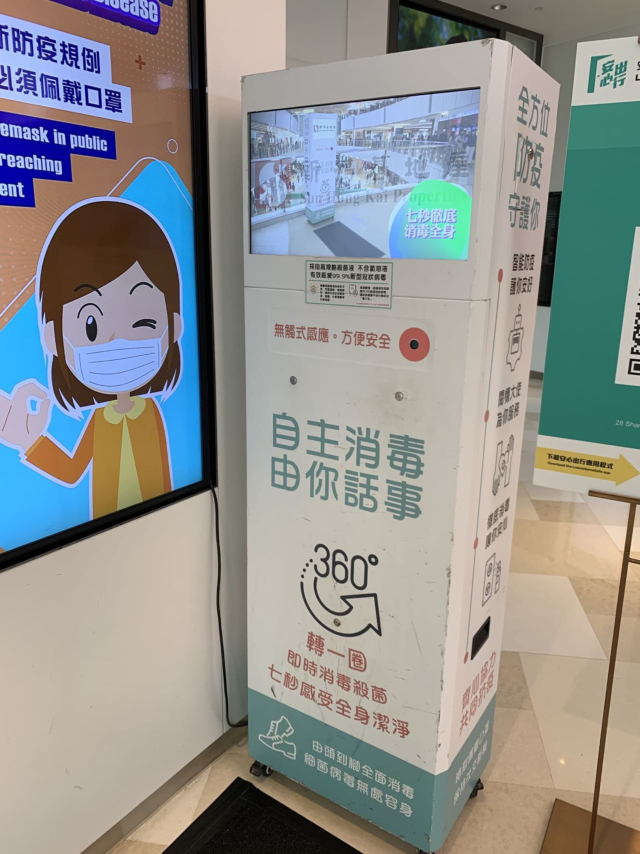
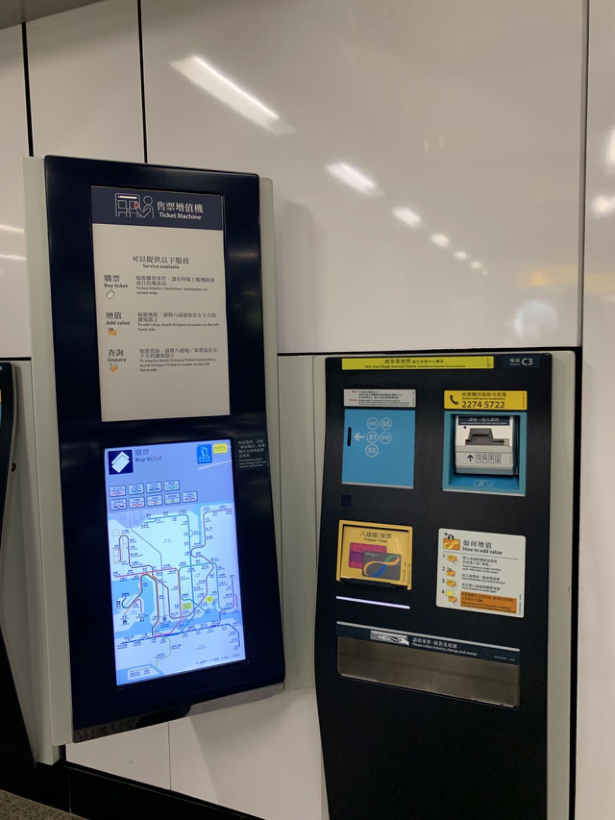
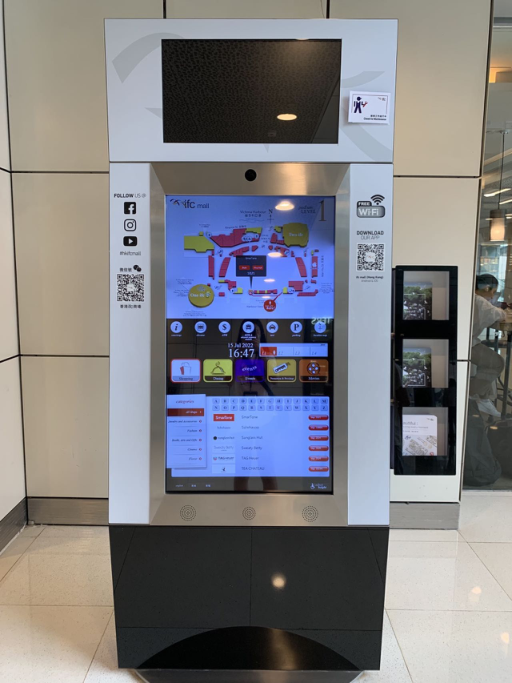
Public ICT and Digital Inclusion in Hong Kong Digital inclusion can be defined as “the activities necessary to ensure that all individuals and communities, including the most disadvantaged, have access to and use of Information and Communication Technologies (ICTs)” (Natio- nal Digital Inclusion Alliance, 2017). Hong Kong is considered a global ICT hub, and with increasing demands for access to ICT facilities, many strategies have been proposed such as the 2008 Digital 21 Strategy, Smart City Blue- print, setting up over 2000 wi-fi access points (see Figure 1) and introducing 130 new initiatives related to smart technologies (see Figure 2). Leading to the roll out of various public ICT facilities (see Figure 3 and Figure 4).
Public digital exclusion is therefore especially prominent in Hong Kong, where 7.1% of the overall population are registered disabled (Hong Kong Census and Statistics Department, 2022).
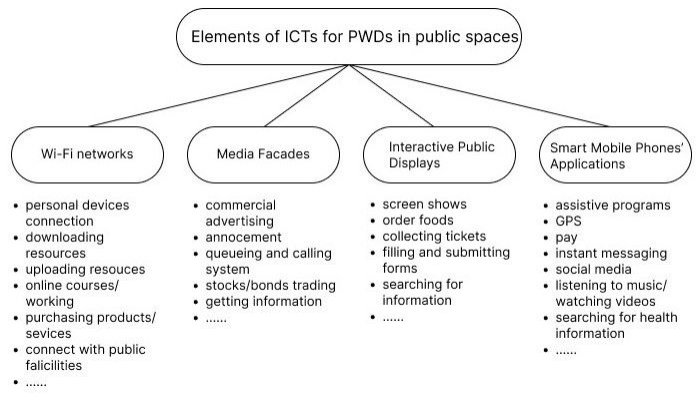
Abdel-Aziz et al. (2016) summarized four forms of ICT engaging and inte- racting with public spaces – Wi-Fi networks, digital interactive media facades, interactive public displays, and smartphones’ applications – which can be a corner stone to embody and specify PWDs’ interactive behaviours with ICT in public space. Building on Abdel-Aziz’s theory, this study explores the rela- tionship between public ICT and disabled participants and proposes a new analysis framework (see Figure 5).
PWDs tend to use assistive technologies or devices, leading to extra requi- rements and assistance to carry out daily activities, which is often ignored
Figure 1: Public Wi-Fi access point in Hong Kong Polytechnic University campus.
Public ICT Access and Use for People With Disabilities (PWDs) 73
Figure 2: Auto-disinfecting machine for combating COVID-19 in public space.
in ICT cognition, design and planning in public spaces, only considering the behaviours and needs of non-disabled people. The ‘minority marginalized groups’ are automatically excluded, resulting in subsequent digital exclu- sion. Therefore, it is necessary to analyse PWDs’ behaviours and needs when they are interacting with public ICT facilities in dealing with public digital exclusion issues. Despite ICT being increasingly deployed in public space, no research has successfully identified the potential public digital disability divide, which can also be described as a digital disability divide in terms of public ICT access and use.
The Hong Kong government has attempted to address PWDs accessi- bility issues, first through the Web Accessibility Handbook (Office of the
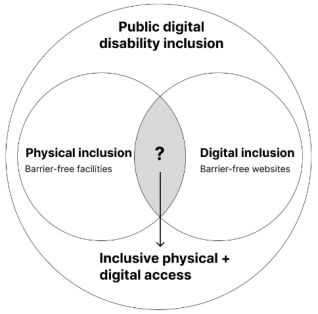
Government Chief Information Officer, 2022), and second through promo- ting barrier-free access to government offices (Development Bureau, 2022). These two documents are treated independently, whilst inclusion in the information society cannot be addressed by sole physical accessibility or digi- tal accessibility, but rather are intertwined in interaction with public ICT facilities (see Figure 6).
Figure 6 demonstrates the need to address both public physical inclusion and digital inclusion as an intertwined relationship. This study focuses on this relationship and regards it as a public digital disability inclusion issue. It attempts to provide solutions and explanations from the perspective of design, since design adopts human-centred approaches that can be under- stood and interpreted from the perspective of users (Kimbell, 2011; Barrett et al., 2015).
Public ICT Access and Use for People With Disabilities (PWDs) 75
Figure 4: Navigating machine in Hong Kong IFC Shopping centre.Figure 5: Elements of ICT and behaviours of PWDs in public spaces.
76 Long and Siu
Figure 6: Relationship between public inclusion, physical inclusion, and digital inclusion.
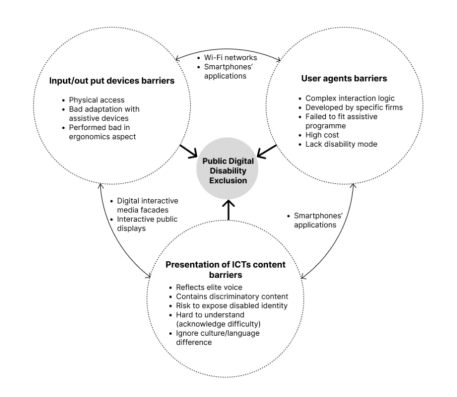
PUBLIC DIGITAL DISABILITY DIVIDE AND INCLUSION ICT has improved accessibility for PWDs, especially through assistive tech- nologies and devices. However, Dobransky and Hargittai (2006) argue that PWDs seldom participate in new technology developments, and barriers for PWDs include: physical internet access; hardware or software provision; accessing resources online; understanding complicated terms and conditions; and internet charges. Weber (2006) proposes a list of barriers for accessing the Internet, which are input and output devices, user agents, and presentation of web content. However, barriers for PWDs specifically in public spaces hasn’t been well identified. This paper uses four elements of ICT in public spaces (Wi-Fi networks, digital interactive media facades, interactive public displays, and smartphones’ applications) introduced by Abdel-Aziz et al. (2016), and the three barriers in public ICT access introduced by Weber (2006) to pro- pose an original framework demonstrating what barriers PWDs face in public ICT access and use. This is a new framework that previous studies have not covered (see Figure 7).
Figure 7: Framework of public digital disability barriers in public spaces.
Public ICT Access and Use for People With Disabilities (PWDs) 77
DESIGN FOR PUBLIC DIGITAL DISABILITY INCLUSION Inclusive design is an effective method to bridge the gap and promote the development of digital social inclusion.
In 2000, the inclusive design cube was proposed as a visualisation tool which helps to understand users’ capabilities through three dimensions: cognitive, sensor, and motion (Keates et al., 2000). This model helps to consi- der different types of disability more comprehensively in the design process, improving coverage and degree of inclusion. Swan (2017) identified inclu- sive design principles which have been widely applied in both academic and practical inclusive design, such as at Barclays Bank and the US National Association of State Workforce Agencies. These are: provide a comparable experience, consider the situation, be consistent, give control, offer choice, prioritise content, and add value.
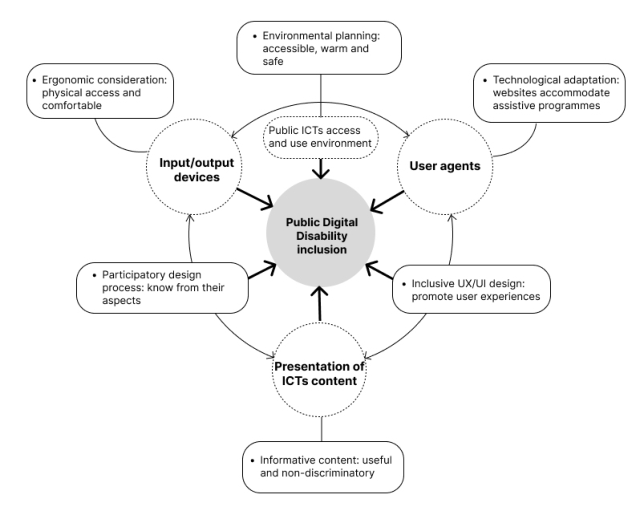
This paper refers to the inclusive design approach and principles mentio- ned above and proposes a novel framework (see Figure 8) to address Weber’s (2006) three exclusions, from six design-related aspects: environmental planning, ergonomic consideration, technological adaptation, informative content, participatory design process and inclusive UX/UI design. Together, these can create a public space in which PWDs can equally and confidently receive the convenience and prosperity brought from ICT in the information society.
This framework addresses public digital disability divides at the beginning stage of planning the public ICT provision. Therefore, this framework is not about how to compensate for the existing public digital disability divide, instead, it is pre-emptively addressing the possibility of digital disability divide before it has started.
Figure 8: Public digital disability inclusion framework.
78 Long and Siu
Environmental Planning: Accessible, Warm and Safe Public ICT access points should be easily accessible, with any curbs, eleva- tors, and stairs suitable for wheelchair or walking aid users. For sensory obstacles such as visual impairment, location of ICT facilities and accessi- ble zones should have a visually friendly identification, clear navigation, and other guidance to locate them. For cognitive barriers, public internet access sites should be designed in a warm atmosphere which will encourage the use of ICT devices and resources.
Ergonomic Consideration: Physical Access and Comfortable Poor ergonomic considerations are evident in designs of assistive technologies and ICT devices (Weber, 2006), with a lack of attention paid by designers on products related to PWDs. Therefore, public ICT should be provided along with facilities and equipment that conform to PWDs’ capabilities. For exam- ple, providing computer desks with the proper height for wheelchair users, disabled mouse for those with weak hand strength, screen readers for visual impairments, etc.
Technological Adaptation: Websites Accommodate Assistive Programmes Websites that are poorly designed or without a disability mode or may limit PWDs understanding of input or output information. Therefore, PWDs may rely on assistive programs to complete online tasks, such as screen readers, optical character recognition (OCR), and software systems (Disabled-World, 2022). This relies on well-designed websites to accommodate these systems. Lazar and Jaeger (2011) argue that if the design of websites is not flexi- ble enough to adapt to various assistive devices, then PWDs will be further excluded.
Informative Content: Useful and Non-Discriminatory PWDs often access the Internet for similar purposes to those without disa- bilities. Dobransky and Hargittai (2006) discovered that more than 50% of PWDs who use the Internet are actively engaging in activities such as email, instant messaging, reading news, etc. Therefore, public ICT should convey information in an easy-to-understand manner that is accessible to PWDs. Due to the anonymity of the network, those who lack digital education and have low digital literacy may face higher risk from discriminatory speech, fraud and private information disclosure. Therefore, the management of public ICT should protect PWDs from discriminatory information and formulate comprehensive accountability systems.
Participatory Design Process: Understand the Pwd Perspective Participatory design involves bringing stakeholders and target users into the design process (Ng, Siu and Chan 2013; Siu and Kwok, 2004; Siu and Xiao, 2020). This can involve including PWDs in the design and development stage to clearly express their insights and needs (Siu, 2009; Siu and Wong, 2013). Schradie (2011) discussed a class-based gap among digital content producers,
Public ICT Access and Use for People With Disabilities (PWDs) 79
with the elite voice dominating, which also exacerbates the digital divide and inequality. Meanwhile, many hardware and software creators do not consider PWDs in their design and development, instead relying on assistive technolo- gies which are hard to implement (Dobransky and Hargittai, 2016; Ellis and Kent, 2011). Without including PWDs at the beginning of design, additio- nal costs or delays at a later stage are likely to increase (Weber, 2006). The use of participatory design methods such as group sketching, mind-maps, in-depth interviews, cooperative workshops, usability tests, etc. during the design process can make design results more targeted and inclusive.
Inclusive UX/UI Design: Promote User Experiences Inclusive UI/UX design can drastically improve equality, for example by sim- plifying interaction logic, ensuring the font size and colour are friendly to visual impairment, or providing appropriate visual guidance to allow users to locate useful information quickly, etc. This will improve the efficiency and experience of PWDs when using the network and obtaining information. The World Wide Web Consortium (W3C) provides a series of web content accessibility standards, which improves accessibility for PWDs. As a refere- nce for web content development and design, it can contribute to improving the inclusiveness of digital content, but there are also limitations in applying it to large screen media displays and the interactive interface of public scenes. Therefore, it is still necessary to conduct specific research on the UI/UX design of ICT in public spaces, improving the experiences “physically, cognitively, and emotionally” (Shalamova, 2019) of PWDs.
CONCLUSION
In the information era, the public access and use of Internet and ICT has become a significant and effective means to bridge the digital divide and provide equal opportunity for all. However, under this trend, if the design and construction ignore PWDs, the digital disability divide will deepen. This paper reviews relevant literature on digital disability divide and inclusion, concluding there are scarce descriptions and analysis aimed at the public space context. This paper advocates the positive role of inclusive design in exploring the needs and requirements of public ICT access and use for PWDs. In doing so, designers can create an environment and atmosphere that allows PWDs to enjoy the public Internet and ICT resources freely and equally.
Based on four engaging elements of ICT and three categories of barri- ers in accessing and using theories, this paper proposes a series of solution and concludes a framework for bridging the public digital divide from six aspects: environmental planning, ergonomic consideration, technological adaptation, informative content, participatory design process, and inclusive UX/UI design. It is hoped this framework will increase the awareness and urgency of the issue and provide ideas and solutions as a reference tool. How- ever, there should be more systematic research and actions to explore and develop this topic, such as interviews, field studies, expert interviews, etc.
80 Long and Siu
How to bridge the public digital disability divide and inequality to create an inclusive society should therefore be a key topic to be addressed in future research, and is the future we are looking forward to.
ACKNOWLEDGMENT
The authors would like to acknowledge the resources and financial support of The Hong Kong Polytechnic University, and the partial research support on the theoretical study of inclusive design by the Hong Kong RGC General Research Fund (RGC Ref: 5612022). Eric C. Yim Endowed Professorship gave partial financial support for the study and paper preparation. The four elements of ICT engaging with the public space (Abdel-Aziz et al., 2016) and findings of internet access barriers from Weber (2006) are adopted as theoretical references in this paper. There was no conflict of interest during the undertaking of this research. All of the figures were drawn, and all photos were captured, by the authors.
REFERENCES
Abdel-Aziz, A. A., Abdel-Salam, H. and El-Sayad, Z., 2016. The role of ICTs in creating the new social public place of the digital era. Alexandria Engineering Journal, 55(1), pp. 487–493. Barrett, M., Davidson, E., Prabhu, J. and Vargo, S. L., 2015. Service innovation in
the digital age. MIS quarterly, 39(1), pp. 135–154. Bezuidenhout, L. M., Leonelli, S., Kelly, A. H. and Rappert, B., 2017. Beyond the digital divide: Towards a situated approach to open data. Science and Public Policy. Development Bureau, 23 Aug 2022, Accessibility of Government Premises, Facilities
and Services. Website: https://www.devb.gov.hk/en/other_information/accessibili ty_of_government_premises_facilities_a/index.html DiMaggio, P. and Hargittai, E., 2001. From the ‘digital divide’to‘digital inequality’: Studying Internet use as penetration increases. Princeton: Center for Arts and Cultural Policy Studies, Woodrow Wilson School, Princeton University, 4(1), pp. 4–2. disabled-world, 2022. Disability Assistive Electronic Devices and Software. Disabled-world website: https://www.disabled-world.com/assistivedevices/comp uter/ Dobransky, K. and Hargittai, E., 2006. The disability divide in internet access and
use. Information, Communication & Society, 9(3), pp. 313–334. Dobransky, K. and Hargittai, E., 2016. Unrealized potential: Exploring the digital disability divide. Poetics, 58, pp. 18–28. Ellis, K. and Kent, M., 2011. Disability and new media. Routledge. Gran, A. B., Booth, P. and Bucher, T., 2021. To be or not to be algorithm aware: a
question of a new digital divide?. Information, Communication & Society, 24(12), pp. 1779–1796. Hacker, K. L. and van Dijk, J. eds., 2000. Digital democracy: Issues of theory and practice. Sage. Hargittai, E., 2001. Second-level digital divide: Mapping differences in people’s
online skills. arXiv preprint cs/0109068.
Public ICT Access and Use for People With Disabilities (PWDs) 81
Hong Kong Census and Statistics Department, 2022. Hong Kong Monthly Digest of Statistics. [pdf]Hong Kong: Hong Kong Census and Statistics Department. Availa- ble at: <http://www.bankofengland.co.uk/publications/inflationreport/ir08nov.p df> [Accessed December 2022]. Hsia, C. J., 1994. Public space (Chinese ed.). Taipei: Artists. Keates, S., Clarkson, P. J., Harrison, L. A. and Robinson, P., 2000, November. Tow-
ards a practical inclusive design approach. In Proceedings on the 2000 conference on Universal Usability (pp. 45–52). Kimbell, L., 2011. Rethinking design thinking: Part I. Design and culture, 3(3), pp. 285–306. Lazar, J. and Jaeger, P., 2011. Reducing barriers to online access for people with
disabilities. Issues in Science and Technology, 27(2), p.69. Lythreatis, S., Singh, S. K. and El-Kassar, A. N., 2021. The digital divide: A review and future research agenda. Technological Forecasting and Social Change, p.121359. Macdonald, S. J. and Clayton, J., 2013. Back to the future, disability and the digital
divide. Disability & Society, 28(5), pp. 702–718. Mattila, H. and Nummi, P., 2022. The Challenge of the Digital Public Sphere: Finnish Experiences of the Role of social media in Participatory Planning. Planning Theory & Practice, 23(3), pp. 406–422. National Digital Inclusion Alliance. 2017. Definitions. National Digital Inclusion
Alliance. Retrieved from: https://www.digitalinclusion.org/definitions Ng, A. W. Y., Siu, K. W. M. and Chan, C. C. H. 2013. How do designers perceive user involvement in the creative design process? In S. B. Tan (Ed.), The convergence of the performing and creative arts: Reimagining methodologies and traditions (pp. 201–210). Universiti Sains Malaysia Press. NTIA, 1999. Falling Through the Net: Defining the Digital Divide. US Department
of Commerce, Economics and Statistics Administration Washington, DC. Office of the Government Chief Information Officer, June 2022. Web Accessibility Handbook. [online] Available at: https://www.ogcio.gov.hk/tc/our_work/commu nity/web_mobileapp_accessibility/promulgating_resources/handbook/doc/Web _Accessibility_Handbook.pdf Ruggiero, T. E., 2000. Uses and gratifications theory in the 21st century. Mass
communication & society, 3(1), pp. 3–37. Sachdeva, N., Tuikka, A. M., Kimppa, K. K. and Suomi, R., 2015. Digital disability divide in information society: A framework based on as tructured literature review. Journal of Information, Communication and Ethics in Society. Scheerder, A., Van Deursen, A. and Van Dijk, J., 2017. Determinants of Internet
skills, uses and outcomes. A systematic review of the second-and third-level digital divide. Telematics and informatics, 34(8), pp. 1607–1624. Scholz, F., Yalcin, B. and Priestley, M., 2017. Internet access for disabled people: Understanding socio-relational factors in Europe. Cyberpsychology: Journal of Psycho social Research on Cyberspace, 11(1). Schradie, J., 2011. The digital production gap: The digital divide and Web 2.0 collide.
Poetics, 39(2), pp. 145–168. Schweitzer, Eva Johanna. “digital divide”. Encyclopedia Britannica, 23Nov. 2015, https://www.britannica.com/topic/digital-divide. Accessed 17April 2022. Shalamova, N., 2019, October. Beyond cultural dimensions: digital inclusion in glo-
bal UX. In Proceedings of the 37th ACM International Conference on the Design of Communication (pp. 1–5). Siu, K. W. M., 2001. The practice of everyday space: The reception of planned open space in Hong Kong. Hong Kong Polytechnic University (HongKong).
82 Long and Siu
Siu, K. W. M., 2009. Reader Response and Reception Theories: User Oriented Design. New Era of Product Design: Theory and Practice. Beijing Institute of Technology Press, Beijing. Siu, K. W. M. and Kwok, J. Y. C., 2004. Collective and democratic creativity: Parti-
cipatory research and design. The International Journal of Creativity & Problem Solving, 14(1), pp. 11–27. Siu, K. W. M. and Wong, M. M. Y., 2013. Promotion of a healthy public living environment: participatory design of public toilets with visually impaired persons. Public health, 127(7), pp. 629–636. Siu, K. W. M. and Xiao, J. X., 2020. Public facility design for sustainability: Parti-
cipatory action research on household recycling in Hong Kong. Action Research, 18(4), pp. 448–468. Swan, H., 7 June 2017. Inclusive Design Principles. TPGi website: https://www.tpgi .com/inclusive-design-principles/ Van Deursen, A. J. and Van Dijk, J. A., 2019. The first-level digital divide shifts from
inequalities in physical access to inequalities in material access. New media & society, 21(2), pp. 354–375. Viseu, A., Clement, A., Aspinall, J. and Kennedy, T. L., 2006. The interplay of public and private spaces in internet access. Information, Community & Society, 9(5), pp. 633–656. Watling, S., 2011. Digital exclusion: coming out from behind closed doors. Disability
& Society, 26(4), pp. 491–495. Weber, H., 2006. Providing access to the internet for people with disabilities: short and medium term research demands. Theoretical issues in ergonomics science, 7(5), pp. 491–498. Wei, K. K., Teo, H. H., Chan, H. C. and Tan, B. C., 2011. Conceptualizing and testing
a social cognitive model of the digital divide. Information Systems Research, 22(1), pp. 170–187.
LISTED IN THE AHFE DIGITAL BOOKSTORE CATALOGUE
Explore the complete digital volume
Design for Inclusion
Read this individual research paper free through the original publisher, or explore the full digital proceedings book.
ISBN 978-1-958651-51-3
Explore this ISBN in the AHFE Bookstore ↗Listed in the July 2026 bookstore catalogue; search by ISBN to confirm current availability · Digital book purchase optional