Kin Wai Michael Siu, Jinjin Wang, Changxue Pan (2023). Theatricalization of Large Cruise Public Space and Design Transformation. In: Affective and Pleasurable Design. AHFE Open Access, vol. 71, pp. 206–213. https://doi.org/10.54941/ahfe1003260
1 School of Design, The Hong Kong Polytechnic University, Hong Kong, China; School of Art and Design, Wuhan University of Technology, Wuhan 430070, Hubei China ↗
2 School of Art and Design, Wuhan University of Technology, Wuhan 430070, Hubei, China ↗
As a place for tourists to communicate and interact, the public space of large cruise ships has become an important aspect of the design and construction of large cruise ships due to its dense functional units and core spatial location. In response to the lack of experience and spatial vitality in the public space of large cruise ships, this study attempts to apply dramaturgical theory and take the theatre, the physical space that carries the core of dramatic meaning, as the origin of the analogy. From the perspective of the dramatization of large cruise ship public spaces, “theatricalization” is introduced into the design of large cruise ship public spaces for exploration, returning to the meaning and emotional value of large cruise ship public spaces and attracting tourists to revisit them. Based on the core characteristics of the “theatricalization” of large cruise ship public spaces - theatricality, presence and spectacle, combined with theatrical narrative performance and scene construction, the design methods of large cruise ship public spaces are summarised and analysed in depth, actively building large cruise ship public spaces that interact with tourists. The study breaks through disciplinary limitations and forms a heterogeneous dimension for observing and understanding large cruise ship public spaces.
Due to its irreplaceable functions and attributes, the public space of large cruise ships is influenced by many social factors in the design process, and becomes a reflection of capital, culture and other forces. With the rise of “experience economy”, people’s sensory and emotional experience has become important (Jørgensen, 2020). However, the public space of large cruise ships is increasingly showing a flat level of experience, which gra- dually makes tourists lose the desire to revisit. In the realm of immersive theatre, the integration of the spectator through the immersive quality of the scenography seeks to advance an involving and participatory experie- nce (Home-Cook, 2015), theatre spaces inherently carry a rich content of meaning and experiential value. Like a theatre, the public space of a large cruise ship is an active force rather than a neutral or decorative background (O’Doherty, 2008. Beyes and Steyaert, 2012). All signs in the performance space have meaning (Taylor, 2004).
Theatricalization of Large Cruise Public Space and Design Transformation 207
This study focuses on the analogy between large cruise ship public spaces and theatres, discussing the multiple similarities between the two in terms of the representation of events and the forms of audience participation. This fit is attributed to the meaning and emotional connection behind the spa- tial presentation, and the innovative use of dramaturgical theory and theatre design methods in the context of large cruise ship public spaces is explored to give them a theatrical effect. On the basis of this, a design transformation path is developed to enhance tourists’ willingness to revisit and to restore the meaning and emotional value of large cruise ships.
INTRINSIC CONNECTION BETWEEN THEATRE AND LARGE CRUISE SHIP PUBLIC SPACE Representation of Event Manifestation
Theatres and large cruise ship public spaces are both essentially spaces of manifestation. Whereas theatre is the manifestation of false events on stage, public space is the manifestation of real and sometimes under-rehearsed events in life (Goffman, 2002). The representation of the manifestation of events in fact suggests a triadic relationship between “person”, “space” and “emotion”, where the “space” includes both the theatre and the public space of a large cruise ship, both of which are, in a broad sense, mediums for com- municating between people and their spiritual world. As Antonin Artaud, the pioneer of brutal theatre, said, theatre does not exist in anything, it exists precisely where the mind needs words to express itself (Artaud, 2019). Alth- ough the two present different functional models in the real world, they are essentially interconnected.
The theory of “empty space” explains the appearance of events in a non - “real stage”: by choosing any space, calling it an empty stage, one walks through it under the watchful eye of others, and this is enough to constitute a drama (Brook, 1996). In large cruise ship public spaces, in addition to the overtly visible physical environment and context, the interaction between tourists and tourists, waiters, and public space can be seen and heard by all, and the manifestation of events is a real phenomenon that can be perceived with the greatest degree of openness.
Forms of Audience Participation Ambient theatre encourages giving and receiving in a spherically organised space, where the audience occupies an area that is an ocean in which the actors swim, and the performance area is a number of islands and land mas- ses in the middle of the audience (Schechner, 1994). In this space, there are no fixed boundaries that automatically separate the audience from the actors. The actors present themselves to the roles performed by other actors under the shelter of a role in which the audience constitutes an interactive third party; the design encourages participation and is also a response to the desire to participate. Similarly, in the public space of the large cruise ship, the three parties merge into two, with the roles played by the large cruise ship wai- ters catering to the roles played by the other tourists present, who, however,
also constitute the audience. Tourists experience the public space with their own senses and body movements, and it is only through the participation of tourists that the public space is able to give its full meaning.
In both the theatre and the public space of a large cruise ship, “audience participation” is an important way of realising the experience, and is arran- ged and directed by the designer with a clear sense of initiative and purpose. However, the experience of the visitor in the public space of a large cruise ship is relatively more complex, with the tourist’s behaviour in the public space being autonomous and cognitively structured in a jumpy, reciprocal and random way.
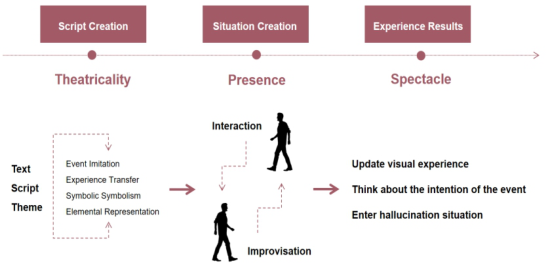
THE FEATURES OF THEATRICALIZATION OF LARGE CRUISE PUBLIC SPACE The exploration of the theatricalization of public spaces on large cruise ships is a study of the intertwined, complex and multi-dimensional relationships resulting from the various elements within “public space vs. Theatre”, which embodies several key features of the theatricalization of public spaces on large cruise ships: theatricality, presence and spectacle (see Figure 1). From the perspective of script writing, “theatricality” emphasizes the intertextual rela- tionship between the script and the public space of a large cruise ship, which is also the axis of the concept. From the perspective of situation creation, impro- visation, interactive performance, physical intervention, non-storytelling and logic are the characteristics of “presence”. From the perspective of experience results, “spectacle” provides a heterogeneous experience for the visitor.
Figure 1: Theatrical features of public space for large cruise ships. (Adapted from Social Theatricalization, 2015).
“Theatricality”emphasises both the performance properties of theatre and the scripted properties of drama. It means that the characters or scenes in the public space of a large cruise ship have a plot, character, words, ideas, and images that make the events appear as if they were theatrical scenes “performed in imitation of a script” (Pu, 2015). An example of this is the Disney Magic cruise ship (see Figure 2), a special cruise ship designed with the Disney story in mind. A bronze statue of Mickey at the helm sits in
Theatricalization of Large Cruise Public Space and Design Transformation 209
the centre of the atrium space, marking the beginning of the cruise. The entire public space of the cruise ship combines fantasy, imagination, crea- tivity and adventure, continuing the Disney tradition of providing the best shipboard experience as well as an immersive and magical experience for guests.
Figure 2: Disney magic cruise atrium space.
Figure available in the original PDF paper.
“Presence” is the essential characteristic of the theatricalization of the public space of a large cruise ship. In theatre, “presence” becomes the spontaneous presentation of the inner spirit of the actor in the theatri- cal moment and the real and shared creation of an irreducible theatrical experience by theatre and audience in a changing space and without pre- conceived conditions (Man-WahLuke, 2010). Similarly, in the same way as the concept of theatre presence, the “presence” of the theatricalization of the public space of a large cruise ship is not centred on imitation, but on the improvisational energy and the sexual energy of presence generated by the power of a certain medium on site. It is the improvisational, episodic, bodily and authentic nature of the large cruise ship public space, a huge “theatre”.
“Spectacle” has the dual characteristics of the theatre of illusion and the creativity of the unpredictable (Pu, 2015). The public space of a large cruise ship develops according to the logic of the spectacle, which, to a certain extent, gives tourists the illusion of entering the cloning era of mimesis, copying, proliferation and reproduction (see Table 1).
Table 1. The spectacle of large cruise ship public spaces.
Table available in the original PDF paper.
DESIGN TRANSFORMATION OF THEATRICALZATION OF LARGE CRUISE PUBLIC SPACE Concentration and Expansion
The design of “concentration” in the theatre is strongly intended to capture the audience’s attention with the present situation, suggesting its significance. Human vision is inherently selective, always focusing on the most meaningful part of the current environment, showing the intentionality of the subject and leaving out the rest. The inspiration and inducement generated by “concen- tration” in turn leads to the audience’s rich associations, which are projected into the entire theater space. As imagination is not limited by physical space, the realm of “expansion” necessarily transcends the physical space of the theatre (see Figure 3).
Figure 3: Illustration of tourist experience under “concentration and expansion”.
Figure available in the original PDF paper.
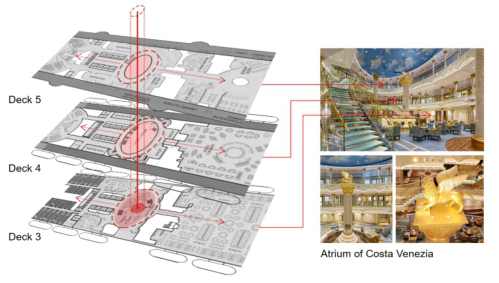
In the atrium space of Costa Venezia (see Figure 4), the rhythmic interface around the ship, together with the “flying lions” on the columns of the axis, lead the tourists’ eyes to the ceiling, where a group of “white doves”fly freely in the blue sky and white clouds, interpreting the romantic poetry of San Marco Atrium. The “concentration” of this scene becomes an important part of the enclosing interface that triggers tourists’ imagination and strengthens their sensory experience, making them feel as if they are really in the Piazza San Marco, breaking through the limitation of the size of the atrium space.
Figure 4: The atrium space of Costa Venezia cruise ship.
Limitations and Features The “limitations” of the theater are concentrated in the limitations of the stage space, and limitations and features are often mutually conditional and transforming. According to Soviet director Nikolai Okhlopkov, there is noth- ing that theater cannot express by its own unique means. The so-called unique
Theatricalization of Large Cruise Public Space and Design Transformation 211
Figure 5: Illustration of tourist experience under “limitations and features”.
Figure available in the original PDF paper.
means of theater is none other than to call the audience to participate. The key to this is to guide the audience through two or more situations that are repeatedly folded back and forth, an overlay that both emphasizes the diffe- rences between several situations and makes the audience aware of the salient features of each situation itself (see Figure 5).
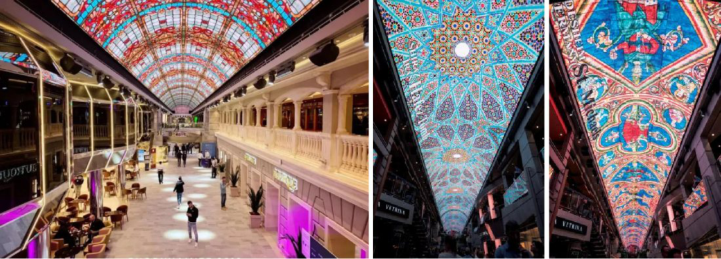
Large cruise ships are generally slender in shape due to the constraints of their appearance, so narrow public corridor spaces are inevitable. MSC Bellissima cruise ship (see Figure 6), however, converts this limitation into its characteristic, creating a 96-meter-long Glory Avenue, which is topped by an 80-meter-long LED canopy. Through the tandem setting of two different experience paths, that is, to meet the needs of tourists for entertainment, rest and socialization, generating a touring and viewing path of entertainment and resting areas, and at the same time providing a commercial path that can meet the shopping and consumption of tourists.
Figure 6: Public space of MSC Bellissima cruise ship.
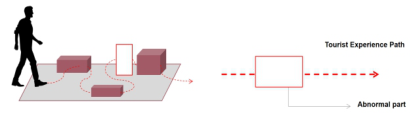
Normal and Abnormal While “normal” is homogeneous, directionless and purposeless, and is expressed as a rhythm of behavioral and visual features, “anomaly” inter- mittently draws the audience out of the continuous narrative rhythm, inter- rupting the coherence of the previous contextual atmosphere and making the audience feel surprised and curious (see Figure 7). In order to make the audience feel the aesthetic sensation of perversity, it is necessary to make the artistic reproduction deviate from the natural form of the reproduced object (Hu, 2002).
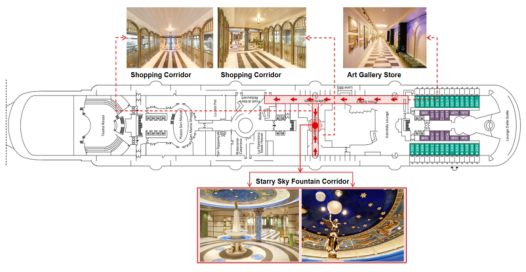
Located on the fifth deck of the Costa Venezia (see Figure 8), the corridor of the shopping center connects to the art gallery to form a long and narrow public space with visually consistent interior decoration and colors. However, the design of the “12 Constellations Star Fountain” breaks the sequence of
Figure 7: Illustration of tourist experience under “normal and abnormal “.Figure 8: Deck 5 of costa venezia cruise ship.
the space, guiding tourists from a normalized sensory experience to a perverse aesthetic one. Under the stimulation of contrast, it not only enhances the rich- ness of the public space experience level, but also creates a more meaningful space of spectacle.
CONCLUSION
This study is based on the dramaturgical theory and aims to discuss the thea- tricalization and design transformation of large cruise ship public space from the perspective of theater. Based on the analysis of the intrinsic connection between theater and large cruise ship public space, it reveals the key features of theatricalization of large cruise ship public space and proposes three design transformation paths: concentration and expansion, limitation and identity, and normal and abnormal.
ACKNOWLEDGMENT
This article was produced with the support of the joint supervision sch- eme (G-SB4P) between The Hong Kong Polytechnic University and Wuhan University of Technology. The authors would also acknowledge the support of the Eric C. Yim Endowed Professorship in Inclusive Design.
REFERENCES
Artaud, A. (2019). Le Théâtre et son double: Suivi de: le Théâtre de Séraphin.
République des Lettres, 9. Beyes, T., & Steyaert, C. (2012). Spacing organization: Non-representational theory and performing organizational space. Organization, 19(1), 45–61.
Theatricalization of Large Cruise Public Space and Design Transformation 213
Brook, P. (1996). The empty space: A book about the theatre: Deadly, holy, rough, immediate (Vol. 11). Simon and Schuster, 3. Goffman, E. (2002). The presentation of self in everyday life. 1959. Garden City,
NY, 259. Home-Cook, G. (2015). Theatre and aural attention: Stretching ourselves. Springer,
134. Hu Miaoshen, ed. (2002). Reading Space: Aesthetics of Stage Design. Shanghai: Shanghai Literature and Art Publishing House. Jørgensen, L. (2020). The theatricality of organizational atmosphere. Ambiances.
Environnement sensible, architecture et espaceurbain, (6). Man-WahLuke, C. (2010). On “Presence” in Contemporary Western Thea- tre. Foreign Literature Studies, 32(5), 145–153. O’Doherty, D. P. (2008). The blur sensation: Shadows of the future. Organization, 15(4), 535–561. Pu Bo. (2015). Social Theatrization. Nanjing: Southeast UniversityPress. Schechner, R. (1994). Environmental theater. Hal Leonard Corporation. Taylor, H. (2004). Deep Dramaturgy: Excavating the Architecture of the Site-Specific
Performance. Canadian Theatre Review, 119, 16–19.
LISTED IN THE AHFE DIGITAL BOOKSTORE CATALOGUE
Explore the complete digital volume
Affective and Pleasurable Design
Read this individual research paper free through the original publisher, or explore the full digital proceedings book.
ISBN 978-1-958651-47-6
Explore this ISBN in the AHFE Bookstore ↗Listed in the July 2026 bookstore catalogue; search by ISBN to confirm current availability · Digital book purchase optional