BENEDETTA TERENZI, Giovanna Binetti, Sofia Busti (2025). Human and Artificial Systems in the Design for Social Innovation: Critical issues and opportunities. In: Design for Inclusion. AHFE Open Access, vol. 169, pp. 120–130. https://doi.org/10.54941/ahfe1006161
The complexity of human and artificial systems plays a crucial role in Design for Social Innovation (DfSI), an approach that aims to solve social problems through the co-creation of innovative solutions. In this context, design must take into account the dynamic interactions between individuals, communities, and advanced technologies. Indeed, the concept of systemic complexity is fundamental to understanding how heterogeneous elements can interact, influence each other, and generate nonlinear and often unexpected outcomes. In the field of DfSI, the main challenge is to integrate human systems, characterized by diverse behaviors, needs, and values, with artificial systems, such as artificial intelligence (AI) and cybernetic systems, which operate according to algorithmic logic. This integration requires a thorough understanding of socio-technical dynamics, including the analysis of social networks, collective decision-making processes, and technological mediation. Human systems, inherently complex, are defined by a network of social, cultural, and economic relationships. In DfSI, these systems must be viewed not only as recipients of innovations but also as active co-creators. Indeed, human participation is essential to ensure that design solutions are sustainable, accepted, and adapted to local contexts. The systems approach to DfSI, therefore, requires interdisciplinary collaboration that integrates expertise in design, social sciences, technology, and ethics. The goal is to develop design methodologies that are capable of managing complexity and promoting inclusive, sustainable, and adaptive social innovation. Internationally, there are interesting case studies demonstrating the potential of integrating artificial systems into complex social problems in a wide variety of contexts. For example: i) Smart Cities and Social Innovation - Case Study: the city of Barcelona; ii) Healthcare Innovation with AI - Case Study: Babyl in Rwanda; iii) Educational Innovation and AI - Case Study: Adaptive Learning Platforms; iv) Sustainable Agriculture and AI - Case Study: Precision Agriculture in Kenya. In Italy, too, the application of advanced digital technologies in the social context is now widespread. Significant examples include: i) "Educational Robotics" project - Stripes Cooperative; ii) "AI & Welfare" project - Idee in Rete National Consortium; iii) Artificial Intelligence for Social Good project - ABN Consortium; iv) "Care for Carers" project - ASAD Social Cooperative. This research has systematized DfSI initiatives that integrate artificial systems into complex social problems currently present in the Umbria Region, with the aim of addressing the challenge of scalability, i.e., the ability to adapt design solutions to different contexts and communities. This process aims to create a map of criticalities and potentials, facilitating interactions, as well as the development of operational guidelines that can stimulate the emergence of new creative and innovative opportunities. The goal is to develop design methodologies that can manage complexity and promote inclusive, sustainable, and adaptive social innovation. In conclusion, the complexity of human and artificial systems is a key challenge in DfSI, but it also offers significant opportunities to develop more effective and resilient solutions. The interaction between these systems must be carefully managed to ensure that social innovation is driven by people's needs and supported by technologies in an ethical and responsible manner. 1. Manzini, E. (2015). Design, When Everybody Designs: An Introduction to Design for Social Innovation. MIT Press. 2. Mulgan, G. (2019). Social Innovation: How Societies Find the Power to Change. Policy Press. 3. Latour, B. (2005). Reassembling the Social: An Introduction to Actor-Network-Theory. Oxford University Press. 4. Smith, A., & Stirling, A. (2018). Grassroots Innovation and Innovation Democracy. Science and Technology Studies, 31(2), 35-52. 5. Ratti, C., & Claudel, M. (2016). The City of Tomorrow: Sensors, Networks, Hackers, and the Future of Urban Life. Yale University Press. 6. Fu, Z., & Zhou, Y. (2020). Research on human–AI co-creation based on reflective design practice. CCF Transactions on Pervasive Computing and Interaction, 2(1), 33-41. 7. Dionisio, M. et al., (2023) The role of digital social innovations to address SDGs: A systematic review Environmental Management and Sustainable Development” (23 February 2023), Springer 8. Cila, N., Giaccardi, E., Trotto, A., & Bogers, S. (2017). Products as agents: Metaphors for designing the products of the IoT age.
INTRODUCTION TO SOCIAL INNOVATION Innovation has the power to transform society, redefining the ways in which we work, live, and interact. Over time, the meaning of innovation has broadened, expanding beyond the technological domain to embrace social, cultural, and economic dimensions. Within this broader context, social innovation stands out as the most comprehensive form of innovation, capable of integrating diverse dimensions in order to effectively address collective needs that traditional systems are unable to fully meet. Despite the growing interest in social innovation, no universally accepted definition has yet emerged. According to a recent study, there are more than 250 definitions of the term, a figure that illustrates the wide-ranging and multifaceted nature of the concept. The difficulty of theorizing social innovation reveals its fluid and complex nature.
A significant contribution was made by Michael Young, a British sociologist and politician, who coined the term “social innovation” in 1968 in his book titled “The Rise of the Meritocracy.” Young argued that social innovation is necessary to address inequality and promote equity in society. Social innovation first entered the public discourse during a speech
Human and Artificial Systems in the Design for Social Innovation 121
delivered by Hughes de Varine at a Council of Europe symposium on cultural animation held in Lyon in September 1978. On that occasion, social innovation was defined as “an initiative taken by an individual or a group, or by an institution or public authority, with the aim of solving a problem or a set of problems that are not addressed by traditional systems or established norms” (Chambon et al., 1982, p. 16).
A crucial contribution to the theoretical development of social innovation has come from CRISES (Centre de recherche sur les innovations sociales) in Montreal. This interuniversity research center, active for over thirty years, defines social innovation as “new social, organizational, or institutional arrangements that respond to unmet needs, aim to transform social relations, or propose new cultural orientations” (Klein et al., 2009).
In the European public debate, the concept of social innovation was popularized by the research report Social Silicon Valleys. A Manifesto for Social Innovation (The Young Foundation, 2006). Since the publication of this document—supported by a strategic campaign of cultural lobbying— the term and its underlying concept have gained widespread traction in the decision-making processes of European political and technical bodies. This culminated in the influential BEPA (Bureau of European Policy Advisers) report coordinated by Agnès Hubert (BEPA, 2011), which positioned social innovation as a key policy direction for economic and social development within the Europe 2020 strategy.
The Young Foundation identifies key characteristics of social innovation as:
Implementation of the idea: going beyond invention, it manifests in real and sustainable applications with potential for diffusion.
Superior effectiveness: it must demonstrate measurable improvements over existing solutions, including higher quality, satisfaction, impact, or cost reduction.
Social value creation: success is assessed in social terms, such as reducing isolation, improving well-being, and enhancing cohesion.
In the report Empowering People, Driving Change, BEPA (2011) defines social innovation as: “new ideas (products, services, or models) that meet social needs more effectively than alternatives and that create new social relationships or collaborations.” BEPA emphasizes that the value of social innovation lies not in profit-making but in its ability to improve quality of life, promote solidarity, and foster well-being.
Moreover, the BEPA report, supported by projects such as TEPSIE (Theoretical, Empirical and Policy Foundations for Social Innovation in Europe, 2012–2015) and ImPRovE (Poverty Reduction in Europe: Social Policy and Innovation, 2013–2016) identifies three fundamental dimensions:
Processes: development of new forms of organization and interaction.
Responses: addressing needs traditionally overlooked by markets and institutions, including those of vulnerable groups.
Objectives: promoting empowerment, learning, and participation as both means and outcomes.
The European Union adopts the following definition: “Social innovations are innovations that are social in both their ends and their means. Specifically, we define social innovations as new ideas (products, services, and models) that simultaneously meet social needs (more effectively than existing approaches) and create new social relationships or collaborations” (Caulier-Grice et al., 2010).
According to Article 9 of Regulation (EU) No. 1304/2013 concerning the European Social Fund, social innovation is also intended to trigger behavioral changes necessary to address contemporary societal challenges. In this context, civil society plays a fundamental role, being actively involved in identifying appropriate solutions.
Generally speaking, it is possible to identify common elements across all definitions. Social innovation is thus characterized by three fundamental aspects:
Response to emerging social needs: it addresses problems or aspirations that remain unfulfilled.
Diversity of forms: it may take the shape of a product, service, process, or project tied to a social issue.
Plurality of actors: it involves individuals, public institutions, economic organizations, informal groups, and individual citizens.
According to the Stanford Social Innovation Review (Phills et al., 2008), an innovation can be considered social only if its primary impact is oriented toward the collective good, rather than individual gain.
Murdock and Nicholls (2012) provide an in-depth analysis of the notion of the “social” within social innovation, advocating a tripartite approach:
Who promotes the innovation (social actors: third sector, communities, social enterprises);
How it is evaluated (not only economically, but also in terms of social impact and inclusive governance);
Why it is “social” (it addresses welfare gaps, creates collective value, and transforms relationships and markets).
Here, the term “social”is not merely an intention but a structural criterion: it encompasses modes of action, metrics of evaluation, and long-term systemic effects. Within the International Handbook of Social Innovation, one of the most comprehensive texts published to date on the subject, social innovation is once again defined as an innovative method for addressing social problems or meeting unmet needs.
DESIGN FOR SOCIAL INNOVATION: A THEORETICAL OVERVIEW Design for social innovation constitutes a strategic and systemic approach oriented toward the design of services, processes, and relationships among individuals, organisations, and institutions. It is a rapidly expanding field that focuses on understanding human behaviours, patterns of interaction, and social needs, with the aim of developing design solutions capable of generating a positive impact on the socio-cultural context.
Human and Artificial Systems in the Design for Social Innovation 123
This perspective aligns with the notion of “a way out,” as described by Koenig (1970), wherein the designer is no longer merely the author of “signature”products intended for individual or elite consumption, but rather repositions their practice toward the conception of systems of processes, products, and services, service design, that contribute to the improvement of living conditions for society as a whole; in other words, in service of the common good.
Among the most authoritative voices to criticise the excesses of consumer- driven design were Tomás Maldonado (1970) and Victor Papanek (1971) who both published seminal works advocating for an urgent awareness of the profound cultural and environmental transformations underway. Seeking to theorise the necessity of a socially and morally responsible design, Papanek (1971) maintained that design cannot be considered a neutral activity. Rather, it is an inherently ethical discipline whose impact must be evaluated in terms of collective well-being.
A significant contribution to this vision was provided by Victor and Margolin (2002), who introduced a social model of design that shifts the goal from the production of market-driven goods to the satisfaction of essential human needs.
At the core of design for social innovation is the in-depth analysis of societal and community needs, followed by the implementation of concrete interventions that respond effectively to these demands. It is a practice-oriented field, centred on solving real-world problems through the development of models and processes that enhance quality of life and contribute to long-term social transformation. The approach adopted in this domain places a strong emphasis on human centrality, aiming to develop solutions that authentically reflect the needs of people and communities. Design methodology in this context is therefore guided by a human-centred logic, ensuring a meaningful and lasting impact and positioning design as a key driver of positive change.
Social innovation foregrounds the active role that individuals and groups can play in development processes through their competencies and original forms of collaboration. Central to this is the concept of agency, defined as the capacity of social actors to take action. As Murray et al. (2010) argue, agency is crucial to understanding how social innovation operates within development processes. Furthermore, agency can be co-performative, as highlighted by Sennett (2012), particularly when it is fuelled by collective, shared action.
It is therefore important to distinguish between social innovation and social impact. Social impact (or social value) refers to the tangible and measurable effects on individuals and communities resulting from the implementation of specific design solutions. In essence, social impact is the outcome of change driven by innovative policies and processes that reshape cultural symbols, behavioural norms, social structures, or value systems within a given social framework. The solutions and measures adopted in a socially impactful process are often themselves social innovations, as they are based on novel approaches and methods. Accordingly, an innovation
may be considered “social” if it produces enduring transformations in social relationships and behaviours among the people involved.
Today, the design discipline is increasingly reclaiming its political and critical function, as originally envisioned by early design theorists and practitioners. Within this renewed framework, the notion of social sustainability emerges as a fundamental principle, ensuring that innovations yield long-term positive effects on communities. Social sustainability can be understood as the capacity of a system to ensure well-being, social cohesion, and equal opportunities through targeted interventions in the key domains of human development. These domains are articulated into six macro-thematic areas: access to resources, education, employment and income, health, human rights, and safety. Each area encompasses specific sub-themes that further define the constituent elements of social sustainability.
SOCIAL INNOVATION AND ARTIFICIAL SYSTEM Digitalisation is increasingly influencing multiple aspects of human life, transforming the way people work, shop, travel, teach, govern, and, more broadly, live. Digital technologies now serve as a strategic tool for achieving the Sustainable Development Goals (SDGs) outlined in the 2030 Agenda.
The report Technology for a Secure, Sustainable and Superior Future: Technology as a Force for Good, published by the organization Force for Good in 2023, analyses the contribution of technological innovations to global sustainability progress.
The impact of information and communication technologies (ICT) is particularly evident in the social sector, where digital tools offer new opportunities to enhance collective well-being, improve access to services, and foster social inclusion. While social innovation does not necessarily rely on advanced technologies, they nevertheless represent a powerful enabler for its implementation and dissemination. As highlighted in the volume edited by Caroli (2018) technology may not always be an essential or sufficient condition for social innovation, but its enabling and transformative potential is undeniable. Within this framework, so-called Technology Social Ventures are emerging, social enterprises that leverage digital technologies to develop innovative solutions in critical sectors such as healthcare, education, and workplace inclusion.
Digital solutions constitute a powerful mechanism to amplify and accelerate social change. They enhance access to services, optimise the use of resources, and support more equitable and sustainable development models. These solutions are also reshaping the processes of goods and services production, organizational strategies, and the modes of interaction between organizations and stakeholders (Terenzi, 2022).
In its 2014 report, the TEPSIE project analysed thirty case studies across five macro thematic areas, employment, health, education, community and local development, and the sharing economy. The report identified three main categories of effects resulting from the use of ICT in social innovation: i) Support effect; ii) Enabling effect; iii) Transformative effect.
Human and Artificial Systems in the Design for Social Innovation 125
Concrete examples include case studies such as Accexible, a technological innovation addressing mental and neurological health; Be my Eyes, an assistive technology enhancing accessibility for individuals with visual impairments; Decidim, a platform for participatory democracy; Familiar, a digital tool designed to support care for cognitive decline; Kujakuja, a participatory innovation initiative aimed at improving humanitarian services; Prompts, an AI-based solution for maternal health; Refugee.info, a digital information service for refugees and migrants; and Ushahidi, an open- source platform that strengthens communities and enhances quality of life. Most of the initiatives examined use standard ICT tools that are commercially available, require minimal customization, and are intuitive for non-specialist users. This suggests that digital competencies do not necessarily constitute a barrier to adoption, thereby allowing disadvantaged social groups with limited technological proficiency to access and benefit from these innovations.
This reflection finds theoretical resonance in the work of Schumacher (1973), proposed an alternative vision of technological development. Schumacher advocates for “intermediate technology”, an approach to innovation that is more advanced than primitive technology but simpler, more affordable, and more accessible than the elite technologies of affluent countries. This type of technology is designed to address the actual needs of communities, is easily replicable, and empowers individuals to actively participate in both production and decision-making processes.
Artificial intelligence (AI) is also emerging as a transformative tool in the social care sector, offering innovative means to improve the efficiency, accessibility, and effectiveness of services. AI applications span predictive analytics, smart home systems, and inclusive solutions for individuals with disabilities. However, the widespread deployment of AI in social services remains constrained by technological, regulatory, and cultural barriers (Terenzi et al., 2024).
In Italy, the implementation of AI within welfare and social services is still in an experimental phase. Challenges include limited digital literacy among social workers, concerns over data privacy and security, and outdated technological infrastructures, all of which hinder the integration of AI-based solutions.
Recent research (Cingolani et al., 2023) has highlighted the potential role of AI in integrated home care (ADI), particularly in the remote monitoring of elderly patients. The study emphasises that intelligent assistive technologies can enhance the quality of life for both elderly individuals and their caregivers. Furthermore, the adoption of AI in social services may contribute to reduced healthcare costs and improved service delivery outcomes.
HUMAN AND ARTIFICIAL SYSTEMS IN DEPARTMENT OF SOCIAL POLICIES OF THE MUNICIPALITY OF PERUGIA The Third Sector refers to a set of private entities that operate with civic, solidaristic, and socially beneficial aims, complementing public institutions and the market in serving the interests of local communities. These
organizations are characterised by their commitment to areas such as social assistance, environmental protection, healthcare and social welfare services, and cultural promotion.
Third Sector Entities (Enti del Terzo Settore, ETS) include both commercial and non-commercial organizations legally constituted as associations, committees, foundations, or enterprises. Their defining feature is the exclusive or predominant pursuit of activities of general interest, without the objective of generating profit. These entities are regulated by the Codice del Terzo Settore (Third Sector Code), which also outlines the requirements for registration in the Registro Unico Nazionale del Terzo Settore (National Single Register of the Third Sector – RUNTS).
The Municipality of Perugia implements numerous social projects in collaboration with Third Sector Entities, employing tools such as public procurement and co-design. The latter, considered more flexible, enables the active participation of diverse stakeholders in the planning and implementation of social interventions. This collaborative approach often leads to more effective initiatives, adaptive responses, and broader community involvement, thereby contributing to the development of a more inclusive and sustainable network of local social services. The most recent and significant examples include: ForTEEN, since 2021; La città che vorrei, since 2024; Consultori familiari 2.0, initiated in 2025.
A Mapping of Third Sector Entities in the Municipality of Perugia Mapping is a strategic tool to facilitate interaction between public administration and the Third Sector, fostering a more participatory, transparent, and integrated approach. National case studies served as significant references that inspired the design of the local mapping project in Perugia. Specifically, these include:
Community Resource Map for Social Services (Bologna): a digital tool designed to guide citizens and social service operators through the extensive range of local resources available to address personal and family needs. The platform allows targeted searches by district and user group.
Dynamic Resource Mapping (Pescara): the Ma.D.Ri. (Dynamic Resource Mapping) project represents a strategic initiative for cataloging the social, welfare, educational, health, and community services available in the city of Pescara. Co-designed with the University “G. d’Annunzio,” Caritas, and the company Maiora, Ma.D.Ri. aims to increase accessibility and knowledge of local services, contributing to the creation of a dynamic and efficient territorial network.
Mapping of the Third Sector in Verona: a project to map and enhance social resources in the city of Verona. Its key priorities include promoting collaboration among Third Sector organizations, fostering local networks, and encouraging inclusive listening practices and community engagement.
Human and Artificial Systems in the Design for Social Innovation 127
Research Methodology and Objectives To pursue these objectives, a research project was launched as part of the Design for Emergency course within the master’s degree in Planet Life Design at the University of Perugia. In collaboration with the Department of Social Policies of the Municipality, a questionnaire was developed to map the various Third Sector entities operating in the municipal area. This tool provides in-depth insight into the geographic and demographic composition of the local Third Sector, as well as information on active projects, services, and target groups.
The mapping process constitutes a first step towards enhancing relational and listening practices in the territory, with the aim of identifying and fostering opportunities for collaboration and connection among the various stakeholders.
The design of the questionnaire drew on the Operational Manual for Design in Public Administration: Designing Websites and Digital Services, a guide developed to support public sector bodies and their providers in the design and implementation of digital touchpoints. The manual offers practical guidelines to improve user experience and the effectiveness of digital services, including the use of questionnaires as tools for collecting qualitative data.
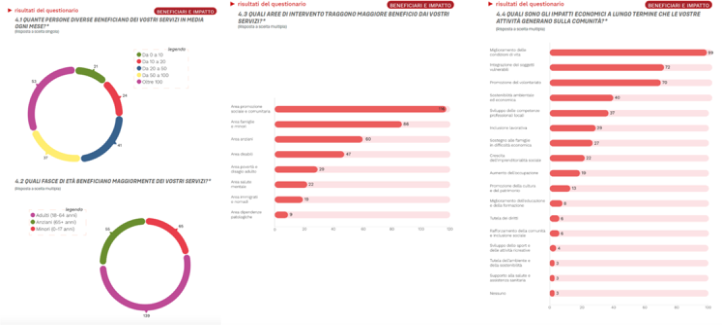
The questionnaire administered to Third Sector entities yielded 178 responses out of a total of 547 identified organizations, corresponding to a response rate of 32.5%. This sample is sufficiently representative to provide an initial qualitative and quantitative overview of the Third Sector in the Municipality of Perugia. The questionnaire comprised six sections aimed at collecting data on organizational identity, needs and available resources, operational practices, beneficiaries and impact, implemented projects, and future perspectives. The findings, summarized in the following charts, offer valuable insights into the structure and role of the local Third Sector.
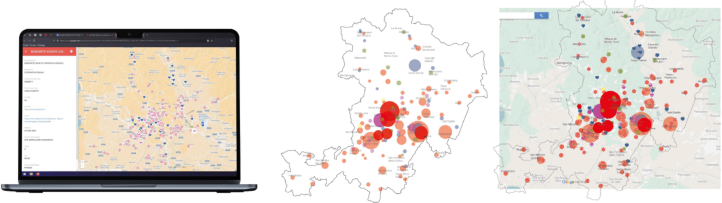
Figure 1: Graphic visualizations example from questionnaire’s analysis (design by Sofia Busti, thesis master degree in planet life design, supervisor prof.ssa Benedetta Terenzi, 2025).Figure 2: Digital and interactive mapping of third sector entities in the municipality of Perugia (design by Sofia Busti, thesis master degree in planet life design, supervisor prof.ssa Benedetta Terenzi, 2025).
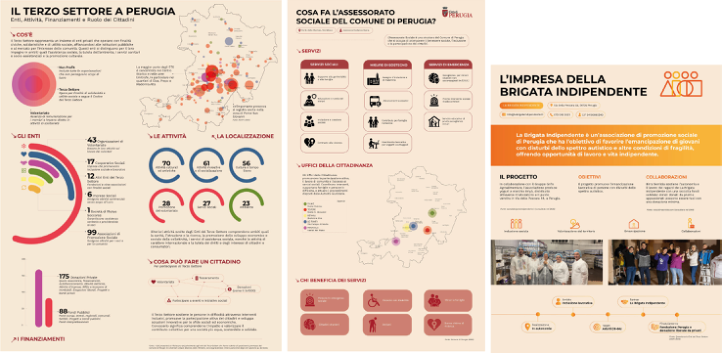
The design process was structured in several phases: i) the development of a shared visual language for Third Sector Entities through the design of an identifying icon system; ii) the creation of a graphic layout for detailed profiles dedicated to the most significant entities operating within the Municipality of Perugia; iii) the construction of a consultation table for the Department of Social Policies, based on a visual language aimed at simplifying data access and interpretation; iv) the creation of an interactive map using Google MyMaps, for the geolocation and categorization of the mapped entities; v) the analysis of questionnaire responses, both in textual form and through graphic visualizations; vi) the development of communication materials and infographics designed to present the collected data in a concise, clear, and accessible manner, for the benefit of citizens and institutional stakeholders.
Figure 3: Phigital infographics inclusive and accessible for citizens and institutional stakeholders (design by Sofia Busti, thesis master degree in planet life design, supervisor prof.ssa Benedetta Terenzi, 2025).
Human and Artificial Systems in the Design for Social Innovation 129
CONCLUSION
This study confirms that Design for Social Innovation (DfSI) constitutes not merely a transdisciplinary research domain, but also a critical operational framework for addressing the multidimensionality of contemporary social challenges. The mapping project of Third Sector Entities (TSEs) in the Municipality of Perugia demonstrates the epistemological and practical relevance of design methodologies in fostering inclusive, adaptive, and systemic forms of social intervention.
By engaging both institutional stakeholders and civil society actors, the project exemplifies a paradigmatic shift from hierarchical models of service provision to distributed, relational configurations of innovation.
The integration of digital technologies within the mapping process substantiates existing literature on the enabling potential of technology in DfSI. When embedded within design frameworks grounded in human- centeredness, accessibility, and shared responsibility, technology becomes a key mediator of social innovation. The evidence-based and user-sensitive logic that informed the questionnaire design resulted in a robust dataset, strategically positioned to inform both policy-making and design-led research.
Critically, the research underscores the role of design within public systems, reclaiming its political agency and transformative capacity. Within this horizon, DfSI emerges as a strategic and reflexive practice, capable of articulating human and artificial systems, engendering long-term social impact, and contributing to novel modalities of territorial governance.
Ultimately, this contribution define with practice-based approach how mapping, digitalization, and collaborative design can be integrated to support institutional innovation. Moreover, it calls for sustained reflection on issues such as scalability, data ethics, and advancing the field of DfSI thus requires a deeper interrogation of power asymmetries, cultural heterogeneity, and structural inequalities dimensions that must be redefine within the design process as both methodological and ethical imperatives.
REFERENCES
BEPA (2011), Empowering people, driving change. Social innovation in the European Union, BEPA, Publications Office of the European Union, Luxembourg. Caroli, M. G. (ed.), 2018. Modelli ed esperienze di innovazione sociale in Italia:
Secondo rapporto sull’innovazione sociale. Milano: FrancoAngeli. Caulier-Grice J., Kahn L., Mulgan G., Pulford L., Vasconcelos D. (2010), Study on Social Innovation, A paper prepared by the Social Innovation eXchange (SIX) and the Young Foundation for the Bureau of European Policy Advisors, The Young Foundation/European Union. Chambon, J. L., David, A., Devevey, J. M. (1982). Les innovations sociales. Paris,
Presses Universitaires de France. Cingolani M, Scendoni R, Fedeli P, Cembrani F. Artificial intelligence and digital medicine for integrated home care services in Italy: Opportunities and limits. Front Public Health. 2023 Jan 5;10:1095001. European Regolation (UE) 1304/2013 art. 9 relativo al Fondo sociale europeo;
Documento della Commissione europea “Guide to Social Innovation” (2013); Definizione di innovazione sociale data da Howaldt e Schwarz in Working Paper No. 036/12 (2012).
Garcia, C. M., Pradel, M. M., Eizaguirre, A. S. (2013), Theorizing multi-level governance in social innovation dynamics, in F. Moulaert, D. MacCallum, A. Mehmood, A. Ham¬douch (eds.) (2014), The International Handbook on Social Innovation: Collective Ac¬tion, Social Learning and Transdisciplinary Research, paperback ed., Cheltenham: Ed¬ward Elgar Publishing, pp. 155–168. Klein J-L., Fontan J-M., Harrisson D., Lévesque B. (2009), “L’innovation sociale au
Québec: un système d’innovation fondé sur la concertation”, Cahiers du CRISES, Collection Etudes Théoriques, ET0907. Koenig, G. K. (1970). Design per la comunità. La Biennale di Venezia n.66, pp. 19–29. Maldonado, T. (1970). La speranza progettuale. Ambiente e Societá. Milano,
Feltrinelli. Margolin, V. & Margolin, S., (2002) ‘A “Social Model” of Design: Issues of Practice and Research’, Design Issues, 18(4), pp. 24–30. Murray, R., Caulier-Grice, J., Mulgan, G. (2010). The open book of social
innovation. London, NESTA (National Endowment for Science, Technology and the Arts). Nicholls, A. and Murdock, A., (2012). Social Innovation: Blurring Boundaries to Reconfigure Markets. Basingstoke: Palgrave Macmillan. Papanek, V. (1971). Design for the Real World: Human Ecology and Social Change.
New York: Pantheon Books. Phills, J. A., Deiglmeier, K., Miller, D. T. (2008) Rediscovering Social Innovation, in “Stanford Social Innovation Review”, 6, 4, 34–43. Sennett, R. (2012). Insieme. Rituali, piaceri, politiche della collaborazione. Milano,
Feltrinelli. Social Innovation Theory and Research: A Summary of the Findings from TEPSIE. A deliverable of the project: “The theoretical, empirical and policy foundations for building social innovation in Europe”(TEPSIE) European Commission 2014 – 7th Framework Programme, Brussels: European Commission, DG Research. Schumacher, E. F. (2022). Piccolo è bello. Uno studio di economia come se la gente
contasse qualcosa. Mursia Editore. The Young Foundation (2006) Social Silicon Valleys. A manifesto for Social Innovation. What it is, why it matters and how can be accelerated, The Basingstoke Press, The Young Foundation, London. Terenzi, B., (2022). Hybrid territorial-artificial systems: Opportunities in design for
territories. In: T. Ahram, W. Karwowski, P. Di Bucchianico, R. Taiar, L. Casarotto and P. Costa, eds. Intelligent Human Systems Integration (IHSI, 2022): Integrating People and Intelligent Systems. International Conference, vol. 22. Terenzi, B. Menchetelli, V., Pagnotta, G., Avallone, L. (2024). Connection Between AI and Product Design. Potentials and Critical Issues in the Text-to-Image Software- Assisted Design Experience. Intelligent Human Systems Integration (IHSI, 2024), Vol. 119, 2024, 465–475.
LISTED IN THE AHFE DIGITAL BOOKSTORE CATALOGUE
Explore the complete digital volume
Design for Inclusion
Read this individual research paper free through the original publisher, or explore the full digital proceedings book.
ISBN 978-1-964867-45-8
Explore this ISBN in the AHFE Bookstore ↗Listed in the July 2026 bookstore catalogue; search by ISBN to confirm current availability · Digital book purchase optional