Magdalena Młynarczyk, Joanna Orysiak, Magdalena Warszewska-Makuch (2024). Subjective feelings of physical and psychological workload among nurses in Poland – case study. In: Physical Ergonomics and Human Factors. AHFE Open Access, vol. 147, pp. 69–79. https://doi.org/10.54941/ahfe1005179
The aim of this research was to present workload of nurses in Poland.Anonymous survey research was conducted among 43 Polish nurses over 2 summer months (in 2023). To check the physical load in the subjective assessment of nurses, questions were asked regarding: thermal comfort and the severity of work performed (separated by the duration of the COVID-19 pandemic and currently).The psychological workload of nurses was examined using selected questions from the third version of the COPSOQ, taking into account psychosocial working conditions. The examined factors included: demands at work, work organization and job content, interpersonal relations and leadership and work-life conflict. The research received approval from the Research Ethics Committee KEBN-23-82-MM.The results showed that currently 40% of respondents do not feel thermal comfort when working in standard clothing. In the case of using barrier clothing (e.g. against infectious agents), 53% of respondents currently work outside their comfort zones (compared to 100% during the COVID-19 pandemic).In terms of the severity of the work performed, 56% of respondents considered their work as hard and very hard, 37% as moderate and 7% defined it as light and very light. Therefore, 60% of respondents admitted that they often or very often feel physical strain due to their work, while 35% admitted that they sometimes feel such strain.All the results, regarding the physical and psychological load, presented the current workload situation of nurses in Poland (as the examined sample). The results obtained will allow us to direct the necessary changes in the work of nurses.This paper was created (and published) on the basis of results of a research task carried out within the scope of the 6th stage of the National Programme “Governmental Programme for Improvement of Safety and Working Conditions” funded by the resources of the National Centre for Research and Development. Task no. III.PN.08 entitled “Working time in personal protective equipment (PPE) in relation to the risk of infectious agents and the heat load on the body”. The Central Institute for Labour Protection – National Research Institute is the Programme’s main co-ordinator.
The professions such as doctors, nurses, midwives and laboratory diagnos- ticians are professions of public trust. Human health and life are entrusted to them, and what’s more, the mistakes they make affect others and may even lead to the patient’s death. Therefore, it is so important to maintain the best possible working conditions so that they do not negatively affect both the physiology and psychomotor skills of the above-mentioned health care workers (Cennet et al., 2023).
In the light of the past global COVID-19 pandemic, it can be stated that the employee’s thermal load is not only limited to exposure to unfavourable
microclimate conditions, but also occurs among employees (both medical and non-medical) when working in personal protective equipment due to with the threat of infectious agents. This applies to personal protective equipment such as protective suits, barrier aprons or filtering half masks against SARS-CoV-2.
Survey research enabled the assessment of both the physical and psycho- logical workload of Polish nurses during the COVID-19 pandemic, as well as in real-time.
RESEARCH METHODOLOGY – SURVEY STRUCTURE The validated (created for the purpose of project implementation) survey included questions regarding subjective feelings of thermal comfort at work in relation to the use of protective clothing (both past and present). The research was conducted online among hospital staff, emergency medical services units, as well as individuals associated with the healthcare sec- tor obtained through occupational health and safety personnel from Polish hospitals, medical rescue stations, and announcements on social media platforms.
The preliminary analysis of survey results on two selected aspects of nurses’ work is provided below:
1) Demographic Information:
this section contains information about age, gender, years of experience, and workplace location
2) Thermal Comfort and Physical Strain at Work:
this part includes questions related to the subjective perception of ther- mal comfort using the ASHRAE scale (ANSI/ASHRAE Standard 55), as well as subjective assessments of skin and clothing humidity (e.g., Nielsen scales - Nielsen et al., 1987). The workload severity was assessed subjectively based on the Borg Rating of Perceived Exertion Scale (Borg, 1970; Borg, 1998), as well as through self-assessment of physical workload.
3) Psychological Questions:
the psychological workload of nurses was examined using selected ques- tions from the third version of the COPSOQ (Burr et al., 2019). The questions covered areas such as demands at work, work organization and job content, interpersonal relations and leadership, and work-life conflict.
The survey research was approved by the Ethics Committee under the reference number KEBN-23-82-MM.
RESULTS
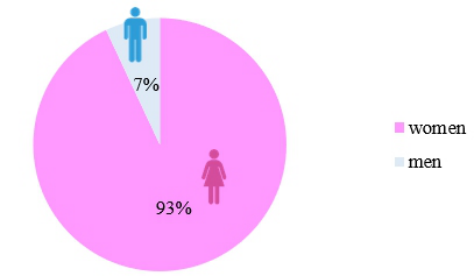
Characteristics of the Group (Demographic Information) Anonymous survey research was conducted among 43 Polish nurses over 2 summer months (in 2023). In Poland, nursing is a predominantly female profession. The majority of respondents were women (see Figure 1).
Subjective Feelings of Physical and Psychological Workload Among Nurses in Poland 71
Figure 1: The gender distribution of the surveyed individuals.
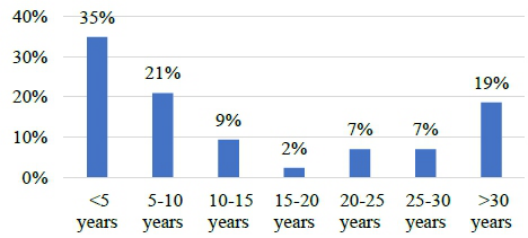
The average age of the respondents was 37 years (with a standard deviation of 13). 33% of the respondents have been working in the profession for 20 years or more (see Figure 2).
Figure 2: The frequency of responses to the question regarding years of experience in the nursing profession.
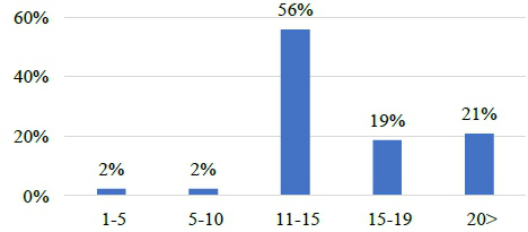
The vast majority of respondents work in a shift system (86%), typically covering an average of 11–15 shifts per month (56%) (see Figure 3).
Figure 3: Frequency of responses regarding the number of shifts worked per month.
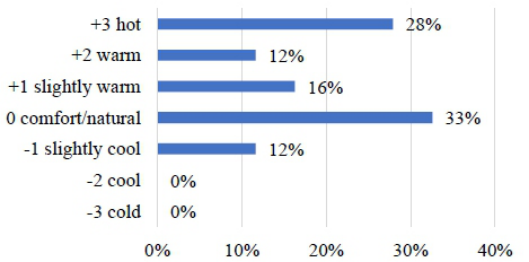
Thermal Comfort at Work Comfort at work translates into better work efficiency, improved well-being in the workplace, and a reduced number of errors. According to the ASHRAE scale (ANSI/ASHRAE Standard 55), thermal comfort is perceived within the range from +1 (slightly warm) to −1 (slightly cool). Nurses were asked about their subjective perception of comfort at work while wearing standard clothes (commonly used in their daily work). 61% of respondents indicated that they perceive comfort at work within the range from −1 to +1 (see Figure 4).
Figure 4: Frequency of responses regarding the perception of thermal comfort at work while wearing standard attire (according to the ASHRAE thermal comfort scale).
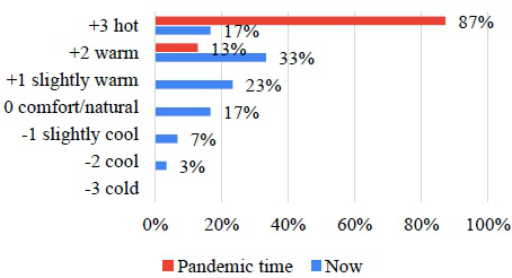
As part of the conducted survey research, respondents were asked to compare their current work experience with their experience during the COVID-19 pandemic, particularly in relation to the use of specialized protective clothing against infectious agents (see Figure 5).
Figure 5: Frequency of responses regarding the perception of thermal comfort at work while wearing specialized protective clothing against infectious agents (according to the ASHRAE thermal comfort scale).
During the pandemic, 100% of respondents indicated that they experi- enced discomfort while wearing clothing for protection against infectious
Subjective Feelings of Physical and Psychological Workload Among Nurses in Poland 73
agents. Currently, 53% of respondents stated that they still experience discomfort.
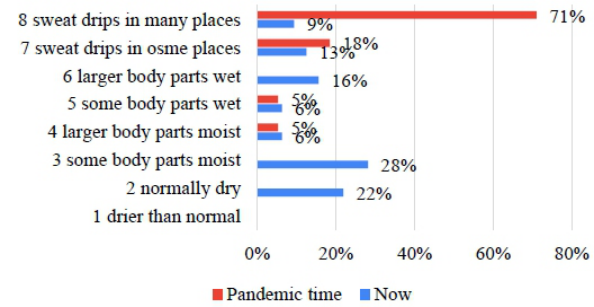
Figure 6: Frequency of responses regarding the perception of skin humidity while wear- ing specialized protective clothing against infectious agents (according to Nielsen’s scale).
Respondents were also asked to subjectively assess the feeling of skin and clothing moisture while wearing protective clothing against infectious agents, both currently and during the pandemic (see Figure 6).
During the pandemic, 89% of respondents stated that they experienced skin moisture at the maximum level (7–8 “sweat drips in some/many places”). Currently, subjective perceptions are evenly distributed on a scale from 1 to 8, but half of the respondents assess skin moisture at a level of 2–3 (“normally dry”, “some body parts moist”).
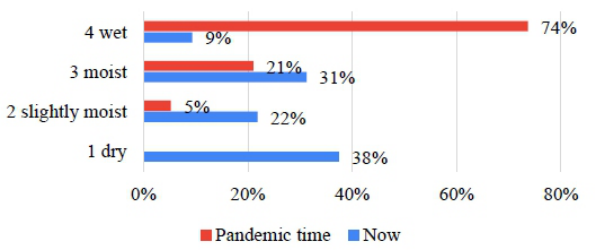
Respondents also, when assessing skin moisture while wearing protective clothing against infectious agents during the pandemic, tended to choose the highest possible responses. 95% of respondents stated that their skin was either “moist” or “wet” (see Figure 7).
Figure 7: Frequency of responses regarding the perception of clothing humidity while wearing specialized protective clothing against infectious agents (according to Nielsen’s scale).
Currently, subjective responses lean towards perceiving the skin as either “dry” or “slightly moist” (60%) or “moist” (31%).
The diversity in subjective perceptions during the pandemic and currently does not result from using “better” sets of clothing. It stems from the time spent in this clothing (see Table 1).
Table 1. The duration of usage of protective clothing against infectious agents varied among respondents.
Table available in the original PDF paper.
The duration of usage Pandemic time Now 0-2 h 2% 76% 2–4 h 14% 11% 4–6 h 26% 0% 6–8 h 31% 5% >8 h 26% 8%
During the pandemic, protective clothing against infectious agents was worn for the majority of the time by respondents for over 4 hours (as declared by 83% of respondents), whereas currently, such clothing is used for up to 4 hours by 87% of respondents.
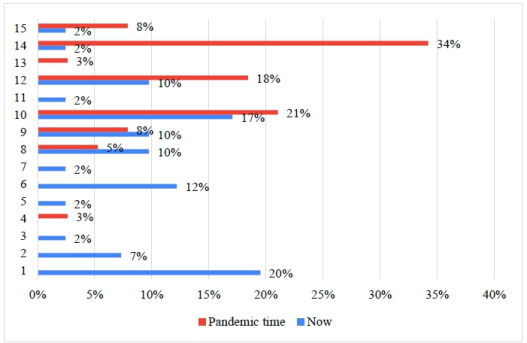
Respondents were also asked to indicate their subjective assessment of the effort rating during their work while wearing protective clothing against infectious agents during the pandemic and currently. They evaluated the severity of their work using from 1 (no exertion; sitting and resting) to 15 (maximal exertion) scale based on the Borg scale (see Figure 8).
Figure 8: Frequency of responses regarding the effort rating.
During the COVID-19 pandemic, respondents rated their work on effort rating scale from 8 (“somewhat hard”) to 15 (“maximal exertion”). How- ever, currently, the assessment tends towards lower values on scale, from 1 (“no exertion”) to 10 (“hard”). Feelings of “hardest work you have ever done” or “don’t work this hard!” (as points from 12 to 15) (TREK) were indicated by over 60% of respondents during the pandemic, while currently, this group comprises 14% of respondents.
Subjective Feelings of Physical and Psychological Workload Among Nurses in Poland 75
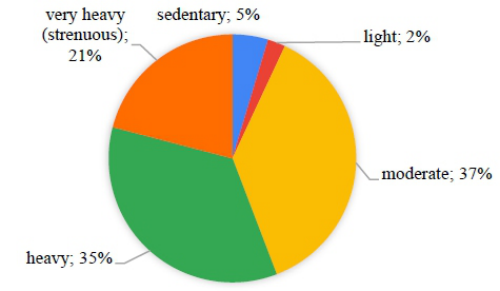
The obtained results align with the subjective assessments of physical workload. In response to the question, “How would you rate the severity of your job in terms of physical load?” 56% of respondents rated their work as “heavy” or “very heavy” (see Figure 9).
Figure 9: Frequency of responses regarding the subjective assessment of the severity of work.
The Psychological Workload Working in the nursing profession entails numerous exposures to harmful influences not only of biological, chemical, and physical nature but also psy- chosocial. To assess the psychosocial working conditions, the scales of the COPSOQ III questionnaire (Burr et al., 2019) were applied. Selected research findings are presented below.
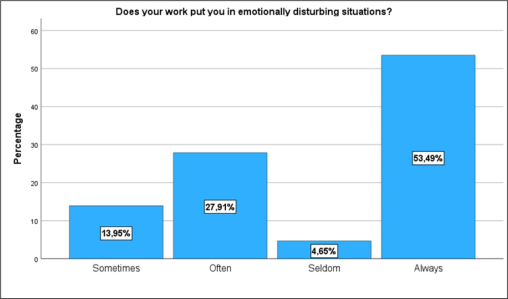
Respondents were asked, among other things, whether their work involves emotionally challenging situations. The results showed that among nurses, 54% constantly and 28% frequently experience such situations in the work- place (see Figure 10).
Figure 10: The percentage of responses regarding emotional burden at work (COPSOQ III questionnaire).
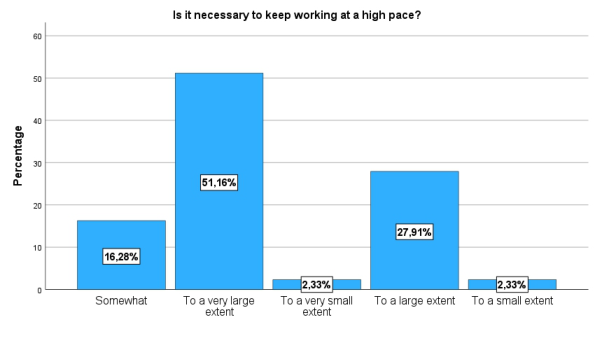
When it comes to quantitative demands, a particular issue in the surveyed group turned out to be time pressure. Specifically, 28% of nurses declared that they have to work at a high pace to a large extent, while 51% have to do so to a very large extent (see Figure 11).
Figure 11: The percentage of responses regarding the necessity to work at a fast pace (COPSOQ III questionnaire).
Nurses were also asked about the conflict between work and private life. The results showed that 37% of nurses often, and 42% sometimes, experience difficulties reconciling their professional and private lives.
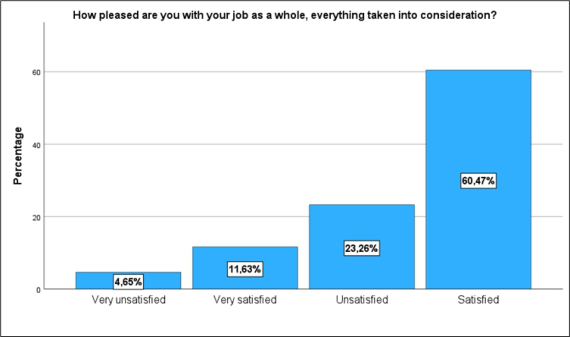
It’s noteworthy that despite high emotional and quantitative demands, as well as numerous other stressors specific to nursing work, it was found that 60% of respondents are satisfied, and 12% are very satisfied with their job (see Figure 12).
Figure 12: The percentage of responses regarding job satisfaction (COPSOQ III questionnaire).
Subjective Feelings of Physical and Psychological Workload Among Nurses in Poland 77
DISCUSSION AND CONCLUSION The results of the survey research on thermal comfort perception and sub- jective experiences align with the findings of other studies (Cennet et al., 2023; Zhao et al., 2023; Davey et al., 2021). During the use of protective clothing against infectious agents during the pandemic, 100% of respon- dents experienced discomfort while working (highest ratings according to the ASHRAE scale). It is important to note that this is a very dangerous sit- uation, as the experienced discomfort translates into e.g. an increase in the number of medical errors (Cennet et al., 2023).
The ratings regarding skin and clothing moisture also aligned with the experiences reported by other users of specialized clothing. Profuse sweating was listed as the most frequently occurring physical symptom while using the aforementioned clothing (80% of respondents) (Zhu et al., 2022). In the case of the presented research results, 95% of respondents rated skin moisture at the level of “moist” or “wet”.
In the presented research results, it can also be observed how the imple- mented clothing influenced the subjective assessment of the severity of the work performed. According to Potter et al. (2015) and Gaever et al. (2014), the work of nurses was assessed at a level of 80–112 W/m2, defined as light work. However, in self-assessment during work in specialized clothing (dur- ing the pandemic), 60% of respondents rated their work as “the hardest work they have ever done” or “don’t work this hard!”. In another scale, only 7% of respondents assessed their work in terms of physical exertion as “seden- tary” or “light”, while 37% stated that their work is “moderate”, and 56% as “heavy” and “very heavy”.
The duration of work in specialized clothing is not insignificant. The feel- ing of discomfort is greater the longer the duration of usage of such clothing. During the pandemic, nurses often declared working for >6 hours in special- ized clothing (Lan et al., 2020). In the presented research, above 6 hours of work was declared by 57% of respondents. Such a duration of work not only affects subjective perceptions but may also contribute to skin damages (Lan et al., 2020).
The obtained results of psychological part correspond with the findings of numerous previous studies (e.g., García-Iglesias et al., 2021; Misiak et al., 2020; Kackin et al., 2021). The greatest psychological burdens in the work of nurses are associated with factors such as immense time pressure, which can understandably affect their effectiveness and efficiency. Additionally, research has shown that nurses are constantly exposed to significant emotional bur- dens. This arises from the necessity of establishing close interactions with individuals often experiencing difficult life situations such as severe illness or loss of loved ones.
Moreover, most respondents also experience strong conflicts between their work and private life. The sources of these conflicts can be attributed to fac- tors such as shift work, working night shifts, and the exhaustive nature of personal responsibilities. This can lead to physical and mental health dete- rioration among nurses, with consequences not only for themselves but also
for the entire organization - colleagues, patients, and their families - result- ing from more frequent absenteeism, reduced work performance, and lower engagement (Baka, 2013).
It is significant that in the presented research, nurses rated their job sat- isfaction quite high. Undoubtedly, despite the significant psychological and physical burdens, their level of satisfaction was also influenced by a range of factors that were not included in the analysis but significantly impact this satisfaction, such as social climate, support from colleagues and superiors, opportunities for professional development and advancement, appreciation from the organization, and patient satisfaction (Gaweda et al., 2018).
The obtained results indicate the need for improvement in the working conditions of healthcare workers, both in terms of physical and psychological aspects. A more in-depth analysis of the research results, not only from the presented scope, will allow for proposing changes in both aspects to improve the working comfort of medical personnel.
ACKNOWLEDGMENT
This paper was created (and published) on the basis of results of a research task carried out within the scope of the 6th stage of the National Programme “Governmental Programme for Improvement of Safety and Working Con- ditions” funded by the resources of the National Centre for Research and Development. Task no. III.PN.08 entitled “Working time in personal protec- tive equipment (PPE) in relation to the risk of infectious agents and the heat load on the body”. The Central Institute for Labour Protection – National Research Institute is the Programme’s main co-ordinator.
REFERENCES
ANSI/ASHRAE Standard 55; Thermal Environmental Conditions for Human Occupancy. Baka Ł. (2013) Relationships between work–family and family–work conflicts and
health of nurses – buffering effects of social support, Medycyna Pracy Volume 64, No. 6, pp. 775–784. Borg G. (1970) Perceived exertion as an indicator of somatic stress, J. REHABIL.
MED. Volume 2, No. 2, pp. 92–98. Borg G. (1998) Borg’s perceived exertion and pain scales, Human Kinetics. Burr H., et al. (2019) The third version of the Copenhagen psychosocial questionnaire, Safe and Health at Work, Volume 10, No. 4, pp. 482–503. doi: 10.1016/j.shaw.2019.10.002. Cennet CY., et al. (2023) The effect of personal protective equipment use on nurses’ tendencies to make medical errors and types of their medical errors: a cross- sectional study, International Journal of Occupational Safety and Ergonomics, Volume 29, No. 2, pp. 596–603, doi: 10.1080/10803548.2022.2061131. Davey, S. L., et al. (2021) Heat stress and PPE during COVID-19: Impact on health-
care workers’ performance, safety and well-being in NHS settings, The Journal of Hospital Infection, Volume 108, pp. 185–188, doi: 10.1016/j.jhin.2020.11.027. Gaever, R. V., et al. (2014) Thermal comfort of the surgical staff in the operating room, Building and Environment, Volume 81, pp: 37–41, doi: 10.1016/j.buildenv.2014.05.036.
Subjective Feelings of Physical and Psychological Workload Among Nurses in Poland 79
García-Iglesias JJ., et al. (2021) Relationship Between Work Engagement, Psychosocial Risks, and Mental Health Among Spanish Nurses: A Cross-Sectional Study, Front. Public Health, Volume 8, 627472, doi: 10.3389/fpubh.2020.62747. Gaweda A., ´Snie˙zek A., Serzysko B. (2018) Job satisfaction in the opinion of sur-
veyed nurses, Pielegniarstwo I Zdrowie Publiczne, Volume 8, No. 4, pp. 269–276, doi: 10.17219/pzp/91608. Kackin O., et al. (2021) Experiences and psychosocial problems of nurses caring for patients diagnosed with COVID-19 in Turkey: A qualitative study, International Journal of Social Psychiatry, Volume 67, No. 2, pp. 158–167, doi: 10.1177/0020764020942788. Lan J., et al. (2020) Skin damage and the risk of infection among healthcare work-
ers managing coronavirus disease-2019, J AM ACAD DERMATOL. Volume 82 No. 5, pp: 1215-1216, doi: 10.1016/j.jaad.2020.03.014. Misiak, B., et al. (2020) Psychosocial Work-Related Hazards and Their Relationship to the Quality of Life of Nurses—A Cross-Sectional Study, Int. J. Environ. Res. Public Health, Volume 17, 755, doi: 10.3390/ijerph17030755. Nielsen R., Berglund L., Gwosdow A. and Dubois A. (1987) Thermal sensation of
the body as influenced by the thermal microclimate in a face mask, Ergonomics, Volume 30. No. 12, pp. 1689–1703 Potter, A., Gonzalez, J. and Xu, X. (2015) Ebola Response: Modeling the Risk of Heat Stress from Personal Protective Clothing, PLOS ONE 1-10, doi: 10.1371/jour- nal.pone.0143461. Trek https://exercise.trekeducation.org/assessment/borg-scale-rpe/ (access 15.02.2024). Zhao, Y., et al. (2023) Thermophysiological and Perceptual Responses of Amateur
Healthcare Workers: Impacts of Ambient Condition, Inner-Garment Insulation and Personal Cooling Strategy, Int. J. Environ. Res. Public Health Volume 20, 612, doi: 10.3390/ijerph20010612. Zhu, Y., et al. (2022) Thermal discomfort caused by personal protective equipment in healthcare workers during the delta COVID-19 pandemic in Guangzhou, China: A case study, Case Studies in Thermal Engineering, Volume 34, 101971, doi: 10.1016/j.csite.2022.101971.
LISTED IN THE AHFE DIGITAL BOOKSTORE CATALOGUE
Explore the complete digital volume
Physical Ergonomics and Human Factors
Read this individual research paper free through the original publisher, or explore the full digital proceedings book.
ISBN 978-1-964867-23-6
Explore this ISBN in the AHFE Bookstore ↗Listed in the July 2026 bookstore catalogue; search by ISBN to confirm current availability · Digital book purchase optional